By David Bautz, PhD
NASDAQ:BTAI
READ THE FULL BTAI RESEARCH REPORT
Business Update
Commercial Day Highlights Positive Early Launch Metrics for IGALMI™
On October 18, 2022, BioXcel Therapeutics, Inc. (NASDAQ:BTAI) hosted a Commercial Day presentation to provide an update on the recent launch of IGALMI™, which is approved for the acute treatment of agitation associated with schizophrenia or bipolar I or II disorder. Below we provide a brief overview of the event, however we invite investors to view the presentation themselves as there was a wealth of data presented. In the four months since the approval of IGALMI, BioXcel has seen a very positive market reception from key hospital stakeholders and the company will be expanding its national sales team to cover approximately 1700 hospitals in 70 geographies.
During the presentation, Dr. Sheldon Preskorn discussed his personal experience with agitation while working in the Emergency Department, including witnessing two firefights, being held hostage at gunpoint, suffering a torn ligament while trying to restrain an agitated patient, and most recently having two patients refuse an intramuscular (IM) injection to help with their agitation. Dr. Preskorn emphasized how situations such as these could be minimized with an easy to administer, safe, and effective agitation treatment. He also discussed the advantages of IGALMI, including how dexmedetomidine has the highest potency and agonist efficacy at the alpha-2 receptors while also being highly selective for the alpha-2 receptors in comparison to the I1-imidazoline receptors, which is not the case for clonidine or lofexidine.
Karen Sands shared the experiences of nurses who are on the front lines and treat agitated patients on a daily basis. She stated that a number of lessons have been learned over the past few decades in regard to treating agitated patients, including the necessity to avoid oversedation and respiratory depression that can lead to a risk of hypoxia, aspiration, and/or endotracheal intubation. Agitation control while maintaining hemodynamic stability and an equivalent functional status on discharge equivalent to baseline are absolute goals. Ms. Sands went over three case studies of incidents in which nurses had been hurt while treating agitated patients, including one nurse who suffered a dislocated elbow that forced her to retire from nursing, another nurse that was severely beaten in the back of the head requiring her to leave her position, and a third nurse that was bitten on the arm and necessitated time off work and lab tests. Those incidents highlight the need for a safe, effective, and rapid treatment option for agitated patients.
Jacob Hanaie provided an overview of Hospital Networks and Practice Groups and the new drug formulary process. Multiple committees are involved in the formulary development process. The Therapeutic Assessment Committee (TAC) reviews the available evidence for a new therapeutic and creates monographs for the Pharmacy & Therapeutics (P&T) Committee. The P&T reviews the monographs and determines the clinical parameters to pass on to the Value Assessment Committee (VAC). The VAC performs both a clinical and financial evaluation of the therapeutic and then makes formulary recommendations to the P&T. The P&T then reviews the VAC recommendations and makes the final determination about the formulary.
One thing that has changed about this process in a post-COVID-19 environment is that the P&T Committee might meet quarterly (or might not), they might meet in person (or might not), all or only some of the members may be present, more of the time for the P&T meeting is going to be used discussing COVID, Monkey Pox, and infection control instead of new therapeutics, budgets have changed, and priorities have shifted. This presents both a challenge and an opportunity for a drug such as IGALMI. The challenge is getting the committee to spend sufficient time examining it for inclusion in the formulary, however the opportunity arises in that IGALMI represents a new approach to treating agitation and is not just a “me too” drug with only slightly superior attributes.
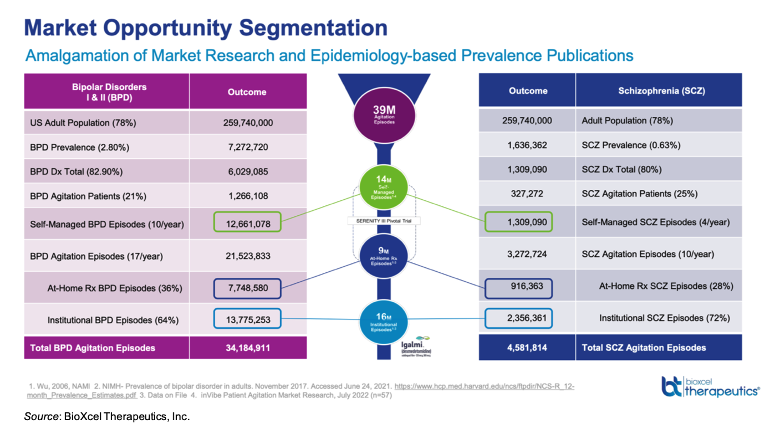
Matt Wiley, BioXcel’s Chief Commercial Officer, provided an overview and update on the commercial launch of IGALMI. In just four months time, the company believes there has been a positive reception from key hospital stakeholders and based on this positive initial feedback the sales team will be expanded to cover approximately 1700 hospitals in 70 geographies. The following figure shows the breakdown for the estimated number of agitation episodes per year in the U.S., which totals 16 million in the institutional setting and another 23 million that occur at home. IGALMI is currently approved for use in an institutional setting, however the ongoing SERENITY III trial will be evaluating IGALMI’s use at home to potentially expand the market opportunity to the full 39 million that occur annually.
In regards to market access, a contract with the GPO Vizient was executed and effective October 1, 2022. Approximately 46% of all target hospital beds are now covered and the company is in advanced stages of engagement with other GPOs. The company also noted that approximately 10% of the Integrated Delivery Networks (IDNs) in the country control approximately 60% of the IDN-affiliated hospitals and that 59 IDNs represent nearly one-third of target hospital beds. BioXcel has appointed the Corporate Account Director (CAD) team to engage with and target these IDNs in the third quarter of 2022 and that coordination between the sales team and the CAD team is designed to drive interest and adoption in these systems.
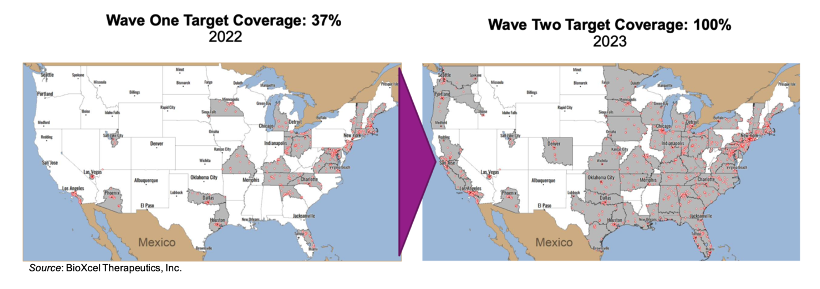
Brendan Schulek, Vice President of Sales, provided an update on the sales force deployment and key performance indicators. The following figure shows how the company plans to mobilize sales efforts toward approximately 1700 hospitals, which covers approximately 70% of the commercial opportunity and covers all major U.S. population centers.
BioXcel expects multiple formulary votes at IDNs in 2022 that represent approximately 17% of target hospital beds (approximately 50,000 total beds). Thus far, there have been over a dozen formulary approvals and there are approximately 400 votes in queue. A survey of clinicians showed that approximately 70% of ED physicians anticipate using IGALMI within the first year post-formulary approval.
The Commercial Day presentation gave a comprehensive overview of where the company stands in regard to the IGALMI launch and we are very encouraged by the early positive response that the sales team is seeing. We look forward to updates from the company regarding formulary approvals and other key metrics.
SERENITY III Trial to Initiate 2H22
BioXcel will be initiating the SERENITY III trial of BXCL501 for the treatment of agitation associated with bipolar disorder and schizophrenia, with a focus on its at-home use. The SERENITY III trial will be a pivotal, double blind, placebo controlled single study of BXCL501 60 μg and will consist of two parts. Part I will be very similar to the SERENITY I and II trials and will test BXCL501 in an institutional setting with the primary outcome of change in PEC score from baseline at two hours compared to placebo. Part II of the trial will assess the safety of BXCL501 compared to placebo when administered at home. The company chose the 60 μg dose because that dose separated from placebo at two hours and a large proportion of patients responded, thus the number of patients estimated to need a second dose is very small. We anticipate topline results from Part I of the trial in the first half of 2023 and for Part II of the trial to initiate in the first half of 2023.
TRANQUILITY II Results in 1H23
The TRANQUILITY II trial of BXCL501 for the treatment of agitation associated with Alzheimer’s disease is continuing to enroll and topline results are expected in the first half of 2023. This trial is focusing on patients in assisted living or residential facilities. The TRANQUILITY III trial is expected to commence in December 2022 and is supported by positive efficacy, safety, and tolerability data in 100 patients in the Phase 1b/2 TRANQUILITY trial along with a recent study of BXCL501 40 μg dose.
Update on Phase 1 MDD Trial
BXCL501 is currently being investigated as an adjuvant treatment for major depressive disorder (MDD). The Phase 1 multiple ascending dose study in healthy volunteers is continuing to progress with 30, 60, and 80 μg daily dose cohorts completed. Twice daily dosing of 30 μg in the morning and 60 μg in the afternoon is also completed. The study is currently testing twice daily dosing of 40 μg in the morning and 80 μg in the afternoon. After a maximum tolerable dose is determined, the final testing cohort will test a daily maximum well-tolerated dose in combination with a daily SNRI. We anticipate topline results from this study in the first half of 2023.
BXCL701 Update
OnkosXcel Therapeutics is a subsidiary of BioXcel focused on the company’s immuno-oncology programs, including BXCL701. BXCL701 (talabostat) is an oral small molecule immunomodulator designed to activate the innate immune system through inhibition of dipeptidyl peptidase (DPP) 8/9 and fibroblast activation protein (FAP). Its purpose is to initiate inflammation in the tumor microenvironment, thus potentially turning “cold” tumors “hot” and making them more amenable to immunotherapy treatment.
BXCL701 is currently being evaluated in an ongoing Phase 2 trial in combination with Keytruda in metastatic castration-resistant prostate cancer (mCRPC) patients with small cell neuroendrocrine (SCNC) or adenocarcinoma phenotype. The company recently presented updated, preliminary results showing a 33% response rate for the first 15 evaluable SCNC patients that included a median duration of response of 9 months for the five responders. In addition, enrollment has completed for the 28-patients SCNC cohort and we anticipate final efficacy data in the first half of 2023.
Financial Update
On November 9, 2022, BioXcel announced financial results for the third quarter of 2022. The company reported net revenue of $137,000, which was comprised of sales of IGALMI™ related to early product trials and limited market access. Net loss in the third quarter of 2022 was $41.8 million, compared to a net loss of $26.8 million in the third quarter of 2021. R&D expenses in the third quarter of 2022 were $22.1 million, compared to $11.9 million for the third quarter of 2021. The increase was primarily due to clinical trial costs related to the TRANQUILITY program, at-home use, and MDD. G&A expenses in the third quarter of 2022 were $17.1 million, compared to $14.9 million for the third quarter of 2021. The increase was primarily due to personnel related costs along with costs related to the commercial launch of IGALMI™ in the U.S.
As of September 30, 2022, BioXcel had approximately $232.3 million in cash and cash equivalents. We estimate the company has sufficient capital to fund operations into 2025. As of November 7, 2022, the company had approximately 28.0 million shares outstanding and when factoring in stock options a fully diluted share count of approximately 32.9 million.
Conclusion
We’re very encouraged by the early metrics reported for the commercial launch of IGALMI™ and we look forward to continued updates from the company. It was nice to see the first sales reported and we fully anticipate revenues to begin ramping next year as the drug continues to gain formulary access. We have made a few minor changes to our model in regard to how quickly we expect revenues to ramp, which has lowered our valuation slightly to $82 per share.
SUBSCRIBE TO ZACKS SMALL CAP RESEARCH to receive our articles and reports emailed directly to you each morning. Please visit our website for additional information on Zacks SCR.
DISCLOSURE: Zacks SCR has received compensation from the issuer directly, from an investment manager, or from an investor relations consulting firm, engaged by the issuer, for providing research coverage for a period of no less than one year. Research articles, as seen here, are part of the service Zacks SCR provides and Zacks SCR receives quarterly payments totaling a maximum fee of up to $40,000 annually for these services provided to or regarding the issuer. Full Disclaimer HERE.