By David Bautz, PhD
NASDAQ:CFRX
READ THE FULL CFRX RESEARCH REPORT
Business Update
Update on Phase 3 DISRUPT Trial
ContraFect, Corp. (NASDAQ:CFRX) is currently conducting the Phase 3 DISRUPT (Direct Lysis of Staph aureus Resistant Pathogen Trial) trial of exebacase in patients with Staphylococcus aureus bacteremia, including right-sided endocarditis. The DISRUPT trial is a randomized, double blind, placebo controlled study being conducted at over 40 centers in the U.S. and will enroll approximately 350 patients randomized 2:1 to receive either exebacase or placebo, with all patients receiving standard of care antibiotics. A preplanned interim futility analysis is scheduled to take place after the first 60% of patients enrolled into the trial are evaluable for efficacy. We currently anticipate results from the interim futility analysis in the first half of 2022.
The primary endpoint of the trial is clinical response at Day 14 in patients with methicillin-resistant S. aureus (MRSA) bacteremia, including right-sided endocarditis. Clinical response is defined using objective clinical criteria including: 1) resolution of S. aureus bacteremia/right-sided endocarditis signs and symptoms that were present at baseline; 2) no new signs or symptoms of bacteremia/right-sided endocarditis; 3) no complications of bacteremia/right-sided endocarditis; 4) no changes in anti-staphylococcal antibiotics after treatment with study drug due to persistence, worsening, or recurrence of signs or symptoms of bacteremia/right-sided endocarditis; 5) blood cultures negative for S. aureus by Day 14; and 6) the patient is alive. Clinical response is being determined by an independent, blinded clinical adjudication committee.
Key secondary endpoints include clinical response rate at Day 14 for all S. aureus bacteremia patients (including both MRSA and methicillin-sensitive S. aureus [MSSA]), 30-day all-cause mortality in MRSA patients, and clinical response at Day 60. The company will also evaluate the impact of treatment with exebacase on length of hospital stay, length of stay in the intensive care unit, and 30-day readmission rates for both all-cause and S. aureus infection readmissions.
In March 2021, ContraFect announced an $86.8 million contract with the Biomedical Advanced Research and Development Authority (BARDA) to support the DISRUPT trial. The company received an initial tranche of $9.8 million with up to $77.0 million in future support being dependent on progress and clinical success in the DISRUPT trial. Following completion of the trial, and assuming a positive outcome, the BARDA funding can be used to support additional development work that may be necessary for FDA approval, including manufacturing and regulatory activities. It could also cover any post-approval commitments, such as the completion of the pediatric study.
Evaluating Exebacase Activity Against MRSA Samples in CF Patients
In January 2022, ContraFect announced an additional award from the Cystic Fibrosis Foundation (CFF) for a 12-month study titled ‘Nonclinical Assessment of Lysin Exebacase for Treating MRSA Infections in CF’. The goal of the study will be to evaluate the in vitro activity of exebacase against bacterial specimens obtains from cystic fibrosis (CF) patients. As the following graph shows, which was used with permission from the CFF 2020 Patient Registry Annual Report, a very high percentage of CF patients harbor S. aureus in their lungs. The data are derived from CF patients under care at CFF-accredited care centers in the U.S., who consented to have their data entered. S. aureus infections, particularly those caused by MRSA, can contribute to decreased lung function in CF patients and are also an independent predictor of mortality in the CF population (Blanchard et al., 2019).
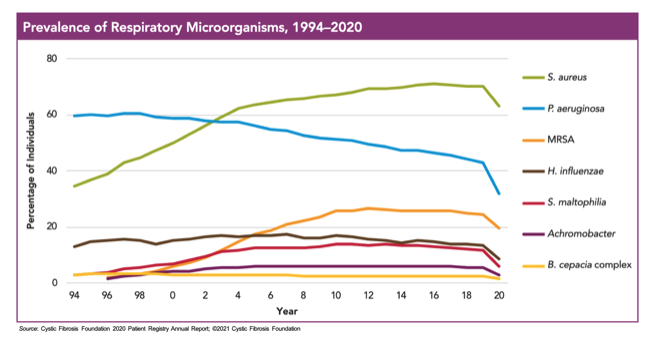
ContraFect previously entered into a funding agreement with the CFF to investigate the use of direct lytic agents against Gram-negative pathogens that affect CF patients (e.g., Pseudomonas aeruginosa). We are glad to see the CFF has provided additional funding support for ContraFect to investigate the use of exebacase in CF as there is a clear need for improved anti-microbial therapies for these patients.
Compassionate Use Case Study Highlights Potential for Exebacase
In December 2021, ContraFect announced the publication of a case study showing the potential of exebacase in treating MRSA bacteremia in a pediatric population (Moorthy et al., 2021). The report discusses the treatment of a previously healthy 5-month-old male infant that was diagnosed with a culture confirmed life-threatening MRSA infection with multi-organ involvement. Clinical improvement was not achieved following standard of care (SOC) antibiotic therapy. The FDA granted the use of exebacase under an emergency individual patient investigational new drug application and the patient received one 3 mg dose of exebacase on hospital day 7. SOC antibiotic therapy was continued and by day 12 blood cultures from the patient were sterile. The patient continued to improve and serial echocardiograms showed no evidence of heart valve vegetation on hospital day 40. The patient was discharged with no additional surgeries necessary.
While very exciting, we remind investors that this is a report of just a single patient that showed improvement following administration of exebacase and it is impossible to know whether exebacase contributed either directly or in concert with the SOC antibiotic therapy to the patient’s improvement. Never the less, it is good to see that exebacase can be safely administered to a pediatric patient and the company is planning to conduct future clinical trials to confirm dosing and efficacy in a pediatric population.
Financial Update
On March 24, 2021, ContraFect Corp. (NASDAQ:CFRX) announced financial results for the fourth quarter and full year 2021. As expected, the company did not report any revenues for the fourth quarter or full year 2021. Net loss for the fourth quarter of 2021 was $4.4 million, or $0.11 per share, compared to a net loss of $6.4 million, or $0.23 per share, for the fourth quarter of 2020. R&D expenses in the fourth quarter of 2021 were $11.0 million compared to $7.3 million in the fourth quarter of 2020. The increase was primarily due to the Phase 3 DISRUPT trial, CMC activities required for potential BLA submission of exebacase, and increased headcount and personnel costs. G&A expenses in the fourth quarter of 2021 were $3.0 million compared to $3.4 million in the fourth quarter of 2020. The decrease was primarily due to decreased legal expenses and recruiting costs.
For 2021, the company reported a net loss of $20.3 million, or $0.55 per share, compared to a net loss of $28.2 million, or $1.24 per share, for 2020. The net loss for the current year includes a $26.9 million, or $0.73 per share, non-cash gain for the change in fair value of warrant liabilities, compared to a $8.1 million, or $0.35 per share, non-cash gain for the change in the fair value of warrant liabilities in 2020. R&D expenses in 2021 were $35.5 million compared to $22.6 million for 2020. The increase was primarily due to activities surrounding the DISRUPT trial along with manufacturing costs for exebacase and the expansion of the company’s internal research, clinical development, and CDC teams. G&A expenses in 2021 were $11.8 million compared to $11.6 million in 2020. The increase was primarily due to increases in insurance costs.
As of December 31, 2021, ContraFect had approximately $54.3 million in cash and cash equivalents. As of March 24, 2021, the company had approximately 39.3 million shares outstanding and, when factoring in stock options and warrants, a fully diluted share count of approximately 53.2 million.
Conclusion
We are anxiously awaiting the results of the planned interim futility analysis for the Phase 3 DISRUPT trial, which we continue to expect in the first half of 2022. The non-dilutive support from the CFF to investigate the utility of exebacase against MRSA samples from CF patients could be a promising area of research and we look forward to results from that program. As we await the futility analysis results we have made no changes to our model and our valuation remains at $23 per share.
SUBSCRIBE TO ZACKS SMALL CAP RESEARCH to receive our articles and reports emailed directly to you each morning. Please visit our website for additional information on Zacks SCR.
DISCLOSURE: Zacks SCR has received compensation from the issuer directly, from an investment manager, or from an investor relations consulting firm, engaged by the issuer, for providing research coverage for a period of no less than one year. Research articles, as seen here, are part of the service Zacks SCR provides and Zacks SCR receives quarterly payments totaling a maximum fee of up to $40,000 annually for these services provided to or regarding the issuer. Full Disclaimer HERE.