By David Bautz, PhD
NASDAQ:CLSN
READ THE FULL CLSN RESEARCH REPORT
Business Update
OVATION 2 Enrollment Expected to Complete in 3Q22
Celsion Corporation (NASDAQ:CLSN) is currently conducting the Phase 1/2 OVATION 2 study of GEN-1 (the company’s lead immunotherapy development product) in advanced stage (Stage III/IV) ovarian cancer. The company recently announced that 106 patients are currently enrolled in the study and it will meet the target of enrolling 110 patients by the end of this month, however the company is hoping to go above that number to increase the robustness of the data set. The primary endpoint of progression-free survival (PFS) will be reported after 80 PFS events occur, or 16 months median time on study, whichever comes first. We anticipate topline data in the third quarter of 2023.
Celsion reported that that with only 30% of the data reported, the company is seeing the data favor GEN-1. However, investors should keep in mind that it is only 30% of the data and holds no statistical significance at this time. In June 2022, following a pre-planned interim safety review of 87 as-treated patients, the data safety monitoring board (DSMB) unanimously recommended that the OVATION 2 study continue treating patients at a dose of 100 mg/m2. The next milestone will be to enroll approximately 130 patients and share their preliminary data with the company’s medical advisors.
In April 2022, Celsion reported findings on the use of synthetic control arm (SCA) in a completed OVATION 1 Phase 1b study of GEN-1. The SCA was created by applying key OVATION 1 inclusion criteria to the Medidata Enterprise Data Store to identify candidate historical clinical trial patients for comparison. A total of 41 patients were included in the SCA. Fifteen OVATION 1 patients (15/18, 83%) were matched to 15 SCA patients (15/41, 37%), with the median progression free survival (PFS) time not being reached by the OVATION 1 patients, compared to 15.8 months for the SCA patients (H.R. 0.53, 95% CI 0.16, 1.73). The comparison of the SCA and the OVATION 1 patients yielded estimates of efficacy endpoints that led to a decrease in the number of planned patients for the OVATION 2 trial.
In addition to the trial of GEN-1 in patients with newly diagnosed ovarian cancer, the company is planning two collaborations to explore GEN-1 in combination therapies. Celsion will be collaborating with Dr. Haider Mahdi of the University of Pittsburgh on combining GEN-1 with dual checkpoint inhibitors in patients with persistent or recurrent ovarian cancer (e.g., failed first line therapy). Another Phase 1/2 trial will evaluate GEN-1 with Avastin in collaboration with several major cancer centers. We anticipate additional details of this trial being announced in the near future.
GEN-1
IL-12 is a broad-acting immune stimulatory molecule that showed remarkable promise in preclinical studies in the 1990’s. However, this activity was never recapitulated in the clinical following the systemic administration of IL-12 due to severe side effects and the molecules short half-life. In an effort to develop an alternative approach to IL-12 delivery, a gene-based IL-12 therapeutic was formulated that produced locally increased concentrations of IL-12 and IFN-γ but did not produce systemic toxicity in a mouse model of ovarian cancer (Fewell et al., 2005; Fewell et al., 2009). These experiments provided proof-of-concept for Celsion’s TheraPlas technology, which consists of a plasmid DNA payload encoding a therapeutic protein and a delivery system. GEN-1 (formerly EGEN-001), the company’s lead development product based on the TheraPlas technology, comprises a plasmid encoding human IL-12 coupled to a non-viral DNA delivery system, polyethyleneglycol-polyethyleneimine-cholesterol (PPC). The compound forms nanoparticles that are approximately 150 nm in diameter, protect the plasmid from degradation after administration, and aid in getting the plasmid across the cell membrane. The composition of GEN-1 is shown in the following figure.
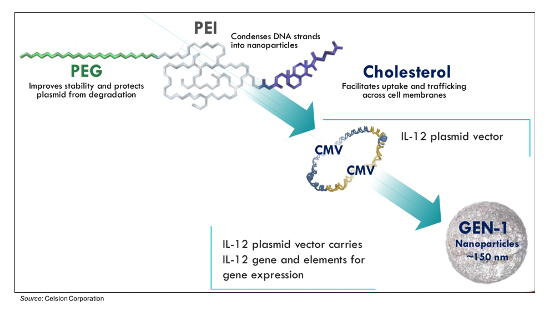
Multiple preclinical studies of GEN-1 showed that it could be utilized in combination with different ovarian cancer treatments to increase their efficacy, leading to significant reductions in tumor burden. Previous clinical trials of GEN-1 showed that the drug was well tolerated and potentiated the activity of various chemotherapy agents, including the OVATION 1 study, in which a total of 18 patients received increasing doses of GEN-1 (36, 47, 61, 79 mg/m2). Tumor response was associated with higher doses of GEN-1, and in the highest dose cohort 100% of patients had a complete or partial response and 88% achieved R0 resection.
Non-Human Primate Study of SARS-CoV-2 Vaccine Candidate Initiated
Celsion is currently conducting a non-human primate challenge study with the company’s DNA-based approach for a SARS-CoV-2 vaccine. The NHP study is a five-arm study that has three objectives: 1) confirm that the same positive response that was seen in mice is seen in NHPs; 2) determine how the DNA vaccine compares to the mRNA vaccine; and 3) determine the durability of response with the DNA vaccine. The study consists of a control group, a group receiving an mRNA SARS-CoV-2 vaccine, two cohorts each receiving a different dose of Celsion’s DNA vaccine candidate, and a fifth cohort that will be challenged with SARS-CoV-2 after six months. Comparisons regarding antibody titer will be made between the mRNA vaccine and DNA vaccine cohorts, with those animals being challenged with SARS-CoV-2 after antibody levels been built up. At the six-month mark, the fifth cohort that received the DNA vaccine will be challenged with SARS-CoV-2 to determine durability of response.
In April 2022, Dr. Khursheed Anwer, Celsion’s Chief Scientific Officer, presented the company’s PLACCINE platform vaccine technology at the World Vaccine Congress. A copy of the presentation can be found here. Dr. Anwer’s presentation included data showing that in mice, the multivalent vaccine targeting two different variants of SARS-CoV-2 induced a potent immune response as exhibited by IgG levels, neutralizing antibody levels, and T cell responses.
Dr. Corinne Le Goff Named President and Chief Executive Officer
In July 2022, Celsion announced the appointment of Dr. Corinne Le Goff as President, Chief Executive Officer, and Director. Dr. Le Goff has decades of experience in the pharmaceutical industry across a range of therapeutic areas, including oncology, vaccines, immunology, CNS, and cardio-metabolism. She was most recently the Chief Commercial Officer of Moderna (MRNA), where she was responsible for developing the global presence and capabilities necessary to ensure the global distribution of Moderna’s COVID-19 vaccine. Prior to Moderna, Dr. Le Goff was President of the U.S. Business at Amgen, where she was responsible for driving the growth strategy with increased contributions from Repatha® and Aimovig®.
Financial Update
On August 15, 2022, Celsion announced financial results for the second quarter of 2022. The company reported licensing revenue of $125,000 for the second quarters of 2022 and 2021. The revenue is derived from a technology development contract entered into in January 2013 with Hisun to support the development of ThermoDox in China. Hisun paid a non-refundable technology transfer fee of $5.0 million in the first quarter of 2013 and it has been recorded to deferred revenue and amortized over the ten-year term of the agreement.
R&D expenses for the second quarters of 2022 and 2021 were $3.2 million and $2.6 million, respectively. The increase was primarily due to increased costs for the OVATION 2 study and development of the PLACCINE DNA vaccine technology. G&A expenses in the second quarters of 2022 and 2021 were $2.9 million and $2.6 million, respectively. The increase was primarily due to higher professional fees partially offset by decrease stock-based compensation.
As of June 30, 2022, Celsion had approximately $42.1 million in cash, cash equivalents, and short-term investments. In addition, the company has $3.5 million in future planned sales of the State of New Jersey net operating losses (NOLs). Thus, we estimate Celsion has sufficient capital to fund operations into the second quarter of 2025. As of August 12, 2022, the company had approximately 7.1 million common shares outstanding and, when factoring in stock options and warrants, a fully diluted share count of 7.8 million.
Conclusion
We look forward to the finalization of enrollment in the OVATION 2 study, which we anticipate occurring in the third quarter of 2022. We also await results from the ongoing NHP study of the company’s SARS-CoV-2 vaccine, which could serve as a nice proof-of-concept for the PLACCINE technology. The hiring of Dr. Le Goff as CEO is a nice strategic move, as she has a tremendous amount of experience and industry knowledge that the company will need during this critical juncture. We have made no changes to our model and our valuation remains at $20 per share.
SUBSCRIBE TO ZACKS SMALL CAP RESEARCH to receive our articles and reports emailed directly to you each morning. Please visit our website for additional information on Zacks SCR.
DISCLOSURE: Zacks SCR has received compensation from the issuer directly, from an investment manager, or from an investor relations consulting firm, engaged by the issuer, for providing research coverage for a period of no less than one year. Research articles, as seen here, are part of the service Zacks SCR provides and Zacks SCR receives quarterly payments totaling a maximum fee of up to $40,000 annually for these services provided to or regarding the issuer. Full Disclaimer HERE.