By David Bautz, PhD
NASDAQ:IMNN
READ THE FULL IMNN RESEARCH REPORT
Business Update
Update on SARS-CoV-2 Vaccine Candidate
Imunon, Inc. (NASDAQ:IMNN) is currently conducting a non-human primate (NHP) challenge study with the company’s DNA-based approach for a SARS-CoV-2 vaccine using the PLACCINE technology. The NHP study is a five-arm study that has three objectives: 1) confirm that the same positive response that was previously seen in mice is seen in NHPs; 2) determine how the DNA vaccine compares to the mRNA vaccine; and 3) determine the durability of response with the DNA vaccine. The study consists of a control group, a group receiving an mRNA SARS-CoV-2 vaccine, two cohorts each receiving a different dose of Imunon’s DNA vaccine candidate, and a fifth cohort that will be challenged with SARS-CoV-2 after six months. Comparisons regarding antibody titer will be made between the mRNA vaccine and DNA vaccine cohorts, with those animals being challenged with SARS-CoV-2 after antibody levels have been built up. At the six-month mark, the fifth cohort that received the DNA vaccine will be challenged with SARS-CoV-2 to determine durability of response.
In October 2022, Imunon provided an update on the NHP study. Cynomolgus monkeys were vaccinated with PLACCINE or a commercial mRNA vaccine on Day 1, 28, and 84. Blood analysis showed evidence of immunogenicity for both vaccines through the presence of specific IgG and neutralizing antibody titers. The protective efficacy of each vaccine was similar as judged by viral clearance following challenge with the SARS-CoV-2 virus. Lastly, the physico-chemical properties and immunogenicity of the PLACCINE vaccine did not change following storage for up to three months at 4ºC.
In September 2022, the company reported final data from its completed proof-of-concept mouse challenge study. Mice were immunized with the PLACCINE vaccine expressing the SARS-CoV-2 spike antigen from the D614G variant, the delta variant, or a combination vaccine expressing both antigens on Day 0 and Day 14 before being challenged with live SARS-CoV-2 virus on Day 42. All three vaccines inhibited viral load by 90-95%, with the dual antigen vaccine being equally effective against both variants of the SARS-CoV-2 virus.
On November 10, 2022, Imunon announced an agreement with Acuitas Therapeutics to evaluate the combination of the company’s PLACCINE nucleic acid vaccine construct formulated with Acuitas’ proprietary lipid nanoparticle (LNP) delivery technology. The agreement calls for Imunon to evaluate its vector constructs formulated in various LNP formulations for gene expression and immunogenicity in murine models.
In regards to developing a SARS-CoV-2 booster vaccine, the company recently met with The Biomedical Advanced Research and Development Authority (BARDA) and the presentation was very well received. In the near-term, Imunon will be requesting a pre-IND meeting to discuss the potential for a COVID booster with the FDA and hope to apply to receive non-dilutive funding from BARDA to apply to development programs.
With the encouraging preclinical data in hand and the innate advantages of a DNA vaccine, Imunon believes that the PLACCINE technology can be utilized against any number of different pathogens. The advantages of the PLACCINE technology include: 1) durability of protection, as DNA antigen expression is more durable and longer-lasting than mRNA; 2) breadth of protection, as the multivalent vectors afforded by use of a DNA plasmid allows for combination vaccines; 3) DNA has a greater capacity to induce a robust T cell response; 4) the DNA vector is safe and presents no risk of genotoxicity or cytotoxicity; and 5) manufacturing of the DNA plasmid is very straightforward and offers much better stability than mRNA at refrigerated temperatures.
OVATION 2 Enrollment Complete; Topline Results Expected in the Mid-2024
Imunon is currently conducting the Phase 1/2 OVATION 2 study of GEN-1 (the company’s lead immunotherapy development product) in advanced stage (Stage III/IV) ovarian cancer. In October 2022, the company announced that enrollment in the study completed with 110 patients at more than 20 centers in the U.S. and Canada. The primary endpoint of the trial is progression-free survival (PFS), which will be reported after 80 PFS events occur, or 16 months median time on study, whichever comes first. We anticipate topline results in mid-2024, however the timing of the data readout will depend on how quickly patients progress in their disease.
During the recent conference call, management indicated that patients who are BRCA-negative and have not received PARP inhibitor treatment are seeing a PFS benefit from GEN-1, however it must be noted that this data is interim and is not statistically significant. It does serve as a basis for continuing evaluating the drug in BRCA-negative patients and initiating combination trials with other therapies such as Avastin® or checkpoint inhibitors. Imunon is working with MD Anderson Cancer Center to initiate a combination study of GEN-1 with Avastin. We anticipate preclinical data supporting that combination to be presented at an upcoming scientific conference and for the first patient to be enrolled in the combination trial in the first half of 2023. A second Phase 1/2 combination trial is being planned with GEN-1 and a checkpoint inhibitor, however when this study is going to initiate will depend on having sufficient capital.
GEN-1
IL-12 is a broad-acting immune stimulatory molecule that showed remarkable promise in preclinical studies in the 1990’s. However, this activity was never recapitulated in the clinical following the systemic administration of IL-12 due to severe side effects and the molecules short half-life. In an effort to develop an alternative approach to IL-12 delivery, a gene-based IL-12 therapeutic was formulated that produced locally increased concentrations of IL-12 and IFN-γ but did not produce systemic toxicity in a mouse model of ovarian cancer (Fewell et al., 2005; Fewell et al., 2009). These experiments provided proof-of-concept for Imunon’s TheraPlas technology, which consists of a plasmid DNA payload encoding a therapeutic protein and a delivery system. GEN-1 (formerly EGEN-001), the company’s lead development product based on the TheraPlas technology, comprises a plasmid encoding human IL-12 coupled to a non-viral DNA delivery system, polyethyleneglycol-polyethyleneimine-cholesterol (PPC). The compound forms nanoparticles that are approximately 150 nm in diameter, protect the plasmid from degradation after administration, and aid in getting the plasmid across the cell membrane. The composition of GEN-1 is shown in the following figure.
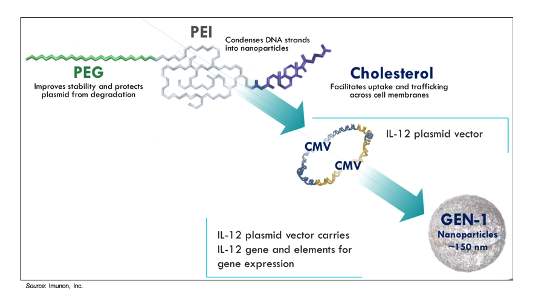
Multiple preclinical studies of GEN-1 showed that it could be utilized in combination with different ovarian cancer treatments to increase their efficacy, leading to significant reductions in tumor burden. Previous clinical trials of GEN-1 showed that the drug was well tolerated and potentiated the activity of various chemotherapy agents, including the OVATION 1 study, in which a total of 18 patients received increasing doses of GEN-1 (36, 47, 61, 79 mg/m2). Tumor response was associated with higher doses of GEN-1, and in the highest dose cohort 100% of patients had a complete or partial response and 88% achieved R0 resection.
Financial Update
On November 14, 2022, Imunon announced financial results for the third quarter of 2022. The company reported licensing revenue of $125,000 for the third quarters of 2022 and 2021. The revenue is derived from a technology development contract entered into in January 2013 with Hisun to support the development of ThermoDox in China. Hisun paid a non-refundable technology transfer fee of $5.0 million in the first quarter of 2013 and it has been recorded to deferred revenue and amortized over the ten-year term of the agreement.
R&D expenses for the third quarters of 2022 and 2021 were $2.4 million and $2.5 million, respectively. G&A expenses in the third quarters of 2022 and 2021 were $3.9 million and $2.7 million, respectively. The increase was primarily due to higher professional fees, higher insurance premiums, and higher compensation partially offset by lower non-cash stock compensation.
As of September 30, 2022, Imunon had approximately $43.4 million in cash, cash equivalents, and short-term investments. In addition, the company has $3.5 million in future planned sales of the State of New Jersey net operating losses (NOLs). Thus, we estimate Imunon has sufficient capital to fund operations into 2025. As of November 9, 2022, the company had approximately 7.4 million common shares outstanding and, when factoring in stock options and warrants, a fully diluted share count of 8.4 million.
Conclusion
The preliminary data for the company’s SARS-CoV-2 vaccine is very encouraging and serves as a nice proof of principle for the PLACCINE platform. We look forward to updates from the company as it evaluates next moves for the SARS-CoV-2 program and additional indications for the PLACCINE technology. We are glad to see the OVATION 2 trial is fully enrolled and we look forward to updates as that trial progresses to a topline data readout in mid-2024. Based on the new timing for the OVATION 2 readout we have pushed out the projected approval date, which has resulted in a slight decrease to our valuation to $17 per share.
SUBSCRIBE TO ZACKS SMALL CAP RESEARCH to receive our articles and reports emailed directly to you each morning. Please visit our website for additional information on Zacks SCR.
DISCLOSURE: Zacks SCR has received compensation from the issuer directly, from an investment manager, or from an investor relations consulting firm, engaged by the issuer, for providing research coverage for a period of no less than one year. Research articles, as seen here, are part of the service Zacks SCR provides and Zacks SCR receives quarterly payments totaling a maximum fee of up to $40,000 annually for these services provided to or regarding the issuer. Full Disclaimer HERE.