By John Vandermosten, CFA
NASDAQ:LPCN
READ THE FULL LPCN RESEARCH REPORT
Third Quarter 2022 Financial and Operational Results
On November 9, 2022 Lipocine (NASDAQ:LPCN) filed its third quarter 2022 Form 10-Q and posted its earnings release for the quarter ending September 30, 2022. In addition to the events listed below, the company attended several investor and scientific conferences since our last update targeting a NASH gathering and a neurology and psychiatric event among others.
Highlights for the third quarter 2022 and to-date include:
➢ LPCN 1144 end of Phase II meeting with FDA – July
➢ LPCN 2101 IND cleared – July
➢ LPCN 1154 (post-partum depression) pathway to approval clarified – September
➢ Strategic realignment towards CNS disorders – September
➢ Addition of new CMO and Lead Director/Board Chairman – November
Lipocine did not generate any revenues in the quarter and posted a net loss of ($2.4) million, or ($0.03) per diluted share.
For the quarter ending September 30, 2022 and versus the same period in the prior year:
➢ Revenues were nil compared to $55,000 with prior year amounts relating to Spriaso revenues generated in the cough and cold field;
➢ Research & Development expense totaled $2.1 million, falling 11% from $2.4 million, driven by lower contract research organization spending on LPCN 1154 and 1144. Other contributors include lower spending on associated Tlando expenses, that were offset by an increase in the Phase II study for LPCN 1148, manufacturing scale up for LPCN 1111 and increase in clinical studies for LPCN 1107;
➢ General & Administrative expenses were $0.8 million, falling 35% from $1.2 million primarily due to lower legal costs relating to the out-licensing of Tlando and class action lawsuit that occurred in the prior year. Lower personnel costs, corporate insurance and other general and administrative expenses were also lower. These amounts were offset by higher directors’ fees, consulting and professional fees, and travel related expenses;
➢ Total other net income was $0.5 million, similar to prior year levels;
➢ Net loss was ($2.4) million or ($0.03) per share compared with net loss of ($3.1) million or ($0.03) per share, respectively.
At quarter’s end, marketable securities, cash and equivalents totaled $34.3 million. Cash burn for 3Q:22 was ($3.2) million, compared with ($7.0) million in 2Q:21. During the three-month period, there were no material financing cash flows.
CNS Disorders
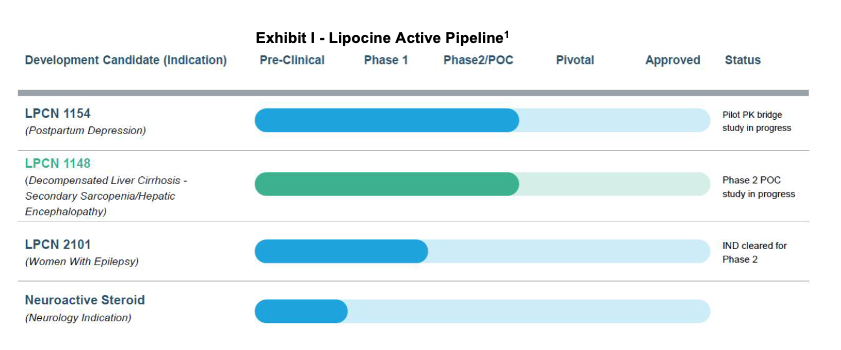
In late September, Lipocine announced that it had narrowed its research and development aims. It will apply the Lip’ral technology to creating new treatments for central nervous system (CNS) disorders. The company’s initial focus will be on oral formulations of endogenous neuroactive steroids that are applicable to the CNS space. Lipocine anticipates that its approach can be applied to enable effective oral delivery of endogenous modulators of the GABAA receptor, which historically have been challenging to deliver orally due to poor aqueous solubility. The CNS development portfolio includes LPCN 1154, a fast-acting oral antidepressant for postpartum depression (PPD) with potential for outpatient use; LPCN 2101, with a novel mechanism of action, for women with epilepsy; and another undisclosed CNS-focused candidate. LPCN 1148 will also be considered to be in the active pipeline for its use in hepatic encephalopathy.
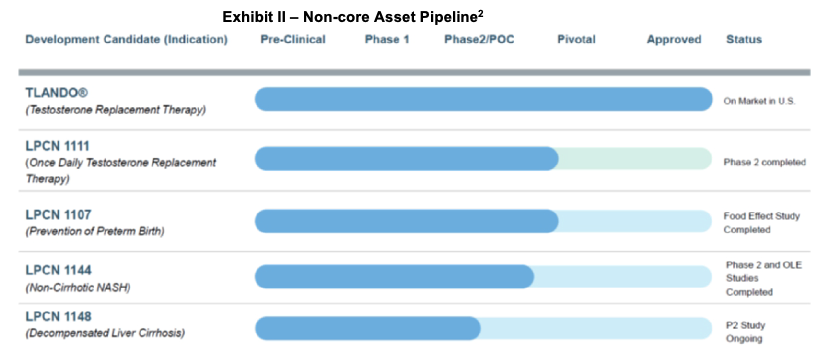
The shift towards a CNS-focused portfolio converts the non-core assets into partnership opportunities. In terms of priority for business development, Tlando ex-US is first, with 1107 for pre term birth, 1144 for non-alcoholic steatohepatitis (NASH), 1148 for cirrhosis and Tlando XR following in order of priority. No further material investment is expected by Lipocine in these assets and related indications.
To support its move toward CNS disorders, Lipocine has appointed several new leaders, as shared in a November press release. George Nomikos, M.D., Ph.D. joined the company as Chief Medical Officer (CMO) and Spyros Papapetropoulos, M.D., Ph.D. was elevated to lead director and Chairman of the Board. The new additions are expected to help guide the development portfolio forward leveraging backgrounds in neurology and psychiatry and experience leading CNS-focused companies. Dr. Nomikos is a biopharmaceutical R&D scientist with senior roles at Scholar Rock, Biogen, Sage, Takeda, Astellas Amgen and Eli Lilly. He was also an associate professor at the Karolinska Institutet in Stockholm, Sweden. Dr. Papapetropoulos has been a member of Lipocine’s board since April 2022 and is CMO at Vigil Neuro. Former roles include senior positions at Acadia Pharmaceuticals, SwanBio Therapeutics, Cavion and a number of large pharmaceutical companies including Biogen and Pfizer.
TLANDO
Tlando was launched by partner Halozyme during the second quarter 2022 with initial efforts centered on obtaining formulary access which is expected to take about a year. The asset was acquired by Halozyme from the original license holder Antares Pharma in May 2022. Halozyme announced the launch of the product in a June 7th press release and plans to commercialize Tlando along with Antares’ injectable testosterone replacement therapy Xyosted. Halozyme’s orientation as a commercialization company rather than a development company led to the pass on the Tlando XR (LPCN 1111) option. Lipocine is working with a contract manufacturer for scale up and manufacturing of LPCN 1111 and has completed a technology transfer to this end. Lipocine will not develop the product any further, but is seeking a partner to do so and preparing for an efficient hand off with product ready for clinical trials. Tlando XR is available for partnering and could be ready for FDA submission after a projected 30 months of clinical trials and $10 million in investment.
Lipocine recognized minimum guaranteed revenues upfront in 4Q:21, and will not receive further royalty revenues related to Tlando for the first three years unless sales exceed the minimum contractual amounts. Next objectives for Lipocine are to seek out partners in unlicensed regions including Canada, Europe, China and Korea. Management is in active discussions with prospects for international licensing, and we expect to see a press release when a deal is signed. Our model now adds a component for Tlando ex-US which assumes a 50% likelihood of success.
LPCN 1144
One of Lipocine’s most important assets is LPCN 1144 for the treatment of non-cirrhotic non-alcoholic steatohepatitis (NASH). Program 1144 has completed a Phase II study (LiFT) and management is exploring partnership opportunities for this asset. A takeaway from the end of Phase II meeting is a requirement to conduct a dose ranging study using Lipocine’s proposed testosterone ester, testosterone dodecanoate (TD); however, Lipocine will not pay for or conduct the study. TD has several favorable characteristics compared with testosterone undecanoate including anti-infective properties and favorable pharmacokinetics.
Upcoming Milestones
➢ Scale up and manufacturing of LPCN 1111 registration batches – 2H:22
➢ LPCN 1154 multi-dose PoC study – 4Q:22
➢ LPCN 1148 (sarcopenia) Phase II enrollment complete – 4Q:22
➢ Partnering activities for LPCN 1111, 1144, 1107 & Tlando ex-US – 2022+
➢ LPCN 2101 Phase II epilepsy study to start – 2023
➢ LPCN 1148 Phase II topline data – 1H:23
➢ LPCN 2101 Phase II topline data – 2023
Valuation
In light of Lipocine’s shift in strategy towards its CNS-focused pipeline, we expect the company’s research and development to center on LPCN 1154 for post-partum depression, LPCN 2101 for women with epilepsy and LPCN 1148 for management of decompensated cirrhosis and hepatic encephalopathy. LPCN 1154 is undergoing a pilot pharmacokinetic bridge study and is the most advanced of the company’s active assets.
Our valuation model assumes continued royalty revenues from Tlando through its licensing agreement with Halozyme. Lipocine is seeking partners outside the US for Tlando and we apply a 50% likelihood of success in this venture. LPCN-2101 has not yet started clinical trials and we will withhold our assignment of value until phased trials begin. Despite being a noncore asset, LPCN 1144 maintains our highest valuation in the company’s portfolio given the strong results generated in the Phase II LiFT study and open label extension (OLE) and market potential in a space with a dramatic unmet need. Even though LPCN 1144 has made a strong showing, the market for this asset is soft given this shift in attention away from NASH. Therefore, we reduce the probability of eventual success in this program to 33% from 40%. We assign a 10% probability of success to the LPCN 1148 program in decompensated liver cirrhosis and secondarily in sarcopenia/hepatic encephalopathy given its early stage of development. The other assets in the portfolio are also available for development by a partner and include LPCN 1111 and LPCN 1107. For LPCN 1111, the asset that is in development to replace Tlando as a once-daily testosterone replacement is ready for a pivotal trial which will be conducted by a partner if one emerges. LPCN 1107 in pre-term birth is also available for partner development. We will apply a probability of success to these two assets if a partnership agreement emerges.
SUBSCRIBE TO ZACKS SMALL CAP RESEARCH to receive our articles and reports emailed directly to you each morning. Please visit our website for additional information on Zacks SCR.
DISCLOSURE: Zacks SCR has received compensation from the issuer directly, from an investment manager, or from an investor relations consulting firm, engaged by the issuer, for providing research coverage for a period of no less than one year. Research articles, as seen here, are part of the service Zacks SCR provides and Zacks SCR receives quarterly payments totaling a maximum fee of up to $40,000 annually for these services provided to or regarding the issuer. Full Disclaimer HERE.
________________________
1. Lipocine Third Quarter 2022 Form 10-Q
2. Lipocine Third Quarter 2022 Form 10-Q