By John Vandermosten, CFA
NASDAQ:LTRN
READ THE FULL LTRN RESEARCH REPORT
2021 Financial and Operational Results
On March 10, 2022, Lantern Pharma, Inc. (NASDAQ:LTRN) announced 2021 annual financial and operational results, filed its form 10-K with the SEC and hosted a video webcast to review accomplishments. Lantern informed investors that RADR’s dataset had grown to over 18 billion datapoints, preparation for the Phase II trial for LP-300 is taking place and orphan designations have been granted in multiple indications.
Highlights for the fourth quarter and to-date include:
➢ Partnership with Code Ocean to identify drug development collaborations - October 2021
➢ RADR accumulation of more than 10 billion datapoints - November 2021
➢ LP-184 presentation at SNO1 2021 Annual Meeting - November 2021
➢ KOL event - November 2021
➢ Share repurchase program announced - November 2021
➢ Positive data presented on LP-284 at the 63rd ASH2 Annual Meeting - December 2021
➢ Precision oncology collaboration with NCI expanded - January 2022
➢ Collaboration and research agreement executed with DCRC - January 2022
➢ LP-184 receives Rare Pediatric Disease and Orphan Drug Designations - January 2022
➢ Collaboration with Greehey Children’s Cancer Research Institute, San Antonio - February 2022
Lantern generated no revenues during the year and incurred operating expense of $12.6 million, producing a net loss of ($12.4) million, or ($1.13) per share.
For the year ending December 31, 2021 and versus the same ending December 31, 2020:
➢ Research & development expenses totaled $7.6 million, rising 237% from $2.2 million on increases in product candidate manufacturing related expenses, higher expenditures for research studies, expansion in payroll costs and payment of $1.0 million to Allarity Therapeutics for LP-100, a nonrecurring expense;
➢ General & administrative expenses were $5.0 million, rising 37% from $3.7 million, due to greater business and corporate development expense, higher corporate insurance expense and increases in legal and patent related costs;
➢ Net loss was ($12.4) million, or ($1.13) per share, compared to ($5.9) million, or ($1.37) per share.
At the end of 2021, cash and marketable securities on the balance sheet totaled $70.7 million, which management expects to sustain the company into 2025. Cash burn for the year was ($10.6) million, up materially from the ($5.7) million consumed in the prior year. Lantern generated net cash from financing of $63.4 million from issuance of common stock.
Share Repurchase Program
On November 22, 2021, Lantern announced that its board had authorized a share repurchase program to acquire up to $7 million of Lantern’s common stock. Lantern may purchase its common stock on the open market, through private transactions or otherwise. The timing, share repurchase amount and price will vary on market conditions as well as corporate and regulatory limitations. As of March 2022, ~430,000 shares have been repurchased at an average $7.18 per share for a total paid of $3.1 million.
Lantern Expands NCI Precision Oncology Collaboration
On January 12, 2022, Lantern announced the expansion of its precision oncology collaboration with the National Cancer Institute (NCI). Lantern first entered into the partnership with the NCI’s Developmental Therapeutics Branch (DTB) in October 2019 to identify gene signatures that help predict a potential response of a patient’s tumor to a drug therapy. After identifying biomarker correlations for Lantern’s LP-184 and LP-284, the second phase of the collaboration will leverage CellMiner and CellMinerCDB data in search of additional -omic response predictors. Data from Project Achilles at the Broad Institute will also be included for insight into efficacy under specific genetic and molecular conditions.
Danish Cancer Society Research Center Collaboration
On January 18, 2022, Lantern announced a collaboration and research agreement with The Danish Cancer Society Research Center (DCRC) to support clinical development of LP-100 and LP-184, as well as the development of improved diagnostic methods to identify nucleotide excision repair (NER) deficient tumors, a predictor of LP-100 and LP-184 efficacy. The collaboration will explore the use of expanded mutational signature-based analyses to identify said tumors, and will include a comprehensive analysis of breast, ovarian, prostate, lung, kidney, bladder, stomach, pancreatic and esophageal cancer. Through the collaboration, patients that can benefit from NER deficiency targeting will be identified, which will assist in determining overall market size for the candidates. Dr. Zoltan Szallasi, MD, principal investigator at DCRC, will lead the collaboration research. Dr. Szallasi serves joint appointments as Group Leader of the Translational Cancer Genomics department at DCRC and as Faculty, Computational Health Informatics Program (CHIP) and Assistant Professor of Pediatrics at Boston Children's Hospital affiliated with Harvard Medical School. The collaboration is also expected to add millions of datapoints to Lantern’s RADR platform.
Greehey Children’s Cancer Research Institute Collaboration
On February 15, 2022, Lantern announced that it had entered into a research collaboration with The Greehey Children’s Cancer Research Institute (GCCRI) at University of Texas Health Science Center in San Antonio. Lantern’s RADR AI platform aided in the identification of additional, rare pediatric cancers, some of which lack effective treatments, but may be amenable to treatment with LP-184 and LP-284. Research will initially focus on LP-184 in pediatric cancer models developed by Dr. Peter Houghton at GCCRI. The models will assist in validating RADR’s findings.
Presentations
Lantern presented at both Society for Neuro-Oncology (SNO) Annual Meeting 2021 in mid-November and the 63rd ASH3 Annual Meeting in mid-December 2021.
At the SNO meeting, in vivo and in vitro results were presented for LP-184 in glioblastoma multiforme (GBM) expressing elevated PTGR1. Results showed nanomolar potency in multiple cell lines, including those predicted to be sensitive to LP-184 (PTEN mutant), and one GBM cell line with unmethylated MGMT promoter, known to be resistant to standard of care temozolomide (TMZ) chemotherapy. LP-184 was found to be 300-1000 times more potent than TMZ. LP-184 also showed near complete tumor regression and survival benefit in subcutaneous and intracranial GBM xenograft models, respectively. LP-184 was found to have comparable blood-brain barrier permeability to TMZ. The poster presentation can be found here.
The ASH meeting featured positive in vitro data for LP-284 in hematologic cancers. The research sought to evaluate the efficacy of LP-284 in the NCI’s 60 human tumor cell lines (NCI-60), which have the most extensive cancer pharmacology database in the world.4 The research also aimed to identify the metabolic activation enzyme of LP-284 in silico and the hematologic cancer subtypes that may be amenable to LP-284 treatment. Results showed a distinct anti-tumor profile of LP-284 versus other compounds in Lantern’s portfolio and had the broadest anti-hematologic cancer activity. Unlike LP-184 and Irofulven, LP-284 did not show activity correlated with PTGR1 expression. But with activity in low PTGR1 expressing hematologic cancer cell lines, an alternative LP-284 activator was evident. LP-284 exhibited nanomolar potency in mantle cell lymphoma, Burkitt’s lymphoma, multiple myeloma, chronic myeloid leukemia, and acute lymphoblastic leukemia. Finally, spironolactone was found to sensitize SUDHL6 (double-hit lymphoma) and RPMI8226 (multiple myeloma) cell lines, reducing LP-284’s IC50 by 2.4-fold. The poster presentation can be found here.
LP-184 Receives Rare Pediatric Disease and Orphan Drug Designations in ATRT5
On January 24, 2022, Lantern announced that the FDA had granted both Rare Pediatric Disease Designation and Orphan Drug Designation for LP-184 in ATRT. Under the Rare Pediatric Disease program, a sponsor (Lantern) who receives approval for a drug or biologic (LP-184) for a rare pediatric disease6 may qualify for a priority review voucher that can be redeemed for the marketing application for a different product. While the Rare Pediatric Disease Designation can apply to subsequent products, the Orphan Drug Designation has immediate benefits for LP-184 including tax credits for qualified clinical trials, exemption from user fees, and potential seven years of market exclusivity after approval. LP-184 sensitivity in tumors was negatively correlated with SMARCB1 expression. Furthermore, the underlying genetic cause of 90% of pediatric ATRT are changes in SMARCB1 gene. Lantern has partnered with Johns Hopkins School of Medicine to conduct pre-clinical evaluation of LP-184 in ATRT and Glioblastoma multiforme (GBM).
Phase II Clinical Trial For LP-300
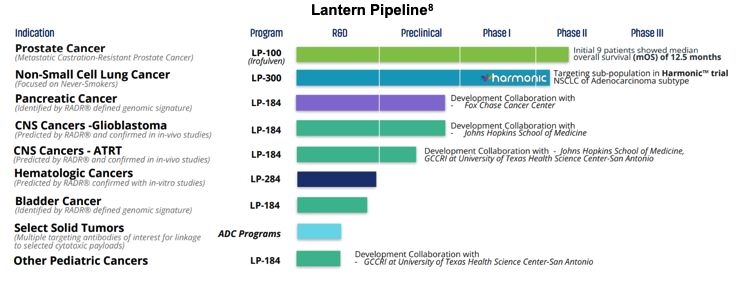
After a delay on multiple fronts resulting from the pandemic, Lantern now prepares to launch its Phase II trial for LP-300 in never-smoker non-small cell lung cancer (NSCLC) patients. Lung cancer is the leading cause of death among cancer patients in the US, and one in six lung cancer deaths will occur in never-smokers. Previous clinical results7 showed that the sub-population of never smokers, and especially female never smokers, benefited from a 125% increase in 2-year survival receiving LP-300 + cisplatin + paclitaxel compared to the doublet chemotherapy.
Over the last several quarter, problems related to equipment, materials and staffing at the drug manufacturer have led to a delay in delivering product to clinical sites for LP-300, causing a delay. Logistics relating to the identification, staffing and briefing of clinical sites also experiences a pause. Management informed investors that the hurdles have largely been addressed; LP-300 has been synthesized and is currently undergoing stability testing. Partner Deep Lens was added to enable faster recruitment of suitable patients in the never-smoker NSCLC study. The partner’s technology will search through thousands of medical records to match the most appropriate patients with the objectives of the trial.
The trial, which has now been assigned the moniker “Harmonic,” will enroll subjects at 20 sites with 4 to 5 patients expected per site which, if successful, will achieve the 90-patient target. The subjects will be randomized into two arms 2:1, receiving LP-300 (18.4 g/m2) + cisplatin + paclitaxel vs cisplatin + paclitaxel, respectively. Inclusion criteria stipulates never smoker patients with relapsed advanced primary adenocarcinoma of the lung. The trial will require approximately two years to generate the needed data. Primary objectives will be to evaluate overall- and progression-free survival.
Milestones
➢ LP-100 (mCRPC)
◦ Responsibility for trial transferred to Lantern – July 2021
➢ LP-300 (non-smoker NSCLC)
◦ Collaboration with Deep Lens to accelerate recruitment – 3Q:21
◦ Launch of 90 patient Phase II – 1H:22
➢ LP-184 (pancreatic cancer)
◦ Granted orphan designation – August 2021
◦ Host KOL event – November 18, 2021
◦ Develop and submit IND – 2022
◦ Phase I trial – mid-2022
➢ LP-184 (GBM)
◦ Preclinical results from collaborative research program – November 2021
◦ Launch Phase I/II study – 2022
➢ LP-184 (ADCs)
◦ Preclinical studies launched – 2022
◦ Preclinical data available – 2022
◦ IND development – 2022
➢ LP-284 (mantle cell lymphoma)
◦ Data presentation at American Society of Hematology (ASH) conference – December 2021
Summary
On March 10th, Lantern reported 2021 financial and operational results. Key events included the milestone of adding over 18 billion data points via RADR, continues preparation for the start of the LP-300 trial in 2022, multiple orphan designation grants and new patent applications. At the end of 2021, cash and marketable securities on the balance sheet totaled $70.7 million, providing support for the company’s initiatives into 2025. Cash burn for the year was ($10.6) million, up materially from the ($5.7) million consumed in the prior year.
Other highlights include LP-184 presentation at SNO 2021 Annual Meeting, a virtual KOL webinar, the announcement of a share repurchase program, presentation on LP-284 at 63rd ASH Annual Meeting, expansion of collaboration with NCI, and establishment of a collaboration and multiple research agreements.
Management anticipates 2022 to be a year of continued growth and progress with six programs in the pipeline and a large war chest of cash to fund preclinical and clinical work for years to come. We anticipate the start of the Phase II LP-300 study in NSCLC among non-smokers in 2022, and look forward to IND-enabling studies of LP-184 in multiple solid tumors and multiple potential trials for the candidate. Lantern also is considering continuing LP-100’s Phase II trial in mCRPC.
For added detail on Lantern’s proprietary AI development platform, RADR, and for background on indications and Lantern’s clinical candidates, please refer to further discussion in our initiation.
SUBSCRIBE TO ZACKS SMALL CAP RESEARCH to receive our articles and reports emailed directly to you each morning. Please visit our website for additional information on Zacks SCR.
DISCLOSURE: Zacks SCR has received compensation from the issuer directly, from an investment manager, or from an investor relations consulting firm, engaged by the issuer, for providing research coverage for a period of no less than one year. Research articles, as seen here, are part of the service Zacks SCR provides and Zacks SCR receives quarterly payments totaling a maximum fee of up to $40,000 annually for these services provided to or regarding the issuer. Full Disclaimer HERE.
________________________
1. Society for Neuro-Oncology
2. American Society of Hematology
3. American Society of Hematology
4. Abaan OD, Polley EC, Davis SR, et al. (2013) The exomes of the NCI-60 panel: a genomic resource for cancer biology and systems pharmacology. Cancer Research.
5. Atypical Teratoid Rhabdoid Tumor - an aggressive and rapidly growing cancer of the central nervous system
6. The FDA defines rare pediatric disease as a disease that manifests as serious or life threatening in children age 0-18, and affects fewer than 200,000 persons in the US. Rare Pediatric Disease Priority Review Vouchers (fda.gov)
7. DMS32212R, BioNumerik Pharmaceuticals
8. Source: Lantern Pharma 4Q:21 Earnings Presentation