By John Vandermosten, CFA
NASDAQ:LTRN
READ THE FULL LTRN RESEARCH REPORT
Second Quarter 2022 Financial and Operational Results
On August 8, 2022, Lantern Pharma, Inc. (NASDAQ:LTRN) announced 2Q:22 annual financial and operational results, filed its Form 10-Q with the SEC and hosted a video webcast to review accomplishments. Cleared to start by the FDA in July, Lantern expects its Phase II Harmonic trial to enroll its first patient in 3Q:22. The company also announced that it had surpassed 21 billion data points on the RADR platform with future data collection centered upon automation of data acquisition and improved tagging of metadata and algorithms. IND-enabling work is being conducted on behalf of LP-184 and LP-284 that is expected to lead to IND submissions and Phase I clinical trials in 1H:23. Attendance at several investor and scientific conferences was highlighted as was a September KOL event that will focus on childhood cancers.
Highlights for the first quarter and to-date include:
➢ KOL event addressing Glioblastoma Multiforme (LP-184) – May 2022
➢ FDA Authorization to start LP-300 trial – July 2022
➢ RADR exceeds 21 billion data points – August 2022
Lantern generated no revenues during the first quarter and incurred operating expense of $4.5 million, producing a net loss of ($4.5) million or ($0.41) per share.
For the quarter ending June 30, 2022 and versus the same ending June 30, 2021:
➢ Research & development expenses totaled $3.0 million, rising 160% from $1.2 million on increases to increases in product candidate manufacturing related expenses of approximately $1,092,000 and increases in research studies of approximately $644,000;
➢ General & administrative expenses were $1.4 million up 7% vs. $1.3 million on increases in office and administrative expense, greater travel expense, higher professional fees, increases in payroll and compensation related expense, and a rise in net other expenses. This was partially offset by decreases in business development, corporate insurance and legal and patent related expenses;
➢ Interest income was $55,000 vs. $48,000 in the prior period while other income was ($153,000) recognizing a loss on equity securities, foreign currency loss, and a gain on loan forgiveness partially offset by dividend income and tax incentives;
➢ Net loss was ($4.5) million, or ($0.41) per share, compared to ($2.3) million, or ($0.21) per share.
At the end of 2Q:22, cash and marketable securities on the balance sheet totaled $62.1 million, declining $3.1 million sequentially. Cash burn for the quarter was ($3.3) million, vs. ($2.1) million consumed in the prior year. There was zero movement in cash from financing sources in the quarter.
Harmonic Trial to Start
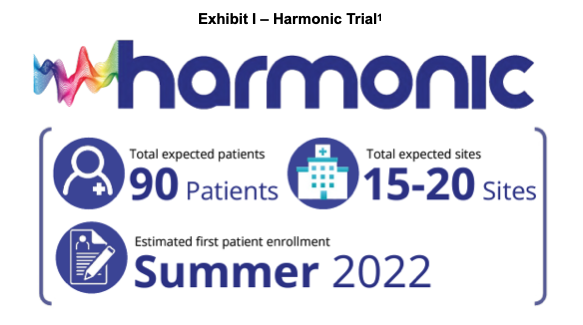
In mid-July, Lantern announced what we all have been waiting for: the start of the Harmonic trial that will evaluate LP-300 in never smokers with non-small cell lung cancer (NSCLC). 90 subjects are expected to enroll in the Phase II study at 15 – 20 sites around the United States with enrollment expected to last from 12 to 16 months. It will target never smokers with lung adenocarcinoma who have relapsed after treatment with tyrosine kinase inhibitors (TKIs). The study will consist of two stages, the safety lead-in stage and the randomization stage. Patients on LP-300 + pemetrexed and carboplatin will be measured against patients on pemetrexed and carboplatin only in a 2:1 ratio. Primary endpoints are progression free survival (PFS) and overall survival (OS). Secondary endpoints include objective response rate (ORR), duration of objective response (DOR) and clinical benefit rate (CBR). It has been a while since our initial work on the drug and indication, so we will provide a review of the relevant details on LP-300 and never smoker NSCLC.
LP-300 Phase II Clinical Trial
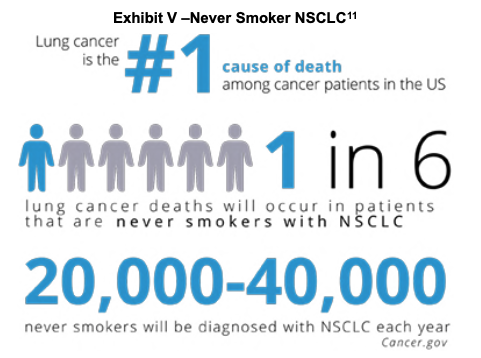
Lantern has been cleared to begin its Phase II trial for LP-300 in never-smoker non-small cell lung cancer (NSCLC) patients in the Harmonic study. Lung cancer is the leading cause of death among cancer patients in the US, and one in six lung cancer deaths will occur in never-smokers. Previous clinical results2 showed that the sub-population of never smokers, and especially female never smokers, benefited from a 125% increase in 2-year survival receiving LP-300 + cisplatin + paclitaxel compared to the doublet chemotherapy.
Over the last year, delays related to equipment, materials and staffing at the drug manufacturer have slowed the delivery of product to clinical sites for LP-300. Logistics relating to the identification, staffing and briefing of clinical sites also caused a pause. Partner Deep Lens was added to the roster in order to accelerate recruitment of suitable patients in the never-smoker NSCLC study. The partner’s technology will search through thousands of medical records to match the most appropriate patients with the objectives of the trial.
Harmonic will enroll an estimated 90 subjects at 15 - 20 sites with 4 to 5 patients expected per site which with the first enrollee expected in 3Q:22. The subjects will be randomized into two arms 2:1, receiving LP-300 (18.4 g/m2) + cisplatin + paclitaxel vs cisplatin + paclitaxel, respectively. Inclusion criteria stipulates enrollment of never smoker patients with relapsed advanced primary adenocarcinoma of the lung. Primary objectives will be to evaluate overall- and progression-free survival.
LP-300
LP-300 is a small molecule capable of modifying the amino acid cysteine in select proteins (ALK) and modulates protein function in others (EGFR, Met and ROS1)3. The molecule was in-licensed from BioNumerik Pharmaceuticals, Inc. in May 2016 and was fully acquired in January 2018.
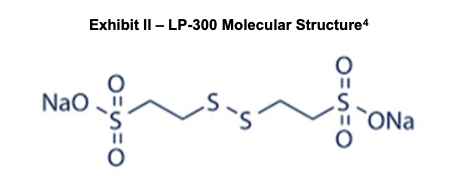
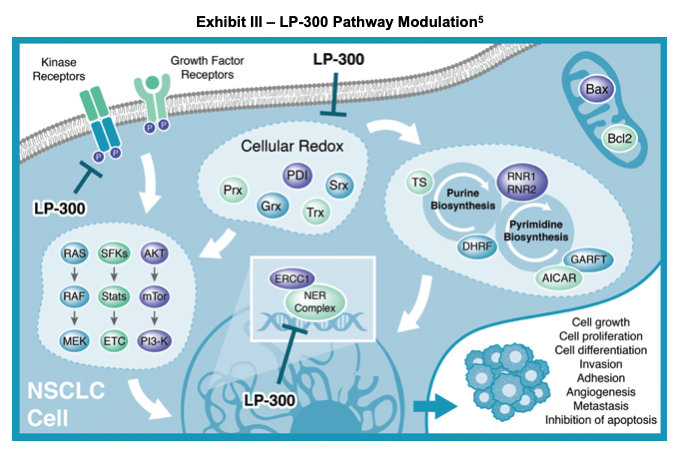
LP-300 can modulate multiple cellular pathways simultaneously, and can act as a chemo-sensitizer for combination therapies by counteracting the protein-basis for drug resistance. LP-300 can also serve as a chemoprotectant, reducing toxicities associated with taxane and platinum-based chemotherapies. Lantern is currently designing Phase II trials of LP-300 in never-smokers with adenocarcinoma of the lung, an indication for which there is no approved therapy.
LP-300 Mechanism of Action
LP-300 is a small molecule with the ability to modify cysteine on anaplastic lymphoma kinase, a receptor tyrosine kinase. Inhibition of this receptor has downstream effects on RAS, SFK, and AKT pathways. LP-300 also affects the cell’s redox balance, which, in turn modulates the RAS, SFK and AKT pathways. Proteins involved in cellular redox also can confer drug resistance, namely thioredoxin (TRX), peroxiredoxin (PRX), glutaredoxin (GRX) and protein disulfide isomerase (PDI), which are inhibited by LP-300 and act as chemo-sensitizers in combination therapy. LP-300 can also act as a chemoprotectant and reduce toxicities associated with taxane and platinum-based therapies. Through the multiple mechanisms of action, LP-300 is potentially a first-in-class combination agent in NSCLC.
Previous Trials
LP-300 has been investigated in multiple clinical trials in the past, both as a monotherapy and in combination with other agents. Over 1,000 patients have been administered LP-300 where it has largely been well tolerated. However, these trials failed to meet designated endpoints, likely due to the lack of patient stratification based on biomarkers or smoking status.
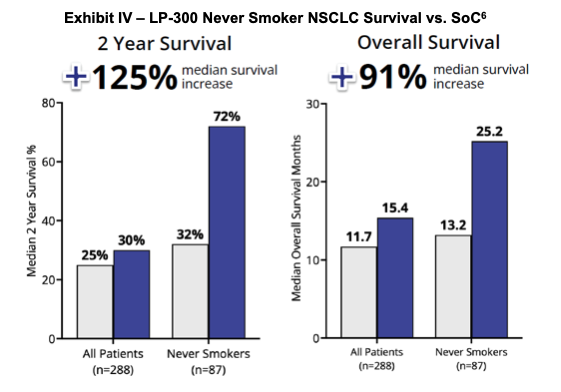
In combination therapy trials, LP-300 was evaluated with paclitaxel and cisplatin or docetaxel and cisplatin, platinum-based therapies. Retrospective analysis of these past studies revealed subgroups that demonstrated substantial improvement in overall survival, particularly among female non-smokers. The subpopulation showed a 13.6-month improvement in overall survival (OS). Based on this observation and LP-300’s multiple effects on cell metabolism, Lantern intends to position LP-300 as a combination therapy in never smokers with adenocarcinoma NSCLC.
Clinical Trials & Partners
LP-300 was in-licensed from BioNumerik Pharma in May 2016 and acquired from them in January 2018. Following acquisition of the license, Lantern planned a Phase II trial for LP-300 in combination with chemotherapy in never-smoker adenocarcinoma NSCLC. The Phase II is intended as the continuation of a Phase III trial that demonstrated benefit in a subgroup, despite failing to meet its endpoint overall and was able to advance under an existing IND. LP-300 in combination with cisplatin and paclitaxel was able to produce a 125% increase in 2-year survival in never-smokers.
Non or Never Smoker NSCLC Incidence & Prevalence
Lung cancer is a leading cause of cancer death worldwide. In the US, lung cancer ranks second only after prostate and breast cancer in incidence, and leads all other cancers in mortality.7 NSCLC is the most common type of lung cancer, accounting for nine out of every 10 cases.8 Of the total NSCLC cases, adenocarcinoma is the most common type, accounting for 40% of NSCLC occurrences. Though prevalence of lung cancer has declined with the decrease in smoking, there exists a subset of the lung cancer population that has never smoked, and NSCLC in never-smokers is metabolically distinct compared to smoking-related NSCLC. Met/ALK and EGFR alterations are more common in non-smokers and LP-300 has demonstrated in the lab that it targets both EGFR WT/mut+ and Met/ALK. Additionally, a large proportion of adenocarcinoma patients are EGFR mutants or Met/ALK positive making this population particularly receptive to LP-300 therapy. The proportion of never-smokers with lung cancer has risen sharply. Approximately 10-15% of all lung cancer cases in the US are in never-smokers.9 As tobacco smoking has been ruled out, several etiologic factors are under consideration for the increased risk of lung cancer in never smokers (LCINS) including radon, cooking fumes, asbestos, heavy metals, human papillomavirus and genetics.
While Lantern had initially targeted LCINS in female populations, the Harmonic trial will pursue all never-smokers, resulting in a slightly larger population. Adenocarcinoma is the predominant subtype of LCINS, comprising 53% to 70% of cases.10 When applied to the 229,000 US cases provided by the American Cancer Society and the 146,000 Western European cases and 313,000 in the EU as provided by GLOBOCAN, this suggests almost 14,000 cases in the US and 19,000 in Europe. We estimate almost 90,000 cases in other regions around the globe.
NSCLC Symptoms & Diagnosis
NSCLC typically presents in advanced stages; asymptomatic diagnosis can occur via routine chest x-ray. Advanced NSCLC may cause symptoms such as cough, shortness of breath, joint or bone pain, wheezing, hemoptysis, chest pain, weight loss, hoarseness and fatigue.12 If the tumor metastasizes, other symptoms will result based on the location. Paraneoplastic syndrome13 can also occur, resulting in hypercalcemia, confusion, excessive thirst or urination, fatigue, seizures, coma and abnormal antidiuretic hormone secretion.
Diagnosis of NSCLC includes bone scan, imaging tests such as magnetic resonance imaging (MRI), computed tomography (CT) scan and positron emission tomography (PET) scan, analysis of sputum for cancer cell content, and biopsy of the lung.14
Standard of Care
Treatment of NSCLC depends on cancer stage and degree of metastasis. If the tumor remains localized, surgery with (neo) adjuvant chemo- or radiation-therapy is recommended. If the tumor has metastasized, chemotherapy, targeted therapy or immunotherapy is used to control the condition. Pembrolizumab can be used as a first line treatment in cancer cells with 50% or greater programmed cell death ligand 1 (PD-L1) expression. Patients that do not express sufficient levels of checkpoints are prescribed cisplatin or carboplatin in combination with pemetrexed or a taxane, such as paclitaxel or docetaxel. Bevacizumab can also be used, although it is contraindicated in patients with a concern of thrombolysis, hemoptysis, or brain metastasis.15
SUBSCRIBE TO ZACKS SMALL CAP RESEARCH to receive our articles and reports emailed directly to you each morning. Please visit our website for additional information on Zacks SCR.
DISCLOSURE: Zacks SCR has received compensation from the issuer directly, from an investment manager, or from an investor relations consulting firm, engaged by the issuer, for providing research coverage for a period of no less than one year. Research articles, as seen here, are part of the service Zacks SCR provides and Zacks SCR receives quarterly payments totaling a maximum fee of up to $40,000 annually for these services provided to or regarding the issuer. Full Disclaimer HERE.
________________________
1. Source: Lantern Pharma June 2022 Presentation
2. DMS32212R, BioNumerik Pharmaceuticals
3. EGFR: epidermal growth factor receptor; MET is also known as hepatocyte growth factor receptor (HGFR); ROS1 gene that encodes for an enzyme that drives uncontrolled cellular growth.
4. Lantern Pharma Website Pipeline Page Accessed July 2022. The chemical composition is disodium 2,2’-dithio-bis-ethane sulfonate
5. Lantern S-1 dated April 2020
6. Source: Lantern Pharma 2Q:22 Earnings Call Presentation, subset of non-smoker NSCLC patients from larger NSCLC trial
7. ACS Cancer Facts and Figures 2020
8. https://www.cancercenter.com/cancer-types/lung-cancer/types
9. Pelosof L, Ahn C, Gao A, Horn L, Madrigales A, Cox J, McGavic D, Minna JD, Gazdar AF, Schiller J. Proportion of Never-Smoker Non-Small Cell Lung Cancer Patients at Three Diverse Institutions. J Natl Cancer Inst. 2017 Jan; 109(7):.
10. Wakelee, H., et al. Lung cancer incidence in never-smokers. J Clin Oncol. 2007 Feb 10; 25(5): 472–478.
11. Source: Lantern Pharma June 2022 Presentation
12. https://www.myamericannurse.com/wp-content/uploads/2016/12/ant2-CE-Lung-Cancer-116a.pdf
13. Paraneoplastic syndromes are a group of rare disorders that are triggered by an abnormal immune system response to a cancerous tumor known as a "neoplasm." Paraneoplastic syndromes are thought to happen when cancer-fighting antibodies or white blood cells (known as T cells) mistakenly attack normal cells in the nervous system. These disorders typically affect middle-aged to older people and are most common in individuals with lung, ovarian, lymphatic, or breast cancer. Source: NIH, National Institute of Neurological Disorders and Stroke.
14. https://www.healthline.com/health/lung-cancer-non-small-cell#diagnosis
15. https://www.myamericannurse.com/wp-content/uploads/2016/12/ant2-CE-Lung-Cancer-116a.pdf