By John Vandermosten, CFA
NYSE:PLX
READ THE FULL PLX RESEARCH REPORT
Second Quarter Financial and Operational Review
Protalix Biotherapeutics, Inc. (NYSE:PLX) announced its 2Q:22 financial and operational results in an August 15, 2022 press release and filing of Form 10-Q. The materials were followed by a conference call which discussed recent achievements, regulatory updates and drivers for financial performance. It was a light period for Protalix since the previous quarter update in mid-May with a poster presentation and a new board member dominating the news flow over the last three months. During the call, CEO Dror Bashan noted that the clinical study report (CSR) for the BALANCE trial had been completed and that Protalix expects to start its Phase I trial for PRX-115 in gout in 1Q:23.
Key events year to date include topline data from the BALANCE clinical trial, final results from the BRIGHT clinical trial and the submission of a Marketing Authorisation Application (MAA) to the European Medicines Agency (EMA) for PRX-102.
In the financial sphere, Protalix generated revenues of $8.8 million in 2Q:22 compared to revenue of $6.4 million in the prior year period. This resulted in net loss of ($5.3) million versus ($11.2) million in 2Q:21.
Financial results for the quarter ending June 30, 2022, compared to the quarter ending June 30, 2021:
➢ Revenues were $8.8 million, up 36% from $6.4 million; sales from goods rose 4% to $3.4 million, which were dominated by Pfizer efforts. Revenues from license and R&D services, which are related to Chiesi license and supply agreements, rose 69% to $5.4 million from $3.2 million;
➢ Cost of revenues was down 14% to $4.1 million producing a negative 21% gross margin;
➢ Research and development expenses fell to $7.6 million from $7.7 million, a 1% decrease. Subcontractor related expenses and salary costs were the primary drivers for the amount;
➢ Selling, general and administrative expenses fell 18% to $2.6 million vs $3.2 million;
➢ Financial expenses were a net ($190,000) vs $2.1 million, declining on lower interest and debt amortization costs;
➢ Net loss was ($5.3) million vs ($11.2) million, or ($0.11) per share versus ($0.25) per share;
Cash and equivalents balance including short-term bank deposits on June 30, 2022 totaled $28.6 million versus $39.0 million at the end of 2021. Cash burn was ($13.1) million for the first six months of the year. Financing cash flows of $2.6 million related to proceeds from issuance of common stock. Protalix holds sufficient cash to fund operations until 3Q:23, after the expected regulatory approval of PRX-102.
Following the end of the quarter, 1.0 million shares were sold in return for proceeds of $1.2 million, Pfizer disbursed $1.1 million for product sales and Chiesi delivered $1.1 million for expense reimbursements.
Posters at the 2022 Program: 7th Update on Fabry Disease
Protalix shared five poster presentations at the 7th Update on Fabry Disease: Biomarkers, Progression and Treatment Opportunities held in Würzburg, Germany at the end of May 2022. The following presentations were highlighted:
➢ Safety and Efficacy of Pegunigalsidase Alfa vs Agalsidase Beta on Renal Function in Fabry Disease: 24-Month Results from the Phase III Randomized, Double-blind, BALANCE Study
➢ Long-term Safety and Efficacy of Pegunigalsidase Alfa: A Multicenter Extension Study in Adult Patients with Fabry Disease
➢ Tolerability and Infusion Duration of Pegunigalsidase Alfa in Patients with Fabry Disease: Data from 5 Completed Clinical Trials
➢ Switching from Agalsidase Alfa to Pegunigalsidase Alfa to Treat Patients with Fabry Disease: 1 Year of Treatment Data from BRIDGE, a Phase 3 Open-label Study
➢ Safety and Efficacy of Pegunigalsidase Alfa Administered Every 4 Weeks in Patients with Fabry Disease: Results from the Phase 3, Open-label, BRIGHT Study
Addition of Shmuel Ben Zvi, Ph.D. to Board of Directors
Protalix’ board of directors appointed Shmuel "Muli" Ben Zvi, Ph.D. to serve on the body as an independent director. His role includes ancillary duties as member of the company’s audit and compensation committees. Dr. Ben Zvi brings experience in finance, economics, management business and audit. He also has connections to other life sciences companies and sits on the board of directors for Sol-Gel Technologies and Vascular Biogenics. His background includes senior roles at Teva Pharmaceuticals and in the Israeli government. The announcement was made June 30.
Topline Results from BALANCE
Protalix began the second quarter with good news from its BALANCE trial evaluating PRX-102 against Fabrazyme. In an April 4th press release, Protalix and partner Chiesi Global Rare Diseases announced topline data from the study. The BALANCE trial met its primary endpoint and the drug showed a favorable tolerability and immunogenicity profile. Data from the successful study will be included in the planned biologics license application (BLA) submission to the FDA expected in 2H:22.
The 24-month study evaluated renal function in Fabry patients with progressing kidney disease. It enrolled 78 patients and was designed to evaluate the safety and efficacy of 1 mg/kg of PRX–102 (pegunigalsidase alfa) administered every two weeks compared to Fabrazyme (agalsidase beta).
Topline results demonstrated non-inferiority of the primary endpoint of kidney function in a head–to–head active comparison on both the Intent–to–Treat (ITT) and Per Protocol (PP) analysis sets. The median estimated glomerular filtration rate (eGFR) slope for PRX-102 was -2.514 mL/min/1.73 m2/year compared to Fabrazyme at -2.155. The -0.359 difference presented an associated confidence interval of -2.444 and 1.726 and demonstrates non-inferiority of PRX-102 compared to Fabrazyme.
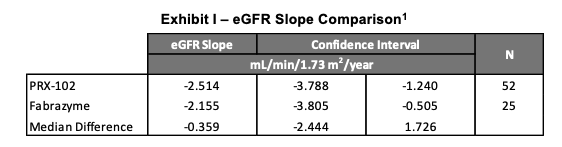
Results from the BALANCE trial will be submitted as part of the resubmission of a BLA to the FDA. Last autumn, as part of a Type A End–of–Review meeting, the FDA agreed that successful BALANCE results demonstrating non-inferiority to agalsidase beta have the potential to support the approval of PRX–102 for the treatment of Fabry disease. Results from the BALANCE trial will also be submitted to the EMA during the clock stop question period following day 120 of its review.
Safety Profile of BALANCE
Forty-seven patients (90.4%) in the PRX-102 arm experienced at least one adverse event vs. twenty-four (96.0%) using Fabrazyme. Per 100 years of exposure, this equates to 572 events for PRX-102 and 817 events for Fabrazyme. Treatment-related adverse events occurred in twenty-one (40.4%) patients taking PRX-102 vs. eleven (44%) administered Fabrazyme. Per 100 years exposure, this represents 42.8 events for PRX-102 and 153 events for Fabrazyme.
With respect to anti-drug antibodies (ADA), a lower proportion of PRX-102 subjects expressed ADA compared with the Fabrazyme group and of the subjects with ADA, fewer of the PRX-102 subjects generated the neutralizing antibodies vs. Fabrazyme at the end of the study.
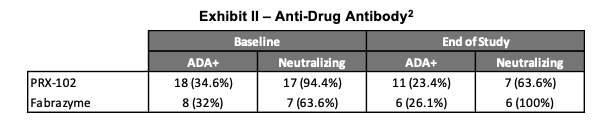
Use of infusion pre-medication to prevent infusion-related reactions can help reduce allergy symptoms. During the study, both groups reduced the proportion of the pre-medication during the course of the study with PRX-102 having only 6.4% of patients using it compared with Fabrazyme at 12.5%. PRX-102 also reported fewer infusion-related reactions compared with Fabrazyme.
Seventy-eight patients were randomized in the study, and six discontinued. Five were from the PRX-102 arm, but only one of the withdrawals was attributed to a treatment-related adverse event. No deaths occurred in the trial. Patients that completed the trial were given the opportunity to continue receiving PRX-102 bi-weekly in a long-term extension study. 69 of 77 patients elected to continue in the extension.
PRX-102 demonstrated non-inferior efficacy and favorable safety in the BALANCE trial, providing an improved median reduction in eGFR slope over the 24 months of the trial compared with Fabrazyme. Protalix’ product offers a new opportunity for Fabry patients that experience difficulties with other treatments. PRX-102 benefits compared with Fabrazyme include:
➢ Shorter infusion time
➢ Potential for 4-week interval of infusion vs. 2-week
➢ Improved immunogenicity
➢ Reduced severity of side effects
➢ Superior eGFR slope
MAA Submission
On February 24, 2022, Protalix and partner Chiesi Global Rare Disease announced the submission of a Marketing Authorization Application (MAA) to the European Medicines Agency (EMA) for PRX-102 in treatment of adults with Fabry disease. The application was validated, confirming that all essential elements required for scientific assessment were included in the application. The MAA included data from both PRX-102’s completed and ongoing trials: 12-month interim data from BALANCE, data from BRIDGE and BRIGHT, Phase I/II trial data in naïve/untreated patients, and from extension studies using bi-weekly 1 mg/kg dosing. If the MAA is approved, PRX-102 will be marketable in all member nations of the European Union. Final results from the BRIGHT and BALANCE study will be submitted to the EMA following the 120-day list of questions. Despite the uncertainties around Brexit, Chiesi and Protalix may also submit for approval to the UK using the EMA centralized procedure or they can apply directly to the UK’s Medicines and Healthcare Products Regulatory Agency (MHRA).
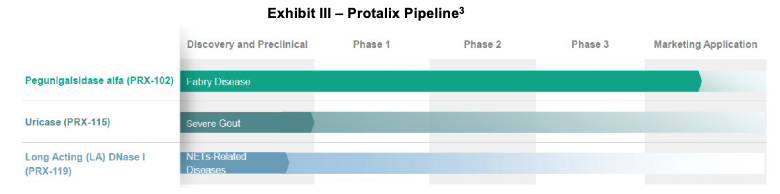
Milestones
➢ MAA submission of PRX-102 to the EMA – February 2022
➢ BRIGHT final results – March 2022
➢ BALANCE topline results – April 2022
➢ EMA 120-day clock stop – June 2022
➢ BALANCE final data – mid-2022
➢ BLA submission to the FDA – 2H:22
➢ PRX-115 to start Phase I – 1Q:23
➢ EMA approval for PRX-102 – 1H:23
➢ FDA approval for PRX-102 – 1H:23
SUBSCRIBE TO ZACKS SMALL CAP RESEARCH to receive our articles and reports emailed directly to you each morning. Please visit our website for additional information on Zacks SCR.
DISCLOSURE: Zacks SCR has received compensation from the issuer directly, from an investment manager, or from an investor relations consulting firm, engaged by the issuer, for providing research coverage for a period of no less than one year. Research articles, as seen here, are part of the service Zacks SCR provides and Zacks SCR receives quarterly payments totaling a maximum fee of up to $40,000 annually for these services provided to or regarding the issuer. Full Disclaimer HERE.
________________________
1. Source: Protalix data compiled by Zacks analyst
2. Source: Protalix data compiled by Zacks analyst
3. Source: Protalix 2Q:22 Form 10-Q