By John Vandermosten, CFA
NYSE:PLX
READ THE FULL PLX RESEARCH REPORT
Protalix Biotherapeutics, Inc. (NYSE:PLX) announced its 1Q:22 financial and operational results in a May 16, 2022 press release and filing of Form 10-Q. The materials were followed by a conference call that morning which discussed recent achievements, regulatory updates and summarized clinical trial results for the company. Key events year to date include topline data from the BALANCE clinical trial, final results from the BRIGHT clinical trial and the submission of a Marketing Authorisation Application (MAA) to the European Medicines Agency (EMA) for PRX-102.
In the financial sphere, Protalix generated revenues of $16.1 million in 1Q:22 compared to revenue of $11.3 million in the prior year period. This resulted in net loss of ($2.3) million versus ($5.5) million in 1Q:21.
Financial results for the quarter ending March 31, 2022, compared to the quarter ending March 31, 2021:
➢ Revenues were $16.1 million, up 42% from $11.3 million; sales from goods doubled to $9.0 million, as sales in Brazil rose to $5.5 million from zero due to timing differences. The total was offset by a 26% drop in Pfizer sales. Revenues from license and R&D services, which are related to Chiesi license and supply agreements, rose 4% to $7.1 million from $6.8 million;
➢ Cost of revenues was up 27% to $6.0 million as product gross margins improved markedly to 33% vs. a negative value due to leverage of fixed components;
➢ Research and development expenses rose to $8.8 million from $7.1 million, a 23% increase primarily due to subcontractors costs related to the completion of PRX-102 trial and maintenance of extension studies;
➢ Selling, general and administrative expenses were up 0.5% at $3.2 million vs $3.1 million;
➢ Financial expenses were $0.4 million vs $1.4 million, declining on lower interest and debt amortization costs;
➢ Net loss was ($2.3) million vs ($5.5) million, or ($0.05) per share versus ($0.14) per share;
Cash and equivalents balance including short-term bank deposits on March 31, 2022 totaled $32.9 million versus $40.0 million at the end of 2021. Cash burn was ($6.1) million. No financing cash flows were recognized.
Following the end of the quarter, about 750,000 shares were sold in return for proceeds of $886,000.
Topline Results from BALANCE
Protalix began the second quarter with good news from its BALANCE trial evaluating PRX-102 against Fabrazyme. In an April 4th press release, Protalix and partner Chiesi Global Rare Diseases announced topline data from the study. The BALANCE trial met its primary endpoint and the drug showed a favorable tolerability and immunogenicity profile. Data from the successful study will be included in the planned biologics license application (BLA) submission to the FDA expected in 2H:22.
The 24-month study evaluated renal function in Fabry patients with progressing kidney disease. It enrolled 78 patients and was designed to evaluate the safety and efficacy of 1 mg/kg of PRX–102 (pegunigalsidase alfa) administered every two weeks compared to Fabrazyme (agalsidase beta).
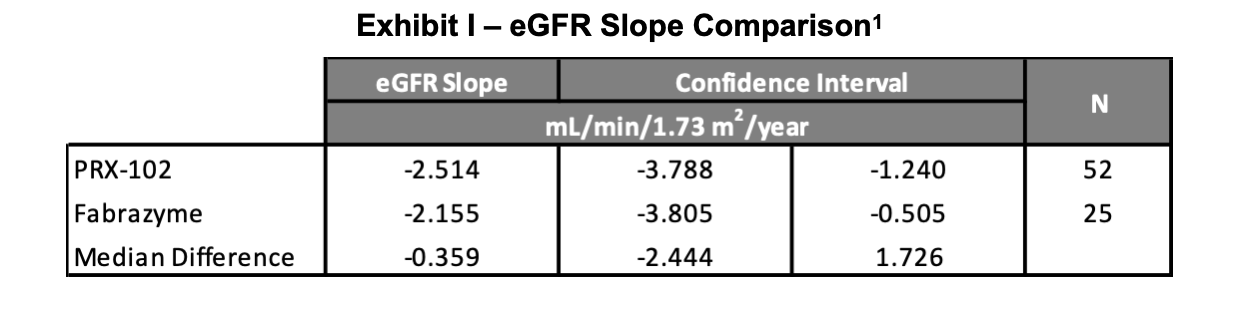
Topline results demonstrated non-inferiority of the primary endpoint of kidney function in a head–to–head active comparison on both the Intent–to–Treat (ITT) and Per Protocol (PP) analysis sets. The median estimated glomerular filtration rate (eGFR) slope for PRX-102 was -2.514 mL/min/1.73 m2/year compared to Fabrazyme at -2.155. The -0.359 difference presented an associated confidence interval of -2.444 and 1.726 and demonstrates non-inferiority of PRX-102 compared to Fabrazyme.
Results from the BALANCE trial will be submitted as part of the resubmission of a BLA to the FDA. Last autumn, as part of a Type A End–of–Review meeting, the FDA agreed that successful BALANCE results demonstrating non-inferiority to agalsidase beta have the potential to support the approval of PRX–102 for the treatment of Fabry disease. Results from the BALANCE trial will also be submitted to the EMA during the clock stop question period following day 120 of its review.
Safety Profile of BALANCE
Forty-seven patients (90.4%) in the PRX-102 arm experienced at least one adverse event vs. twenty-four (96.0%) using Fabrazyme. Per 100 years of exposure, this equates to 572 events for PRX-102 and 817 events for Fabrazyme. Treatment-related adverse events occurred in twenty-one (40.4%) patients taking PRX-102 vs. eleven (44%) administered Fabrazyme. Per 100 years exposure, this represents 42.8 events for PRX-102 and 153 events for Fabrazyme.
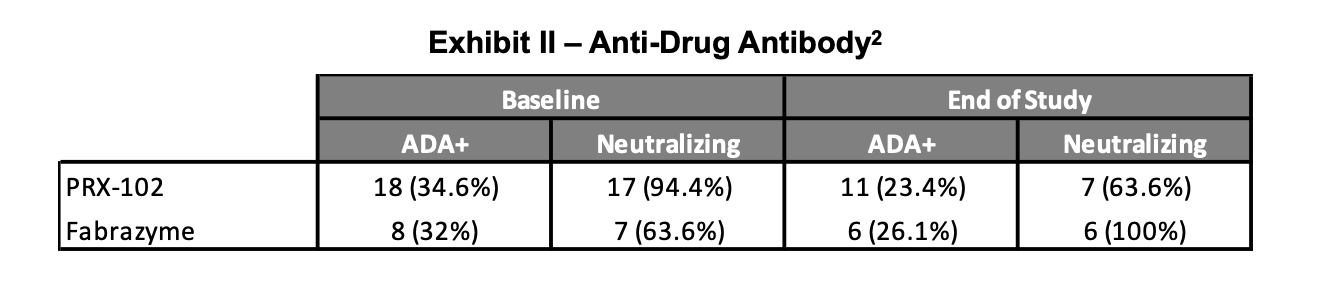
With respect to anti-drug antibodies (ADA), a lower proportion of PRX-102 subjects expressed ADA compared with the Fabrazyme group and of the subjects with ADA, fewer of the PRX-102 subjects generated the neutralizing antibodies vs. Fabrazyme at the end of the study.
Use of infusion pre-medication to prevent infusion-related reactions can help reduce allergy symptoms. During the study, both groups reduced the proportion of the pre-medication during the course of the study with PRX-102 having only 6.4% of patients using it compared with Fabrazyme at 12.5%. Even with a lower rate of the use of this medicine, the PRX-102 reported fewer infusion-related reactions compared with Fabrazyme.
Seventy-eight patients were randomized in the study, and six discontinued the study. Five of them were from the PRX-102 arm, but only one of the withdrawals was attributed to a treatment-related adverse event. No deaths occurred in the trial. Patients that completed the trial were given the opportunity to continue receiving PRX-102 bi-weekly in a long term extension study. 69 of 77 patients elected to continue in the extension.
PRX-102 demonstrated non-inferior efficacy and favorable safety in the BALANCE trial, providing an improved median reduction in eGFR slope over the 24 months of the trial compared with Fabrazyme. Protalix’ product offers a new opportunity for Fabry patients that experience difficulties with other treatments. PRX-102 benefits compared with Fabrazyme include:
➢ Shorter infusion time
➢ Potential for 4 week interval of infusion vs. 2 week
➢ Improved immunogenicity
➢ Reduced severity of side effects
➢ Superior eGFR slope
Phase III BRIGHT Final Results
Final results for the BRIGHT study were presented on March 18, 2022, which examined the safety and efficacy of switching Fabry PRX-102 patients to a 2 mg/kg every four week from a 1 mg/kg every two week regimen. The results indicated that intravenous (IV) 2 mg/kg PRX-102 administered once every four weeks was well tolerated and that disease remained stable as evidenced by eGFR and plasma lyso-Gb3 levels. Fabry patients typically receive bi-weekly dosing. PRX-102’s unique pegylation formulation was hypothesized to allow longer duration in the body. The clinical evidence from BRIGHT supports the option of dosing once every four weeks, a significant relief of patient burden. BRIGHT (NCT03180840) was a multicenter, multinational open-label, switch-over study designed to evaluate the safety, efficacy and pharmacokinetics of treatment with IV 2 mg/kg of PRX-102 administered every four weeks for 52 weeks. The study enrolled 30 adult patients (24 males and 6 females) who previously received an approved enzyme replacement therapy (ERT) for at least three years on a stable dose administered every two weeks, of which 28 were evaluable. Overall, 33 of 182 total treatment-emergent adverse events (TEAEs), reported in nine (30.0%) patients, were considered treatment related; all were mild or moderate in severity and the majority were resolved by the end of the study. There were no serious or severe treatment-related TEAEs and no TEAEs led to death or study withdrawal. Of the treatment-related TEAEs, 27 were infusion-related reactions (IRRs) and the remainder were single events of diarrhea, erythema, fatigue, influenza-like illness, increased urine protein/creatinine ratio, and urine positive for white blood cells. The 27 IRRs were reported in five (16.7%) patients, all male. All IRRs occurred during the infusion or within two hours post-infusion; no events were recorded between two- and 24-hours post-infusion. None of the patients without anti-drug antibodies (ADAs) at screening developed treatment-induced ADAs following the switch to PRX-102 treatment, indicating favorable lack of immunogenicity. Plasma lyso-Gb3 concentrations remained stable during the study with a mean change (±SE) of 3.01 nM (0.94) from baseline (19.36 nM ±3.35) to Week 52 (22.23 ±3.60 nM). Mean absolute eGFR values were stable during the 52week treatment period, with a mean change (SE) from baseline of 1.27 (1.39) mL/min/1.73 m2. Mean (SE) eGFR slope, at the end of the study, for the overall population, was 2.92 (1.05) mL/min/1.73m2/year indicating stability. Long-term data continues to be collected in the extension study (NCT03614234).
2022 Scientific Presentations
Several posters were presented related to pegunigalsidase alfa and Fabry disease by individuals associated with Protalix earlier this year. Below we summarize the details of the presentations:
➢ “Safety and Efficacy of Pegunigalsidase Alfa Administered Every 4 Weeks in Patients with Fabry Disease: Results from the Phase 3, Open-label, BRIGHT Study” was given by Mr. Myrl D. Holida, PA at the Annual WORLDSymposium February 7-11 in San Diego.
➢ “Long-Term-Safety and Efficacy of pegunigalsidase alfa: A Multicenter Extension Study in Adult Patients with Fabry Disease” was presented by Dr. Derralynn Hughes at the Annual WORLDSymposium February 7-11 in San Diego.
➢ “Long-term safety and efficacy of pegunigalsidase alfa: a multicenter extension study in adult patients with Fabry disease” was presented to the American College of Medical Genetics and Genomics (ACMG) Annual Clinical Genetics Meeting by John A Bernat, M.D., Ph.D. in late March in Nashville, Tennessee.
➢ Dr. Bernat also presented “Safety and Efficacy of Pegunigalsidase Alfa, Every 4 Weeks, in Fabry Disease: Results from the Phase 3, Open-label, BRIGHT Study” at ACMG in late March.
MAA Submission
On February 24, 2022, Protalix and partner Chiesi Global Rare Disease announced the submission of a Marketing Authorization Application (MAA) to the European Medicines Agency (EMA) for PRX-102 in treatment of adults with Fabry disease. The application was validated, confirming that all essential elements required for scientific assessment were included in the application. The MAA included data from both PRX-102’s completed and ongoing trials: 12-month interim data from BALANCE, data from BRIDGE and BRIGHT, Phase I/II trial data in naïve/untreated patients, and from extension studies using bi-weekly 1 mg/kg dosing. If the MAA approved, PRX-102 will be marketable in all member nations of the European Union. Final results from the BRIGHT and BALANCE study will be submitted to the EMA following the 120 day list of questions. Despite the uncertainties around Brexit, Chiesi and Protalix may also submit for approval to the UK using the EMA centralized procedure or they can apply directly to the UK’s Medicines and Healthcare Products Regulatory Agency (MHRA).
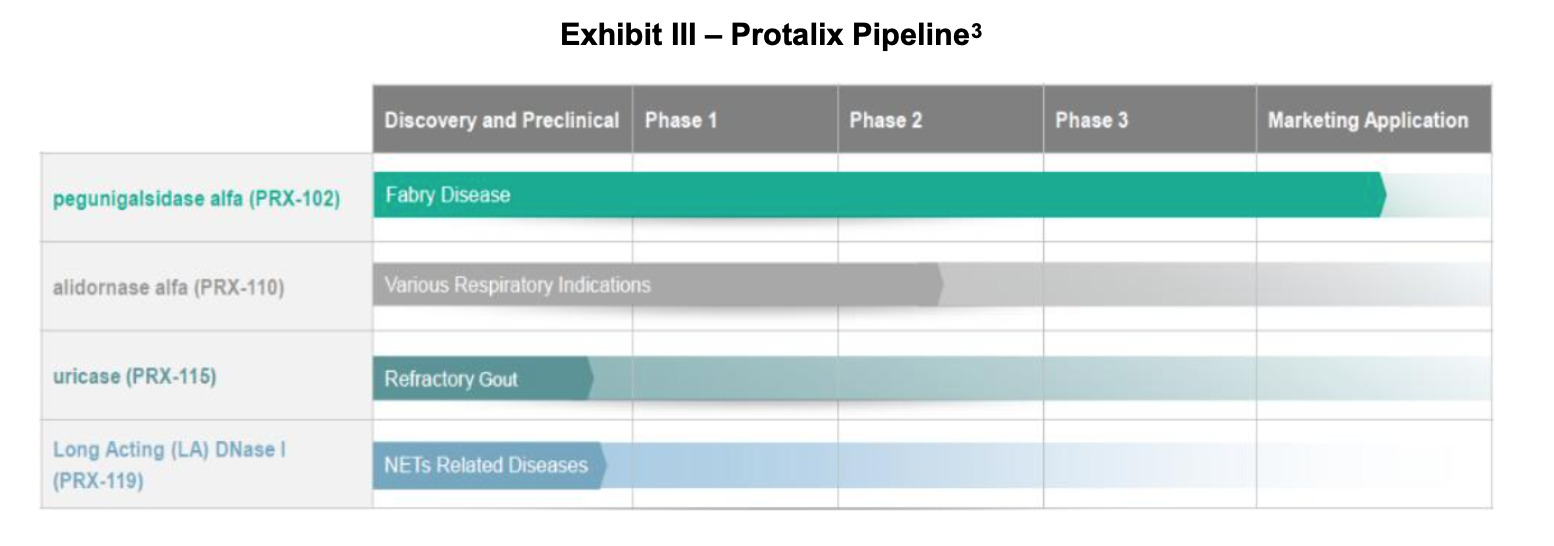
Milestones
➢ MAA submission of PRX-102 to the EMA – February 2022
➢ BRIGHT final results – March 2022
➢ BALANCE topline results – April 2022
➢ EMA 120 day clock stop – June 2022
➢ BALANCE final data – mid-2022
➢ BLA submission to the FDA – 2H:22
➢ EMA approval for PRX-102 – 1H:23
➢ FDA approval for PRX-102 – 1H:23
SUBSCRIBE TO ZACKS SMALL CAP RESEARCH to receive our articles and reports emailed directly to you each morning. Please visit our website for additional information on Zacks SCR.
DISCLOSURE: Zacks SCR has received compensation from the issuer directly, from an investment manager, or from an investor relations consulting firm, engaged by the issuer, for providing research coverage for a period of no less than one year. Research articles, as seen here, are part of the service Zacks SCR provides and Zacks SCR receives quarterly payments totaling a maximum fee of up to $40,000 annually for these services provided to or regarding the issuer. Full Disclaimer HERE.
________________________
1. Source: Protalix data compiled by Zacks analyst
2. Source: Protalix data compiled by Zacks analyst
3. Source: Protalix 1Q:22 Form 10-Q