By David Bautz, PhD
NASDAQ:SNGX
READ THE FULL SNGX RESEARCH REPORT
Business Update
HyBryte™ NDA Anticipated in 2022
Soligenix, Inc. (NASDAQ:SNGX) previously completed a Phase 3 clinical trial of HyBryte™ (SGX301, synthetic hypericin) in patients with cutaneous T cell lymphoma (CTCL). The FLASH (Fluorescent Light Activated Synthetic Hypericin) trial was a randomized, double blind, placebo controlled study that enrolled 169 patients with either Stage IA, IB, or IIA mycosis fungoides (the most common type of CTCL) (NCT02448381).
The trial consisted of three treatment cycles, with each cycle lasting eight weeks. Each study subject had three target lesions treated during the trial. In Cycle 1, patients were randomized 2:1 (n=116 for SGX301; n=50 for placebo) to receive twice weekly treatment of either 0.25% SGX301 or placebo (an ointment with the same light exposure as for SGX301) for six weeks, with treatment response determined at the end of the eighth week. In Cycle 2, all subjects received 0.25% SGX301 on their target lesions, and for those that decided to continue in the trial there was a third treatment cycle where 0.25% SGX301 was applied to all of the patient’s lesions.
The results for Cycle 1 showed a statistically significant treatment response in the Composite Assessment of Index Lesion Score (CAILS) primary endpoint assessed at 8 weeks with 16% of patients receiving SGX301 responding compared to only 4% receiving placebo responding (P=0.04).
In Cycle 2, a total of 155 patients received 0.25% SGX301 on their target lesions (110 receiving 12 weeks of SGX301 and 45 receiving six weeks of placebo treatment followed by six weeks of SGX301 treatment). The results of Cycle 2 showed that continued treatment out to 12 weeks resulted in increased efficacy as shown by a 40% responder rate (P<0.0001 compared to both placebo and six-week treatment data). Response rates further improved in Cycle 3 with 49% of patients electing to receive SGX301 for 18 weeks demonstrating a 50% or greater reduction in the combined CAILS. (P<0.0001 compared to the end of Cycle 1).
Importantly, after 12 weeks of treatment with HyBryte, there is a similar response on both patch (37% response; P=0.0009) and plaque (42% response; P<0.001) lesions when compared to Cycle 1 placebo lesion responses.
HyBryte is a safe and well tolerated CTCL treatment that shows positive effects in a relatively short period of time and has increasing efficacy with continued use. Since CTCL is a long-lasting condition, safety and tolerability are at the forefront of prescribing physicians concerns when treating patients, and many other CTCL therapies have a number of potential serious side effects, particularly with extended use. We believe the data that Soligenix has compiled for SGX301 in treating CTCL positions it as a promising front-line therapy for a large percentage of patients.
Soligenix is now in a position to submit an NDA to the U.S. FDA for HyBryte in the second half of 2022. HyBryte has received both Orphan Drug and Fast Track designations from the U.S. FDA as well as Orphan Drug designation from the European Medicines Agency (EMA).
The company is planning to commercialize HyBryte in the U.S. in lieu of seeking a commercialization partnership. Since the CTCL market is a specialized market, Soligenix can cost effectively market the drug with a launch cost of less than $10 million. This way, the company is able to keep 100% of the drug’s value. For overseas markets, we anticipate a commercial partnership and the company is currently in discussions with potential partners. Approval will be sought first in the U.S. followed by other key markets worldwide.
SGX302 for Psoriasis
Soligenix will be developing synthetic hypericin (the active ingredient in HyBryte) as part of a photodynamic therapy in mild-to-moderate psoriasis patients under the research name SGX302. Psoriasis is a common, chronic, noncontagious, multisystem inflammatory condition that most commonly presents on the skin of the elbows, knees, scalp, back, and thighs. There are multiple types of psoriasis, with plaque psoriasis, being the most common and affecting 80-90% of all individuals with psoriasis. Plaque psoriasis involves the hyperproliferation of epidermal keratinocytes that results in red or white, scaly, and typically itchy skin lesions. In addition, approximately 20% of psoriasis patients suffer from psoriatic arthritis, an inflammatory joint disease associated with psoriasis (Zacharlae, 2003). There is no known cure for the disease, thus depending upon the severity of the condition and how responsive it is to treatment, some patients are on therapy for life.
While psoriasis itself is not life-threatening, there are several conditions that are associated with the disease, including cardiovascular disease (Shlyankevich et al., 2014) and hypertension (Armstrong et al., 2013). In addition, patients with psoriasis have an increased risk for a number of non-skin cancers, including cancer of the lung, upper gastrointestinal tract, urinary tract, liver, and pancreas (Richard et al., 2013).
The severity of psoriasis is dependent on how much of a person’s body surface area (BSA) is affected by the condition. Mild psoriasis typically covers <3%, moderate covers between 3-10%, and severe covers more than 10% (National Psoriasis Foundation). However, the severity of the disease also takes into account how it affects a patient’s daily life, with even small psoriatic lesions on the palms or soles of the feet capable of having a severely negative impact on an individual’s quality of life.
Soligenix previously tested synthetic hypericin in a small Phase 1/2 trial involving 13 patients with psoriasis (Rook et al., 2010). Results showed that of the 11 evaluable patients, six responded to treatment with hypericin. There were no deaths or serious adverse events and the only reported adverse events were mild to moderate and included itching, burning, erythema, and pruritis at that application site.
The company is currently evaluating different topical formulations of synthetic hypericin while at the same time working with psoriasis experts to finalize a clinical trial protocol. We anticipate a Phase 2a study initiating in the second half of 2022. We estimate that the company has sufficient capital to conduct the trial without the need to raise additional capital.
Multiple Potential Opportunities for SGX942
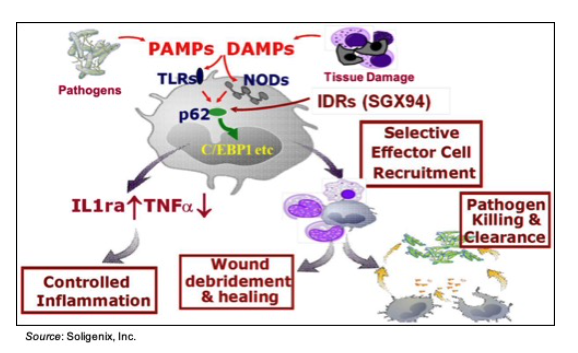
SGX942 belongs to a class of compounds known as innate defense regulators (IDRs). IDRs are synthetic versions of host defense peptides, a ubiquitous class of molecules that possess angiogenic, immunomodulatory, and anti-inflammatory properties (Steinstraesser et al., 2009). SGX942 is a five amino acid peptide that binds to the intracellular protein sequestosome-1 (p62), which acts as a signal transducer during activation and control of the innate immune system (see figure below). This novel mechanism of action leads to a number of observed activities for SGX942, including anti-inflammatory and anti-infective properties. The company has already completed a Phase 3 trial for SGX942 in oral mucositis (OM), and the company is considering advancing SGX942 in other areas as well.
Oral Mucositis
Soligenix previously evaluated SGX942 in the Phase 3 DOM-INNATE (Dusquetide treatment in Oral Mucositis – by modulating INNATE immunity) trial for the treatment of OM in patients with squamous cell carcinoma of the oral cavity and oropharynx undergoing chemoradiation therapy. A total of 268 patients were randomized 1:1 to receive either SGX942 or placebo. Despite a 56% decrease in the median duration of serious OM (SOM) from 18 days in the placebo cohort to 8 days in the SGX942 cohort, the primary endpoint did not achieve statistical significance, defined as a P value ≤0.05. When looking at the per-protocol cohort, which includes patients receiving a minimum of 55 Gy radiation and at least 10 doses of study drug throughout the intended treatment period, there was a statistically significant 50% decrease in the median duration of SOM from 18 days in the placebo cohort to 9 days in the SGX942 cohort (P=0.049)
Since announcing the results in December 2020, Soligenix has completed the analysis of the full dataset, including the 12-month long-term follow-up safety data. In addition, the company conducted a meeting with the Medicines and Healthcare products Regulatory Agency (MHRA) in the UK to gain further clarity on the future of the OM program. The outcome of the meeting was that the DOM-INNATE trial could serve as the first of two Phase 3 studies required to support potential marketing authorization, assuming the second Phase 3 trial achieves statistical significance for the primary outcome. Soligenix will look to identify a potential partner to continue the OM program.
Anti-Tumor Activity
The company also recently announced that new studies showed dusquetide was effective at reducing tumor size in preclinical xenograft models, results that recapitulated results from previously conducted studies. SGX942 was tested against the MCF-7 cell line, which is both ER+ and responsive to anti-HER2 therapy, and was effective as both a monotherapy (P<0.01 for tumor size) as well as in combination with radiation (P<0.05 vs. radiation only for survival), chemotherapy (paclitaxel) and anti-HER2 therapy (trastuzumab; P<0.001 vs. placebo only for tumor size). Soligenix is continuing to evaluate the best path forward for SGX942, which may include a collaborative partnership.
Gastrointestinal Injury
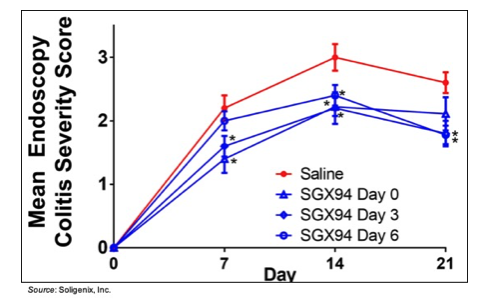
In a mouse model of irritable bowel disease (IBD), which is triggered through oral administration of dextran sulfate sodium (DSS) on Days 0 to 5, SGX942 effectively reduced the mean colitis severity score whether it was administered before, during, or after DSS treatment, as shown in the following figure.
Public Health Solutions Pipeline
Soligenix is focused on developing thermostable vaccines for a number of public health issues, including COVID19, filoviruses (Ebola and Marburg), and ricin poisoning.
• CiVax™ contains a pre-fusion stabilized from of the SARS-CoV-2 spike protein in combination with the adjuvant CoVaccine HT™. Previously announced results in non-human primates (NHPs) showed that immunization with CiVax resulted in the generation of neutralizing antibodies against the Alpha, Beta, Gamma, and Delta variants. In addition, when challenged with the Gamma variant five months post vaccination, the NHPs continued to demonstrate good immune protection with lower peak viral titers and faster resolution of viral shedding. The company recently announced that boosting with CiVax seven months after primary vaccination with a COVID-19 adenovirus vaccine resulted in a 27-fold increase in neutralizing antibodies against the original and Delta strains along with protective neutralizing antibody levels against the Omicron strain one week post-vaccination.
• The filovirus vaccine candidates are composed of surface glycoproteins from Zaire ebolavirus, Sudan ebolavirus, and Marburg Marburgvirus in combination with CoVaccine HT. A paper published in August 2021 described positive preclinical results for the vaccine candidates in NHPs (Lehrer et al., 2021). The company is now focusing its efforts on vaccine candidates for Sudan ebolavirus and Marburg Marburgvirus due to 1) vaccines being approved for Zaire ebolavirus (albeit with the necessity for refrigeration and/or freezing), and 2) the U.S. government’s funding prioritizations, which includes the desire to rapidly produce vaccines effective against any virus family.
• RiVax® is the company’s heat stable ricin toxin vaccine and is being developed under the FDA’s “Animal Rule”, which relies upon studies conducted in animals to gauge the effectiveness of a product candidate if testing of that product in humans would be unethical (as in the case of ricin exposure). Positive results have already been demonstrated in both mice and NHPs. Due to the fact that it is a “medical countermeasure”, approval of RiVax may result in the issuance of a Priority Review Voucher (PRV), which in recent years have sold for approximately $100 million each.
Financial Update
On March 29, 2022, Soligenix announced financial results for 2021. The company reported revenues of $0.8 million for 2022, compared to $2.4 million for 2020. The revenues include payments on grants received to support the development of: SGX943 for the treatment of emerging and/or antibiotic-resistant infections; ThermoVax®, the company’s thermostabilization platform; and CiVax™, the vaccine candidate for the prevention of COVID-19. R&D expenses were $8.4 million in 2021, compared to $9.8 million for 2020. The decrease was primarily due to the conclusion of the CTCL and oral mucositis Phase 3 studies. G&A expenses in 2021 were $4.8 million, compared to $4.3 million in 2020. The increase was primarily due to increased legal fees associated with the Emergent arbitration partially offset by a decrease in company headcount.
Soligenix exited 2021 with approximately $26.0 million in cash and cash equivalents. As of March 22, 2022, Soligenix had approximately 43.0 million shares outstanding, and when factoring in stock options, warrants, and the potential convertible debt the fully diluted share count is approximately 50.8 million.
Conclusion
Soligenix has a number of important milestones/events upcoming in 2022, including the NDA filing for HyBryte and the initiation of a psoriasis clinical trial for SGX302, both of which we anticipate in the second half of 2022. SGX942 is an underappreciated asset for the company given the many avenues that could be pursued for its development. The company’s public health solutions pipeline aligns nicely with the U.S. government’s new emphasis on vaccine preparedness for future pandemics, as the thermostabilized vaccine platform offers a number of advantages that could lead to expansion into additional development products. The current cash position, along with additional financial instruments available to the company, should provide funding into 2023. We have made no changes to our model, and our valuation remains at $6.00 per share.
SUBSCRIBE TO ZACKS SMALL CAP RESEARCH to receive our articles and reports emailed directly to you each morning. Please visit our website for additional information on Zacks SCR.
DISCLOSURE: Zacks SCR has received compensation from the issuer directly, from an investment manager, or from an investor relations consulting firm, engaged by the issuer, for providing research coverage for a period of no less than one year. Research articles, as seen here, are part of the service Zacks SCR provides and Zacks SCR receives quarterly payments totaling a maximum fee of up to $40,000 annually for these services provided to or regarding the issuer. Full Disclaimer HERE.