By John Vandermosten, CFA
NASDAQ:TENX
READ THE FULL TENX RESEARCH REPORT
Update on Tenax
Tenax Therapeutics, Inc. (NASDAQ:TENX) will delay the start of its Phase III clinical trials for levosimendan and imatinib for the treatment of pulmonary arterial hypertension (PAH) until 2023, pending funding. The share price has been under pressure for some time and there is insufficient capitalization to raise enough funds to support the company’s clinical program. Despite the low valuation carried by the company, the data supporting both candidates support further development for pulmonary hypertension. Tenax’s advertised market capitalization of $4 million1 and valuation accounting for prefunded warrants of around $6 million belies the probability adjusted potential value of the company’s two assets.
In response to the compressed market value of Tenax, management has engaged Roth Capital Partners to evaluate strategic alternatives for the company. This may include new investment, an acquisition or other type of combination activity. Tenax entered into the relationship in September but has not yet provided any updates on options offered by its advisor.
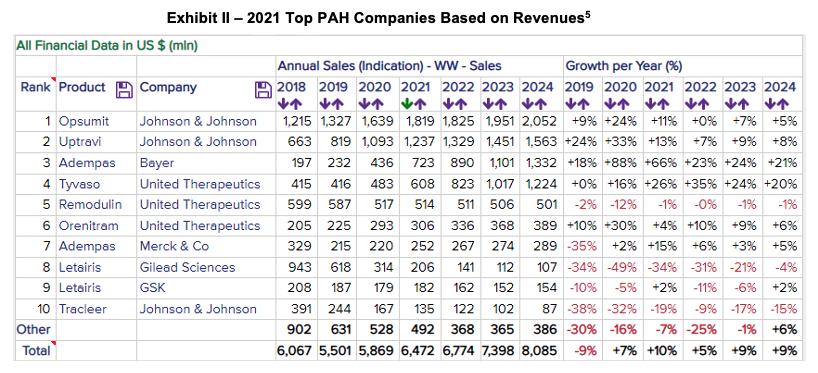
We have discussed Tenax’s assets in depth in previous reports and have provided a summary of supportive clinical data for advancing them to clinical trials. Both imatinib and levosimendan offer to address an unmet need in Group 1 and Group 2 pulmonary hypertension. Imatinib has demonstrated the ability to be disease modifying in Group1 PAH patients and Texax’s formulation of the drug may address the delivery hurdles that are necessary to be surmounted before the drug can be effective. 2021 sales for products serving this indication are $6.5 billion and expected to grow at mid to high single digits over the next several years.2 Levosimendan has shown the ability to reduce wedge pressure, increase patient physical performance and improve how patients feel for Group 2 PAH patients. If approved in the United States for Group 2 PAH, levosimendan could potentially treat 2 million patients that suffer from the condition. Assuming a modest 5% penetration at $1,000 per month could generate over $1 billion in sales. Given that there are no other treatments for Group 2 PAH, penetration and price could reasonably go higher.
One of the barriers to Tenax raising additional capital is the heavy burden of the outstanding claims on equity. As reported in the 2Q:22 10-Q, there are 25.2 million shares outstanding, 20.6 million prefunded warrants and 33.3 million warrants and options with exercise prices averaging under $1.00. While the addition of a substantial quantity of derivatives to the mix makes it complicated for a potential investor to make a clean investment in Tenax, our analysis has made some assumptions to determine the value it may require to simplify Tenax’s liabilities to prepare Tenax for new investment.
We run some scenario analyses to evaluate the total cost of an entity acquiring Tenax. If an acquiror’s bid price was set at $1.00 per share, the estimated cost to acquire the company would be approximately $52 million. At $2.00 per share, the price increases to $131 million and at $3.00, $210 million. See exhibit below for details on the valuation of various components. Beyond the acquisition price, Tenax will require additional funds to support the launch of the two Phase III trials for imatinib and levosimendan.
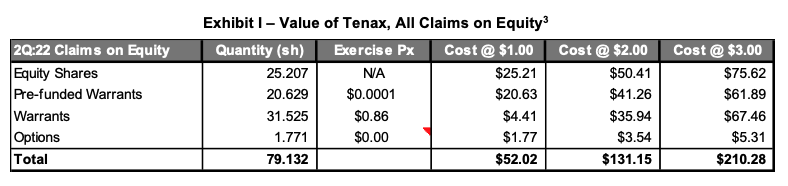
While the burden to negotiate a deal with Tenax may be difficult given all of the competing claims on equity, there is substantial value to be recognized for investors willing to work through the difficulties of the capital structure. From this concise analysis, we outline scenarios where two Phase III ready assets could be acquired for $1.00, $2.00 or $3.00 per share, which equates to enterprise values below our target of approximately $325 million.
Tenax Valuation and Potential Acquirors
Based on the data released so far, there is a compelling argument for value for Tenax’s assets which we conservatively calculate to be approximately $325 million after applying an onerous 40% probability of success to our NPV value of the levosimendan and imatinib programs.4 There are many large pharmaceutical and biotechnology companies with pulmonary hypertension assets in their portfolios which could benefit from a new product that addresses a substantial unmet need. One of the primary companies that stands out in our research is United Therapeutics (NASDAQ:UTHR) which has many products currently generating sales in the PAH space and has several others in development. Other potential suitors such as Johnson & Johnson (NYSE:JNJ), Bayer (OTC:BAYRY) and Merck (NYSE:MRK) also have dominant products in the Group 1 PAH space which could augmented by additional products in both Group 1 and Group 2. Below we have summarized the top 10 companies based on 2021 revenue that offer a product in the PAH space and may comprise the opportunity set.
Update on HELP Open Label Extension
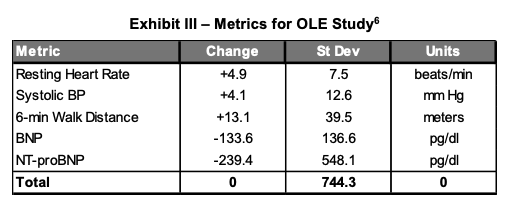
On October 10th, Tenax provided an update on the patients who had enrolled in the open label extension (OLE) of the HELP (Hemodynamic Evaluation of Levosimendan in PH-HFpEF) trial. A presentation was given that summarized the data from the patients who switched from the intravenous (IV) form of levosimendan to the oral form entitled “The Transition from Chronic Intravenous to Oral Levosimendan Is Safe and Effective in Patients with Pulmonary Hypertension with Heart Failure and Preserved Ejection Fraction.”
The substudy included 18 patients who transitioned from IV to oral levosimendan who showed improvement across a number of metrics summarized below. The six-minute walk test increased compared to baseline by over 13 meters, while measures of heart failure declined (improved) over the measurement period. Improvement in the measures led to an increase in the Kansas City Cardiomyopathy Questionnaire scores (KCCQ-TS, KCCQ-CS and KCCQ-OS) (n=16) improved by 4.7, 2.5 points and 3.7 points, respectively.
SUBSCRIBE TO ZACKS SMALL CAP RESEARCH to receive our articles and reports emailed directly to you each morning. Please visit our website for additional information on Zacks SCR.
DISCLOSURE: Zacks SCR has received compensation from the issuer directly, from an investment manager, or from an investor relations consulting firm, engaged by the issuer, for providing research coverage for a period of no less than one year. Research articles, as seen here, are part of the service Zacks SCR provides and Zacks SCR receives quarterly payments totaling a maximum fee of up to $40,000 annually for these services provided to or regarding the issuer. Full Disclaimer HERE.
________________________
1. Adding the prefunded warrants increases the market capitalization to the total listed on our page 1.
2. Source: Evaluate Pharma, Ltd. Pulmonary hypertension indication overview. Accessed November 2022.
3. Compiled by Zacks analyst using company filings. Note that Tenax does not disclose exercise price for all options issued by the company. We therefore assume that the options have an exercise price of $0.00. Given that the options comprise only 2% of potential shares, the impact of this conservative assumption is minimal.
4. Note that the average probability of success (PoS) for a Phase III asset is around 50%. See Evaluate Pharma’s Evaluate Omnium: Development Risk | Success Rates (PTRS) which calculates a 51% PoS similar to numerous other resources.
5. Source: Evaluate, Ltd. Accessed November 2022.
6. Compiled by Zacks analyst from company press release.