By David Bautz, PhD
NASDAQ:ABEO
READ THE FULL ABEO RESEARCH REPORT
Business Update
Additional Data from VIITAL™ Trial Presented at ISID
On May 24, 2023, Abeona Therapeutics Inc. (NASDAQ:ABEO) held a conference call to discuss additional data from the Phase 3 VIITAL study evaluating EB-101 for recessive dystrophic epidermolysis bullosa (RDEB). The data was recently presented at the inaugural International Societies for Investigative Dermatology (ISID) meeting. The company had previously reported positive topline results from the trial that showed the trial met the co-primary endpoints:
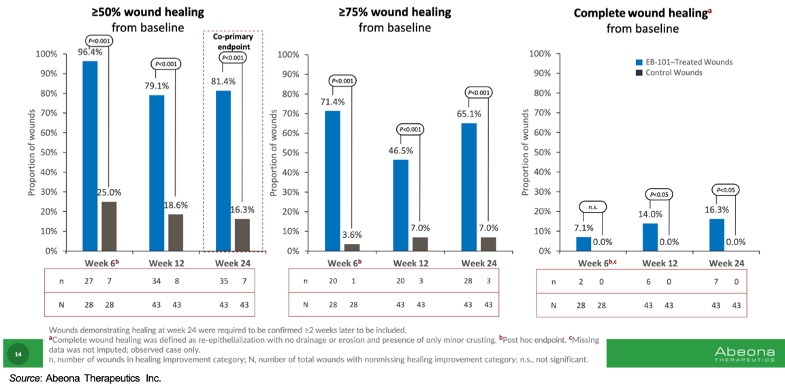
1. Eighty-one percent of the wounds treated with EB-101 showed ≥ 50% healing at the six-month timepoint compared to only 16% of control wounds (P<0.0001).
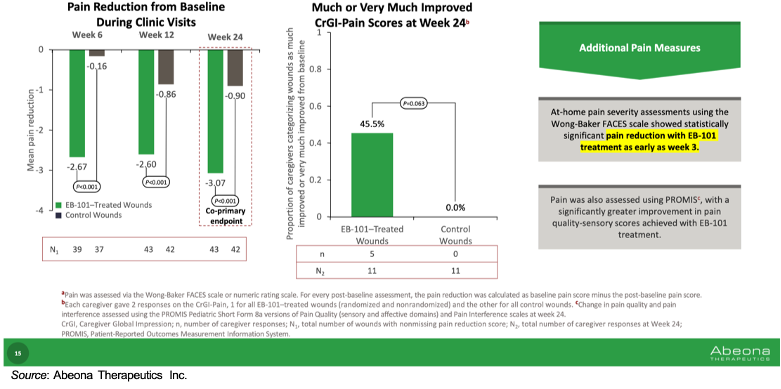
2. The mean pain reduction for wounds treated with EB-101 was 3.07 points on the Wong-Baker FACES scale, compared to just 0.90 points for control wounds (P=0.0002).
The new data presented at ISID showed that EB-101 improved would healing in as early as six weeks and across all time points. The following graphs show that at Week 6 there was a statistically significant difference in the percentage of wounds that showed ≥50% or ≥75% healing. These statistically significant differences were maintained at both Week 12 and Week 24. In addition, while no placebo-treated wounds showed complete wound healing, 7.1%, 14.0%, and 16.3% of EB-101-treated wounds showed complete wound healing at Weeks 6, 12, and 24, respectively.
In addition to a statistically significant improvement in wound healing, there was also a significant reduction in pain for EB-101-treated wounds compared to control wounds. The following graphic shows that as early as Week 6 there was a statistically significant difference in pain as assessed by the Wong-Baker FACES scale or numeric rating scale. While not statistically significant, 45.5% of EB-101-treated wounds were categorized as improved or very much improved by caregivers compared to 0.0% of control wounds.
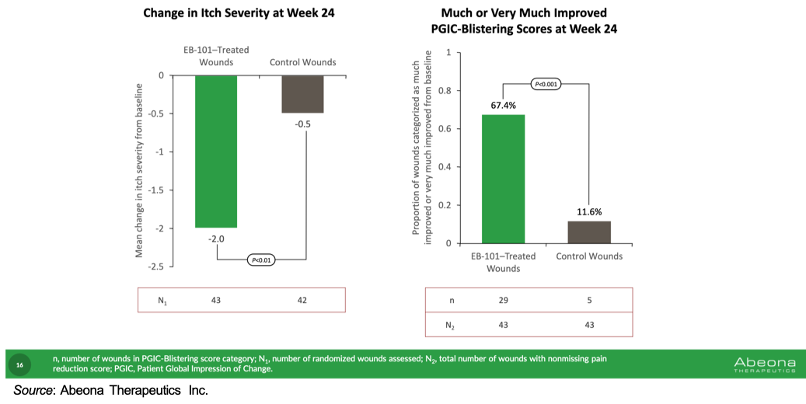
Lastly, the following graphs show additional outcomes demonstrating quality of life improvements. The graph on the left shows a statistically significant change in itch severity from baseline for EB-101-treated wounds compared to control wounds. The graph on the right shows a statistically significant difference in the proportion of wounds that were judged to be much or very much improved in regards to blistering when comparing EB-101-treated wounds to control wounds.
In regards to safety, EB-101 was safe and well tolerated and there were no reports of patient-level or wound-specific serious EB-101-related treatment emergent adverse events (TEAEs) and only a small number of nonserious EB-101-related TEAEs that were consistent with previous clinical trials.
Based on the totality of the data, the company is planning to submit a Biologics License Application (BLA). A pre-BLA meeting with the FDA is scheduled for July 10, 2023 and we anticipate the company filing the BLA early in the third quarter of 2023. Abeona’s commercial planning remains on track and thus far the company has received encouraging initial feedback from members of the healthcare system. Given the value proposition of EB-101, we believe premium pricing will be supported in-line with other one-time treatments that can offer years of wound healing and pain reduction.
Proof-of-Concept Animal Data for Ophthalmology Program Presented at ASCGT
On May 16, 2023, Abeona announced new preclinical animal data for three internally developed preclinical gene therapy product candidates from its adeno-associated virus (AAV) ophthalmology program was presented at the 26th Annual Meeting of the American Society of Gene & Cell Therapy (ASCGT).
In Vivo Production of Full-Length ABCA4 Protein Following Cre-Mediated Recombination from Dual AAV Vectors in AGCA4-/- Mice
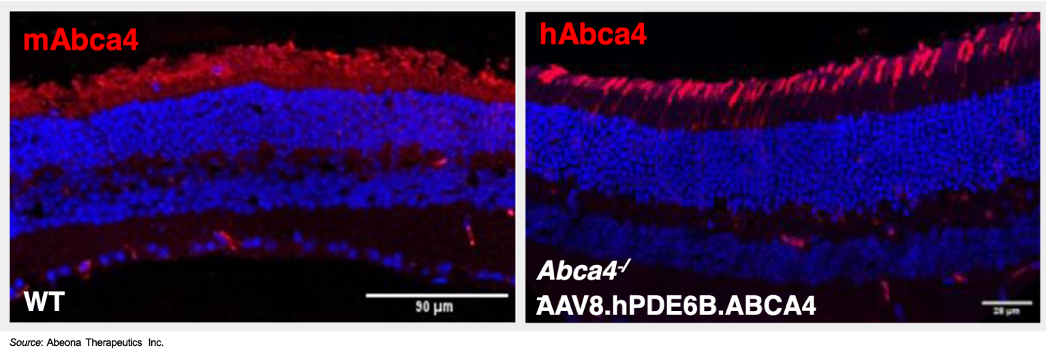
Stargardt disease is caused by a mutation in the ABCA4 gene and causes loss of central vision and sensitivity to light. The company is utilizing a dual vector strategy using Cre recombinase to reconstitute the ABCA4 gene. The results showed that full-length hABCA4 protein is expressed in vitro via viral transduction of HEK293 cells and in vivo in photoreceptor cells after subretinal injection into ABCA4-/- mouse eyes. Cre-mediated recombination of ABCA4 was confirmed by mRNA sequencing from transfected HEK293 cells and AAV-dosed animals. Lastly, immunohistochemistry confirmed the correct localization of recombinant hABCA4 protein in photoreceptor cells, as shown in the following figures.
ABO-503, a Novel Gene Therapy for Treatment of X-Linked Retinoschisis
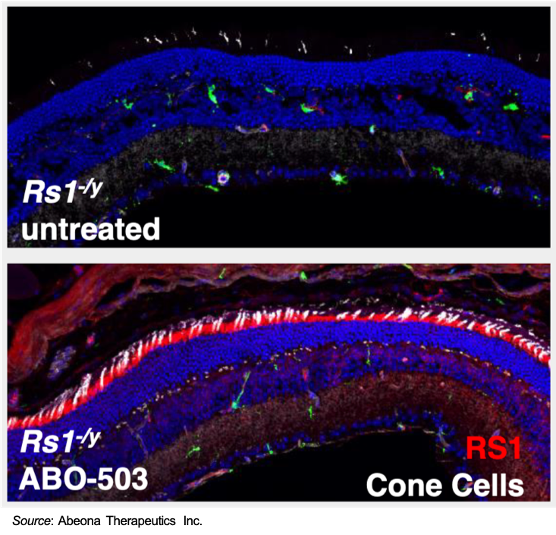
X-Linked Retinoschisis (XLRS) is caused by a mutation in the RS1 gene on the X chromosome. In this study, RS1 protein expression was observed in photoreceptor cells near the injection site and in adjacent inner retina in RS1 mutant mice six months after treatment with ABO-503. The following figure shows that RS1 expression was associated with improvement in cone photoreceptor density and increased thickness of photoreceptor outer nuclear layer.
AAV Gene Therapy for Autosomal Dominant Optic Atrophy Caused by Mutation in the Opa1 Gene
Autosomal Dominant Optic Atrophy (ADOA) is a rare genetic eye disease that results in progressive and irreversible vision loss in both eyes starting during childhood. It is commonly caused by mutations in the Opa1 gene. In this study, vectors expressing Opa1 showed robust expression of RNA and protein both in vitro and in vivo, with variants 1 and 7 showing robust protein expression following intravitreal injection in wild type mice. Lastly, visual acuity assessments demonstrate function recovery in treated Opa1-mutant mice.
VYJUVEK™ Approved for RDEB
On May 19, 2023, Krystal Biotech, Inc. (NASDAQ:KRYS) announced the approval of VYJUVEK (beremagene geperpavec-svdt) for the treatment of dystrophic epidermolysis bullosa with mutation(s) in the collagen type VII alpha 1 chain (COL7A1). VYJUVEK is a herpes-simplex virus type 1 (HSV-1) vector-based gene therapy that is topically applied to wounds. While we have never viewed the treatment of RDEB as a zero-sum game, but instead believe that RDEB patients will likely be treated with multiple therapies at once, we believe investors should be aware of the following as it relates to VYJUVEK:
1) According to the prescribing information, VYJUVEK is to be applied weekly by a healthcare professional. At the present time this will necessitate a trip to a physician’s office or clinic each week, which may limit the perceived convenience of the therapy.
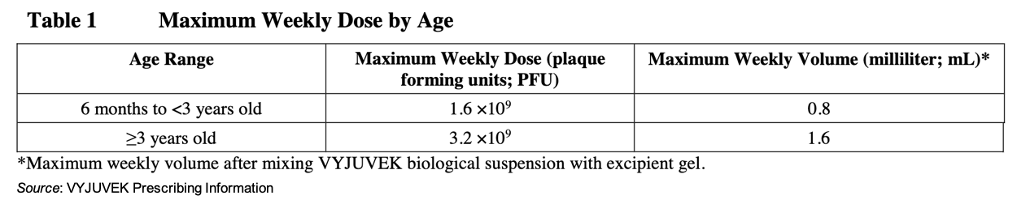
2) The amount of drug that can be administered weekly is capped according to the following table (VYJUVEK Prescribing Information)
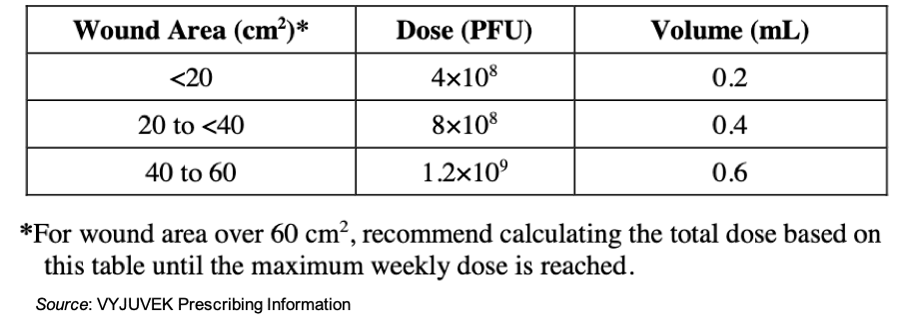
3) The dose of VYJUVEK to be applied to a wound is based on its area according to the following chart, thus for a patient with multiple wounds that need treatment, VYJUVEK is likely not going to be sufficient to treat all of them when considering the maximum allowable weekly dose.
4) The prescribing information states to “Apply VYJUVEK gel to wounds until they are closed before selecting new wound(s) to treat. Prioritize weekly treatment to previously treated wounds if they re-open”. What this means is that if a previously treated wound re-opens then that wound will need to be treated again (thus using up some of the maximum weekly dosing), which could slow down treatment of other wounds. We will be curious to see how patients react to this and if it affects their opinion of the product.
Krystal announced the WAC for VYJUVEK is $24,250 per vial, which equates to an annual cost of $631,000 or $485,000 after mandatory government discounts. Given the fact that EB-101 could offer many years of wound closure/pain reduction, we view the price for VYJUVEK as a floor for EB-101 pricing and are confident in our estimated price of $700,000 per treatment in our model.
Financial Update
On May 14, 2023, Abeona announced financial results for the first quarter of 2023. The company did not report any revenue in the first quarter of 2023 compared to $0.3 million in the first quarter of 2022. The revenue in 2022 consisted of the recognition of deferred revenue related to the grants for the ABO-102 and ABO-101 development programs. R&D expenses in the first quarter of 2023 were $8.0 million compared to $10.5 million for the first quarter of 2022. The decrease was primarily due to decreased clinical and development work for the cell and gene therapy product candidates, the discontinuation of the ABO-102 and ABO-101 programs, and decreased salary and related costs. G&A costs in the first quarter of 2023 were $4.0 million compared to $4.2 million for the first quarter of 2022. The decrease was primarily due to decreased professional fees, salaries, non-cash stock-based compensation, and other costs.
Abeona exited the first quarter of 2023 with approximately $40.7 million. We estimate the company has sufficient capital to fund operations into the third quarter of 2024. As of May 4, 2023, the company had approximately 18.8 million shares outstanding and, when factoring in stock options and warrants, a fully diluted share count of approximately 27.5 million.
Conclusion
The new data presented from the VIITAL study reinforces our belief that EB-101 will be approved for treating RDEB patients and that the value-added proposition for the therapy in terms of wound healing and pain reduction means that there should be little to no pushback on a premium pricing strategy. We look forward to the company submitting the BLA for EB-101 early in the third quarter of 2023 and we remind investors that approval of EB-101 could be accompanied by issuance of a PRV, which is likely to sell in the $100 million range based on sales of PRVs for the past few years. We have made no changes to our model and our valuation remains at $10 per share.
SUBSCRIBE TO ZACKS SMALL CAP RESEARCH to receive our articles and reports emailed directly to you each morning. Please visit our website for additional information on Zacks SCR.
DISCLOSURE: Zacks SCR has received compensation from the issuer directly, from an investment manager, or from an investor relations consulting firm, engaged by the issuer, for providing research coverage for a period of no less than one year. Research articles, as seen here, are part of the service Zacks SCR provides and Zacks SCR receives quarterly payments totaling a maximum fee of up to $40,000 annually for these services provided to or regarding the issuer. Full Disclaimer HERE.