By David Bautz, PhD
NASDAQ:ARWR
READ THE FULL ARWR RESEARCH REPORT
On January 9, 2023, Arrowhead Pharmaceuticals, Inc. (NASDAQ:ARWR) announced topline results for the Phase 2 SEQUOIA trial of fazirsiran (TAK-999/ARO-AAT) for the treatment of alpha-1 antitrypsin deficiency (AATD) liver disease. A copy of the slides discussing the results can be found here. The SEQUOIA trial is a placebo controlled, multi-dose study in which patients were enrolled into dose cohorts of 25 mg (n=9), 100 mg (n=8), 200 mg (n=9), or matching placebo (n=14). All participants received a pre-dose biopsy and those with baseline fibrosis (n=25) also received a post-baseline biopsy at week 48.
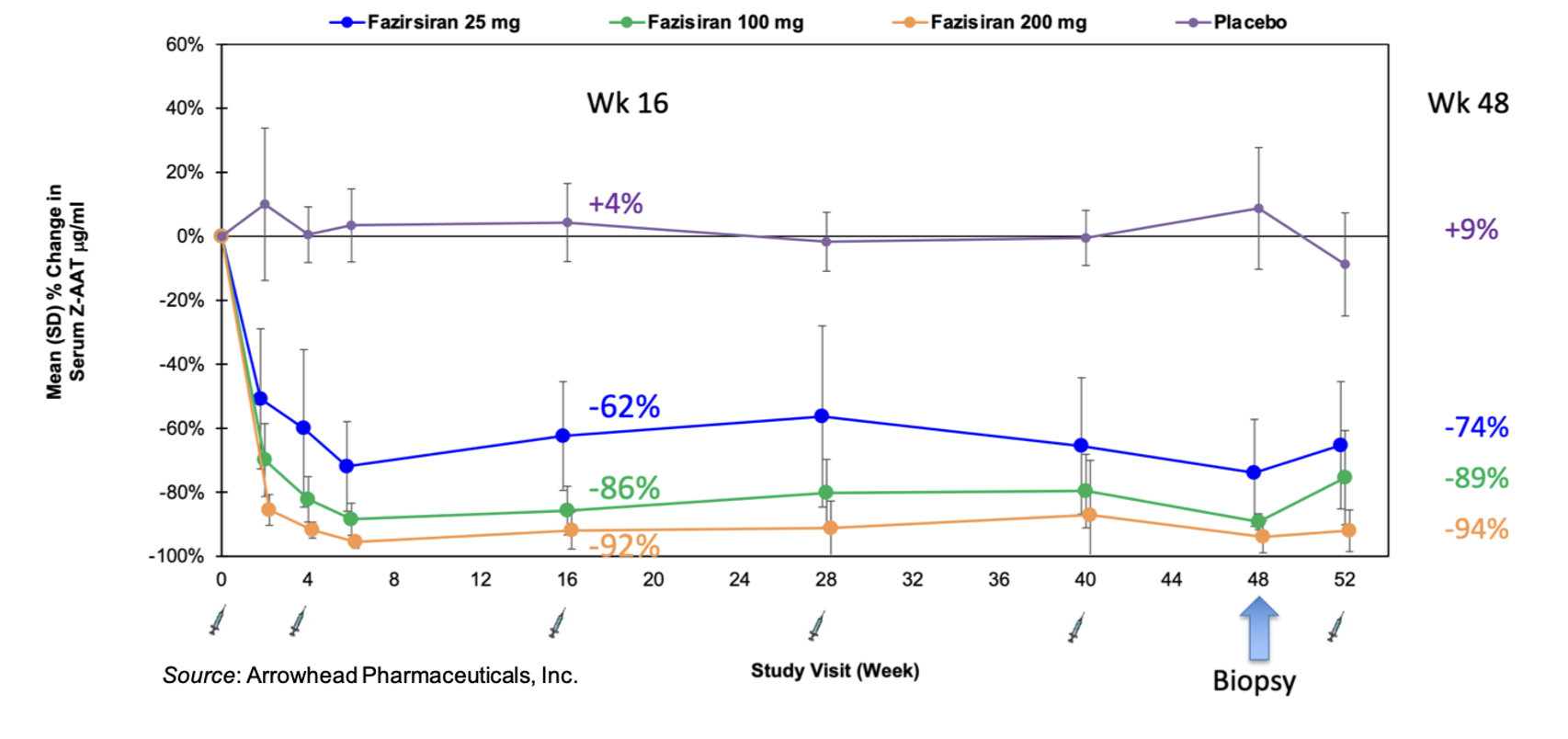
The following figure shows the reduction in serum mutant alpha-1 antitrypsin protein (Z-AAT), which occurred in a dose dependent manner of 74%, 89%, and 94% for patients treated with 25 mg, 100 mg, or 200 mg fazirsiran, respectively.
This decrease in Z-AAT level was accompanied by a mean reduction of 94% in total liver Z-AAT for those treated with fazirsiran, compared with a 26% increase for those treated with placebo. In addition, there was a ≥1-point improvement in portal inflammation in 42% of fazirsiran-treated patients compared to 0% of placebo treated patients (44% of those in the placebo cohort saw a ≥1-point worsening). Lastly, there was a ≥1-point improvement in fibrosis by METAVIR stage in 50% of fazirsiran-treated patients compared to 38% for placebo-treated patients. These results are summarized in the following tables.
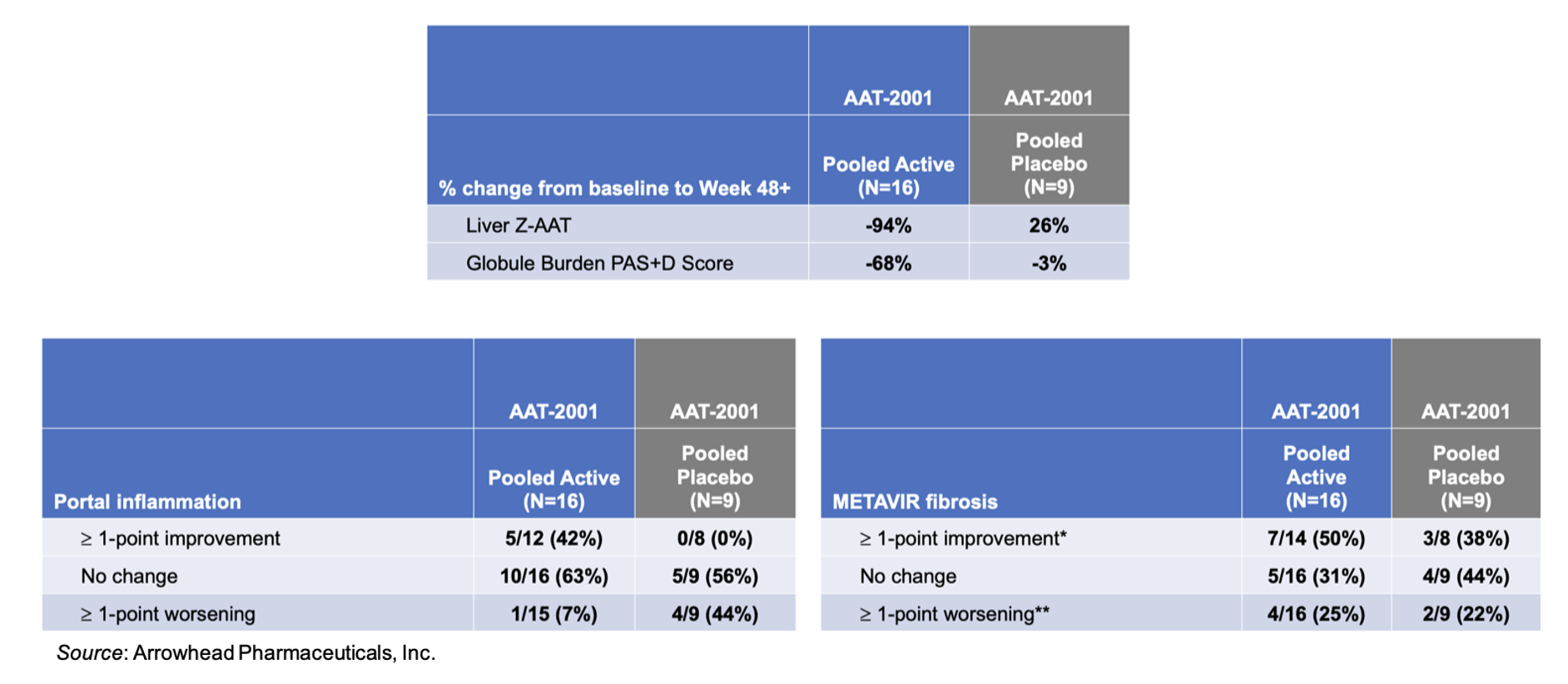
The fact that 38% of placebo-treated patients showed improvement in fibrosis is a bit perplexing and we also believe is one factor that caused the stock to sell off following release of the data. However, we believe it’s important for investors to consider the following regarding the data set:
1) Histologic fibrosis assessment is known to have a high degree of variability. Thus, the small sample size for the placebo group could have been impacted by this. The Phase 3 trial (discussed below) will have a larger sample size and should more closely match results from natural history studies of patients with AATD liver disease.
2) On the conference call to discuss the results, Dr. Virginia Clark discussed a natural history study that her research group had performed in which they had 3-year biopsy data for patients (n=52) with AATD liver fibrosis. Those results showed that 15.4% showed improvement, 46.2% were stable, and 38.5% showed progression. Thus, given a larger data set we would expect approximately 15-20% of placebo-treated AATD patients to show fibrosis improvement, compared to the 38% that was seen in the SEQUOIA trial.
3) The findings between studies AAT-2001 and AAT-2002 are remarkably consistent, particularly in the ability of fazirsiran to lower Z-AAT levels in the liver. This increases our confidence that similar results will be seen in the Phase 3 trial. This is important because Z-AAT accumulation in the liver is known to lead to liver injury.
4) The ability of fazirsiran to improve portal inflammation is a very important finding. Dr. Clark commented that in her natural progression study, patients who had portal inflammation had a much higher risk for fibrosis progression. Thus, any decrease in portal inflammation will likely lead to improved fibrosis findings over a longer period of time.
Importantly, there were no safety concerns as the treatment-emergent adverse events (TEAEs) were evenly split between treated and placebo cohorts with none related to drug discontinuation, dose interruptions, or early study withdrawals.
Takeda (Arrowhead’s partner for fazirsiran) will soon be initiating a randomized, double blind, placebo controlled Phase 3 trial in 160 patients with AATD liver disease with F2, F3, and F4 METAVIR fibrosis at baseline. The primary endpoint will be the decrease from baseline of at least 1 stage of histologic fibrosis (METAVIR staging) in the centrally read liver biopsy (for those with F2/F3 fibrosis) at Week 106. Fazirsiran will be dosed on Day 1, Week 4, Week 16, and then every 12 weeks thereafter until the end of treatment at Week 196 with liver biopsy’s taken at Weeks 106 and 202. There will be an interim analysis (safety assessment) at Week 52 to allow for possible pulmonary inclusion/safety monitoring adjustment.
Conclusion
The topline data for the SEQUOIA trial were encouraging and we have a lot of confidence in fazirsiran heading into the impending Phase 3 trial. We understand investors may be a bit concerned by the limited separation between treated and placebo patients in regards to fibrosis improvement, however as discussed above we believe this can be explained by the variability in histological assessment and the small size of the placebo cohort. The unexpectedly high placebo response should not overshadow the fact that 50% of patients saw fibrosis improvement in the fazirsiran cohort, which was replicated in both the AAT-2001 and AAT-2002 trials. Our enthusiasm for the company remains high, however with a long Phase 3 trial planned for fazirsiran we have pushed back our expected approval of the drug to 2028 and our valuation has decreased slightly to $85.
SUBSCRIBE TO ZACKS SMALL CAP RESEARCH to receive our articles and reports emailed directly to you each morning. Please visit our website for additional information on Zacks SCR.
DISCLOSURE: Zacks SCR has received compensation from the issuer directly, from an investment manager, or from an investor relations consulting firm, engaged by the issuer, for providing research coverage for a period of no less than one year. Research articles, as seen here, are part of the service Zacks SCR provides and Zacks SCR receives quarterly payments totaling a maximum fee of up to $40,000 annually for these services provided to or regarding the issuer. Full Disclaimer HERE.