By David Bautz, PhD
NASDAQ:BCLI
READ THE FULL BCLI RESEARCH REPORT
Business Update
AdCom Granted for NurOwn®
On March 27, 2023, BrainStorm Cell Therapeutics, Inc. (NASDAQ:BCLI) announced that the U.S. Food and Drug Administration (FDA) has granted an Advisory Committee (AdCom) meeting to discuss the company’s Biologics License Application (BLA) for NurOwn® for the treatment of amyotrophic lateral sclerosis (ALS). A date for the Adcom has not been announced yet.
This news follows the company’s Type A meeting with the FDA in early January 2023 to discuss the refusal to file letter (RTF) that the company received in November 2022. The RTF letter made the BLA inactive and the FDA offered multiple options for BrainStorm to pursue to re-activate the BLA. One of those was to follow the File Over Protest procedure with the FDA, which the company did. Alternatively, the FDA would have allowed for the company to withdraw the BLA and then re-file, however that process likely would have taken 4-6 months. BrainStorm has always been interested in finding the fastest route to approval as the ALS community has a real sense of urgency for getting access to new therapies. Thus, BrainStorm requested that the Center for Biologics Evaluate and Research (CBER) utilize the FDA’s File Over Protest procedure and the company has filed an amendment to the BLA that responds to most of the outstanding questions the FDA had posed. Another advantage of filing the formal protest is that the countdown to the PDUFA date begins from when BrainStorm first submitted the BLA. We anticipate an announcement for the PDUFA date to be made soon as well.
The news announced today is exactly the outcome the company has been working toward, and it is now up to BrainStorm to win the support of the Advisory Committee, which we are confident will occur. We believe the political environment is quite favorable regarding access to new therapies for patients with terminal illnesses such as ALS, particularly for therapies that have a strong safety and tolerability record. Thus, given the totality of the data that BrainStorm has accumulated for NurOwn, we are confident in a positive outcome for the AdCom and eventual approval of the drug.
Presentation at MDA Meeting Highlights Floor Effect in ALS Studies
In March 2023, Brainstorm’s Co-CEO Dr. Stacy Lindborg presented post hoc sensitivity analyses from NurOwn’s Phase 3 ALS trial. A copy of the presentation can be found here. The presentation also included an analysis of data from the PRO-ACT database, which includes data from 29 Phase 2 or Phase 3 clinical trials in ALS (source). The data presented showed that a floor effect was observed in the PRO-ACT database as well as in NurOwn’s Phase 3 trial. The floor effect occurs when the scale of measurement is not able to capture progression at the bottom of the scale. The ALSFRS-R score is composed of 12 items each scored on a scale from 0 to 4. When one of those items is scored at 0 any further progression can’t be measured.
A quantitative method was utilized to identify a functional decline point in the ALSFRS-R score that reflected a floor effect (“hinge point”), thus showing a plateau in the clinical data. An example of this is given in the following figures. The example on the left shows a plateau in decline of the ALSFRS-R score for a patient from the PRO-ACT database where all six Fine and Gross Motor items reached 0 during the trial. The following figure on the right shows a patient from NurOwn’s Phase 3 ALS trial in which 5 of 6 Fine and Gross Motor items and 2 of 3 Respiratory items reached 0 during the trial.
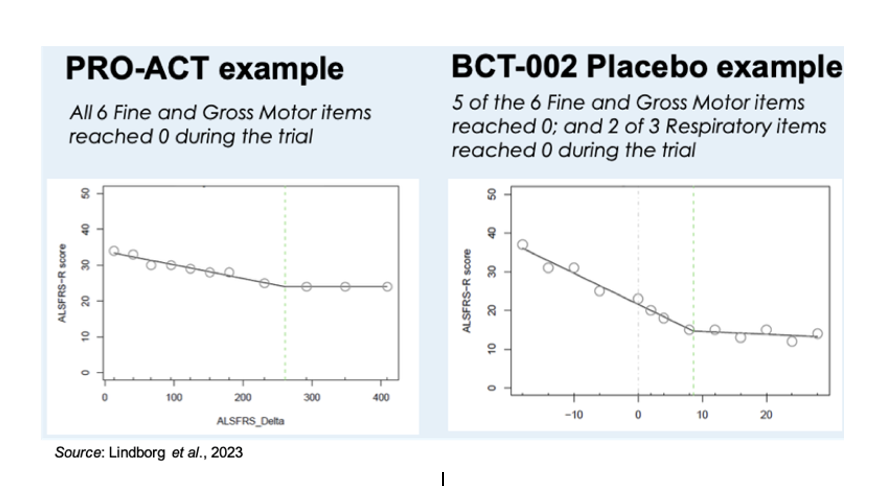
Results showed that 185/3930 (4.7%) of PRO-ACT participants showed a floor effect pattern with an average “hinge point” occurring at an ALSFRS-R score of 25 ± 11 while 21/94 (22.3%) of NurOwn Phase 3 trial placebo participants showed a floor effect pattern with an average hinge point of 27 ± 9. A visual inspection of each participant identified as having a hinge point suggested that data after the hinge point reflected a plateau.
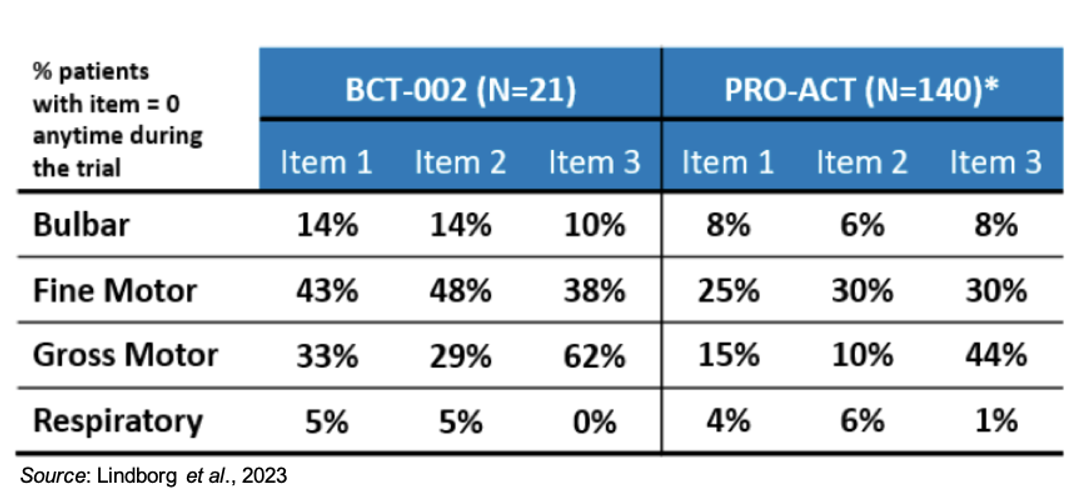
The following figure shows the percentage of patients in both NurOwn’s Phase 3 ALS trial and the PRO-ACT database that had any ALSFRS-R item with a score of 0 anytime during the trial. Compared to the PRO-ACT database, participants in NurOwn’s Phase 3 ALS trial showed an elevated rate of 0 scores across Fine Motor and Gross Motor items showing how the floor effect impacted the trial.
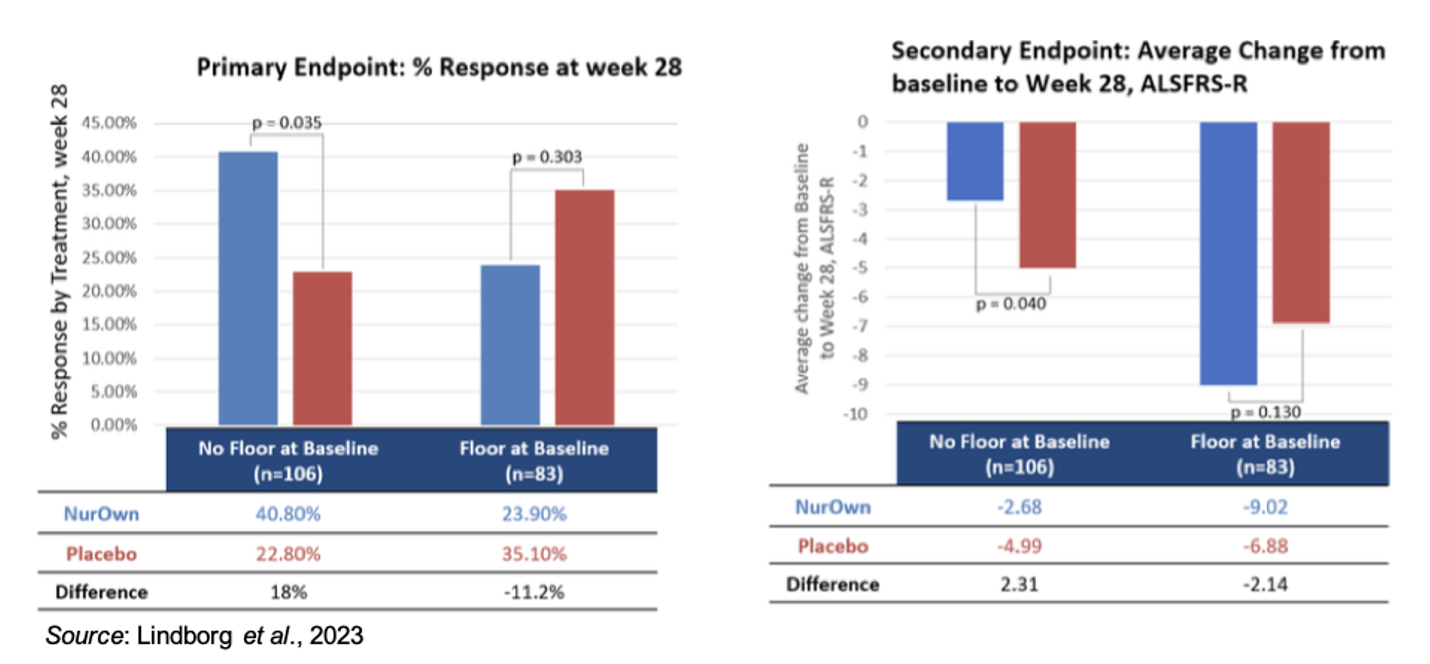
Lastly, an analysis was performed of participants from the NurOwn Phase 3 ALS trial that did not have evidence of a floor effect at baseline (defined as all baseline ALSFRS-R items ≥ 1). The following graph on the left shows that for participants with no floor effect at baseline, there was a statistically significant difference in the primary endpoint between patients treated with NurOwn and those treated with placebo (P=0.035) while there was no difference for those patients with evidence of a floor effect at baseline. A similar difference was seen in the secondary endpoint of average change from baseline to Week 28 for the ALSFRS-R, as shown in the following figure on the right.
Dr. Terry Heiman-Patterson, the President and Co-Founder of the ALS Hope Foundation who has served as Co-Chair of the Northeast ALS (NEALS) Consortium, was recently quoted as saying “…the floor effect is real,” and that “…it’s reasonable to do a post hoc analysis removing those [people] who had a floor effect to see if there was really a difference in people who didn’t have a floor effect” (Biospace.com). Thus, we believe the analysis on the floor effect in the Phase 3 ALS trial presented by BrainStorm is valid and gives important insight into the clinical activity of the drug.
Financial Update
On March 30, 2023, BrainStorm announced financial results for 2022. As anticipated, the company did not report any revenues during 2022. Net R&D expenses for 2022 were $14.0 million compared to $15.2 million in 2021. The decrease was due to decreased costs associated with the Phase 3 trial and preclinical R&D activities. Excluding participation from the IIA and CIRM, R&D expenses decreased by $1.8 million from $15.9 million in 2021 to $14.2 million in 2022. G&A expenses were $10.9 million in 2022 compared to $9.3 million in 2021. The increase was primarily due to increased payroll, travel, rent, consultants, and public relation activities.
The company exited 2022 with approximately $3 million in cash, cash equivalents, and short-term deposits. As of March 28, 2023, the company had approximately 36.7 million shares outstanding and, when factoring in stock options and warrants, a fully diluted share count of 38.2 million.
Conclusion
The FDA’s decision to grant an AdCom for NurOwn is indicative of the agency’s flexibility regarding therapies for terminal illnesses such as ALS, particularly when there are so few treatment options available to patients. We have the utmost confidence in BrainStorm’s management team as they prepare to present their case for NurOwn’s approval. In addition, it’s encouraging to see that KOL’s such as Dr. Heiman-Patterson support the idea that the floor effect can influence outcomes in ALS trials, something that will undoubtedly be discussed during the AdCom. We anticipate the announcement of the AdCom and PDUFA dates sometime in the near future. Our valuation remains at $20 per share.
SUBSCRIBE TO ZACKS SMALL CAP RESEARCH to receive our articles and reports emailed directly to you each morning. Please visit our website for additional information on Zacks SCR.
DISCLOSURE: Zacks SCR has received compensation from the issuer directly, from an investment manager, or from an investor relations consulting firm, engaged by the issuer, for providing research coverage for a period of no less than one year. Research articles, as seen here, are part of the service Zacks SCR provides and Zacks SCR receives quarterly payments totaling a maximum fee of up to $40,000 annually for these services provided to or regarding the issuer. Full Disclaimer HERE.