By David Bautz, PhD
NASDAQ:CFRX
READ THE FULL CFRX RESEARCH REPORT
Business Update
First Patient Dosed in Phase 1b/2 Trial for Exebacase in Chronic Knee Prosthetic Joint Infections
On April 26, 2023, ContraFect Corp. (NASDAQ:CFRX) announced the first patient has been dosed in the Phase 1b/2 clinical trial of exebacase in the setting of a minimally-invasive arthroscopic debridement, antibiotics, irrigation, and retention (DAIR) procedure in patients with chronic prosthetic joint infection (PJI) of the knee due to Staphylococcus aureus or Coagulase-Negative Staphylococci (CoNS).
The trial will be a randomized, double blind, placebo controlled two-part study of exebacase to assess its safety and efficacy. Part I of the study will evaluate the safety, pharmacokinetics (PK), clinical outcomes, and microbiologic response in patients through Day 42. The study allows for up to two doses of intra-articularly administered exebacase in addition to systemic antibiotics in up to two patient cohorts. Part II of the trial will be a long-term follow-up study of safety and efficacy parameters in patients who complete Part 1 of the trial. The follow-up assessments will be performed on Days 90, 180, 360, and 720.
In September 2022, ContraFect announced a presentation by Dr. Tristan Ferry at the 40th Annual Meeting of the European Bone and Joint Infection Society on data from a single center, exploratory, open label prospective study using a minimally invasive LysinDAIR procedure in patients with chronic knee PJIs.
The presentation included data from two cohorts, with each cohort consisting of four patients with chronic PJIs that received the LysinDAIR procedure (arthroscopic debridement with retention of the implant, followed by intra-articular administration of exebacase and systemic antibiotic therapy).
Cohort one consisted of patients experiencing their first episode of chronic knee PJI. Patients received three months of clindamycin and levofloxacin following the LysinDAIR procedure. Results showed that exebacase was well tolerated by all patients with no local or systemic serious adverse events related to exebacase treatment. Through a period of 36 months of follow up the patients have experienced no relapse of infection, no recurrence of joint effusion, and no loosening of the prostheses.
Cohort two included patients suffering from multi-drug resistant knee PJI. These patients received three months of systemic antibiotics plus additional suppressive antimicrobial therapy following the LysinDAIR procedure. Results for this cohort showed that exebacase was again well tolerated by all patients and no local or systemic events related to exebacase treatment were reported. Two patients experienced no relapse of infection through a follow up periods of up to 12 months. One patient experienced a relapse of infection of Staphylococcus caprae after six months. One patient died from an unrelated COVID-19 infection.
In October 2022, ContraFect presented a poster that included new clinical data for the LysinDAIR procedure in patients with chronic prosthetic hip infection (Ferry et al., 2022). Three patients were included in the study and all had previous iterative hip prosthesis exchange, a high total number of surgeries (6-10), and recent persistent or intermittent fistula. At two years follow up, all patients had resolution of fistula and no clinical signs of infection on suppressive antimicrobial therapy.
A recent editorial in the Journal of Bone and Joint Infections discussed the potential for lysins (exebacase and CF-296) as treatments for bone and joint infections (BJIs) due to their activity against coagulase-negative staphylococci, the bacteria most frequently involved in implant-associated BJIs, and their potential for both local and systemic anti-biofilm activity (Sendi et al., 2022). Current antibiotic treatments are often unable to resolve these infections, thus the authors postulated that the use of lysins could help to potentiate antibiotic activity and make these types of infections more easily treated.
Another recent publication highlighted the in vitro activity of exebacase against biofilms formed by Staphylococcus epidermidis isolated from PJIs (Souche et al., 2022). Results showed that exebacase displayed significant anti-biomass activity, significant bactericidal activity on biofilms, and worked synergistically with rifampicin, vancomycin, or daptomycin. The authors concluded that exebacase was a promising therapy that should be investigated further for its use in the treatment of PJIs alongside the aforementioned antibiotics.
CF-370 Highlighted in Multiple Presentations at ECCMID
In April 2023, ContraFect had one oral presentation and three poster presentations at the 33rd European Congress of Clinical Microbiology & Infectious Diseases (ECCMID) Annual Meeting. The data presented featured both exebacase and CF-370, the company’s lead development candidate that demonstrates potent in vitro bactericidal activity against drug-resistant pathogens, including mult-drug resistant (MDR) and extensively drug-resistant (XDR) strains.
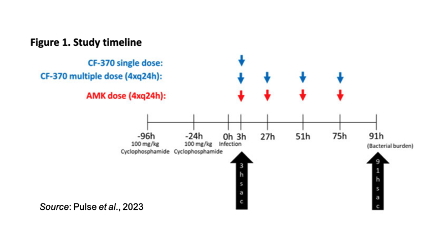
Efficacy of lysin CF-370 in addition to amikacin in a neutropenic rabbit lung infection model caused by an extensively drug-resistant (XDR) P. aeruginosa (Pulse et al., 2023): This study examined the in vivo efficacy of CF-370 alone or in combination with amikacin (AMK) in rabbit lung infection model induced by Pseudomonas aeruginosa strain AR-769. The study timeline is indicated below. Neutropenia was induced in the rabbits by injecting with cyclophosphamide on Day -4 and Day -1. Lung infection was then induced by intratracheal inoculation with AR-769. Three hours post infection, the rabbits were assigned to the treatment groups and all treatments were administered intravenously. Efficacy was measured by comparing mean bacterial densities in lungs at 16 hours after the last dose of AMK.
The bacterial densities in the lung following treatment showed that CF-370 alone caused a significant reduction in colony forming units (CFU) compared to vehicle. A single dose of CF-370 along with AMK further reduced bacterial density compared to AMK alone. Dosing CF-370 over 24 hours along with AMK further reduced bacterial density compared to AMK alone and compared to CF-370 alone. A repeated daily dose of CF-370 was more efficacious than a single dose when given along with AMK.
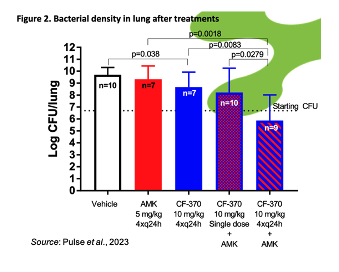
These results showed that CF-370 enhanced the activity of AMK against an XDR strain of P. aeruginosa and support the potential for CF-370 in the treatment of pneumonia, including infections caused by highly resistant P. aeruginosa.
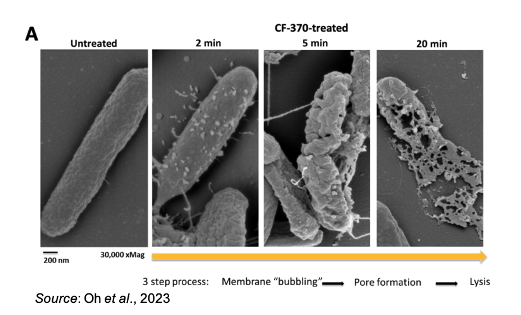
Activity of lysin CF-370 at the cell envelope of Gram-negative (GN) ESKAPE pathogens revealed by electron microscopy (Oh et al., 2023): This study examined the impact of CF-370 treatment on the surface ultrastructure with and without the presence of human serum using electron microscopy (EM). Isolates of P. aeruginosa, Klebsiella pneumoniae, Enterobacter cloacae, Acinetobacter baumannii, Escherichia coli, and Burkholderia cenocepacia were treated with 1x the minimum inhibitory concentration (MIC) of CF-370 prior to fixation and analysis by scanning EM. The following images show the rapid lysis of P. aeruginosa over 20 minutes. Clearly visible are discrete regions of envelope destabilization, resulting in pore formation and lysis. Similar results were seen with other Gram-negative bacteria.
Bacteriolytic and anti-virulence activities of engineered lysin CF-370 against Gram-negative (GN) ESKAPE pathogens (da Costa Ramos et al., 2023): This study utilized membrane permeability assays to demonstrate the ability of CF-370 to disrupt the outer membrane and depolarize the inner membrane of target pathogens. Results showed that CF-370 not only disrupted the outer membrane of target Gram-negative pathogens, but also cause membrane depolarization. At sub-lethal concentration, the membrane depolarization impaired swarming motility and prevented biofilm formation.
Lysin exebacase exerts potent in vitro bactericidal activity against Staphylococcus aureus strains associated with pulmonary exacerbations (PExs) of cystic fibrosis (CF) (Oh et al., 2023): This study examined the effect of exebacase against clinical isolates of S. aureus from patients with CF. The results showed that exebacase had potent in vitro anti-staphylococcal activity against CF patient isolates, including those that were methicillin sensitive, methicillin resistant, and small-colony variants. Exebacase was active both in the presence and absence of pooled CF patients sputa. Lastly, antibiofilm activity was also observed.
Financial Update
On May 15, 2022, ContraFect announced financial results for the first quarter of 2023. As expected, the company did not report any revenues for the three months ending March 31, 2023. Net loss for the first quarter of 2023 was $1.4 million, or $0.69 per share, compared to a net loss of $20.2 million, or $41.00 per share, for the first quarter of 2022. R&D expenses for the first quarter of 2023 were $5.3 million, compared to $12.7 million for the first quarter of 2022. The decrease was primarily due to significantly reduced expenditures on late-stage development activities to support the continued closure of the Phase 3 DISRUPT trial, CMC activities for exebacase, external clinical consultants, and headcount as a result of restructuring. G&A expenses for the first quarter of 2023 were $3.6 million, compared to $3.3 million for the first quarter of 2022. The increase was primarily due to an increase in costs for consulting fees and related expenses.
As of March 31, 2023, ContraFect had approximately $13.9 million in cash, cash equivalents, and marketable securities. As of May 10, 2022, the company had approximately 3.7 million shares outstanding and, when factoring stock options and warrants, a fully diluted share count of approximately 10.8 million.
Conclusion
We’re glad to see that the Phase 1b/2 trial of exebacase in PJI has begun enrolling patients. This is a great opportunity for the company to test the efficacy of exebacase in a new indication and one for which there are limited treatment options. We look forward to updates from the company regarding the trial throughout the year. In addition, we look forward to the IND filing for CF-370 so that a clinical trial can be initiated later this year. The preclinical data discussed above is very encouraging and supports the development of CF-370 as a treatment for Gram-negative infections. With no changes to our model our valuation is $7.00 per share.
SUBSCRIBE TO ZACKS SMALL CAP RESEARCH to receive our articles and reports emailed directly to you each morning. Please visit our website for additional information on Zacks SCR.
DISCLOSURE: Zacks SCR has received compensation from the issuer directly, from an investment manager, or from an investor relations consulting firm, engaged by the issuer, for providing research coverage for a period of no less than one year. Research articles, as seen here, are part of the service Zacks SCR provides and Zacks SCR receives quarterly payments totaling a maximum fee of up to $40,000 annually for these services provided to or regarding the issuer. Full Disclaimer HERE.