By Steven Ralston, CFA
OTCQX:DYLLF | ASX:DYL
READ THE FULL DYLLF RESEARCH REPORT
Deep Yellow Ltd. (OTCQX:DYLLF) (ASX:DYL) is unique among junior mining companies: the company is being positioned to provide a leveraged opportunity to participate in all phases of the expected upswing in uranium prices. Management’s Dual Pillar strategy is designed to deliver both organic and inorganic growth by advancing the company’s Namibian and Australian projects through the production stage and by acquiring additional projects as the industry consolidates. Management is focused on becoming a low-cost, Tier I uranium producer, defined as a multi-project producer of uranium with the capacity to deliver 5-10 million lbs. of uranium annually.
CEO John Borshoff and his team previously achieved the same accomplishment with Paladin Energy Ltd by acquiring, developing and advancing the Langer Heinrich deposit into production within four years (2002-2006) and the Kayelekera Mine in Malawi (production 2009 to 2013) during the last uranium up cycle.
The Langer Heinrich uranium mine is situated 30km northeast of the Tumas Project. Deep Yellow’s executive team acquired, defined, funded, developed, optimized and operated Langer Heinrich from 2002 to 2017. The geology and type of deposit mineralization in these paleochannel systems at Langer Heinrich and Tumas are quite similar, and the mining jurisdiction is one in the same. Management is well-prepared to fast-track Tumas to production during this uranium up-cycle.
The company’s most advanced flagship project is the 95%-owned Tumas Project, which is in the exact same jurisdiction and shares the same paleochannel network as Langer Heinrich mine, as does EPL 3669 (aka Tumas North) in the NOVA JV, in which Deep Yellow holds a 39.5% interest.
We expect that management will deliver on its plan of becoming a secure and reliable tier-one uranium producer with an annual operating capacity of 5-to-10 million lbs. of U308. We also expect management to pursue additional acquisitions and/or mergers as the uranium consolidates during the current upcycle.
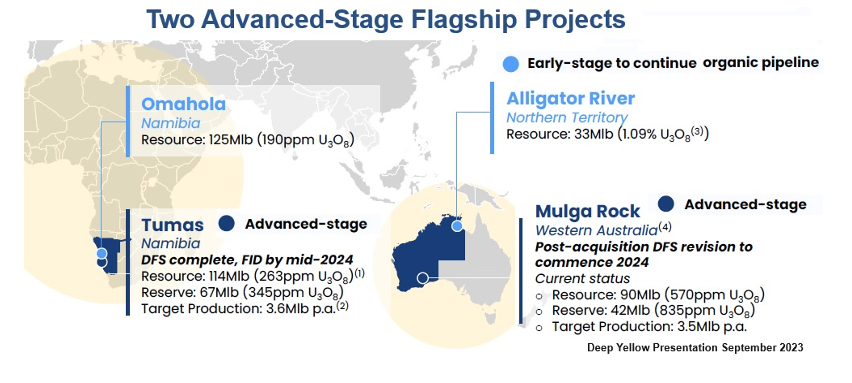
During fiscal 2023, management impressively advanced all of the company’s uranium projects through exploration programs, in-fill drilling and/or upgrades in the project’s MRE. The company is on the path to commence uranium production as early as 2026 (at Tumas).
LIST OF ACHIEVEMENTS OF FISCAL YEAR 2023
Operational Integration of Vimy Resources Limited
The integration of the staff and assets of Vimy Resources Limited was substantially completed during fiscal 2023. The Western Australian Mulga Rock and Northern Territory Angularli Projects have augmented the company’s Mineral Resources and Ore Reserves, and the pace of development of these Australian projects appears to have accelerated under Deep Yellow’s management.
Namibian Flagship Tumas Project
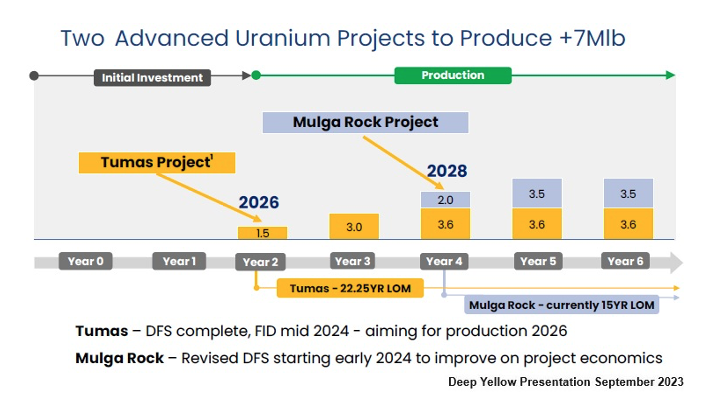
In early February 2023, a Definitive Feasibility Study (DFS) on Tumas was released. The base case (US$65/lb. U308) projects annual production of 3.6Mlb U308 and 1.15 Mlb V2O5 that provides a post-tax NPV8 of $341 million (IRR 19.2%) and a LOM of 22.25 years. Immediately thereafter, the Board approved the commencement of the Front-End Engineering and Design (FEED) phase. Management has moved forward with additional exploration in order to expand the LOM to 30 years. In addition, the project’s financing activities commenced with a target for the Final Investment Decision during the second half of FY2024 with the development/construction of a mine to follow in the 2024-2025 timeframe.
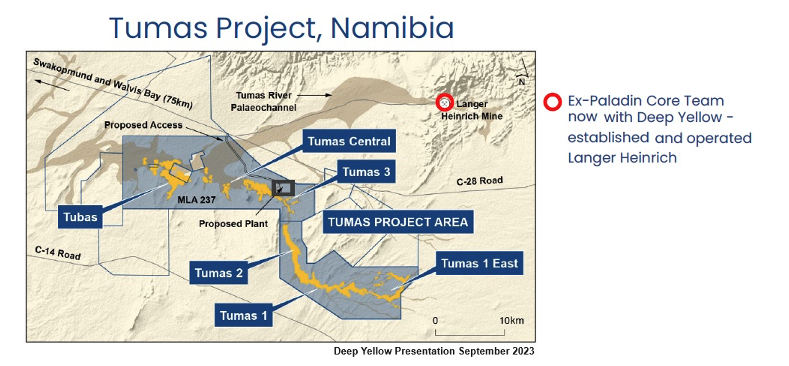
Between March and August 2023, Deep Yellow conducted a 2-phase 340-hole (9,500m) RC resource drilling program west of Tumas 3 in order to expand the current resource base with a goal of increasing the LOM of the Tumas Project to over 30 years. A prospective 2.5km x 1.8km area west of Tumas 3. Was identified for infill drilling (hole spacing of 100m). We await the results of the drill program.
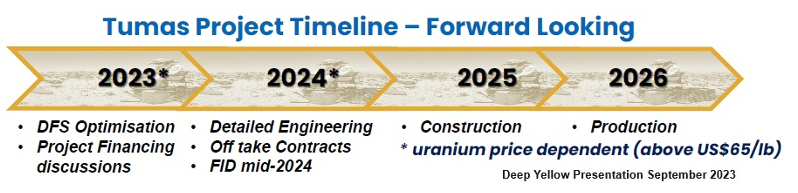
Concerning the Mining License (MLA237), the Ministry of Mines and Energy is prepared to grant the License subject to receiving an Environmental Clearance Certificate (ECC). An Environmental Impact Assessment (EIA) was submitted in April 2023. Management anticipates a three-to-four month approval period, after which the ECC should be issued during calendar 2023.
Australian Flagship Mulga Rock Project
In late December 2022, Deep Yellow purchased the 1.15% royalty on the Mulga Rock Project held by Resource Capital Fund VI LP in consideration of 19,444,444 shares of Deep Yellow. The elimination of this legacy royalty will enhance the project’s potential value going forward.
In February 2023, the Sandhill Dunnart Conservation Plan for the Mulga Rock Project was approved by the Commonwealth Department of Climate Change, Energy, the Environment and Water.
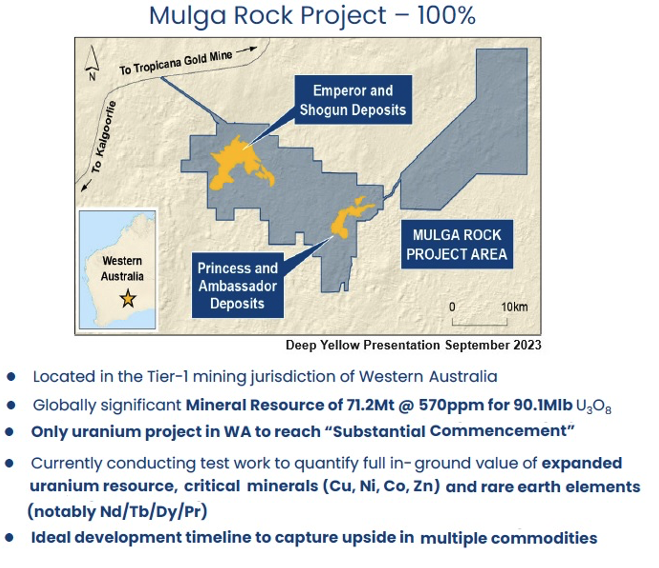
Between March and August 2023, Deep Yellow conducted a 2-phase 656-hole (36,647m) resource drilling program at Mulga Rock. Phase 1 focused the grade variability of uranium and non-uranium critical minerals while Phase 2 consisted of infill drilling at the Ambassador and Princess deposits. Both phases will contribute to an updated MRE that management anticipates will be completed during the fourth quarter of 2023. The results of the infill drilling are expected to contribute to an upgrade of the Inferred Mineral Resource to the Indicated category.
Work continues to expand the value of the Mulga Rock Project’s value by extending the scope of mining and processing to include polymetallic base metals (copper, nickel, cobalt, zinc) and rare earth minerals (neodymium, terbium, dysprosium and praseodymium) within the identified uranium resource shells. This work will contribute to the ongoing progress on the revised DFS for Mulga Rock for its expected completion mid-2025 (calendar year).
Production Profile of Two Most Advanced Uranium Projects (Tumas & Mulga Rock)
With its two most advanced uranium projects (Tumas & Mulga Rock), Deep Yellow projected the company’s production profile in its May 2023 presentation. Management is motivated and determined to develop and construct operating uranium mines with capacity to produce over 10 million pounds of U308 annually.
Early-Stage Exploratory Projects
OMAHOLA Basement Project (Namibia)
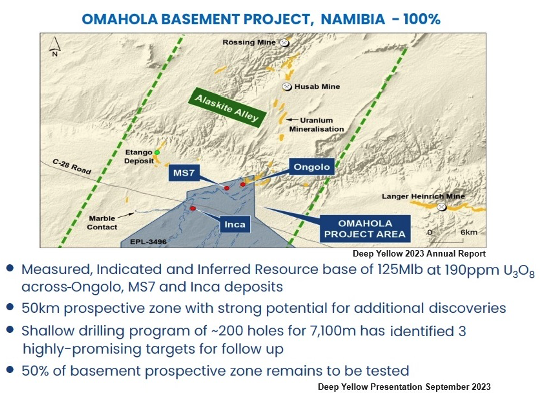
Omahola Basement Project - In mid-November 2022, Deep Yellow completed a Phase 2 follow-up RC drill program, which consisted of 78 holes (4,929m). Phase 1, which consisted of 40 holes (5,252m), had been completed in July 2022. Three new prospective target areas were identified. The most prospective area is located 2km north of Inca and west of MS7 targets where thick, stacked mineralized alaskites were intersected. Management plans to conduct deeper RC drilling in that area.
AUSSINANIS Project (Australia) - Yellow Dune JV
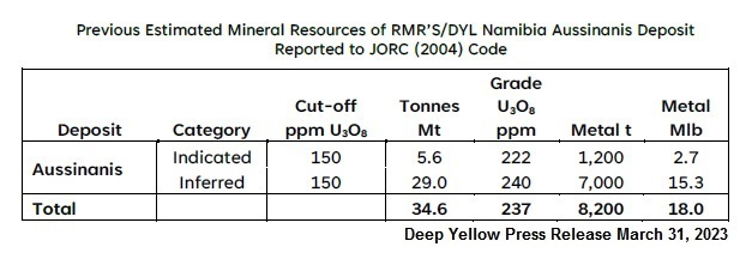
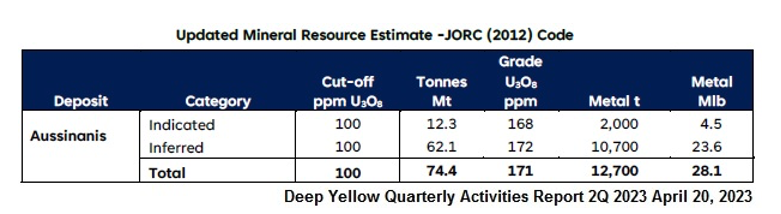
In late-March 2023, a detailed review of the Mineral Resource base at Aussinanis by Deep Yellow’s in-house geologist (a Competent Person), the MRE was upgraded to JORC (2012), which uses a 100ppm cut-off. The updated Indicated & Inferred Resource base is now 28.1Mlb at 171ppm U308versus the prior 18Mlb at 237ppm U308 150ppm cut-off JORC (2004).
ALLIGATOR RIVER Project (Australia)
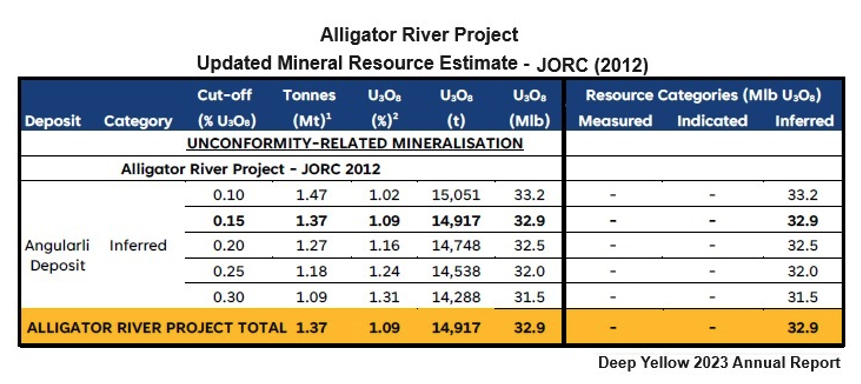
In July 2023, the Mineral Resource Estimate for the Alligator River Project (Angularli deposit) was upgraded by 29% from its Maiden Inferred MRE (March 2018) totaling 0.91Mt at 1.29% U308 for 25.9Mlb U308 to an Inferred MRE totaling 1.37Mt at 1.09% U308 for 32.9 Mlb U308 at a cut-off grade of 0.15%. The updated MRE was supported by an 18-hole extension drilling program completed in October 2022, which identified up-dip extensions of the sandstone-hosted uranium mineralization, along with detecting a continuity of mineralization down-plunge. Furthermore, the mineralized system was found to extend along strike toward the north.
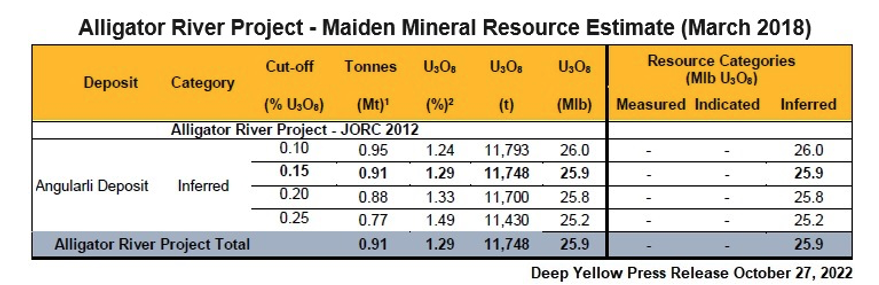
These tables of the 2018 maiden MRE (above) and the current upgraded MRE (below) exhibit the Resource Estimate at various cut-offs, thereby demonstrating the relative insensitivity of the Angularli deposit to the cut-off grade.
NOVA Joint Venture Project (Namibia)
In February 2023, a 14-RC hole (1,597m) follow-up drill program at the Nova JV was completed. The program focused on exploring a cluster of prospective areas consisting of Barking Gecko North, Barking Gecko East, Iguana and Turtle’s Neck. The drilling results indicated that the highly prospective area of high grade and thick uranium mineralization at Barking Gecko appears to continue at depth to the northeast; however, drilling results at Barking Gecko East, Turtle’s Neck and Iguana do not support further exploration at this point in time.
ANTICIPATED MILESTONES IN THE 2024 FISCAL YEAR
Tumas Project
• Results of resource in-fill drilling program west of Tumas 3 in 2Q FY2024
• Official granting of Mining License by the Ministry of Mines and Energy in 2Q FY2024
• Updated MRE from Tumas 3 West drilling program in 2H FY2024
• Final Investment Decision during 2H FY2024
Mulga Rock Project
• An updated MRE on the Mulga Rock Project should be completed in 2Q FY2024
• Results of metallurgical test work on 63 samples in 3Q FY2024
Alligator River Project
• Desk top prospectivity appraisal to define exploration corridors in 2Q FY2024
Tubas Calcrete Project
• The Tubas Calcrete Project is being reviewed in order to update the MRE from JORC (2004) to JORC (2012)
UPDATE ON THE URANIUM INDUSTRY
Since the World Nuclear Association’s Symposium held in early September, the spot price of uranium oxide has increased 19% to a 12-year high. Year-to-date (through September), spot uranium prices are up 50%. The stocks of almost all uranium junior mining companies have followed suit. The driving force has been the tightening of the supply/demand structure of uranium market with the projected demand by nuclear power plants increasing and the sequestration of uranium by physical funds (such as the Sprott Physical Uranium Trust and Yellow Cake Plc) continuing. The change in sentiment of utility buyers of long-term contracted uranium (estimated to be over 121 million pounds thus far in 2023) has resulted in the volume of contracted volume increasing to the highest level in over a decade. Since the end of April, Deep Yellow’s stock has rallied over 150%.
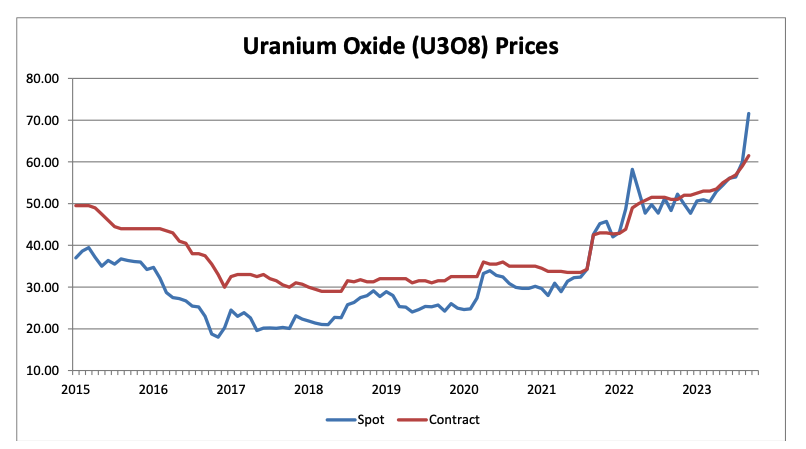
Leading market research firms on the nuclear industry forecast that the deficit between primary supply (from mines) and the demand by nuclear reactors will continue to expand through 2040. In its reference scenario, the World Nuclear Association calculates that the annual primary supply deficit for uranium will exceed 140 million pounds by 2030. Furthermore, in its Base case, UxC estimates that between 2023 and 2040, the needs of operating nuclear reactors will increase by 35%. Both scenarios indicate that new primary production will be needed with the price of uranium being the key determent that will incentivize the development of new mines.
Sentiment noticeably shifted at the World Nuclear Association’s Symposium (held in early September 2023), sparking a stronger tone in the long-term contracting process. Not only are contract prices rising, but also the terms of new collared contracts reflect a tightening market with rising floor and ceiling prices. Year-to-date, long-term contract volume has exceeded 118 million pounds.
The demand for electricity continues to increase due to population growth, the modernization of emerging & developing nations, the adoption of EVs and the growing desire to attain Net-Zero Carbon Emissions targets. According to the latest International Energy Agency (IEA) report, global electricity demand continues to grow with electricity generated from fossil fuels expected to decline and electricity generated from renewables anticipated to expand.
Countries such as China, India, Spain, Finland, Sweden and the U.S. have and continue to embrace nuclear power through new power plant builds and/or life extensions. Elsewhere, there are countries in which governments are updating power policies to encompass or emphasize nuclear electrical power under the mantra of clean, renewable energy. Globally, there are 436 nuclear reactors in operation, 60 under construction and an additional 110 planned with China accounting for 24 under construction and 44 planned reactors.
Uranium Cycle
The uranium industry is composed of many companies, from major established producers to more speculative junior exploration companies. Though larger producers tend to have greater resources to navigate periods of depressed market conditions, junior companies provide greater leverage to the rise in uranium prices.
Almost all uranium stocks should benefit from the anticipated growth of much needed primary supply driven by the expected upcoming fundamental supply deficit; however, certain groups of uranium stocks benefit differently from each stage of the up-cycle. Historically (observing the 2001-2007 up-cycle), current producers reacted well to the initial rise in prices (since their current production could immediately benefit from the increase in the price of uranium), and they significantly outperformed the price of the commodity, itself. However, extreme out-sized returns were enjoyed by junior mining companies that traded below $0.25 per share at the bottom.
Then, there was a mid-phase when the rate of increase of the spot price of uranium moderated to a single-digit rate. In this period, junior mining companies corrected in the 40%-to-50% (sometimes multiple times), while producers corrected about half that amount (around 25%).
In the current uranium cycle, the advent of physical uranium funds has aided the growing demand/supply imbalance by removing supply from the market. Their combined stockpiles now total over 100 million pounds. Currently, these uranium investment vehicles do not have formal redemption mechanisms. As uranium prices rise, there will be the potential for these funds to release supply into the market, triggering one of several expected 40%-to-50% corrections in the uranium space.
VALUATION
Broadly speaking, the public uranium companies can be grouped into three segments: producers, development companies and exploration companies. Producers are actively mining and generating revenues. Exploration companies are prospecting and/or drilling to establish mineral resources. In between these two segments are the development companies that already have established resources and are advancing through the process to bring a mine in operation, generally from the point of initiating a Pre-Feasibility Study to the actual construction of a mine. The comparable companies to Deep Yellow fall into this category.
Further, the comparable companies have been narrowed through quantitative factors, particularly those with a market capitalization over $350 million and trading above $0.75 per share. This process captures a range of well-funded junior uranium development companies, which are listed in the table above. Currently, the P/B valuation range of these comparable companies is between 3.58 and 8.68. With the expectation that Deep Yellow’s stock will attain a mid-second quartile P/B ratio of 6.3, our comparable analysis valuation price target is US$2.00.
SUBSCRIBE TO ZACKS SMALL CAP RESEARCH to receive our articles and reports emailed directly to you each morning. Please visit our website for additional information on Zacks SCR.
DISCLOSURE: Zacks SCR has received compensation from the issuer directly, from an investment manager, or from an investor relations consulting firm, engaged by the issuer, for providing research coverage for a period of no less than one year. Research articles, as seen here, are part of the service Zacks SCR provides and Zacks SCR receives quarterly payments totaling a maximum fee of up to $40,000 annually for these services provided to or regarding the issuer. Full Disclaimer HERE.