By Lisa Thompson
NASDAQ:IDAI
Trust Stamp (NASDAQ:IDAI) is in the business of using biometrics to prevent fraud and confirm identities. It applies its AI-enabled technology to a variety of uses targeting various corporate verticals and government entities. Its technology is unique and a vast improvement over legacy methods for one major reason—it takes a person’s biometric data and irreversibly tokenizes it to be unidentifiable if hacked, but the token can be stored for later use. Currently, many companies that use biometric data are afraid to save it due to the risk of a data breach, so they delete it after its one-time use. Trust Stamp is the only company with the technology (protected by patents) to tokenize the data.
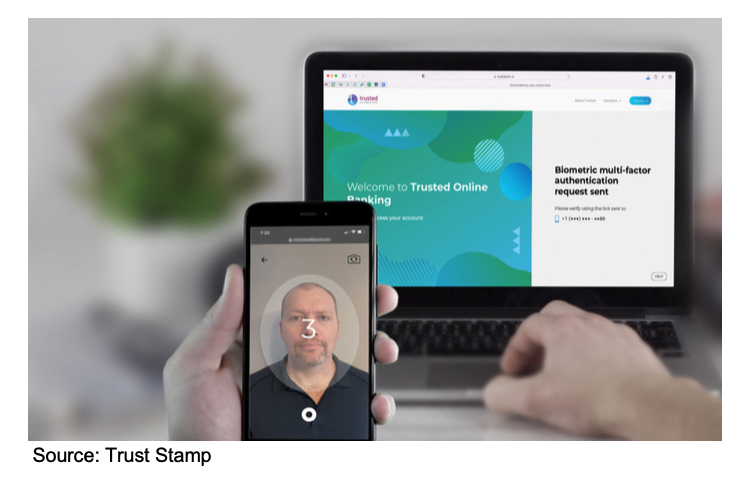
An example of its technology can be shown in an online store purchase where the buyer wants to set up a payment plan. The store may ask you to upload the front and back of a driver’s license, then snap a selfie of your face so they can match the two. Trust Stamp can also check that the license is not counterfeit. If the license and the face match and everything else meets the criteria, the account can be opened. With most biometric vendors, this is the end of the process: once the account is opened, the biometric data is destroyed because of the potential liability involved in keeping even encrypted biometric templates.
Alternatively, using Trust Stamp technology, the retailer can retain a token based on the selfie that was taken with sufficient information to match against another Trust Stamp token, but containing no information that could lead to the outright identification of the person. Tokens have only one use: to match against other tokens. This proprietary technology allows for secure biometric re-authentication at a later point. And if, for example, someone does not have a picture match or the license is counterfeit, the token generated for that person can be put on a watchlist so that person can never open an account in the future without heightened authentication processes. This alleviates considerable fraud loss as most fraudsters are repeat offenders. It also improves a customer’s experience as additional changes to their profile do not require them to input all the deleted biometric data. If your address changes, you don’t have to reinput anything else except the new address.
Trust Stamp trades at a market cap of $16 million (enterprise value of $13 million) and in the past twelve months generated $2.8 million in sales. It is not profitable and is burning about $2 million a quarter in cash but hopes to be cash flow breakeven by the end of 2024 due to a combination of extreme cost-cutting and revenue growth. The company raised a total of $8.13 million in gross proceeds in two registered direct offerings during Q2 2023 on April 14 and June 1 for $5.19 and $2.94 million, respectively. The company is pursuing several large opportunities, particularly with the government that could dramatically change its fate.
93% of Revenues Come From Four Major Customers
The majority of Trust Stamp’s revenues are generated by four major customers, but it is expected to add many smaller businesses as it now sells its products packaged as a low-code SaaS solution implemented using APIs. Its four major customers which totaled 93% of the revenues of the first six months of 2023, were: a Fortune 500 bank (45%), Mastercard (28%), FIS (10%), and Triton, the Canadian background check company, (10%).
Fortune 500 Bank
This customer was one of Trust Stamp’s first and initially deployed a custom solution that is used for its eCommerce customers. It has since transitioned to the company’s standardized Orchestration Layer. The bank offers a B2B solution to retailers offering BNPL (buy now pay later) plans or opening new store-brand credit cards or offering loans. It helps its customers reduce fraud with face-matching biometrics.
Mastercard
Mastercard (NYSE:MA) uses Trust Stamp to facilitate its plans in Africa to provide digital identities to hundreds of millions of residents without traditional access to identification services. Presently Mastercard is working on projects to use biometrics to aid healthcare and vaccine distribution as well as general aid distribution and digital empowerment for farmers.
One such pilot is in Ethiopia where the Ministry of Health, Mastercard, Gavi, and JSI (John Snow, Inc) have partnered on a digital, portable health pass. They are using Mastercard’s Wellness Pass within Ethiopia’s health information system to promote efficiency in healthcare tracking and offline portability of health records in the most marginalized communities. Mauritania is also using the Mastercard Wellness Pass for vaccination records.
FIS
FIS (NYSE:FIS), the $32 billion financial technology company is a channel partner for Trust Stamp, and it sells Trust Stamp’s SaaS solution to the banks and financial institutions with which it works. FIS’s large footprint has it interact with 95% of the global financial institutions making it an excellent source of customer acquisition. So far it has 30 banks testing the Trust Stamp solution which should start generating revenues in 2024. It expects to have 45-50 banks by year-end. Trust Stamp gets paid on transaction volume as banks use their various solutions for various applications including opening credit card or bank accounts and fraud identification.
Triton
Triton is the industry leader for background checks in Canada and was Trust Stamp’s first SaaS customer. Triton also pays by usage and requires little to no support. As Triton uses the Trust Stamp system, the system becomes even more accurate through machine learning from the metadata. Trust Stamp is pursuing more customers in this high-margin vertical.
Opportunities for Trust Stamp Are All Around in Public and Private Applications
Part of the problem for Trust Stamp is seeking the best opportunities to pursue where the customer will get the biggest return and the sale is easiest. They can pursue whales or guppies. The company is focusing on the guppies but continues to bid on the whales which can quickly change its fate.
Huge Upside If the Company Can Win a Government Contract
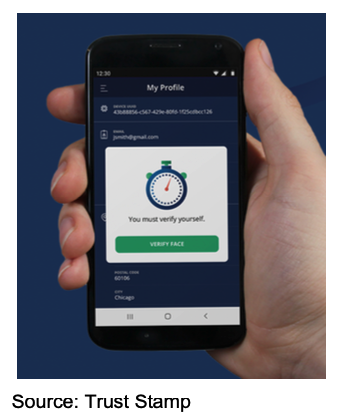
In the past ICE was a large pilot customer for Trust Stamp in the Alternative to Detention program. It used its technology to identify and track illegal aliens that entered the US. ICE took biometrics and gave entrants a phone with which they were to check in with facial recognition each day. Using geolocation, this technology allowed ICE to confirm that a person was where they said they were. However, ICE ran out of money for the project in 2022, and the $7.2 million contract was canceled for convenience with compensation paid to Trust Stamp. The specific function that Trust Stamp worked on is now part of a much larger RFI issued by ICE and it is anticipated that an RFP will result in 2024.
Many Alternative to Detention programs exist at the federal, state and even municipal levels, and last week the company announced the launch of its new “Tap-In Band”, a wrist-worn, tamper-resistant NFC band that can be used for discrete check-in by, and communication with, participants in the ICE (or any other) program. Combined with the user’s smartphone, this band uses GPS and NFC technologies to verify its location by tapping the band to the phone. Then the system uses facial biometric authentication to confirm that the right person is in the right place. Trust Stamp’s identity tokenization assures privacy and security.
Alternative to Detention programs cost taxpayers a fraction of the cost of detention and have been proven to have a high success rate. Compared to competitors' solutions, Trust Stamp believes that its technology and devices will cost up to 100 times less in capital and operational costs and can be quickly implemented. As the border is increasingly overwhelmed and states and cities begin to push back, we think this issue will need to be addressed sooner rather than later. Trust Stamp’s solution has already been proven and that combined with its new hardware may give it an even better chance of winning the rebid.
Other Opportunities
Another opportunity is with the IRS whose login system was deemed the worst ever. The agency is looking to replace it due primarily to privacy issues, and a similar but larger opportunity also exists with the Government Service Agency for which Trust Stamp has already completed a number of RFI responses. Trust Stamp plans to bid on both of those opportunities where it believes its tokenized solution would be far superior to the competition because of the privacy protection that is afforded.
The company also believes there are massive opportunities in the private sector. One industry that could use help is ride-sharing. Trust Stamp could make sure that the person driving the car is the one registered on the app and is the same person showing up which is often not the case.
At the end of August, the company added six veteran sales team members and has already seen a meaningful increase in its sales pipeline. The company continues to primarily pursue financial institutions where it can sell its SaaS solution and any other applications that can use its off-the-shelf offering. This should raise margins and propel the company faster toward profitability. The company has stated that it believes due to these already-signed customers and a large sales pipeline it expects 2024 revenues to be a significant improvement over 2023. Any wins of large government contracts would just be icing on the cake. While still a risky startup, investors should keep an eye on Trust Stamp due to its patented and unique technology, recent sales success, and potential for large government wins in the coming year.
SUBSCRIBE TO ZACKS SMALL CAP RESEARCH to receive our articles and reports emailed directly to you each morning. Please visit our website for additional information on Zacks SCR.
DISCLOSURE: Zacks SCR has received compensation from the issuer directly, from an investment manager, or from an investor relations consulting firm, engaged by the issuer, for providing research coverage for a period of no less than one year. Research articles, as seen here, are part of the service Zacks SCR provides and Zacks SCR receives quarterly payments totaling a maximum fee of up to $40,000 annually for these services provided to or regarding the issuer. Full Disclaimer HERE.