By David Bautz, PhD
NASDAQ:IMNN
READ THE FULL IMNN RESEARCH REPORT
Business Update
PLACCINE Technology Presented at Vaccine Technology Summit
On March 22, 2023, Imunon, Inc. (NASDAQ:IMNN) announced that its Executive Vice President and Chief Scientific Officer, Dr. Khursheed Anwer, presented data on the company’s PLACCINE platform at the Vaccine Technology Summit 2023. A copy of the presentation can be found here.
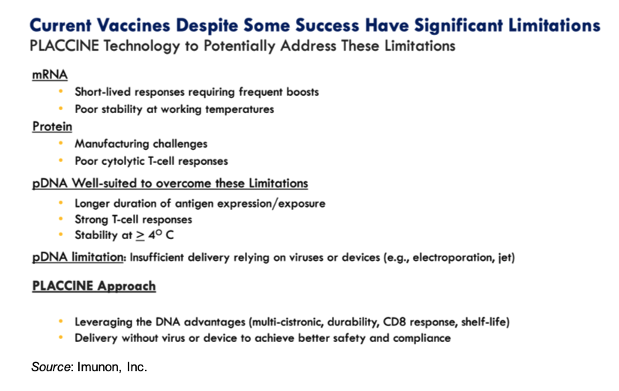
As the following slide shows, the PLACCINE technology can address a number of limitations that other vaccine platforms have, including short-lived responses and poor stability (for mRNA vaccines) and manufacturing challenges and poor T cell responses (for protein vaccines). Plasmid DNA (pDNA) vaccines (which forms the basis of the PLACCINE technology) can result in longer duration of antigen expression, strong T cell responses, and are stable at ≥ 4ºC.
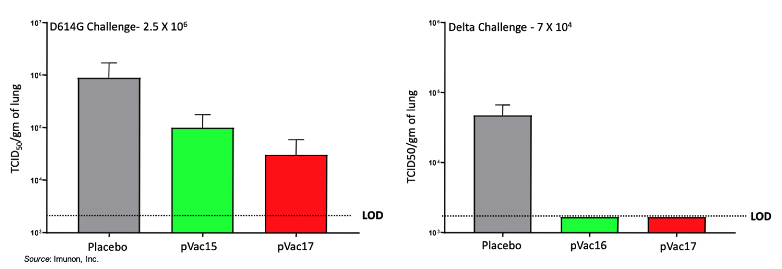
The PLACCINE vaccine provides protection against viral challenge in a SARS-CoV-2 model. Three different vaccines targeting the D614G variant (pVac-15), Delta variant (pVac-16), or a combination of the D614G and Delta variants (pVac-17) were constructed. Mice were immunized on Day 0 and boosted on Day 14 before being intranasally challenged on Day 42. Samples from the mice were collected on Day 49. The following graphs show the level of infectious virus titer recovered from lung tissue. The graph on the left shows the decrease in viral titer after challenge with the D614G variant and treatment with either pVac15 or pVac17. The graph on the right shows the decrease in viral titer after challenge with the Delta variant, in which treatment with pVac16 or pVac17 led to a viral titer below the limit of detection (LOD).
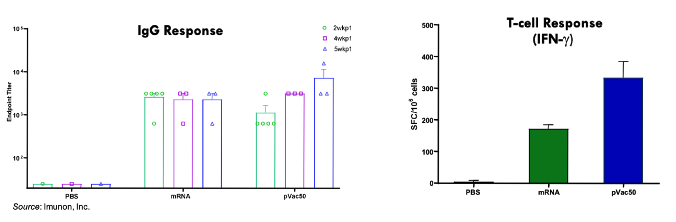
Compared to mRNA vaccines, a single dose of PLACCINE vaccine results in a better immunological response as measured by antibody and T cell response. The IgG titer for the PLACCINE vaccine appears similar to the titer induced by an mRNA vaccine, and it appears to increase from Week 2 to Week 5 post-inoculation, as shown in the following figure on the left. The figure on the right shows a more robust T cell response as measured by interferon gamma (INF-𝑦) response.
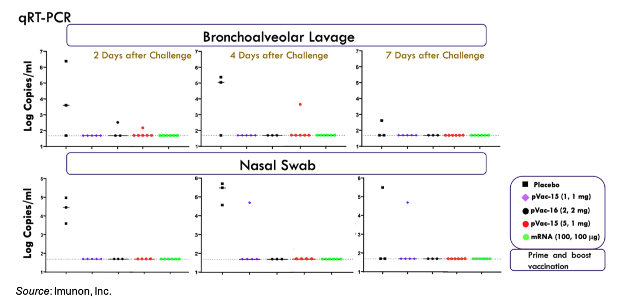
PLACCINE vaccines offer complete protection against viral challenge, with comparable efficacy to a commercial mRNA vaccine. The following figure shows viral copies found in bronchoalveolar lavage and nasal swab following immunization with different doses of pVac-15, pVac-16, or an mRNA vaccine. Except for a few exceptions, there was no detectable level of virus following viral challenge.
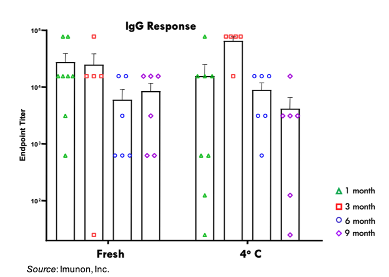
Lastly, in contrast to mRNA vaccines that must be stored at -80ºC, the PLACCINE vaccines can be stored at 4ºC for an extended period of time with little effect on IgG response, as shown in the following figure, with data currently out to nine months.
A Phase 1/2 clinical trial is being planned for a PLACCINE COVID-19 booster vaccine targeting the Omicron XBB1.5 virus along with a highly conserved antigen. The trial will enroll approximately 60 individuals. Three different dose levels and two different dosing schedules will be evaluated. A potential Phase 2 expansion study may take place three to six months into the Phase 1 portion of the study. The primary efficacy and immunogenicity objectives are reactogenicity and neutralizing antibody titer at baseline and different time points over one year. Secondary objectives include seroresponse rate and T cell response. We anticipate Imunon conducting a pre-IND meeting with the FDA to receive guidance on the proposed program in the first half of 2023.
IMNN-001 Combination Trial in Advanced Ovarian Cancer Underway
In February 2023, Imunon announced that patient enrollment had commenced in a Phase 1/2 clinical trial of IMNN-001 (formerly GEN-1) in combination with bevacizumab in patients with advanced ovarian cancer. The trial is being performed in collaboration with Break Through Cancer, a public foundation dedicated to empowering outstanding researchers and clinicians to interpret and find cures for some of the most difficult-to-treat cancers. The trial is expected to enroll 50 patients with Stage III/IV advanced ovarian cancer undergoing frontline neoadjuvant therapy who will be randomized 1:1 to receive standard chemotherapy vs. chemotherapy plus IMNN-001. The primary endpoint is detection of minimal residual disease (MRD) by second look laparoscopy (SLL) with a secondary endpoint of progression-free survival. The initial SLL data are anticipated approximately one year from the completion of enrollment and final PFS data are expected approximately three years from the completion of enrollment. Break Through Cancer will fund approximately two-thirds of the costs of the trial, with Imunon committed to providing approximately $2.0 million to $2.5 million in IMNN-001 product costs, data and safety monitoring, and project management services.
Financial Update
On March 30, 2023, Imunon announced financial results for 2022. The company reported $500,000 in technology development and licensing revenue in both 2022 and 2021. This stems from a non-refundable technology transfer fee of $5 million paid by Hisun in January 2013 to support the development of ThermoDox® in China that was recorded as deferred revenue and is being amortized over the ten-year term of the agreement. As of December 31, 2022, the contract has been fully amortized and recognized as revenue.
In 2022, the company reported a net loss of $35.9 million, or $5.03 per share, compared with a net loss of $20.8 million, or $3.83 per share, in 2021. R&D expenses in 2022 were $11.7 million, compared to $10.6 million in 2021. The increase was primarily due to increased costs associated with the development of IMNN-001 and the PLACCINE technology. G&A expenses in 2022 were $13.7 million, compared to $10.9 million in 2021. The increase was primarily due to higher professional fees including legal fees and compensation expenses.
Imunon exited 2022 with approximately $38.9 million in cash, cash equivalents, restricted cash, short-term investments, and interest receivable. Subsequent to the end of the year, the company received $1.6 million in non-dilutive funding from the sale of New Jersey State net operating losses. We estimate that the company has sufficient capital to fund operations into 2025. Imunon currently has approximately 9.1 million common shares outstanding and, when factoring in stock options and warrants, a fully diluted share count of approximately 10.1 million.
Conclusion
The data presented on Imunon’s PLACCINE vaccine platform is very encouraging and demonstrates a number of positive attributes, particularly in comparison to other vaccine technologies currently in use. We look forward to updates from the company on the SARS-CoV-2 program and the selection of the next pathogen to target with the PLACCINE technology. With no changes to our model our valuation remains at $17 per share.
SUBSCRIBE TO ZACKS SMALL CAP RESEARCH to receive our articles and reports emailed directly to you each morning. Please visit our website for additional information on Zacks SCR.
DISCLOSURE: Zacks SCR has received compensation from the issuer directly, from an investment manager, or from an investor relations consulting firm, engaged by the issuer, for providing research coverage for a period of no less than one year. Research articles, as seen here, are part of the service Zacks SCR provides and Zacks SCR receives quarterly payments totaling a maximum fee of up to $40,000 annually for these services provided to or regarding the issuer. Full Disclaimer HERE.