By John Vandermosten, CFA
NASDAQ:KA
READ THE FULL KA RESEARCH REPORT
2Q:23 Financial and Operational Results
Since our initiation of Kineta, Inc. (NASDAQ:KA) in June, Kineta has announced a $5 million milestone payment from Merck (MRK) and the addition of two individuals to its board of directors. Kineta also participated in a webinar focused on trends in immuno-oncology and the company’s lead candidate KVA12123. On August 11, 2023 Kineta filed its 2Q:23 Form 10-Q and posted its earnings release for the quarter ending June 30, 2023. In its second quarter earnings release, Kineta highlights these recent achievements and reiterates its intent to provide interim data from the KVA12123 Phase I/II trial by year end 2023.
Highlights for 2023 include:
➢ VISTA as I-O target KOL event – March
➢ First patient dosed in KVA12123 Phase I/II study – April
➢ $6 million direct offering priced – April
➢ Presented VISTA biomarker data and KVA12123 Phase I/II clinical trial update at AACR - April
➢ Addition to Russell Microcap Index – June
➢ Addition of new directors to board - June
➢ $5 million milestone announced from Merck - June
➢ Immuno-oncology webinar featuring Kineta CEO Shawn Iodonato – July
Kineta generated $5.2 million revenues during 2Q:23 and reported net income of $0.4 million, or $0.04 per share. For the quarter ending June 30, 2023 and versus the same period in the prior year:
➢ Revenues of $5.2 million represented a milestone payment of $5.0 million related to an ALS program in partnership with Merck and $161,000 related to services provided under the Merck Neuromuscular License Agreement;
➢ Research & Development expense totaled $2.7 million, down 30% from $3.9 million. The decline was attributable to lower activities for KCP-506, which were mostly completed in 2022 and KVA12123 as efforts shifted towards securing clinical trial sites in advance of enrolling the first patient;
➢ General & Administrative expenses were $3.4 million, up 88% from $1.8 million primarily due to higher personnel costs, professional services and other administrative expenses. Stock-based compensation increased as did professional services including legal audit and consulting costs;
➢ Total other income came from interest and investment sources. It declined on account of lower balances of interest paying notes and various non-cash adjustments for change in fair value of financial assets;
➢ Net income was $0.4 million or $0.04 per share compared with net loss of ($2.6) million or ($0.51) per share, respectively.1
At quarter’s end, marketable securities, cash and equivalents totaled $7.8 million. Cash burn for 2Q:23 was ($6.7) million. Following the end of the quarter, the $5.0 million milestone payment recognized in 2Q:23 was received from Merck. In late October of this year, another $22.5 million is expected from the second closing of the private placement which should provide sufficient capital to fund operations until early 2025. Financing cash flows were $6.2 million and represent proceeds from a private placement and issuance of common stock. Kineta holds sufficient cash and equivalents to fund operations until at least August 2024.
In our initiation, we explained that Kineta expected to close the second private placement of $22.5 million in July. Since the capital is not yet needed due to the receipt of the Merck milestone, Kineta has pushed back the event to late October 2023.
Merck Milestones
In connection with the merger between Kineta and Yumanity, Kineta became the successor in interest to the Merck Neuromuscular License Agreement (MNLA) with Merck to support research, development and commercialization of products for treatment of neuromuscular diseases, including amyotrophic lateral sclerosis (ALS). Kineta recognized revenues of $161,000 in 2Q:23 and completed its project services under the agreement.
In June 2023, Merck paid a $5 million milestone related to the MNLA. The milestone related to the discovery and development of ALS candidates. Further work by Merck is expected for the ALS program and the company is eligible for an additional $255 million in milestones and royalties. Merck will assume all future development responsibilities for the program. The amount was recognized in 2Q:23 and payment received in July 2023.
Addition to the Board of Directors
The Kineta board of directors was increased to seven members on June 27, 2023. Scott J. Dylla, Ph.D. and Kimberlee C. Drapkin were appointed as new directors of the company, effective July 1, 2023. Further assignments placed Ms. Drapkin as member of the Audit Committee and Ms. Drapkin and Mr. Dylla as members of the Compensation Committee.
KVA12123 Clinical Study
Following the clearance of the investigational new drug (IND) application by the FDA last November, Kineta began preparations for its Phase I/II clinical study evaluating KVA12123 as a single-agent and in combination with pembrolizumab in patients with advanced solid tumors. The initial timeline for the study called for a start to the trial before year-end 2022, which was achieved, and a report of interim results by late 2023. A summary of the trial has been posted on clinicaltrials.gov under NCT05708950.
Kineta is collaborating with Merck through the latter’s contribution of pembrolizumab (Keytruda) to the alliance and seeks to determine the safety and efficacy of KVA12123 both alone and in combination with the PD-1 inhibitor. Secondary endpoints include pharmacokinetics, immunogenicity, tumor response as per Immunotherapy Response Evaluation Criteria in Solid Tumors (iRECIST) standards and objective response rate (ORR). The study will be conducted in four parts: The first two will focus on dose escalation (single-agent and in combination), and the second two will focus on dose expansion (single-agent and in combination). Up to 10 dose escalation cohorts will be evaluated in Phase I and results will determine a recommended Phase II dose. Maximum tolerated dose will also be identified. Exploratory endpoints will examine receptor occupancy, chemokine and cytokine levels in blood, immune cell populations in blood and VISTA expression in the tumor pre-and post-treatment.
Adult patients with advanced or metastatic solid tumors that have progressed or have been non-responsive to standard-of-care therapies are eligible to enroll. Up to 60 patients will be enrolled for the Phase I portion. Phase II will narrow the patient population primarily for non-small cell lung cancer (NSCLC), head and neck squamous cell carcinoma (HNSCC), ovarian cancer (OC), colorectal cancer (CRC), renal cell carcinoma (RCC) and potentially other malignancies.
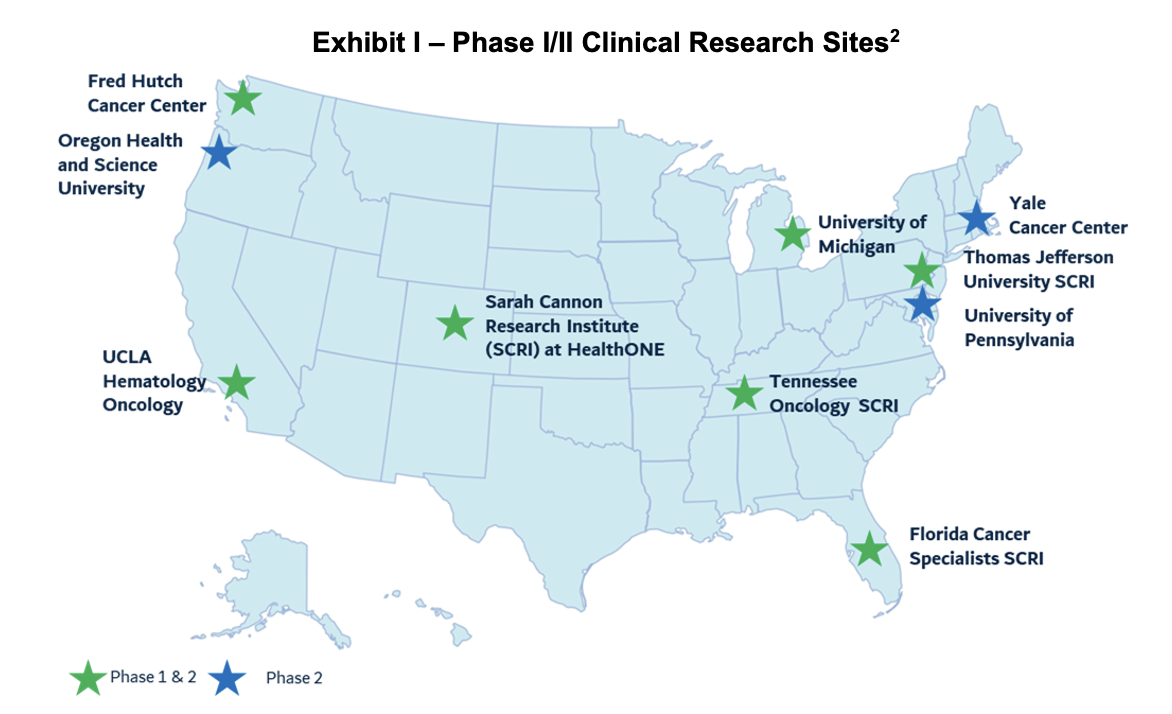
On April 12th, the company announced that the first patient had been dosed and confirmed that initial data from the Phase I portion would be provided by the end of 2023. On April 17th, Kineta provided an update on the trial noting that tissue and serum samples would be collected to isolate predictive biomarkers.
In conjunction with its August 11th 2Q:23 earnings release, Kineta reiterated its intention to report topline data from the trial by the end of the year. New patients continue to be recruited and seven trial sites have been engaged to conduct the study.
Kineta plans to pursue expedited pathways to approval, if available. Several regulatory routes allow for more rapid evaluation and approval of drug candidates. The company has identified Fast Track and Accelerated Approval as possible options. The FDA’s Fast Track requires that a drug demonstrate the potential to address an unmet need for a serious condition. It provides several benefits to the sponsor including closer collaboration with the FDA, rolling review of the drug’s Biologic License Application (BLA), eligibility for Accelerated Approval and Priority Review among other supportive measures. Accelerated Approval is a program intended for serious conditions that qualify as unmet medical needs. The pathway allows for surrogate endpoints to be used, which may greatly accelerate the clinical trial process. As a condition of accelerated approval, the sponsor is required to conduct post-marketing studies to confirm the anticipated clinical benefit.
These programs may allow Phase II data to be used to support a BLA and shorten the length of the trial by using objective response rate (ORR), progression-free survival (PFS) or other intermediate measures to evaluate efficacy. Using these endpoints would reduce the time required to evaluate efficacy as opposed to overall survival (OS), which is considered the most stringent standard for assessing clinical benefit. If a surrogate endpoint is used for provisional approval, OS will likely be required for the primary endpoints in confirmatory trials. To maintain a conservative stance, our estimates assume that Kineta will advance into Phase III trials after Phase II and will not benefit from an expedited pathway. Upon confirmation of either Fast Track or Accelerated Approval, we will adjust the model accordingly.
Our estimates call for the ongoing Phase I study to be completely enrolled by year-end 2023, followed by the start of the Phase II in 3Q 2024. We expect the Phase II to take 24 months to finish, followed by a Phase III in 2026 which would end in late 2027. A BLA is expected to be compiled and submitted to the FDA in 2028 and, if granted, approval and commercialization would come in 2029. For other regions around the world, we anticipate a one-year delay in the submission of a drug application, suggesting that additional regions will grant approval by 2030 and beyond. We discuss the details of our estimates further in the valuation section of this report.
Upcoming Milestones
➢ Initial report of clinical safety data – 3Q
➢ Second closing of $22.5 million private placement – October 31, 2023
➢ Initial report of clinical efficacy data – 4Q:23
➢ IND filing for anti-CD27 agonist – 4Q:24
Summary
Kineta is developing a promising candidate in the checkpoint inhibitor class that will target the VISTA immune checkpoint. Many studies have shown a synergy between anti-VISTA candidates and checkpoint inhibitors, providing a strong rationale for advancing a product in this category.
Kineta has completed its preclinical research which has identified a VISTA-specific candidate that induces a strong anti-tumor response both as monotherapy and with other checkpoint inhibitors. Its asset can reverse MDSC suppression of T cells and sidestep a serious adverse event in immunotherapy, CRS. VISTA is expressed in a wide variety of cancer types, including ovarian cancer, colorectal cancer, non-small cell lung cancer, cervical cancer, melanoma and hepatocellular carcinomas with the first three potentially serving as initial candidates for Kineta’s proof of concept trials.
KVA12123 is Kineta’s lead candidate and the subject of an ongoing Phase I/II clinical trial that is now conducting dosing studies. The multi-phase trial is expected to be run over the 2023-2025 period and generate data that will confirm the initial indications that will be pursued. We expect that Kineta will continue clinical trial work to add more indications as R&D efforts advance. Although our model does not include any expedited treatment for KVA12123, strong initial data in the Phase II may support the use of the Fast Track and Accelerated Approval pathways, which could advance commercialization by up to two years.
Many cancers are not cured and patients move into second, third and later line therapies to eradicate resistant tumors. This provides a large unmet need that new combination therapies may address. Based on our review, there are about 266,000 new cases in the US and 3.8 million outside the US in the primary indications that Kineta plans to pursue in OC, CRC and NSCLC. Our model anticipates an initial approval in the most promising indication, and later expansion into other indications with penetration into these markets growing over time. Pricing for a course of therapy is expected to be in line with other immunotherapies, which is expected to generate royalty and other related revenues for Kineta through the commercialization activities of a partner.
Kineta has recently raised capital and has a private placement planned for late October that will add another $22.5 million to the company’s coffers. Cash burn is estimated to be under $5 million per quarter, which suggests sufficient funding to support operations potentially into early 2025. This forecast includes the contribution from the anticipated private placement in July.
Key reasons to own Kineta shares:
➢ Developing KVA12123, a Phase I/II immune checkpoint, to treat solid tumors
o Addresses mechanism of cancer immune resistance
o Integrates innate and adaptive immune responses
o Demonstrates synergies with checkpoint inhibitors (anti-PD-1/PD-L1/CTLA-4)
➢ KVA12123 offers a favorable treatment effect in specific populations
o OC, CRC and NSCLC are high VISTA expressers
o Patients developing resistance to CIs are high VISTA expressers
➢ KVA12123 may augment response rates when combined with existing checkpoint inhibitors
➢ Produces favorable safety profile with no evidence of cytokine release syndrome (CRS)
o Antibody design with engineered Fc region to reduce immunogenicity
➢ Offers additional monoclonal antibody (mAb) assets in early stage development
o Anti-CD27 agonist
➢ Maintains global rights to intellectual property
KVA12123 adds another compelling entry into the immuno-oncology universe and has shown promising activity along with other checkpoint inhibitors in addressing high VISTA-expressing tumors. Our valuation work takes into account commercialization of the asset around the globe, assuming a 15% probability of success. As KVA12123 progresses and generates additional data, we will refine our indications and timeline accordingly. We maintain our valuation of $13.50 per share.
SUBSCRIBE TO ZACKS SMALL CAP RESEARCH to receive our articles and reports emailed directly to you each morning. Please visit our website for additional information on Zacks SCR.
DISCLOSURE: Zacks SCR has received compensation from the issuer directly, from an investment manager, or from an investor relations consulting firm, engaged by the issuer, for providing research coverage for a period of no less than one year. Research articles, as seen here, are part of the service Zacks SCR provides and Zacks SCR receives quarterly payments totaling a maximum fee of up to $40,000 annually for these services provided to or regarding the issuer. Full Disclaimer HERE.
________________________
1. Prior year earnings per share are adjusted for the May 2023 reverse share split.
2. Kineta corporate presentation, June 2023.