By John Vandermosten, CFA
NASDAQ: KA
READ THE FULL KA RESEARCH REPORT
3Q:23 Financial and Operational Results
Since our last report less than a month ago, Kineta, Inc. (NASDAQ: KA), has reported its third quarter financial and operational results, dosed its first combination therapy patient in its Phase I/II VISTA-101 clinical trial and presented two posters at SITC for its anti-CD27 and anti-VISTA monoclonal antibodies.
Highlights for 2023 include:
➢ VISTA as I-O target KOL event – March
➢ First monotherapy patient dosed in KVA12123 Phase I/II study – April
➢ $6 million direct offering priced – April
➢ Presented VISTA biomarker data and KVA12123 Phase I/II clinical trial update at AACR - April
➢ Addition to Russell Microcap Index – June
➢ Addition of new directors to board - June
➢ $5 million milestone announced from Merck - June
➢ Immuno-oncology webinar featuring Kineta CEO Shawn Iodonato – July
➢ Research agreement with Fred Hutchinson Cancer Center to evaluate VISTA biomarkers - September
➢ $3 million direct offering closed – October
➢ First combination therapy patient dosed in VISTA-101 clinical trial with KVA12123 – October
➢ Multiple presentations at SITC for KVA12123 & Anti-CD27 - November
Kineta generated no revenues during 3Q:23 and reported a net loss of ($5.4) million, or ($0.46) per share. For the quarter ending September 30, 2023 and versus the same period in the prior year:
➢ Revenues were $0 compared with $200,000 which were related to a National Institutes of Health (NIH) grant to research arenavirus hemorrhagic fever in a program that is now concluded;
➢ Research & Development expense totaled $1.9 million, down 27% from $2.6 million. The decline was attributable to substantially lower personnel costs due to reductions in R&D staff as the company transitioned to the clinic. This was partially offset by an increase in KVA12123 program costs and recognition of expenditures related to the ALS program;
➢ General & Administrative expenses were $2.1 million, up 2% from $2.0 million primarily due to higher personnel costs, professional services and other administrative expenses. Increases were generally attributable to public company costs;
➢ Total other income came from interest and investment sources. It declined on account of change in fair value of notes partially offset by less interest expense due to lower balances of interest paying notes;
➢ Net loss was ($5.4) million or ($0.46) per share compared with net loss of ($5.6) million or ($1.14) per share, respectively.1
At third quarter’s end, marketable securities, cash and equivalents totaled $7.6 million. Operating cash burn for 3Q:23 was a paltry ($0.2) million on account of the settlement of the license receivable from Merck which was recorded as revenue in the second quarter. After September 30, Kineta raised a net $2.7 million from a registered direct offering. Effective control of cash expenditures has allowed the company to maintain access to the $22.5 million from the second closing of the private placement. The company expects to access these funds next year which should provide sufficient capital to fund operations until early 2025. Financing cash flows were minimal in 3Q:23.
AACR Presentation of Anti-CD27 Preclinical Data
Dr. Thierry Guillaudeux, Kineta’s Chief Scientific Officer presented a poster entitled CD27 is a New Promising T-cell Co-stimulatory Target for Cancer Immunotherapy at the American Association for Cancer Research (AACR) Special Conference on Tumor Immunology and Immunotherapy, on October 3, 2023 in Toronto, Ontario, Canada. The goal of the work summarized in the poster was to perform in vitro and in vivo assessments to identify an anti-CD27 agonist antibody lead candidate.
In summary, Kineta’s leading monoclonal antibody (mAb) candidates showed high affinity binding to both human and cynomolgus monkey CD27, as well as high specificity against CD27, with no cross-reactivity detected against other members of the tumor necrosis factor receptor super family (TNFRSF). Additionally, none of the selected mAbs block the binding of CD27’s natural ligand, CD70.
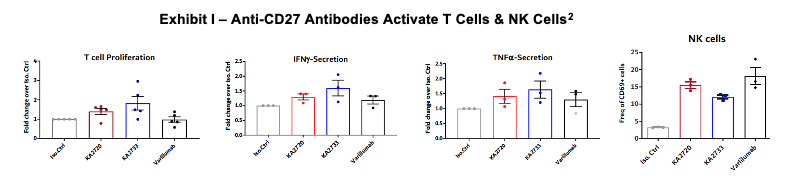
Investigators observed robust agonist properties related to T cell proliferation and activation after engagement of NFkB-mediated CD27 signaling as well as NK cell activation. The lead mAb showed antitumor efficacy in vivo in solid and hematological mouse tumor models as a single agent or in combination with other immunotherapies.
Society for Immunotherapy of Cancer’s (SITC) 38th Annual Meeting Poster Summary
Anti-CD27
A November 3rd press release highlighted the presentation of Kineta’s SITC poster which shared new data from the anti-CD27 monoclonal antibody program. The preclinical work showed that Kineta’s anti-CD27 binds to human and monkey CD27, but not to the rat or mouse variant, indicating that the primate model is appropriate for further preclinical work. The molecule also shares a different binding side from CD70 on CD27, allowing for co-stimulation from other sources. Kineta’s antibody drives strong T cell activation as well as natural killer (NK) cell activation, as shown in the following exhibit. It also demonstrates in vivo antitumor efficacy both as monotherapy or in combination with other immunotherapies such as anti-PD1 checkpoint inhibitors for both solid and hematological tumor models.
Anti-VISTA KVA12123
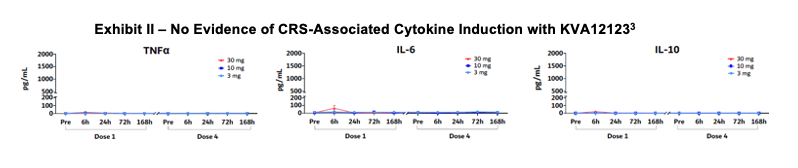
A November 6th press release highlighted Kineta’s poster presentation of data for its Phase I/II monotherapy trial evaluating KVA12123, its VISTA blocking immunotherapy. This is the first look at the company’s first clinical trial which evaluated 11 subjects with mostly late-stage disease who were administered KVA12123 in a twice weekly infusion. Findings from the study included a greater than dose-proportional pharmacokinetic profile, greater than 90% receptor occupancy in the 30 mg dosing cohort and a strong signal from biomarkers including a variety of cytokines, chemokines, NK cells, CD4+ and CD8+ T cells. Three monotherapy cohorts were evaluated, including 3, 10 and 30 mg, establishing a clinical safety profile, favorable tolerability and no dose limiting toxicities. Cytokine release syndrome (CRS) was not observed. On-target changes in anti-tumor immune cell subpopulations were observed after treatment, demonstrating drug activity. Next steps for the study are to expand the monotherapy cohorts to 100, 300 and 1000 mg and move into combination work with pembrolizumab, which has already started. Further data is expected to be shared at an appropriate conference in spring of next year.
SUBSCRIBE TO ZACKS SMALL CAP RESEARCH to receive our articles and reports emailed directly to you each morning. Please visit our website for additional information on Zacks SCR.
DISCLOSURE: Zacks SCR has received compensation from the issuer directly, from an investment manager, or from an investor relations consulting firm, engaged by the issuer, for providing research coverage for a period of no less than one year. Research articles, as seen here, are part of the service Zacks SCR provides and Zacks SCR receives quarterly payments totaling a maximum fee of up to $40,000 annually for these services provided to or regarding the issuer. Full Disclaimer HERE.
________________________
1. Prior year earnings per share are adjusted for the May 2023 reverse share split.
2. Kineta poster presented at SITC 2023. CD27 is a new promising T-cell co-stimulatory target for cancer immunotherapy.
3. Kineta poster presented at SITC 2023. VISTA-101: A phase 1/2 clinical trial of KVA12123, an engineered IgG1 targeting VISTA alone and in combination with pembrolizumab in advanced solid tumors.