By John Vandermosten, CFA
NASDAQ:LEXX
READ THE FULL LEXX RESEARCH REPORT
January 2023 Operational Update
Lexaria Bioscience Corporation’s (NASDAQ:LEXX) CEO, Chris Bunka, published a shareholder letter last week highlighting 2022 achievements and outlining the expected path forward for its portfolio of programs. Mr. Bunka listed capital expenditure priorities, summarized successful results from the numerous active and completed studies, emphasized ongoing partnership development activities and revealed that institutional ownership in the company had increased. The anticipated pathway forward for the DehydraTECH (DHT) cannabidiol (CBD) program that will pursue a 505(b)(2) new drug application following registrational studies was detailed. Advanced clinical work will likely be done in conjunction with a partner. The nicotine program is another valuable program in the pipeline and relatively close to commercial status. A successful result from the NIC-H22-1 trial may clear a path for a relationship with an established company. The CEO also discussed other work in seizures, diabetes and dementia that is expanded upon below.
Nicotine Updates
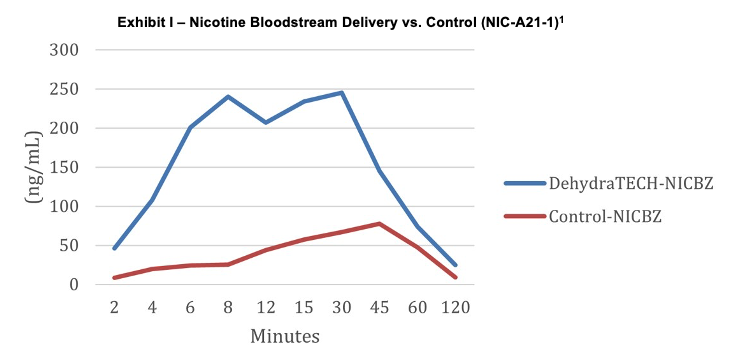
In an November 1st press release, Lexaria announced its receipt of Independent Review Board (IRB) approval for its human nicotine study designated NIC-H22-1. The study, which expects to enroll 36 subjects, is designed to be a randomized, double-blind, cross over study in cigarette smokers. The pharmacokinetic (PK) evaluation will dose each individual three times over a period of several weeks using an oral nicotine pouch. The pouch will be either DHT nicotine, or competing brands On! or Zyn.
Dosing for the trial began in December 2022, and will produce results that are evaluated with questionnaires and eight blood samples to evaluate nicotine delivery to the bloodstream. Other biomarkers including blood pressure and heart rate will also be taken. The goal of the study is to show whether or not DHT is able to provide better oral-tissue absorption and reduced negative experiences vs. the other participants in the study. Support for NIC-H22-1 was provided by previous animal model work demonstrating faster peak delivery of nicotine using DHT.
DehydraTECH and Diabetes
In its consistent effort to expand into new therapeutic areas, Lexaria began an animal study in diabetes which will be designated DIAB-A22-1. The effort, which started in November 2022, will evaluate the DehydraTECH-processed cannabidiol (CBD) and how it impacts diabetes in rats.
The associated press release highlighted the relationship between heart disease, hypertension and diabetes and the prevalence of diabetes, as the seventh most common cause of death. Impetus for the study has come from other work cited in the press release supporting its efficacy in reducing the incidence of diabetes.
A dose ranging study will be conducted over 56 days that will evaluate 32 male Zucker rats. 24 of the rats will be obese and eight will be lean. The two groups will be compared with respect to weight gain, blood glucose, cholesterol and triglyceride levels between those administered DHT-CBD and those which were not. Blood will be drawn six times over the course of the study. It will be conducted in Canada and is expected to be complete in January 2023 with data available shortly thereafter.
DehydraTECH and Dementia
Dementia has been a tough nut to crack over the last several decades, with several drugs approved to treat the symptoms of the disease in the early 2000s, and a long break until the next approval in mid-2021. This drug, Biogen’s Aduhelm for Alzheimer’s disease (AD), suffered several setbacks both before and after it was approved and is not expected to be an important contributor due to its limited benefit and negative side effects. More recently, in early January 2023, another disease modifying therapy was approved, Leqembi, which shows slightly better results, but lacks the clear-cut benefit desired. This leaves the field wide open for therapies that can either slow or improve the symptoms of dementia, and shows that the FDA seriously considers new candidates in this space given the dearth of available therapies.
In response to this unmet need and an anticipated benefit from DehydraTECH administered CBD, Lexaria is conducting a preclinical study designated DEM-A22-1 to measure the impact in 32 Long Evans rats. The rats will be dosed with DHT CBD and will employ a novel object recognition test to measure the impact of the investigational drug on cognitive performance. Lexaria outlines further details of the study and the potential market size for drugs used in dementia in a November 10, 2023 press release.
Support for launching the study is based on the benefit DHT-CBD shows in the reduction of blood pressure. Individuals with high blood pressure are more likely to develop vascular dementia, which is the second most common dementia.2 Research cited by Lexaria in their press release3 finds that the endocannabinoid system is associated with many neurodegenerative diseases including Alzheimer’s disease, Huntington’s disease, Parkinson’s disease and vascular dementia. If DEM-A22-1 is successful, further studies will be considered.
Seizure Study Program
In June 2018, the FDA approved GW Pharmaceuticals’ Epidiolex, a CBD oral solution for treatment of seizures in children with Lennox-Gastaut or Dravet syndrome. This was the first drug approved that included an active ingredient from the cannabis plant. GW Pharmaceuticals was later acquired by Jazz Pharmaceuticals (NASDAQ:JAZZ) in early 2021 and has generated an estimated $750 million in revenues for 2022 and is further expected to break the billion-dollar mark by 2024.
The success of Epidiolex spurred Lexaria to perform its own studies evaluating the efficacy of CBD for seizures using its DHT delivery technology. Animal seizure study program EPIL-A21-1 was designed to evaluate whether DHT-CBD could provide similar seizure inhibiting efficacy at lower doses than those used in Epidiolex. The goal would be to achieve similar efficacy while reducing systemic exposure and related side effects with the lower dose.
In the animal study, Lexaria provided initial results in a November 29th, 2022 press release. An initial electrical stimulation pilot study in animals that examined three different doses revealed that, at the lower doses of 50 mg/kg and 75 mg/kg, DHT-CBD was more efficacious than Epidiolex in reducing or eliminating seizure activity. While Epidiolex was more efficacious than DHT-CBD in eliminating seizure activity at the highest dose tested in the pilot study of 100 mg/kg, only DHT-CBD demonstrated some reduction in seizure activity at the 50 mg/kg dose. At the 75 mg/kg dose DHT-CBD demonstrated full elimination of seizure activity in two thirds of the animals compared to 50% of the Epidiolex treated animals. In this regard, there was an apparent trend for DHT-CBD to work better at lower doses than Epidiolex.
Following the pilot experiment, a second electrical stimulation animal seizure study was performed where time to peak efficacy was measured at various post-dosing time points. DHT-CBD demonstrated an apparent trend toward enhanced effectiveness, in this case based on rapidity of action. After 30 minutes, 50% of the animals dosed with DHT-CBD showed partial reduction or full elimination of seizure activity whereas 100% of the Epidiolex-dosed animals were exhibiting full seizure activity at 30 minutes. After 60 minutes, 87.5% of the animals dosed with DHT-CBD showed partial reduction or full elimination of seizure activity compared to 62.5% of the Epidiolex-dosed animals showing partial reduction or full elimination of seizure activity. Epidiolex demonstrated enhanced seizure reduction capabilities at later time points in the study.
The results are supportive of further study for DHT-CBD in the clinic, providing the benefits of the drug at lower doses and more quickly than the approved medication. However, we caution that these are preclinical, animal studies and that clinical work may produce different results.
Hypertension
Hypertension grabbed the spotlight in early January with AstraZeneca’s (NASDAQ:AZN) bid for the recently IPOed CinCor Pharma (NASDAQ:CINC). CinCor recently provided top-line data from its Phase II study that evaluated baxdrostat in hypertension patients. Baxdrostat is a selective aldosterone synthase inhibitor shown to lower aldosterone levels without affecting cortisol. The primary endpoint of the study was not met; however, there were large reductions in systolic blood pressure. AstraZeneca saw enough promise in the data to support further trials in hypertension and chronic kidney disease. Merger and acquisition activity in the space accentuates the unmet need for effective control of hypertension and provides a healthy backdrop for further work by Lexaria in this area.
Lexaria’s latest update on its hypertension program was in late December 2022, where it provided more details on DHT-CBD absorption levels. The HYPER-H21-4 hypertension study using DHT-CBD was able to achieve a 46% greater human blood plasma level, or 33.3 mg/mL, than was achieved in a previous study using oral CBD solution for seizures related to Dravet syndrome. To compare the results of the HYPER-H21-4 study to the Dravet study, Lexaria provided a graph of the DHT-CBD results (with extrapolation) exhibiting the greater plasma CBD levels between the two approaches and included another data point from the Wheless et al. study (the triangle marker in the exhibit below).
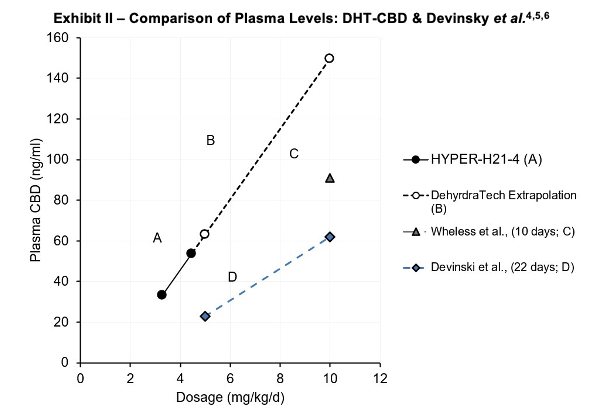
The data support Lexaria’s contention that DHT-CBD can be administered at lower doses than other CBD formulations and achieve therapeutic levels in the bloodstream. Benefits from the approach can reduce systemic levels of the drug, while achieving similar results using higher levels of CBD.
SUBSCRIBE TO ZACKS SMALL CAP RESEARCH to receive our articles and reports emailed directly to you each morning. Please visit our website for additional information on Zacks SCR.
DISCLOSURE: Zacks SCR has received compensation from the issuer directly, from an investment manager, or from an investor relations consulting firm, engaged by the issuer, for providing research coverage for a period of no less than one year. Research articles, as seen here, are part of the service Zacks SCR provides and Zacks SCR receives quarterly payments totaling a maximum fee of up to $40,000 annually for these services provided to or regarding the issuer. Full Disclaimer HERE.
________________________
1. Source: Lexaria Press Release, November 1, 2022. Lexaria Receives Independent Review Board Approval for its Upcoming Human Oral Nicotine Study.
2. Alzheimer’s Society. High Blood Pressure and Dementia.
3. Walther, S., Halpern, M. Cannabinoids and Dementia: A Review of Clinical and Preclinical Data. Pharmaceuticals. August 2010.
4. Devinsky, O., et al. Trial of Cannabidiol for Drug-Resistant Seizures in the Dravet Syndrome. New England Journal of Medicine, May 2017.
5. Wheless, J., et al. Pharmacokinetics and Tolerability of Multiple Doses of Pharmaceutical-Grade Synthetic Cannabidiol in Pediatric Patients with Treatment-Resistant Epilepsy. CNS Drugs, June 2019.
6. Lexaria Press Release, December 21, 2022. Lexaria's DehydraTECH-CBD Achieves Superior Human Blood Absorption Levels.