By John Vandermosten, CFA
NASDAQ:LEXX
READ THE FULL LEXX RESEARCH REPORT
Lexaria Bioscience Corporation (NASDAQ:LEXX) reports fiscal full year 2023 results along with program updates, new deals and a small capital raise since the third quarter report in August. The company announced that the investigational new drug (IND) application would be delayed on account of a supplier. It expanded its GLP-1 agonist research and provided preliminary data from the related studies and announced the grant of two Canadian patents. We expect upfront and other revenues in FY:24 from the announced SulfoSyn license which applies Lexaria’s technology to a supplement to improve bioavailability and stability.
FY:23 Results
Lexaria filed its fiscal year 2023 Form 10-K on November 20, 2023. The company reported FY:23 revenues of $226,000, and total operating expense of $6.7 million resulting in net loss of ($6.7) million or ($1.01) per basic and diluted common share.
For the fiscal year ending August 31, 2023 and versus the comparable prior period in 2022:1
➢ Revenue totaled $226,000, down 11% from $255,000 on a decrease in Product and Other revenues. These amounts were offset by an increase in intellectual property licensing. Some of the year over year decline was attributable to reclassifications required by the new auditor;
➢ Gross profit increased to $195 from $184 on account of the shift to licensing revenues and away from product revenues;
➢ Research and development expenses totaled $3.7 million, up 99% from $1.8 million tied to the multiple DehydraTECH investigational research programs underway, including analysis and execution of the hypertension, nicotine and diabetes studies;
➢ General and administrative expenses totaled $3.1 million, down by almost half from $5.7 million due primarily to a decrease in consulting fees, salary and stock-based compensation. Legal fees, advertising and promotion, and investor relations spending were also lower. Lexaria altered its accounting methodology and excludes changes in value for marketable securities from the general and administrative line which comprised part of the year over year decline in this line item;
➢ Other income included interest on cash balances of $43,000 offset by unrealized losses on marketable securities of ($222,000);
➢ Net loss was ($6.7) million, or ($1.01) per share, compared to net loss of ($7.3) million or ($1.24) per share.
As of August 31, 2023, cash and marketable securities totaled $1.5 million which compares to $6.2 million at the end of fiscal year 2022. Cash burn for FY:23 was approximately ($6.1) million. Following the end of the reporting period, Lexaria raised a net $1.3 million.
SulfoSyn License Agreement
In mid-October, Lexaria announced an exclusive global collaboration and license agreement with SulfoSyn Limited. SulfoSyn lacks any detailed information or a website, but we speculate that it might be associated with an anti-aging-focused life sciences company. Lexaria confirms that the parent company does have a marketed product. We have not been able to confirm the identity of the ultimate owner of SulfoSyn, but it is very likely that SulfoSyn will share the licensed technology with a recognized entity or brand when and if it reaches commercialization stage. The license allows for non-pharmaceutical use of DehydraTECH with sulforaphane, which may be used in supplements, additives, foods and dietary ingredients among other products. An upfront cash payment was made and minimum future payments are in place. Royalties may also be paid if in excess of minimum contractual payments. Lexaria will also perform certain manufacturing services for SulfoSyn in the United States for two years in its Atlanta facility. While a firm order has not yet been placed, we anticipate this will occur in the near term.
Sulforaphane is a chemical compound that is found in a variety of cruciferous vegetables such as cabbage, cauliflower, brussels sprouts and broccoli among others. It is considered an antioxidant and anti-inflammatory that may provide health benefits. It may reduce risks related to cancer and promote cardiovascular and nervous system health. Sulforaphane may also enhance detoxification through activation of enzymes. Sulforaphane tablets are available but offer low bioavailability as is the case with many supplements. The shelf stability of the compound is also very limited as it degrades quickly. After a few days unstabilized sulforaphane degrades 80% or more. Using DehydraTECH to stabilize and deliver this supplement may provide substantial improvement in utility and potentially improve sales of this nutritional supplement.
CPG Product Subsidiary
In July, Lexaria incorporated a new wholly-owned subsidiary called Lexaria Nutraceutical Corp. in order to optimize its DehydraTECH strategy that serves a number of markets that fall under different regulatory regimes worldwide. The strategy enables Lexaria to more efficiently participate in M&A activity. The subsidiary, which is referred to as LEXX Nutra, has received a perpetual license to create consumer packaged goods and intermediate ingredients for any molecule save those associated with nicotine or cannabis. The subsidiary is also prevented from using the license to produce a pharmaceutical product. The parent also made modifications to other subsidiaries’ arrangements, amending the exclusive licensing rights of Lexaria Pharmaceutical Corp. to only pertain to the manufacture or licensing of pharmaceutical products, excluding nicotine.
DehydraTECH and Diabetes
In its ongoing effort to expand into new therapeutic areas, Lexaria launched an animal study in diabetes in November 2022 designated DIAB-A22-1. It has evaluated the DehydraTECH-processed cannabidiol (CBD) molecule and how it impacts diabetes-related biomarkers in rats. The associated press release highlighted the relationship between heart disease, hypertension and diabetes and the prevalence of diabetes, as the seventh most common cause of death. Impetus for the study has come from other work cited in the press release supporting CBD efficacy in reducing the incidence of diabetes.
Results from the diabetes study generated multiple outcomes including weight loss in obese diabetic-conditioned animals, improved triglyceride and variable cholesterol levels. These biomarkers are all associated with diabetes and improvements can be associated with better outcomes for diabetic patients. Weight loss was observed four days after initial dosing of DehydraTECH-CBD. Maximum weight loss was achieved nine days after dosing began and was maintained for the 8-week duration of the study. The weight loss averaged 7% of body weight for both of the doses used in the study (30 mg/Kg and 100 mg/Kg). Only the DehydraTECH-CBD-dosed animals weighed less at the end of the study than at the beginning, whereas the weight of the untreated obese animals trended upwards throughout. Food and water intake for all groups was similar, supporting the hypothesis that weight loss is, at least in part, attributable to enhanced metabolic function.
The strength of the data in the animal studies led Lexaria to pursue a human trial in diabetes using DehydraTECH CBD to see if any of the improvements observed in animals are exhibited in humans. Details of the effort are included in an August 2nd press release. Study design development is underway for the human study, and when complete will be submitted to an independent review board for approval. The study will take place at the same hospital in Europe that conducted the human hypertension studies with DehydraTECH. Study design is targeted to be complete by the first half of September followed by submission to the medical ethics boards for clearance.
Efforts to advance diabetes and weight loss research were further advanced with the September 21, 2003 press release that announced Lexaria’s intent to evaluate performance of the glucagon-like peptide-1 (GLP-1) agonist class using DehydraTECH. The goal of the efforts is to determine if employing DehydraTECH for delivery would be able to reduce side effects, enhance weight loss, improve health outcomes, improve bioavailability and reduce cost. Targeted products include Ozempic, Wegovy and Rybelsus. Another product in this class called Zepbound by Eli Lilly was recently approved by the FDA for weight loss potentially providing another candidate for Lexaria’s work.
In late October, industry news regarding the effectiveness of DehydraTECH was included in an article that highlighted the drug delivery platform’s ability to control blood sugar and reduce body weight. The review noted that DehydraTECH is easily integrated into oral product manufacturing processes, the GLP-1 market has the potential to be very large, DehydraTECH has broad applications and the platform has proven itself in a number of products and indications.
Lexaria provided an update in early November noting that it is expanding its diabetes study program, including using DehydraTECH with GLP-1 drugs alone and in combination with other molecules. This was followed by a pair of press releases in late November summarizing semaglutide comparative performance using Novo Nordisk’s oral formulation and a DehydraTECH formulated version of semaglutide.
On November 27th, Lexaria provided an update on its semaglutide study. The press release reported that the DehydraTECH formulation of semaglutide sustained higher levels of the drug in the blood, achieved faster peak drug delivery and produced fewer side effects compared with Novo Nordisk’s oral formulation Rybelsus. A university research center is conducting the study comparing 7 mg of semaglutide in a Rybelsus tablet to a compound formulated in capsule form using DehydraTECH processing technology enhancements. Rybelsus has distinguished itself with strikingly low bioavailability of 1% or less, providing an opening for an alternative that achieves better results. The exhibit below illustrates the blood plasma levels of Rybelsus and DehydraTECH semaglutide over a 10-hour period with the DehydraTECH formulation achieving higher blood levels at each measurement point.
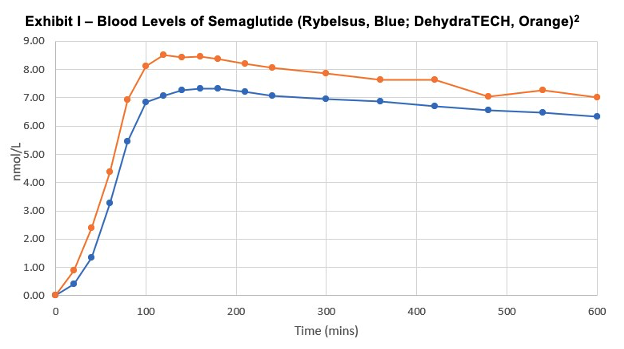
Two of the three control subjects and zero of the four DehydraTECH GLP-1 subjects reported experiencing moderate nausea. All three control subjects reported experiencing mild nausea at both the 2-hour and 10-hour timepoints whereas only one DehydraTECH semaglutide subject reported mild nausea and only at the single, 2-hour timepoint.
On November 28th, a follow up press release was promulgated providing additional data summarizing the effects of varying formulations of semaglutide on blood glucose. The results demonstrated lower overall blood glucose levels and less variability for the DehydraTECH semaglutide oral formulation compared with Rybelsus. The study evaluated blood glucose levels every 20 minutes for the first few hours then every hour over the measurement period. Subjects consumed a standardized meal at the 240-minute (4 hour) mark and a snack at the 360-minute (6 hour) mark.
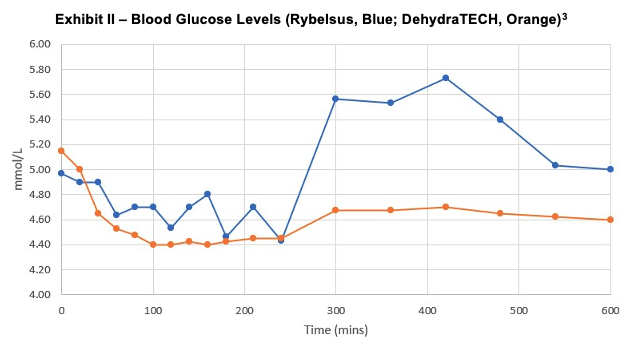
Lexaria emphasized the small sample size for the study noting that the work is intended to guide future studies. Additional results are expected to be released in December or early January following the completion of a part two cross-over study. As is customary in a cross-over design, the control and DehydraTECH subjects will switch treatments and be dosed in reverse order compared to part one.
The semaglutide study is intended to provide pharmacokinetic and pharmacodynamic data to help guide future work. Since there were only seven subjects in the trial, there are insufficient data to provide significant results; however, as shown in the information provided, initial indications show improved performance from the DehydraTECH formulations of semaglutide.
Lexaria may further consider studying DehydraTECH in further diabetes trials to examine both blood sugar control and weight loss. The study may include combination approaches of DehydraTECH CBD with DehydraTECH semaglutide. Management has penciled in this trial to start in mid-2024 pending the availability of funding.
SUBSCRIBE TO ZACKS SMALL CAP RESEARCH to receive our articles and reports emailed directly to you each morning. Please visit our website for additional information on Zacks SCR.
DISCLOSURE: Zacks SCR has received compensation from the issuer directly, from an investment manager, or from an investor relations consulting firm, engaged by the issuer, for providing research coverage for a period of no less than one year. Research articles, as seen here, are part of the service Zacks SCR provides and Zacks SCR receives quarterly payments totaling a maximum fee of up to $40,000 annually for these services provided to or regarding the issuer. Full Disclaimer HERE.
________________________
1. Our year over year comparison uses originally reported data.
2. Source: Lexaria Press Release, November 27, 2023. This was a small sample with only three observations for Rybelsus and four for DehydraTECH.
3. Source: Lexaria Press Release, November 27, 2023. This was a small sample with only three observations for Rybelsus and four for DehydraTECH.