By John Vandermosten, CFA
NASDAQ:LTRN
READ THE FULL LTRN RESEARCH REPORT
Recent Program Updates
Since Lantern Pharma, Inc. (NASDAQ:LTRN) announced 3Q:22 results in early November, there have been a number of program updates for LP-184 and LP-284. In late November, Lantern announced positive data regarding the anti-tumor potency of LP-184 in glioblastoma (GBM) and a few weeks later highlighted LP-184’s results in for triple negative breast cancer (TNBC). The FDA provided pre-IND feedback regarding LP-184 regarding the Phase I trial in multiple solid tumors that is anticipated to begin in 2Q:23. Not to be outdone, LP-284 generated positive new data for Mantle Cell Lymphoma at the American Society of Hematology (ASH) and received FDA orphan drug status in the same indication.
LP-184 Progress
SNO Poster for GBM
In late November, Lantern highlighted positive data around the anti-tumor potency of LP-184 in glioblastoma (GBM) at the Society for Neuro-Oncology Annual Meeting held in Tampa Bay, Florida. Positive preclinical data was presented for the use of LP-184 either alone or in combination with spironolactone for use against GBM. LP-184 preferentially damages DNA in cancer cells that harbor mutations in DNA damage repair (DDR) genes and that overexpress the enzyme PTGR1. The associated poster exhibited the in vitro/in vivo efficacy of LP-184 towards GBM as a single agent or in combination with spironolactone. This may provide an alternative to the standard of care agent temozolomide, which is ineffective in most patients.
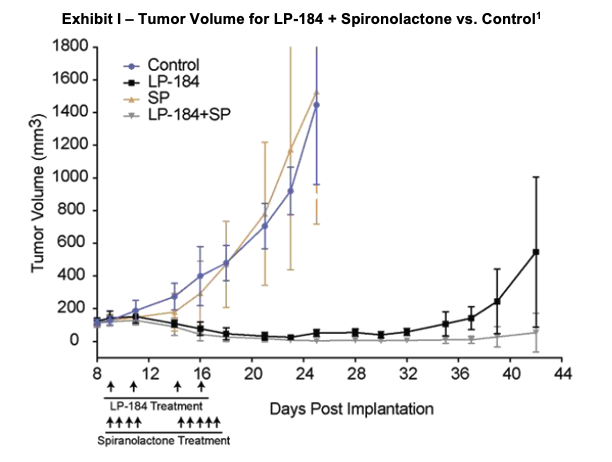
The presentation concluded that LP-184 is effective against temozolomide-resistant preclinical GBM models and is similarly effective independent of methylation status.2 Common GBM tumor characteristics enhance the effectiveness of LP-184 in patients with intrinsic or spironolactone-induced nucleotide excision repair (NER) deficient tumors. Next steps for this program are to test LP-184 in combination with spironolactone in an intracranial xenograft model of GBM to assess survival, tumor response and pharmacokinetics. Additional investigational new drug (IND) enabling work is also planned.
SABCS Poster in TNBC
Lantern presented at the San Antonio Breast Cancer Symposium in December exhibiting LP-184’s anti-tumor efficacy for triple negative breast cancer (TNBC) in comparison with standard of care agents. Many breast cancers lack the receptors for estrogen, progesterone or HER2 and drugs designed for these targets are ineffective. TNBC is a particularly deadly type of breast cancer with median survival of metastatic patients at less than one year.
The poster presented highlights LP-184’s in vitro and in vivo anti-tumor potency across several breast cancer models, including those resistant to poly ADP-ribose polymerase (PARP) inhibitor Olaparib. Summary conclusions from the poster include:
➣ LP-184 demonstrates nanomolar potency in a panel of breast cancer cell lines;
➣ LP-184 dosed at 4 mg/kg was well tolerated in all TNBC PDX tumor models;
➣ Monotherapy LP-184 demonstrated high antitumor efficacy with complete tumor regression observed;
➣ LP-184 may be broadly efficacious in multiple other solid tumors with homologous repair and/or NER pathway defects, such as pancreatic, prostate, ovarian and bladder cancers.
Pre-IND Feedback for LP-184
In mid-January, Lantern announced the receipt of feedback from the FDA regarding its anticipated LP-184 investigational new drug (IND) submission. In 4Q:22, Lantern requested the pre-IND meeting with the agency to ensure that the IND submission would address all of the FDA’s concerns. The submission is expected in the near term, and if there are no outstanding questions, clearance could arrive in time for a trial to start in 2Q:23. The related study will look at a variety of solid tumors including those related to pancreatic cancer, solid tumors with DNA damage repair deficiency and malignant gliomas, including glioblastoma.
LP-284 Progress
LP-284 Presentation at ASH
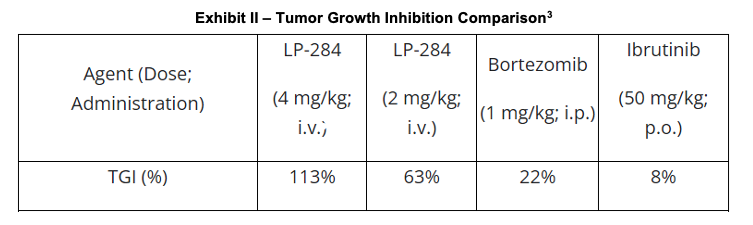
In mid-December, new data from Lantern’s development work for LP-284 was presented at the American Society of Hematology (ASH) 2022 Annual meeting in New Orleans, Louisiana. The associated poster is entitled “Development of a Potent DNA Damaging Agent LP-284 for Treatment of Mantle Cell Lymphoma.” Results in the poster demonstrated significantly greater tumor growth inhibition (TGI) in mice implanted with mantle cell lymphoma (MCL) cell derived xenograft tumors, when compared to treatment with the standard-of-care agents Ibrutinib or Bortezomib.
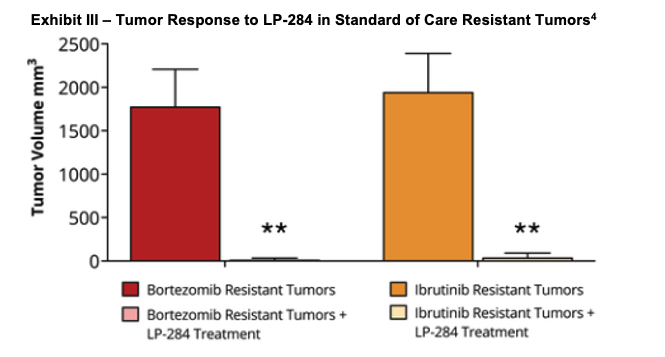
In mouse tumors that had grown resistant to Bortezomib or Ibrutinib, subsequent administration of LP-284 resulted in substantial regression of the standard of care treated lesion. This effect is shown in the following exhibit.
LP-284 treatment of MCL cell lines significantly down-regulated key cancer promoting genes and pathways. These new in vitro and in vivo preclinical data for LP-284 strongly support its anti-tumor activity in MCL over current standard of care agents.
Key conclusions from the poster are that LP-284:
➣ Significantly delays tumor progression and prolongs survival of the mouse models compared with Ibrutinib and Bortezomib;
➣ Shrinks and delays the progression of MCL xenograft tumors;
➣ Induces DNA damage.
Data shared in this presentation will support the preparation of an IND to pursue indications in MCL and double hit lymphoma. IND-enabling studies are expected to be complete in 1Q:23 and validation of LP-284 as a novel agent targeting oncogene addiction is ongoing.
Orphan Drug Designation for LP-284 in MCL
Starting off the year with positive news, Lantern’s first press release for 2023 announced the FDA’s grant of orphan drug status to LP-284 in mantle cell lymphoma (MCL). According to the National Organization for Rare Disorders (NORD), MCL is a type of non-Hodgkin’s lymphoma that affects every one out of 200,000 individuals or about 1700 persons. Lantern plans to file a related IND for LP-284 in B-cell non-Hodgkin’s lymphomas, including MCL by mid-2023.
Orphan drug designation grants several benefits to awardees including tax credits for qualified clinical trials, exemption from user fees and seven years of exclusivity after approval. In the United States, the status may be given to products that address diseases affecting fewer than 200,000 persons. Similar benefits are available in other regions outside the United States, and ten years of exclusivity is offered in the European Union. These incentives may be available if Lantern seeks and is granted orphan designations in these areas. This is the fourth orphan designation granted to Lantern with others for indications in malignant gliomas, atypical teratoid rhabdoid tumors and pancreatic cancer.
SUBSCRIBE TO ZACKS SMALL CAP RESEARCH to receive our articles and reports emailed directly to you each morning. Please visit our website for additional information on Zacks SCR.
DISCLOSURE: Zacks SCR has received compensation from the issuer directly, from an investment manager, or from an investor relations consulting firm, engaged by the issuer, for providing research coverage for a period of no less than one year. Research articles, as seen here, are part of the service Zacks SCR provides and Zacks SCR receives quarterly payments totaling a maximum fee of up to $40,000 annually for these services provided to or regarding the issuer. Full Disclaimer HERE.
________________________
1. Source: Lantern Poster Preclinical efficacy of LP-184, a tumor site activated synthetically lethal therapeutic, in glioblastoma. November 2022.
2. Methylation refers to the attachment of methyl groups to DNA. Methylation typically occurs on cytosine residues in the DNA molecule and can change the expression of genes by affecting the way that the genetic information is interpreted. Methylation is an epigenetic modification, meaning that it can alter gene expression without changing the underlying DNA sequence. MGMT (O6-methylguanine-DNA methyltransferase) is a DNA repair gene that is commonly methylated in glioblastomas. Methylation of the MGMT promoter is associated with the inactivation of the MGMT gene, which leads to chemotherapy resistance with alkylating agents, such as temozolomide. A methylated MGMT gene means that the gene is turned off, and the tumor is resistant to certain chemotherapy drugs. An unmethylated MGMT gene, on the other hand, means that the gene is turned on, and the tumor is sensitive to those drugs. The methylation status of the MGMT gene is therefore an important predictor of response to therapy in glioblastoma patients.
3. Source: Lantern Press Release, December 15, 2022.
4. Source: Lantern Press Release, December 15, 2022.