By Brad Sorensen, CFA
NASDAQ:MIRA
READ THE FULL MIRA RESEARCH REPORT
MIRA Pharmaceuticals (NASDAQ:MIRA) is a preclinical-stage pharmaceutical company focused on the development and commercialization of a new molecular synthetic cannabinoid analog for the treatment of adult patients with neuropathic pain as well as anxiety and cognitive decline typically associated with early-stage dementia. Adding to its continuing pursuit of the company’s primary treatment, MIRA1, MIRA announced that it has acquired an exclusive license to develop and commercialize a product commonly known as Ketamir, which, in layman’s terms, is a potential derivative of the antidepressant ketamine that has shown indications of having fewer side effects, working more rapidly, and having the opportunity to impact millions of patients that have not responded to other, existing treatments. The terms of the deal appear to us to be fashioned in a way that is low risk for MIRA with the potential for a very high return:
• MIRA agreed to make a one-time payment to Miralogx, the owner of Ketamir, of $100,000 and issued warrants that give Miralogx the right to purchase up to 700,000 shares of MIRA at an exercise price of $2.00 per share any time prior to November 15, 2028.
o Additionally, MIRA agreed to pay Miralogx royalty payments of 8% of net sales and other revenue from licensed products.
• In return, the MIRA obtains the rights to license and commercialize Ketamir and can borrow up to $3 million from Miralogx to fund the development of Ketamir.
We believe this is a deal that provides a great opportunity for MIRA at a relatively low cost. Ketamir is at the beginning of the approval process but initial tests that we’ve seen have proved quite promising. Additionally, this deal fits with the MIRA way of doing business by providing an existing treatment in a “better” way—fewer side effects, easier to use, quicker acting, etc.
There are currently roughly 30 antidepressants available to the public, but 33% of patients receive no relief from any of these treatment options, while, for the patients that the treatments do work for, the time to take effect can be lengthy. Additionally, one of the more popular treatments goes by the name Spravato, which is an esketamine marketed by Johnson and Johnson. Although the treatment is given by a nasal spray, patients are required to administer the medication at a certified treatment center where the patient can be observed for at least two hours in order to ensure no dangerous side effects begin. The FDA requires this REMS (risk evaluation and mitigation strategies) due to potential side effects such as sedation and dissociation, while also being concerned about the potential for abuse of the Schedule III substance. Despite these hurdles, sales for 2023 of Spravato are expected to be around $600 million. It’s highly unlikely that Ketamir will face these same hurdles as the company announced that they had received a decision on Ketamir from the Drug Enforcement Agency: “The Drug Enforcement Administration (DEA) conducted a scientific review of the chemical structures of these substances in accordance with the definitions within the CSA and its implementing regulations. Based on this review, DEA determined that Ketamir-1 and Ketamir-2 are not controlled substances or listed chemicals under the CSA.” That decision will make Ketamir, if and when it is approved by the FDA, much easier to obtain and use for patients.
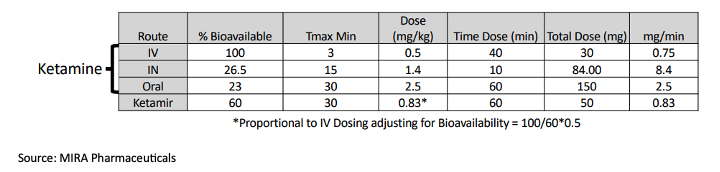
There is still a long FDA process to go through, but in initial testing, Ketamir has been shown to have fewer side effects due to its design that avoids impacting the opiate receptor. Testing has also shown better bioavailability, meaning that the treatment gets into the bloodstream in a more efficient way through better absorption in the intestine. As seen in the table below, Ketamir taken orally has roughly the same bioavailability as what is considered the gold standard for Ketamine bioavailability—injection using an IV.
We’ll learn more about Ketamir as human trials begin in 2024 but what gives us more confidence in this move is the fact that Dr. Adam Kaplin is involved and endorses Ketamir. Dr. Kaplan is one of the foremost experts on ketamine and was the Johns Hopkins Site Principal Investigator for Phase 3 clinical trials that led to the approval of Spravato. Additionally, the doctor founded and directed the Johns Hopkins Esketamine Clinic for Depression and has published multiple peer-reviewed articles about the use of ketamine for depression. In short, there is no other medical professional in our view that has more extensive expertise in this area and whose opinion on Ketamir we would value more highly.
In judging how much value this deal adds to MIRA, we are also pleased to have an in-depth report from the very respected firm IQVIA, which is a provider of biopharmaceutical development and professional consulting services. IQVIA’s report, which was investigated in depth, uses assumptions that we find reasonable and well thought out, both in terms of potential market size and the share of the market Ketamir may be able to capture if approved. Of course, we also look at similar drugs, such as Spravato mentioned above, and consider that Ketamir is at the beginning of a 20-year patent. However, as always, we attempt to err on the side of conservative valuations and recognize that Ketamir still has to endure the arduous FDA approval process. Due to Ketamir’s good initial results and it being a derivative of an already approved drug, we give it better than average chances of being approved but give a weighting to future revenue from Ketamir a 10% weight at the current time, with the belief that percentage will rise rapidly as human trials show expected success.
MIRA continues to focus on the development of MIRA1, which we have written about extensively and believe has great promise, and now adds another potential blockbuster to its portfolio, supported by one of the leading scientists on the subject. Additionally, the company acquired this additional asset along with the access to cash to develop the product, meaning MIRA will not have to hijack funds from the crucial development of MIRA1 and can move along both paths simultaneously. We believe this was a move that will benefit MIRA and its shareholders and urge investors to take a look at MIRA before the expected positive test results start coming in.
SUBSCRIBE TO ZACKS SMALL CAP RESEARCH to receive our articles and reports emailed directly to you each morning. Please visit our website for additional information on Zacks SCR.
DISCLOSURE: Zacks SCR has received compensation from the issuer directly, from an investment manager, or from an investor relations consulting firm, engaged by the issuer, for providing research coverage for a period of no less than one year. Research articles, as seen here, are part of the service Zacks SCR provides and Zacks SCR receives quarterly payments totaling a maximum fee of up to $40,000 annually for these services provided to or regarding the issuer. Full Disclaimer HERE.