By Thomas Kerr, CFA
LSE:OKYO | NASDAQ:OKYO
Overview
Dry Eye Disease (DED) is a stealth disease that affects 35% of the over 50 year-old population with women representing two-thirds of those affected. Worldwide, approximately 700 million patients suffer from some form of dry eye disease. DED is often associated with aging and occurs when a tear film dysfunction creates a situation where tears are unable to provide adequate lubrication for the eyes. Symptoms can include a scratchy sensation in the eyes, excessive blinking, light sensitivity, blurry vision, eyesight fatigue and ocular pain. The prevalence of dry eye disease is expected to increase substantially in the future due to an aging global population and the increased use of contact lenses and digital screen time.
One company leading the way to solve the problems created by DED is OKYO Pharma Ltd. (LSE:OKYO) (NASDAQ:OKYO). The company is a clinical stage bio-pharmaceutical company focused on developing an innovative approach to dry eye care and ocular pain. The company is developing a lipidated chemerin-peptide drug candidate, OK-101, which is designed to target a key ocular receptor controlling inflammation and ocular pain. The drug, developed by a unique proprietary membrane anchored technology, is designed to increase agonist potency and ocular residence time.
The company’s product pipeline targets eye conditions such as dry eye disease (DED), uveitis, allergic conjunctivitis, and ocular pain. The company’s core research efforts are focused on a novel G Protein-Coupled Receptor (GPCR) which may play a key role in the pathology of these inflammatory eye diseases. The company is also evaluating a second candidate, OK-201, which is a bovine adrenal medulla, lipidated-peptide preclinical analogue candidate, but has indicated this program is on hold in order to focus on the clinical development of OK-101.
In February 2018, the company announced that they successfully obtained a license from On Target Therapeutics to patents owned or controlled by OTT and a sub-license from OTT to additional patents licensed by OTT from Tufts Medical Center (TMC) to support their ophthalmic disease drug programs. These licenses gave them the right to exploit the intellectual property which is directed to compositions-of-matter and methodologies for treating ocular inflammation, DED, with chemerin or lipid-linked chemerin analogues. OKYO also has a license from TMC to a separate IP estate for treating symptoms of ocular neuropathic pain and uveitis associated pain. On August 6, 2019, the company signed a collaborative agreement with TMC on a research program focused on ocular neuropathic pain.
On January 7, 2021, the company announced the appointment of Mr. Gabriele Cerrone as Executive Chairman and Director, and Gary S. Jacob, Ph.D. as Chief Executive Officer and Director. The addition of these two experienced executives was a significant step for the company which highlighted a planned realignment of the strategic focus of the research and development program with the aim of advancing towards preclinical programs.
The initial pre-IND meeting regarding OK-101 was held in February 2022 and the FDA subsequently concurred that the first human trial of OK-101 could occur in a Phase 2 clinical trial. Because OK-101 is applied topically and doesn’t enter the bloodstream, clinical approvals of the drug were allowed to skip Phase 1. On December 22nd, 2022, announced that it has received clearance of its Investigational New Drug (IND) application from the FDA to initiate a Phase 2, first-in-human, clinical study of OK-101 for the treatment of DED. The FDA previously concurred with OKYO’s plans for designating primary and secondary efficacy endpoints covering both a sign and a symptom of DED in the clinical study protocol. This Phase 2 trial is expected to start in the 2nd quarter of 2023 with release of topline data anticipated in the 4th quarter of 2023.
OK-101
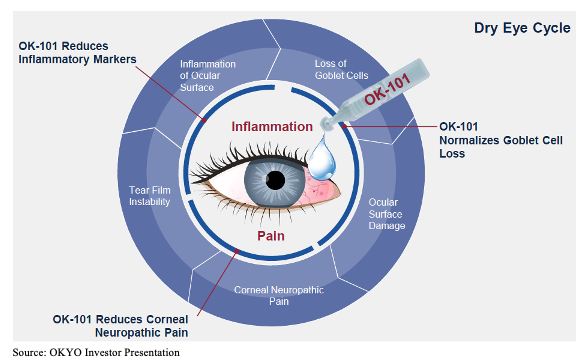
The evidence from over 40 years of medical and scientific literature suggests inflammation as the most common underlying cause of DED. An increase in the levels of inflammatory cytokines in both conjunctiva and tears is known to cause the chronic inflammation associated with DED. Consequently, development of new therapeutic agents that target inflammatory pathways is crucial in improving symptoms in DED patients. The scope of the TMC IP granted to the company through the sublicense with OTT is commensurate with the scope of use of the IP granted to OTT from TMC. This intellectual property forms the basis of the OK-101 program.
OK-101 is the company’s lead preclinical product candidate and is focused on keratoconjunctivitis sicca, commonly referred to as DED, which is a multifactorial disease caused by an underlying inflammation resulting in the lack of lubrication and moisture in the surface of the eye. DED is one of the most common ophthalmic conditions encountered by patients in this field. Symptoms of DED can include major discomfort and irritation accompanied by inflammation of the ocular surface, visual impairment and potential damage to the ocular surface. The disease affects over 35% of the global population ages 50 and above with women representing approximately two-thirds of those affected. Prevalence of DED is anticipated to increase substantially in coming decades due to aging populations in the U.S., Europe, Japan and China and the increasing use of contact lenses in younger population. The increase in the prevalence of dry eye syndrome represents a major expanding economic burden to public healthcare.
Currently, there are five major prescription drugs used to treat DED which have certain limitations or problems:
1) Restasis (cyclosporine) – delayed response (up to 6 months to relieve symptoms), burning sensation
2) Xiidra (lifitegrast) – eye irritation and burning sensation, change in taste
3) Tyrvaya (varenicline) – sneezing, cough and throat irritation
4) Cequa (cyclosporine) – burning, pain upon instillation
5) Eysuvis (loteprednol) – short-term treatment (2 weeks)
DED continues to be a major unmet medical need due to the large number of patients not well served by current treatments available. The development of new drugs to treat DED has been particularly challenging due to the diverse nature of the patient population suffering from DED and due to the difficulties in demonstrating an improvement in both signs and symptoms of the disease in advanced clinical trials. An extensive body of scientific literature suggests inflammation as the most common underlying cause of DED. Consequently, development of new therapeutic agents that target inflammatory pathways is crucial in improving symptoms in DED patients. The company’s OK-101 candidate is focused on an anti-inflammatory pathway for treating dry eye.
OK-101 is designed to target a chemokine-like receptor 1, or CMKLR1, or CHEMR23, which is a G protein-coupled receptor expressed on various human cells. Activation of CMKLR1 by its peptide ligand chemerin is known to modulate inflammation, but natural ligands for CMKLR1 have short half-lives due to rapid inactivation. Discovery of OK-101, a stable, high potency CMKLR1 agonist by OTT provided an important step toward the development of a new class of anti-inflammatory therapeutics that can be applied to the treatment of ophthalmic diseases including DED, uveitis, and ocular pain.
A key driver in the development of OK-101 to treat DED, uveitis and other ocular conditions was an analysis of the inherent advantages and difficulties associated with the treatment of ocular conditions. One of the major issues with topical administration of any drug designed for treating DED is the requirement that the drug have adequate drug “residence” time at the ocular site to afford a medical benefit before being washed out through natural processes of tearing. The drug candidates OKYO have developed are designed to combat washout by including a lipid “anchor” within the candidate drug molecule to enhance the residence time of the drug in the eye. The company refers to their candidates for DED as “lipidated-chemerin” analogues to highlight this pharmacologic characteristic.
IND and Phase 2 Trial
The initial pre-IND meeting was held in February 2022 and the FDA subsequently concurred that the first human trial of OK-101 could occur in a Phase 2 clinical trial. Because OK-101 is applied topically and doesn’t enter the bloodstream, clinical approvals of the drug were allowed to skip Phase 1.
On December 22, 2022, the company announced that it has received clearance of its Investigational New Drug (IND) application from the FDA to initiate a Phase 2, first-in-human, clinical study of OK-101 for the treatment of DED. The FDA previously concurred with OKYO’s plans for designating primary and secondary efficacy endpoints covering both a sign and a symptom of DED in the clinical study protocol.
CEO Gary Jacob stated “We are very pleased to receive clearance from the FDA to initiate our OK-101 Phase 2 study. We believe this first-in-human study will help demonstrate that OK-101 may provide a new way to treat DED patients who are not well-served by currently approved drugs. Based on earlier feedback from the FDA we are designating primary and secondary efficacy endpoints in this study that include both a sign and a symptom of the disease. Should our Phase 2 study meet its prespecified primary endpoint, it may accelerate the timeline to a new drug application (NDA) filing for OK-101 with the FDA. The clearance of our IND for OK-101 has been a key priority for the company this past year, and we are excited to be moving this drug into the clinic in the first quarter of 2023.”
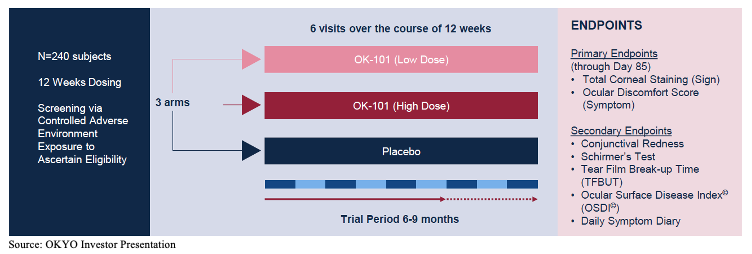
The Phase 2 trial design is expected to enroll 240 patients and is expected to compare the safety and efficacy of OK-101 to placebo for the treatment of the signs and symptoms of dry eye disease. The process includes 12 weeks of dosing utilizing six clinic visits. The trial should last 6-9 months with primary endpoints of Total Corneal Staining (sign) and Ocular Discomfort Score (symptom). Secondary endpoints include Conjunctival Redness, Schirmer’s Test, Tear Film Breakup Time and Ocular Surface Disease Index.
Upon collection of relevant data from the Phase 2 trial, a Phase 3 trial could be initiated in 2024 that would involve approximately 480 subjects.
The Phase 2 trial is being conducted by leading Contract Research Organization (CRO) Ora, Inc. Ora specializes in the ophthalmic area of pharmaceutical development and has overseen over 50 drug approvals in this space as well as conducting over 1,600 trials and consulting projects.
Financial Review
The company’s latest reported financials were for the six-month period ending 9/30/22. Total assets were £1.6 million compared to £3.3 million on 3/31/22. Cash on hand was £0.6 million compared to £2.1 million six months earlier. During the six-month period, the company reported a total comprehensive loss of £4.6 million which compared to a comprehensive loss of £1.8 million for the six-month period ending 9/30/21.
The company’s normalized monthly burn rate is approximately $250,000 and does not include the cost of the Phase 2 trial for OK-101 which is budgeted at $9 million. Assuming the cost of the trial is spread out over 12 months, the 2023 overall burn rate could be $1 million per month and $12 million for the year.
The company has recently closed on a $5.6 million private placement offering, of which approximately $3.0 million will be used to initiate its Phase 2 clinical study.
Management Team
Gabriele Cerrone
Chairman of the Board
Mr. Cerrone has been the Non-Executive Chairman of the company since January 2021. Mr. Cerrone is the Founder of Tiziana Life Sciences Limited and has been its Executive Chairman since April 2014. Mr. Cerrone has founded 10 biotechnology companies in oncology, infectious diseases and molecular diagnostics and has listed seven of these companies on Nasdaq. Mr. Cerrone co-founded Cardiff Oncology company and served as its Co-Chairman. In addition, he was a co-founder and served as Chairman of both Synergy Pharmaceutical and Callisto Pharmaceuticals. He was also a director of and led the restructuring of Siga Technologies. Mr. Cerrone also co-founded FermaVir Pharmaceuticals and served as Chairman of the Board until its merger in September 2007 with Inhibitex. Mr. Cerrone served as a director of Inhibitex until its $2.5 billion sale to Bristol Myers Squibb 2012. Mr. Cerrone graduated from New York University’s Stern School of Business with a master’s degree in business administration (MBA).
Dr. Gary S. Jacob
Chief Executive Officer
Mr. Jacob has served as Chief Executive Officer and a director of the company since January 2021. From November 2018 to March 2020, Dr. Jacob was the Chief Executive Officer of Immuron, an Australian microbiome biopharmaceutical company. From July 2008 until December 2017, Dr. Jacob was President and Chief Executive Officer of Synergy Pharmaceuticals where he held various positions from July 2008 to November 2018 and served as its Chairman from September 2013 to November 2018. Dr. Jacob is the co-inventor of the FDA-approved drug Trulance which is currently marketed in the U.S. by Bausch Health Companies to treat functional GI disorders. Since March 2014, Dr. Jacob has been Chairman of the Board of Hepion Pharmaceuticals and earlier served as its Chief Executive Officer from May 2013 until March 2014. Dr. Jacob served as Chief Executive Officer of Callisto Pharmaceuticals from May 2003 until January 2013 and a director from October 2004 until January 2013. Dr. Jacob also serves as a director of Rasna Therapeutics and is a past director of Cardiff Oncology. Dr. Jacob received his Ph.D. in Biochemistry from the University of Wisconsin-Madison in 1976. Dr. Jacob has over 35 years of experience in the pharmaceutical and biotechnology industries across multiple disciplines including research & development, operations and business development.
Dr. Raj Patil
Chief Scientific Officer
Dr. Patil has over 15 years of ophthalmic drug development experience including research & development, operations and business development. Dr. Patil previously worked with Ora as Vice President of Research & Development where he was responsible for driving all anterior and posterior segment ocular research of Ora’s R&D Institute. From 2013 until 2018, Dr. Patil worked at iVeena Delivery Systems as Vice President of Advanced Ocular Delivery Systems. Dr. Patil’s tenure at iVeena included a two year sabbatical in Singapore where he served as an Associate Professor of Ophthalmology at DUKE/NUS Medical School and Principal Investigator at Singapore Eye Research Institute. From 2004 until 2013, Dr. Patil also held a number of leadership roles at Alcon/Novartis Institute of Biomedical Research. Prior to 2004, Dr. Patil served as an Associate Professor of Ophthalmology, Cell Biology & Genetics at the University of Nebraska Medical Centre in Omaha from 2001 until 2004, and as an Assistant Professor of Ophthalmology, Molecular Biology & Pharmacology at Washington University in St. Louis from 1992 until 2000. Dr. Patil received his PhD in Biochemistry from National Chemical Laboratory/University of Pune, India, and completed his postdoctoral training in Biochemistry and Molecular Biology at the University of Michigan.
Keeren Shah
Chief Financial Officer
Ms. Shah currently also serves as the Finance Director of Tiziana Life Sciences, Accustem Sciences and Rasna Therapeutics having previously served as the Group Financial Controller for all businesses from June 2016 to July 2020. Prior to joining OKYO, Ms. Shah spent 10 years at Visa as a Senior Leader in its finance team where she was responsible for key financial controller activities, financial planning and analysis, and core processes as well as leading and participating in key transformation programs and Visa’s initial public offering. She holds a Bachelor of arts with honors in Economics and is a member of the Chartered Institute of Management Accountants.
Summary
We believe that OKYO has substantial opportunities for growth as the treatment value for DED are expected to reach approximately $6.5 billion by 2027. The company’s lead candidate OK-101 has the potential to significantly address the shortfalls and negative issues associated with current DED treatments. OK-101 has patent protection up to 2034 with possible extension until 2039. These patents cover both DED and neuropathic pain. Meaningful data from the company’s Phase 2 clinical trial should be available by the end of 2023.
OKYO is led by a seasoned management team and scientific advisory board with experience in drug development and biotechnology research. Members of the management team have had extensive and successful careers at major healthcare and biotech companies such as Searle, Monsanto, Alcon, Novartis and Ora.
The company appears to be undervalued when comparing them to other biotechnology companies with similar clinical trials in the ophthalmic space. Current market capitalizations for a selection of these companies range from $413 million to $464 million compared to OKYO’s current market cap of $33.7 million. We believe the current market capitalization for OKYO does not reflect the future growth opportunities ahead for the company.

SUBSCRIBE TO ZACKS SMALL CAP RESEARCH to receive our articles and reports emailed directly to you each morning. Please visit our website for additional information on Zacks SCR.
DISCLOSURE: Zacks SCR has received compensation from the issuer directly, from an investment manager, or from an investor relations consulting firm, engaged by the issuer, for providing research coverage for a period of no less than one year. Research articles, as seen here, are part of the service Zacks SCR provides and Zacks SCR receives quarterly payments totaling a maximum fee of up to $40,000 annually for these services provided to or regarding the issuer. Full Disclaimer HERE.