By John Vandermosten, CFA
NASDAQ:RVLP
The Journal of Plastic, Reconstructive and Aesthetic Surgery published an article entitled The Effect of Topical Oxymetazoline on Eyelid Position, Eye Redness, and Patient-Reported Eye Appearance: A Randomized Controlled Trial. The study, as apparent from its title, examined the effect of oxymetazoline 0.1% on eye features important for eye aesthetics. We had an opportunity to speak with one of the study authors, Dr. Wendy W. Lee, who is at the Department of Ophthalmology at the University of Miami. She highlighted the study’s findings in context of both functional and aesthetic benefit.
RVL Pharmaceuticals plc (NASDAQ:RVLP) is commercializing the product evaluated in the article, branded Upneeq®. Other studies have been conducted which were required for FDA approval. Endpoints for these studies included change in baseline visual field and measurement of marginal reflex distance (MRD). The journal study referenced above added perception of eye redness and quality of life to the marginal reflex distance metric.
The trial evaluated 114 patients, evenly split between treated patients and controls. It was conducted from April 2021 to April 2022 at the University of Miami. The double-blind study enrolled patients 18 and above with stable eye health other than minor ptosis.
Mechanism of Action
Oxymetazoline hydrochloride 0.1% works as a direct-acting α-adrenergic receptor agonist. Müller’s muscle, which elevates the upper eyelid, presents α-2 adrenergic receptors that contract in response to sympathetic stimulation or topical adrenergic agonists. The α-2 effects extend to ocular surface vasoconstriction, which decreases eye redness.
Findings
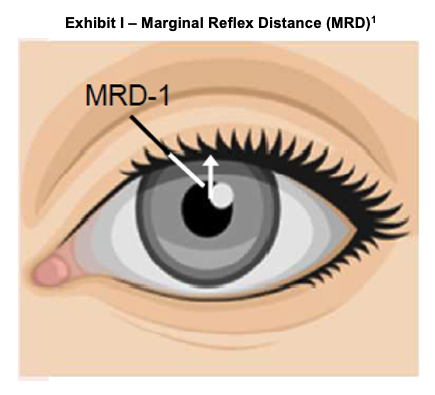
The primary outcome measure used in the article was the change in marginal reflex distance (MRD) of the upper and lower eyelid. Secondary outcomes were the change in eye redness as measured through the Validated Bulbar Scale (VBS) and patient-perceived eye appearance. During our conversation, study author Dr. Lee noted that oxymetazoline 0.1% has both a functional and aesthetic benefit, not only for widening the eye but it also for making it appear whiter. In an extension from previous studies, this work examined eye whiteness and quality of life metrics for patients. The formulation is a good alternative to surgery and can even help patients that are appropriate for surgery, providing temporary relief and a bridge as they are waiting for surgery. Safety is favorable and there are no concerns over long term use as the underlying API has been evaluated and used for many years in other applications.
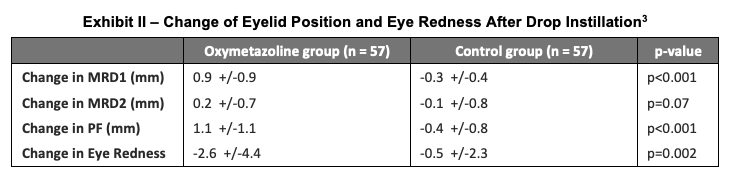
Two hours after application of oxymetazoline hydrochloride 0.1%, the mean MRD of the upper eyelid was 5.1 mm in the treatment group and 4.1 mm in the control group. The oxymetazoline group generated an increase in MRD1 by 0.9 mm (+/- 0.9) while the control group produced a decrease of 0.3 mm (+/- 0.4). A statistically significant change was measured in the difference between the two groups' MRD with a p-value below 0.001. The change in lower eyelid MRD was not statistically significant. Average change eye redness measured by the VBS was -2.6 in the treatment group and -0.5 in the control group, with a p-value of 0.002. 113 of the 114 enrolled patients completed the eye appearance questionnaire using the FACE-Q eye appearance scale.2 The pre- and post-treatment FACE-Q appearance score improved by 3.1 units for the oxymetazoline group and by 0.8 for the control group. Results were statistically significant with a p-value of 0.0002.

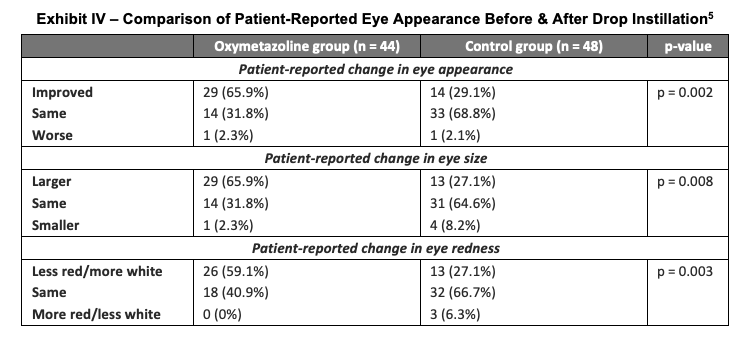
92 patients completed a survey evaluating their eye appearance. The proportion of participants that identified an improvement in eye appearance, eye size and eye redness was substantially greater in the oxymetazoline group. We summarize the patient-reported results below.
Safety was very good with nine (14.0%) treatment emergent adverse events (TEAEs) reported by seven oxymetazoline participants. This compares to 5 (8.7%) TEAEs reported in the control group. All TEAEs were mild and included headache, dry eye, blurry vision that self-resolved in 10 minutes and dizziness.
Summary
The results shared in the article confirm earlier studies that demonstrated oxymetazoline’s ability to increase the openness of the eye by raising the upper eyelid. The study endpoints went further and examined the product’s ability to whiten the eye and to produce improved aesthetic appearance. Oxymetazoline 0.1% is an attractive alternative to surgery for minor ptosis and has shown that it can improve patient eye appearance for both eyelid position and redness. Patients can see the difference as evidenced by responses given in the FACE-Q survey.
The study further supports the validity of RVL Pharma’s Upneeq commercialization efforts in terms of efficacy, safety and aesthetic benefit. Oxymetazoline is an advantageous alternative to surgery for mild ptosis, improving a subject’s appearance with wider and whiter eyes. This article shows not only that the metrics of openness and sclera color are improved but that patients perceive a difference even when compared against a placebo group.
SUBSCRIBE TO ZACKS SMALL CAP RESEARCH to receive our articles and reports emailed directly to you each morning. Please visit our website for additional information on Zacks SCR.
DISCLOSURE: Zacks SCR has received compensation from the issuer directly, from an investment manager, or from an investor relations consulting firm, engaged by the issuer, for providing research coverage for a period of no less than one year. Research articles, as seen here, are part of the service Zacks SCR provides and Zacks SCR receives quarterly payments totaling a maximum fee of up to $40,000 annually for these services provided to or regarding the issuer. Full Disclaimer HERE.
________________________
1. RVL Pharma corporate Presentation, August 2022.
2. The FACE-Q Eye Appearance Module is a patient-reported outcome measure used to evaluate the appearance of the eyes and surrounding areas. It is a comprehensive, validated questionnaire designed to assess patients' perceptions of their facial appearance and the impact on their quality of life. The module consists of a set of questions that ask patients to rate the appearance of their eyes and surrounding areas, such as the eyelids, eyebrows and under-eye area. The questions are designed to evaluate factors such as the presence of wrinkles, bags or puffiness, skin tone and overall eye appearance. The responses are used to generate a score that reflects the patient's satisfaction with their eye appearance. The FACE-Q Eye Appearance Scale is used by healthcare providers and researchers to evaluate the outcomes of eye-related treatments, such as eyelid surgery, eye lifts, or treatments for under-eye bags. It can also be used to assess the impact of eye appearance on patients' quality of life and self-esteem.
3. Zacks analyst work summarized from article.
4. Source: RVL Pharma Corporate Presentation, November 2022. Note that these results are from a prior study and are intended to illustrate the impact. Images from the study cited herein can be found at the link here.
5. Zacks analyst work summarized from article.