By John Vandermosten, CFA
NASDAQ:RVPH
READ THE FULL RVPH RESEARCH REPORT
March Update
Since our previous report that was submitted on the occasion of Reviva Pharmaceutical Holdings, Inc’s (NASDAQ:RVPH) third quarter results, the company has reported the award of new patents, completed brilaroxazine drug-drug interaction studies and an updated stakeholders on the Phase III RECOVER trial. CEO Laxminarayan Bhat, PhD, has also participated in investor events and interviews discussing active and future programs.
Dr. Bhat Interview
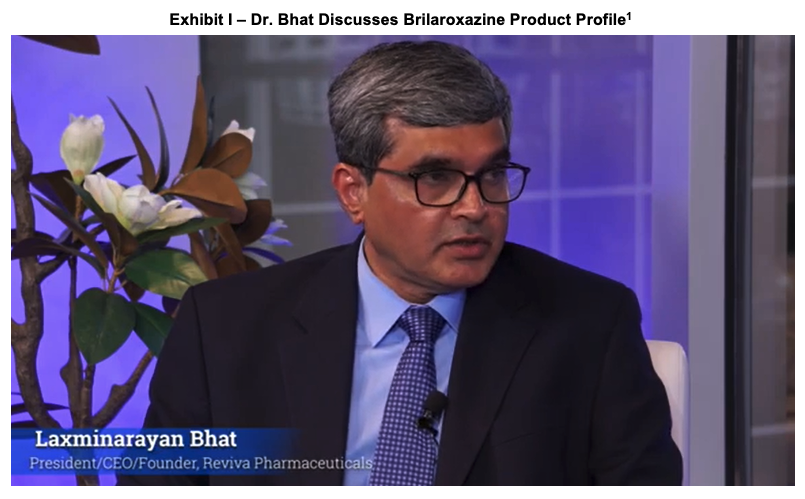
Interviews with Reviva’s CEO, Dr. Laxminarayan Bhat:
➢ Reviva: Next Generation Blockbuster
➢ Reviva’s Clinical and Regulatory Timelines
➢ Reviva: More Than Schizophrenia
➢ Reviva's Brilaroxazine Addresses Antipsychotics' Biggest Hurdles
➢ Fireside Chat: Reviva's RP1208 & Thoughts on Peers
RP1208 Composition of Matter Patent
Reviva holds two compounds in its portfolio of assets: lead candidate brilaroxazine and secondary candidate RP1208. The latter of these is a triple reuptake inhibitor in preclinical development for depression and obesity. Both of these assets are fully owned by Reviva and the claim on their intellectual property was recently strengthened with the grant of a composition of matter patent in Canada. The patent (CA2858837C) protects the composition of novel phenylcycloalkylmethylamine derivatives (PDs) and methods of preparing them. The invention also provides methods of using PDs for the pharmacological treatment of obesity, depression and obesity related co-morbid indications.
Parallel Registrational Studies
One of Reviva’s required parallel registrational studies is for drug-drug interaction (DDI), which is especially important in schizophrenia patients. Antipsychotic medications are the primary class of drugs used to treat schizophrenia, which work by blocking dopamine receptor activity in the brain. However, not all antipsychotic medications work equally well for all patients and some individuals may experience significant side effects. As a result, healthcare providers may need to prescribe a combination of different antipsychotics or other medications, such as mood stabilizers or antidepressants, to achieve the best results for their patients resulting in multiple drug regimens.
Reviva announced positive safety data from its DDI study investigating the potential effect of CYP3A4 enzyme on brilaroxazine in healthy subjects. Management believes the data reinforce brilaroxazine’s potential advantage over other treatments for patients taking multiple drugs who are at higher risk of experiencing adverse drug interactions or discontinuation of their medications due to those interactions. Following FDA guidelines, the DDI clinical study was designed to evaluate the drug interaction effect of a strong CYP3A4 inhibitor or inducer when co-administered with brilaroxazine. The CYP3A4 inhibitor, itraconazole, slightly increased brilaroxazine Cmax, AUClast and AUCinf by 6%, 16% and 13%, respectively, in 11 healthy volunteers. Similarly, a strong CYP3A4 inducer, phenytoin, in 16 healthy volunteers decreased the drug’s Cmax, AUClast and AUCinf by 33%, 56% and 53%, respectively. The DDI study found no clinically significant interaction when combined with a CYP3A4 inhibitor.
Individuals with schizophrenia may have other medical conditions in addition to their mental health condition, and as a result, they may need to take medications for other disorders. Some common medical conditions that may occur alongside schizophrenia include high blood pressure, diabetes and obesity.
Additionally, some medications used to treat schizophrenia can cause side effects or have interactions with other drugs. This requires the use of yet other therapies to manage these issues. For example, some antipsychotic medications can cause weight gain or increase the risk of developing diabetes and individuals taking antipsychotics may need other drugs to manage these coincident disorders.
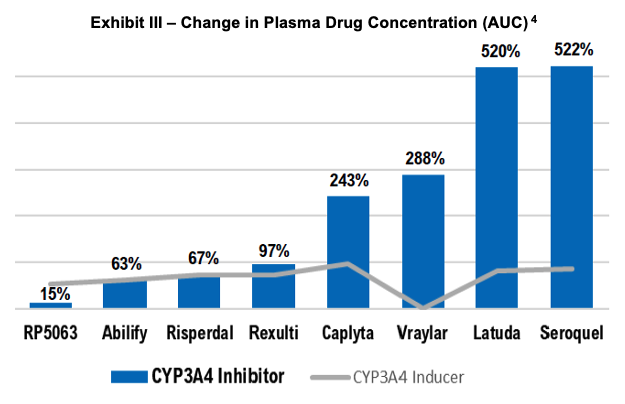
It is important for providers to consider the potential interactions between medications when treating individuals with schizophrenia, as well as monitor for any side effects or adverse reactions to the medications. To provide the necessary data to support these decisions, sponsors must run DDI studies. According to Reviva’s research approximately 50% of prescribed drugs and over 25% of antipsychotics currently on the market are known to cause drug interactions with CYP3A4 inhibitors. Brilaroxazine, specifically, is metabolized by CYP3A4 and CYP2D6. In an unpublished study which will be submitted to the FDA in the NDA, brilaroxazine produced an increase in the area under the curve (AUC)2 in the pharmacokinetic analysis of 15% with a CYP3A4 inhibitor and a 54% AUC decrease with a CYP3A4 inducer. This compares favorably with other commonly prescribed antipsychotics.
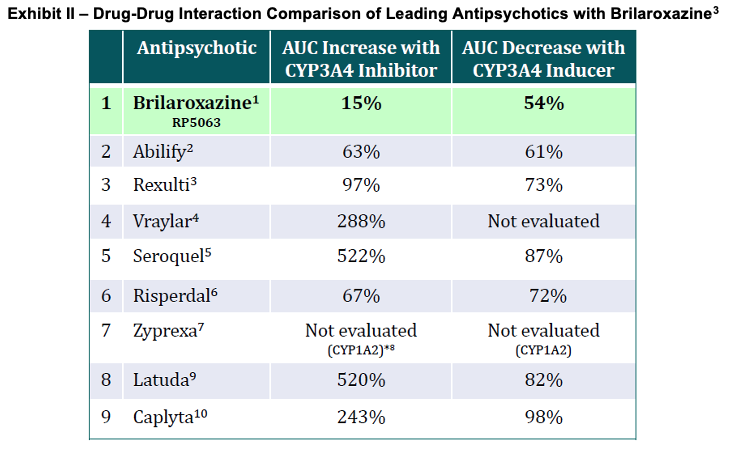
CYP3A4 is a key enzyme responsible for metabolizing a wide range of drugs in the liver. CYP3A4 inhibitors are drugs or compounds that inhibit the activity of this enzyme, which can lead to slower metabolism and clearance of other drugs that are substrates for CYP3A4. As a result, the AUC of these drugs may increase when taken together with a CYP3A4 inhibitor. A minimal change in AUC increase is preferred as it allows for blood plasma levels of the drug to be closer to targeted levels. CYP3A4 inducers are drugs or compounds that increase the activity of this enzyme, which can lead to faster metabolism and clearance of other drugs that are substrates for CYP3A4. As a result, the AUC of these drugs may decrease when taken together with a CYP3A4 inducer. Minimizing the decrease in AUC is desired as it attenuates the reduction in drug levels in plasma from therapeutically efficacious levels.
SUBSCRIBE TO ZACKS SMALL CAP RESEARCH to receive our articles and reports emailed directly to you each morning. Please visit our website for additional information on Zacks SCR.
DISCLOSURE: Zacks SCR has received compensation from the issuer directly, from an investment manager, or from an investor relations consulting firm, engaged by the issuer, for providing research coverage for a period of no less than one year. Research articles, as seen here, are part of the service Zacks SCR provides and Zacks SCR receives quarterly payments totaling a maximum fee of up to $40,000 annually for these services provided to or regarding the issuer. Full Disclaimer HERE.
________________________
1. Screenshot from March 2023 Interview with Dr. Bhat.
2. AUC represents the total amount of drug in the bloodstream over a given period of time after a single dose or multiple doses of the drug.
3. Source: Reviva Corporate Presentation February 2023.
4. Source: Reviva Corporate Presentation February 2023.