By John Vandermosten, CFA
NASDAQ:RVPH
READ THE FULL RVPH RESEARCH REPORT
3Q:23 Financial and Operational Results
On November 14, 2023, Reviva Pharmaceutical Holdings, Inc. (NASDAQ:RVPH) reported 3Q:23 financial and operational results and filed its Form 10-Q with the SEC. The most important news since the previous quarterly update was the topline data for the Phase III RECOVER trial evaluating brilaroxazine in schizophrenia patients. It found meaningful reductions in all components of the PANSS score, a favorable side effect profile and compelling discontinuation rates. The results support plans for a second Phase III study, designated RECOVER-2, which is slated to start in early 2024. To fund the RECOVER-2 study, Reviva has announced a $30 million registered direct offering that is expected to close today, November 20.
Other activities during the third quarter and to date include Reviva’s attendance at and participation in a variety of investor events and periodic status updates for the RECOVER trial.
Highlights for 2023:
➢ Multiple parallel studies in support of schizophrenia program completed – March
➢ Company added to Russell Microcap index - June
➢ RECOVER topline results reported – October
➢ $30 million capital raise - November
Reviva generated no revenues in 3Q:23 and expended ($10.7) million in operational activities, producing a net loss of ($10.5) million or ($0.44) on a per share basis. For the quarter ending September 30, 2023 and versus the same prior year period:
➢ Research & development expense totaled $8.7 million, almost three times the $2.3 million in the comparable period, primarily attributed to higher Phase III clinical trial expenses and drug development costs, and increases in stock-based compensation and salary;
➢ General & administrative expenses totaled $2.0 million, rising 58% from $1.3 million on account of greater stock-based compensation, legal expenses, recruiting expenses, consultant and professional expenses, and salary and board of director compensation. These were partially offset by a decrease in other miscellaneous expenses;
➢ Gain on remeasurement of warrant liabilities of $139,000 resulted from a decrease in the value of the share price during the measurement period;
➢ Net interest income was $92,000 which increased over prior year levels due to higher interest rates and greater interest income;
➢ Provision for taxes was $12,000 related to taxable subsidiary revenue operations;
➢ Net loss was ($10.5) million vs ($3.5) million, or ($0.44) and ($0.18) per share, respectively.
At the end of September 2023, Reviva held $5.0 million in cash on its balance sheet. 3Q:23 cash burn was ($6.2) million and cash flows from financing was zero. Following the end of the quarter, Reviva announced a $30 million registered direct offering that should provide sufficient capital to support operations until the end of 2024. There is also a strong likelihood that the $5 exercise-price warrants associated with the deal may provide additional capital if the shares move back into the money.
RECOVER Topline Announcement
Following enrollment completion of the RECOVER trial on August 17th and evaluation of the last patient on September 25th, Reviva Pharmaceutical Holdings, Inc. (NASDAQ:RVPH) announced topline results. RECOVER was a global Phase III, randomized, double-blind, placebo-controlled, multicenter study designed to assess the safety and efficacy of brilaroxazine in patients with acute schizophrenia compared to placebo. It enrolled 412 subjects. Brilaroxazine was administered at fixed doses of 15 mg or 50 mg once daily for 28 days. The primary endpoint was a decrease in the Positive and Negative Syndrome Scale (PANSS) total score compared to placebo from baseline to Day 28. Key secondary endpoints include clinical global impression (CGI) severity, positive and negative symptoms, social functioning and cognition.
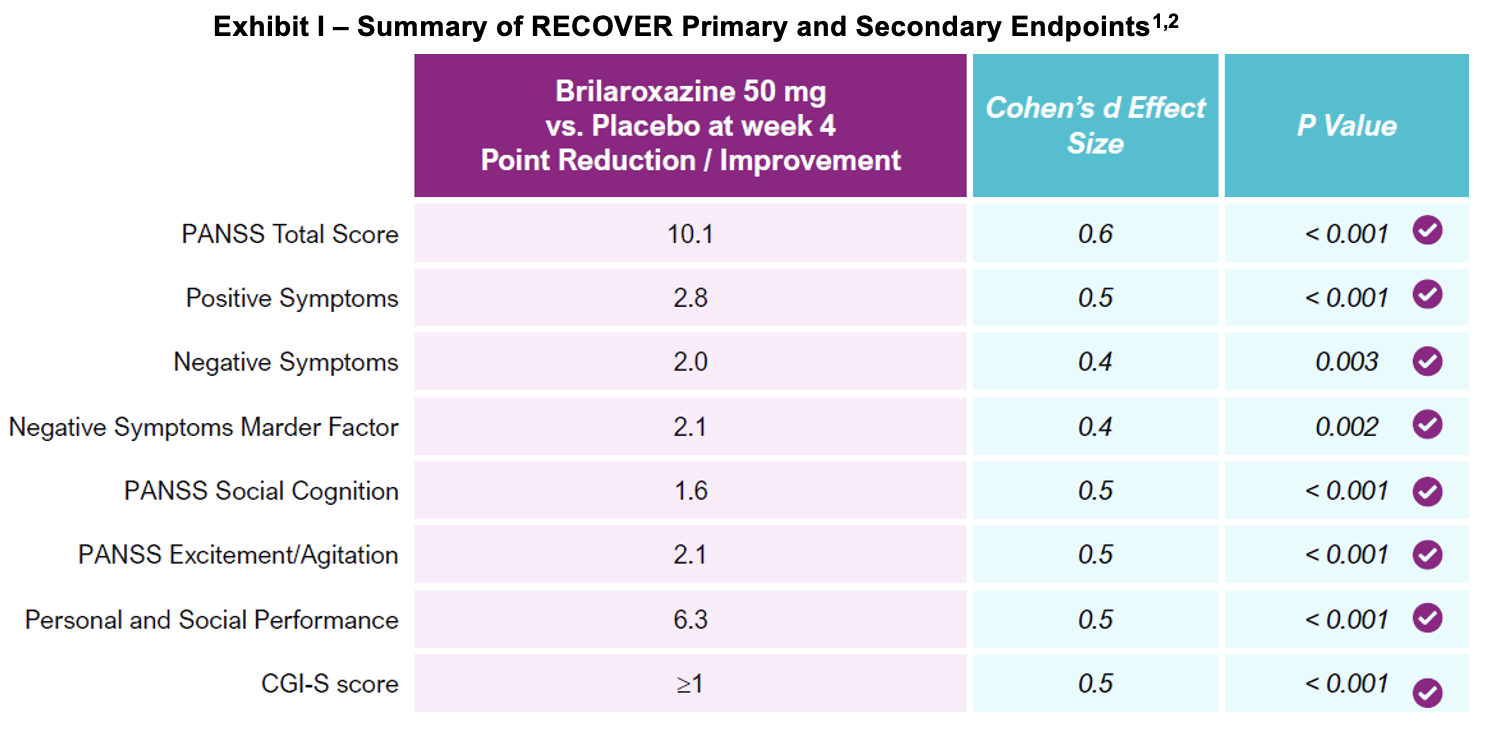
The trial met its primary endpoint, generating a 10.1-point reduction in PANSS score relative to placebo at four weeks for the 50 mg dose. The brilaroxazine arm generated a 23.9-point reduction whereas the placebo arm produced a 13.8-point reduction. Brilaroxazine also achieved statistically significant and clinically meaningful reductions in all major symptom domains and secondary endpoints at week 4 with the 50 mg dose vs. placebo. The 15 mg dose of brilaroxazine was numerically superior to placebo on the primary endpoint and most secondary endpoints, and reached statistical significance on two key secondary endpoints.
RECOVER will evolve into an open label extension (OLE) trial continuing with 100 of the subjects who have completed the four-week regimen. It will have a one-year duration. The outpatient OLE will evaluate the long-term safety and tolerability of brilaroxazine with a once daily 15, 30 and 50 mg flexible dose. The extension is expected to be complete by 4Q:24
Reviva held a webcast to review the data release which featured the CEO, Dr. Laxminarayan Bhat, and Reviva’s consultant, Dr. Larry Ereshefsky. The slide deck review presented topline data, patient characteristics and analysis of each endpoint with score trend by week. It further summarized the safety and side effect profile of the candidate. The final data point for each of the endpoints is included in the following exhibit.
Brilaroxazine was engineered based on the latest understanding in receptor efficacy and side effect relationships guided by the shortcomings and data generated by preceding therapies. Brilaroxazine possesses a high binding affinity for the D2/3/4 and 5-HT1A/2A/2B/7 receptors, moderate affinity for 5-HT6 and nicotinic acetylcholine (α4β2) receptors and the serotonin transporter, a partial agonist of D2/3/4 and 5-HT1A/2A receptors and antagonist of 5-HT2B/6/7 receptors. The agent has either very weak activity or no activity for off target 5-HT2C, adrenergic α1,2 or muscarinic receptors. See our initiation for additional discussion of the drug design. This configuration sought to reduce the side effect profile of brilaroxazine compared with other antipsychotics. In the RECOVER Phase III study, the goal of the design was realized as brilaroxazine was generally well tolerated with treatment emergent adverse events (TEAEs) as listed below.
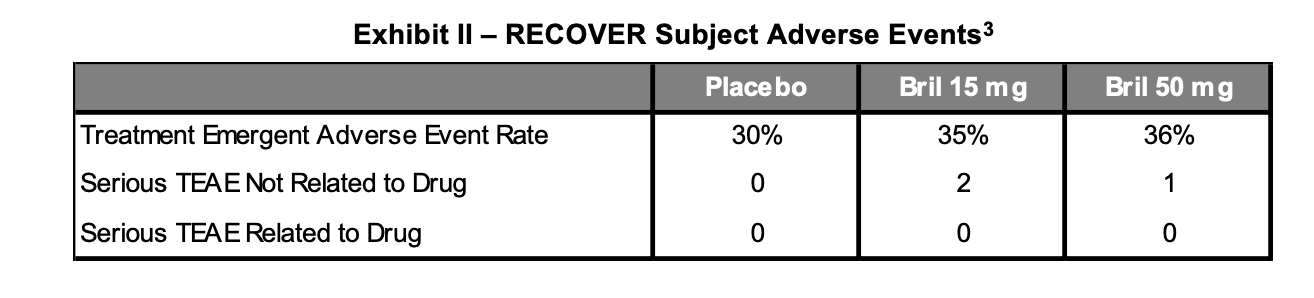
The most common TEAEs above 5% were headache (<6%) and somnolence (<7.5%).
The trial further observed that there was no incidence of suicidal ideation and no significant change in bodyweight, blood glucose levels, lipid levels or endocrine hormones as compared to placebo. In particular, weight gain was measured at a 2.1% increase in the 15 mg arm, 5.9% in the 50 mg arm and 2.9% in placebo. While the 50 mg arm showed an increase in excess of placebo, Dr. Ereshefsky noted that enrolled subjects received meals as part of the treatment regime. This is in contrast to many acutely ill schizophrenia patients who do not receive proper nutrition.
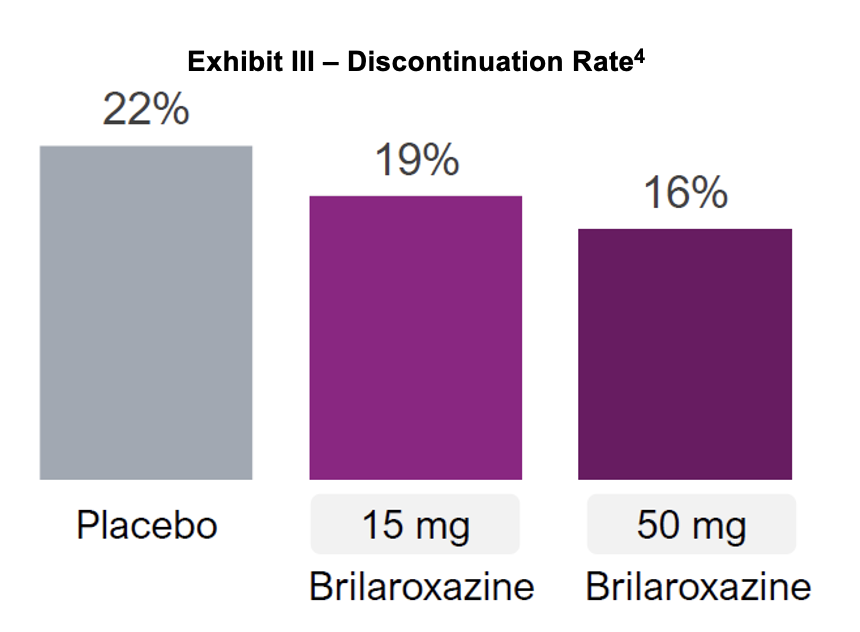
Discontinuation of antipsychotic medication is one of the major problems with treating schizophrenia. This can lead to relapse and can lead to treatment resistance. Many patients stop taking their antipsychotics due to side effects such as sedation, weight gain, movement disorders, or lack of insight into their illness. Estimates range from 50-75% of patients discontinuing within 1-2 years. This hurdle accentuates the need for improved compliance and better adherence to medicine administration. Reviva produced an attractive discontinuation rate for the Phase II and Phase III studies, which was better than placebo in both. As shown below, discontinuation for the RECOVER trial was 22% for placebo, 19% for the 15 mg brilaroxazine dose and 16% for the 50 mg brilaroxazine dose. Discontinuation due to side effects was 4% in the placebo group, 1% for the 15 mg brilaroxazine group and 0% for the 50 mg brilaroxazine group.
In summary, the RECOVER clinical trial met its objectives:
➢ Achieved primary endpoint of clinically meaningful and statistically significant reduction in PANSS score;
➢ Demonstrated improvement in all major symptom domains;
➢ Drug was well-tolerated with side effects comparable to placebo;
➢ Discontinuation rate low and below that of placebo.
RECOVER-2
Reviva is planning to launch its confirmatory Phase III RECOVER-2 trial in 1Q:24. The trial will have a similar design to the RECOVER trial with a few notable differences. We expect that the second Phase III trial will be able to enroll at a faster pace than the first as much of the ground work has already been completed and the trial managers are experienced. The confirmatory trial will measure endpoints over a 6-week (in contrast to 4-week) period and RECOVER-2 will randomize 450 patients 1:1:1 with 30 mg (in place of 15 mg), 50 mg and placebo arms. Completion is expected in early 2025. This sets Reviva up to submit its new drug application (NDA) in 2H:25.
Capital Raise
Following the topline results from the RECOVER trial and the report of third quarter results, Reviva announced a $30 million registered direct offering that is backed by several healthcare focused institutional investors. The sale and issuance of 5,853,660 units, consisting of shares and warrants, is expected to close on November 20th. Unit price is $5.125 and warrant exercise price will be $5.00 with a duration of five years. HC Wainwright is acting as the placement agent.
SUBSCRIBE TO ZACKS SMALL CAP RESEARCH to receive our articles and reports emailed directly to you each morning. Please visit our website for additional information on Zacks SCR.
DISCLOSURE: Zacks SCR has received compensation from the issuer directly, from an investment manager, or from an investor relations consulting firm, engaged by the issuer, for providing research coverage for a period of no less than one year. Research articles, as seen here, are part of the service Zacks SCR provides and Zacks SCR receives quarterly payments totaling a maximum fee of up to $40,000 annually for these services provided to or regarding the issuer. Full Disclaimer HERE.
________________________
1. Reviva RECOVER Topline Results Data Presentation, October 30, 2023.
2. Cohen's d is a statistic used to measure the standardized difference between two group means. The statistic quantifies the difference between two group means relative to the standard deviation. This allows results to be compared across studies using different measures. It is calculated as the difference between the two group means, divided by the pooled standard deviation. d = (Mean 1 - Mean 2)/Pooled SD
The pooled standard deviation is calculated using a weighted average of the variances of the two groups. Cohen provided guidelines for interpreting the size of d: Small effect: d = 0.2; Medium effect: d = 0.5; Large effect: d = 0.8
3. Compiled from data provided in company materials by Zacks analyst
4. Reviva RECOVER Topline Results Data Presentation, October 30, 2023.