By John Vandermosten, CFA
NASDAQ:RANI
READ THE FULL RANI RESEARCH REPORT
Rani Therapeutics Holdings, Inc. (NASDAQ:RANI) reported first quarter 2024 results on May 6th, 2024. However, there has been little public interaction since full year results were reported seven weeks earlier. In the interim, Rani has been focused on its negotiations with Celltrion and possibly others for further development of RT-111. It is also making preparations for launching a Phase II trial for RT-102 and a Phase I trial for RaniPill HC. Both of these studies are expected to begin later this year.
Our main focus is on the negotiations for further development of RT-111 with a partner. We think that an oral option for delivering biologics is an extremely attractive alternative to infusion. It is a method of administration that could dramatically impact the biologics space for sponsors, patients and providers. Results from the RT-111 Phase I trial showed 84% bioavailability for the RaniPill (RP) relative to subcutaneous Stelara. These impressive results for an oral option are sure to attract the attention of many large biopharmaceutical firms as there are no other oral options for delivering biologics that provide bioavailability similar to infusion.
For the first quarter, Rani produced a net loss of ($7.5) million for Class A stockholders and absorbed corporatewide cash burn of ($9.4) million. As we look ahead in 2024, we expect to see a favorable response from Celltrion with respect to its right of first negotiation for the RT-111 program. If signed, an agreement with the Korean biologics developer may include upfront payments that will extend the company’s cash runway.
First Quarter 2024 Operational and Financial Results
Rani reported 1Q:24 results in a press release and Form 10-Q filing with the SEC on May 6, 2024. The company did not hold a conference call. For the quarter ending March 31, 2024, revenues were zero matching prior year amounts. Operating expense was $14.0 million and net loss per share for Class A shareholders was ($0.29).
➢ Research and development expenses totaled $7.6 million, down 22% from $9.7 million mostly due to lower payroll. Lower compensation cost was a result of the workforce reduction announced in November. Other year over year reductions were related to third-party service costs;
➢ General & Administrative expenses were $6.4 million, falling 5% from $6.8 million on account of lower compensation and other costs;
➢ Net interest and other expense totaled ($0.7) million compared to ($0.3) million on lower interest income and higher debt service costs;
➢ Non-controlling interest was ($33.9) million vs. ($32.8) million;
➢ Net loss for Class A shareholders was ($7.3) million vs. ($8.4) million or ($0.29) and ($0.33) per share.
As of March 31, 2024, cash and marketable securities totaled $39.6 million. This amount compares to the $48.5 million balance held at the end of 2023. Long-term debt was held on the balance sheet at $29.4 million. 1Q:24 cash used in operations was ($9.4) million versus ($12.4) million for the comparable period in the prior year.
Rani will need additional capital this year. Rani’s CFO has previously specified sources from equity, debt and licensing agreements from pharmaceutical partners as most likely. The company may tap into the remaining $15 million on a loan agreement if certain milestones are met and is party to a controlled equity sales agreement which allows the company to conduct at the market (ATM) equity sales.
RT-111 Phase I Study Results
Rani shared topline results from its Phase I study for RT-111 in a press release and webcast on February 5, 2024. RP achieved 84% bioavailability for the RP relative to subcutaneously delivered Stelara. RT-111 was well tolerated with no serious adverse events (AEs). Data from the study has now been passed on to partner Celltrion who is negotiating for worldwide rights to the product.
The Phase I trial was designed to assess the safety, tolerability and pharmacokinetics of ustekinumab delivered using the RP. Fifty-five healthy volunteers in Australia were enrolled to participate in one of three study groups: a control group of 0.5 mg of Stelara (N=15), a 0.5 mg RT-111 group (N=20) or a 0.75 mg RT-111 group (N=20). Drug was administered after an overnight fast and blood samples were collected for the following 60 days to measure for serum ustekinumab concentration. Anti-drug antibodies were analyzed and excretion of the device was monitored.
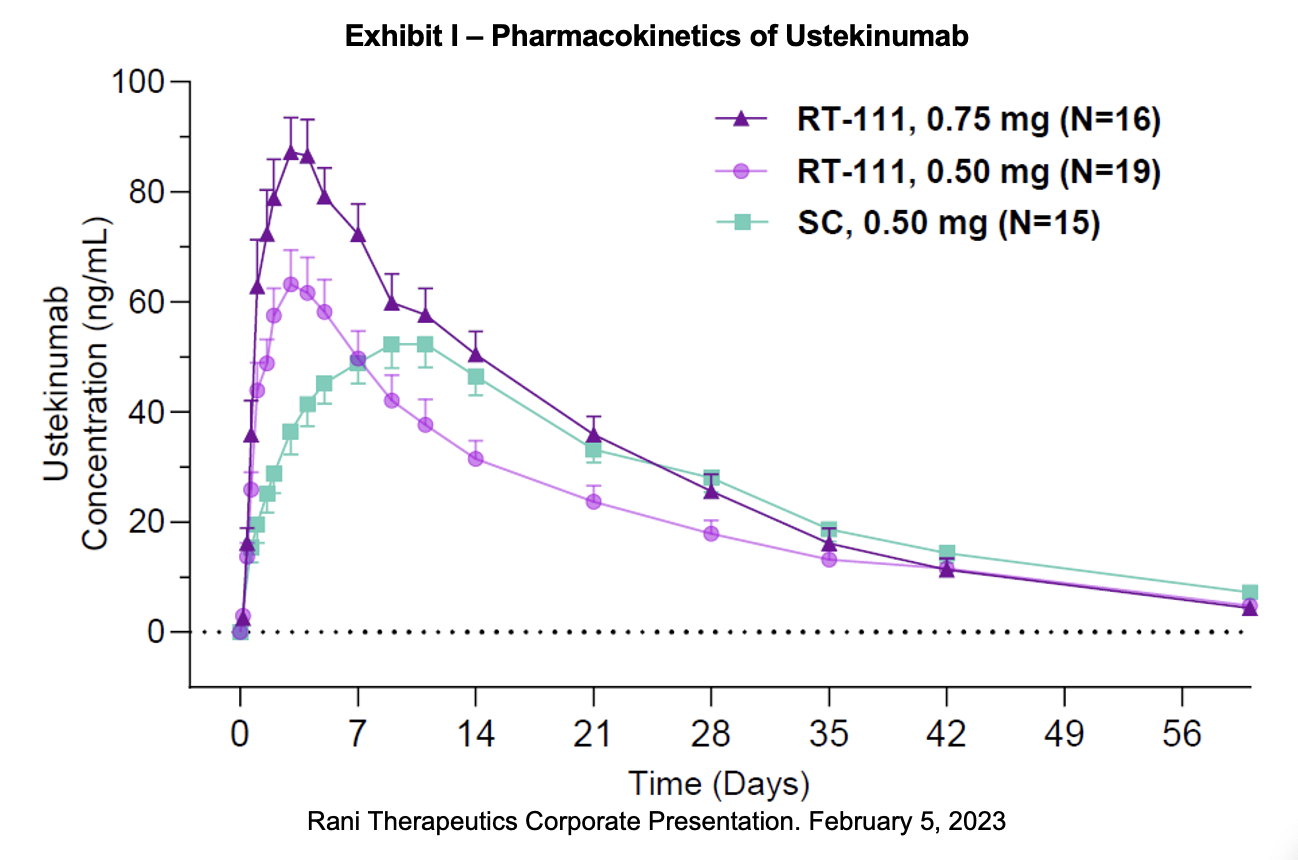
One AE was observed in the Stelara arm and two AEs were observed in the 0.5 mg arm for RT-111. Drug related AEs included abdominal bloating and injection site rash. Potential RP-related AEs were a burning sensation in the stomach.
Rani plans to optimize the loading dose of RT-111 and maintain serum concentration levels within the optimal therapeutic range through more frequent dosing. RT-111’s higher CMAX and faster TMAX will provide more flexibility in achieving better drug levels sooner. An oral option will allow for more dosing flexibility to help maintain blood concentration levels within the optimal therapeutic window of 0.7 μg/ml. Stelara has difficulty remaining in this window with recommended injections every 12 weeks which produce an initial spike followed by sub-therapeutic levels prior to the next administration. While additional studies will be required to find the correct dose and periodicity, improved outcomes are expected.1
The arrangement with Celltrion allows Rani’s partner 30 days to decide whether or not to begin negotiations for a deal. Based on management comments, it appears that the negotiations are ongoing. Following Celltrion’s entry into negotiations, the discussions between the two parties will be exclusive for 90 days during which time the parties may come to a definitive agreement for rights to develop and commercialize RT-111. If Celltrion passes on the deal or the time expires, Rani may negotiate with others.
If a deal is signed with Rani and Celltrion, we anticipate that the latter will assume the costs and primary management of further clinical trials and provide upfront payments to Rani. If another partner is not found, then we anticipate Rani will advance RT-111 into a Phase II which would encompass a dose finding element. However, the data from the trial presented last month was compelling and no other competing oral alternative comes close to providing the same level of bioavailability for biologics. Later development activities will require a supplemental BLA to be filed after a registrational study given ustekinumab’s molecular profile.
RT-105 Development
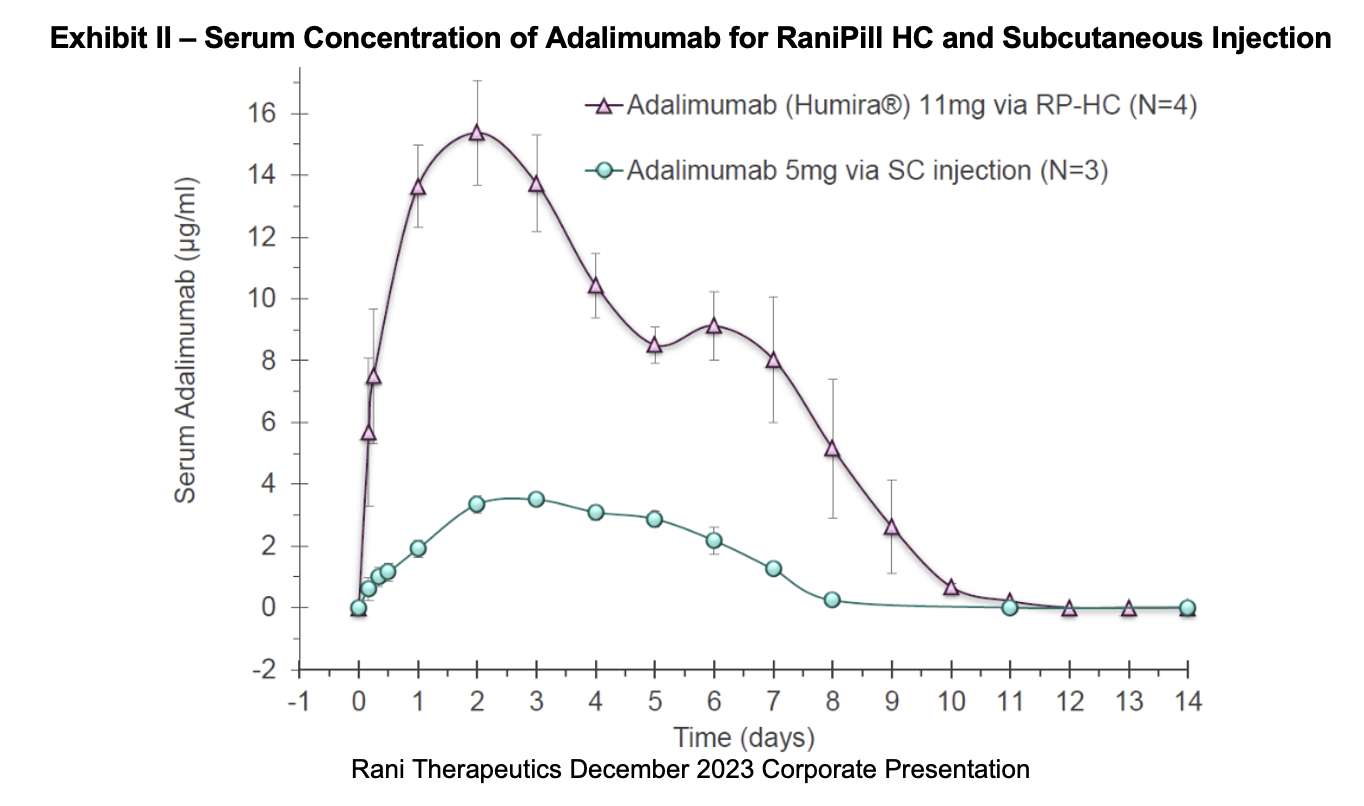
Rani is developing RT-105 for oral administration of an anti-TNF-alpha antibody for the treatment of a host of inflammatory conditions. Preclinical studies with adalimumab (Humira) and an adalimumab biosimilar in the canine model, with both RP GO and HC configurations, produced similar PK profiles and confirmed the bioavailability via the RP platform to be high and similar to SC injection.
One of Rani’s studies in canines evaluated 11 mg of adalimumab in the RP HC, compared with 5 mg administered via SC injection. Shown below are the serum concentrations for both groups. Adalimumab administered orally via RP HC produces higher bioavailability compared to SC administration. These data provide a successful demonstration of biologic delivery with high bioavailability enabled by the RP HC at a high dose, as high doses are needed for some indications of adalimumab such as Crohn’s disease, ulcerative colitis and plaque psoriasis.
Milestones
➢ Topline results for RT-111 Phase I study – February 2024
➢ Presentations (2) of ustekinumab RT-111 data at Digestive Disease Week – May 2024
➢ Launch of RT-102 Phase II study – mid-2024
➢ RaniPill HC Phase I trial – 2H:24
➢ Partnership development – 2024
SUBSCRIBE TO ZACKS SMALL CAP RESEARCH to receive our articles and reports emailed directly to you each morning. Please visit our website for additional information on Zacks SCR.
DISCLOSURE: Zacks SCR has received compensation from the issuer directly, from an investment manager, or from an investor relations consulting firm, engaged by the issuer, for providing research coverage for a period of no less than one year. Research articles, as seen here, are part of the service Zacks SCR provides and Zacks SCR receives quarterly payments totaling a maximum fee of up to $40,000 annually for these services provided to or regarding the issuer. Full Disclaimer HERE.
________________________
1. An earlier third-party study not affiliated with Rani demonstrated improved efficacy in psoriasis as shown in an improved PACI score for the 4x weekly 90 mg dose compared with the approved 45 mg dose. The proportion of AEs was lower in the 90 mg dose (68%) than it was for the 45 mg dose (90%) (See Table 3 in following reference link). Despite the better performance and lower AEs associated with the 90 mg dose, the sponsor may have elected to pursue the lower dose in order to reduce injection frequency. Krueger, G. et al. A Human Interleukin-12/23 Monoclonal Antibody for the Treatment of Psoriasis. The New England Journal of Medicine. February 2007.