By John Vandermosten, CFA
NASDAQ:ACHV
READ THE FULL ACHV RESEARCH REPORT
Achieve Life Sciences, Inc. (NASDAQ:ACHV) reported third quarter results, wrapping up an intense three months since its prior quarterly release. Since August, Achieve has communicated the acceptance of its new drug application (NDA), the assignment of a target action date for cytisinicline, the addition of new executives, publication in the journal Thorax, the award of the Commissioner’s National Priority Voucher (CNPV) and the submission of its 120-day safety update. The company has also made substantial progress developing its commercialization strategy which is thoroughly discussed in a series of video interviews with CEO Rick Stewart and Chief Commercial Officer (CCO) Jaime Xinos. Company accomplishments have also been shared at multiple fall investor conferences.
Financial and Operational Results
Achieve’s third quarter 2025 financial and operational results were detailed in a press release, Form 10-Q filing and a webcast which provided analysts the opportunity to ask questions. No revenues were reported in 3Q:25. Operating expense was $14.7 million producing a net loss of ($14.4) million or ($0.28) per share. For the quarter ending September 30th, 2025 and versus the same comparable prior year quarter:
- Research & development expense totaled $5.3 million, a 30% drop from $7.6 million, due to the trial expenses for ORCA-OL safety trial recognized in the prior year period;
- General & administrative expense was $9.4 million, up 93% from $4.9 million on higher employee expenses and commercial launch preparation;
- Net other income was $251,000 vs. ($46,000) as interest income offset interest expense and other minor miscellaneous items;
- Net loss was ($14.4) million vs. ($12.5) million or ($0.28) and ($0.36) per share, respectively.
As of September 30th, 2025, cash and equivalents totaled $48.1 million. This compares to a $34.4 million balance held at the end of 2024. At quarter end, Achieve carried convertible debt of $9.9 million on the balance sheet which includes accrued interest. In October 2025, the company drew down an additional $5.0 million upon achieving its milestone of NDA acceptance. Cash used in operations during 3Q:25 was ($11.3) million versus ($10.4) million in the same prior year period. Following the end of the reporting period, in October 2025, 421,500 warrants were exercised at $3.00 generating proceeds of $1.3 million.
NDA Submission and Acceptance
Achieve announced its NDA submission of cytisinicline for smoking cessation in a June 26th press release. On September 3rd, the company reported FDA acceptance of its NDA and the assignment of a June 20th, 2026 Prescription Drug User Fee Act (PDUFA) date. Cytisinicline completed two Phase III studies, an open label safety study and other studies that evaluated over 2,000 participants with the results demonstrating its safety, efficacy and tolerability. In November, the final cohort of 12-month safety data was submitted to the FDA, providing all of the expected data submission necessary for the submission to be complete.
Thorax Publication
Data from Achieve’s ORCA trials were published in the journal Thorax under the title Cytisinicline for smoking cessation in individuals with self-reported COPD: a post hoc analysis of the ORCA-2 and ORCA-3 trials. As indicated by the heading, the review examined a subset of patients with Chronic Obstructive Pulmonary Disease (COPD) who were enrolled in Achieve’s cytisinicline trials. The article notes that COPD patients suffer more from the negative effects of smoking than their non-COPD counterparts and that this segment of the smoking population would benefit more from smoking cessation than other groups without such comorbidities. The article observes that while COPD patients try to quit at a higher rate than other smokers, they are less likely to succeed. The journal publication also notes that existing approved smoking cessation products have many associated side effects that lead to high rates of discontinuation.
For long term followers of Achieve, the results shared in the paper were not surprising. Quit rates were substantially higher for patients using cytisinicline. When examining the COPD subset, the relative benefit of cytisinicline was greater in the COPD arm than it was for the non-COPD arm at six weeks of cytisinicline treatment. At 12 weeks the difference between the active and control arm for the non-COPD and COPD subgroups was less pronounced. However, when the two arms were examined at 12 weeks using the Odds Ratio, the COPD arm was slightly ahead at 5.3 vs. 5.2. See the link for a graphic representation. The authors concluded that “Cytisinicline’s low side effect profile and high treatment adherence make it an appealing option for those struggling to quit smoking, potentially lowering medical costs and improving long-term health outcomes.”
National Priority Voucher
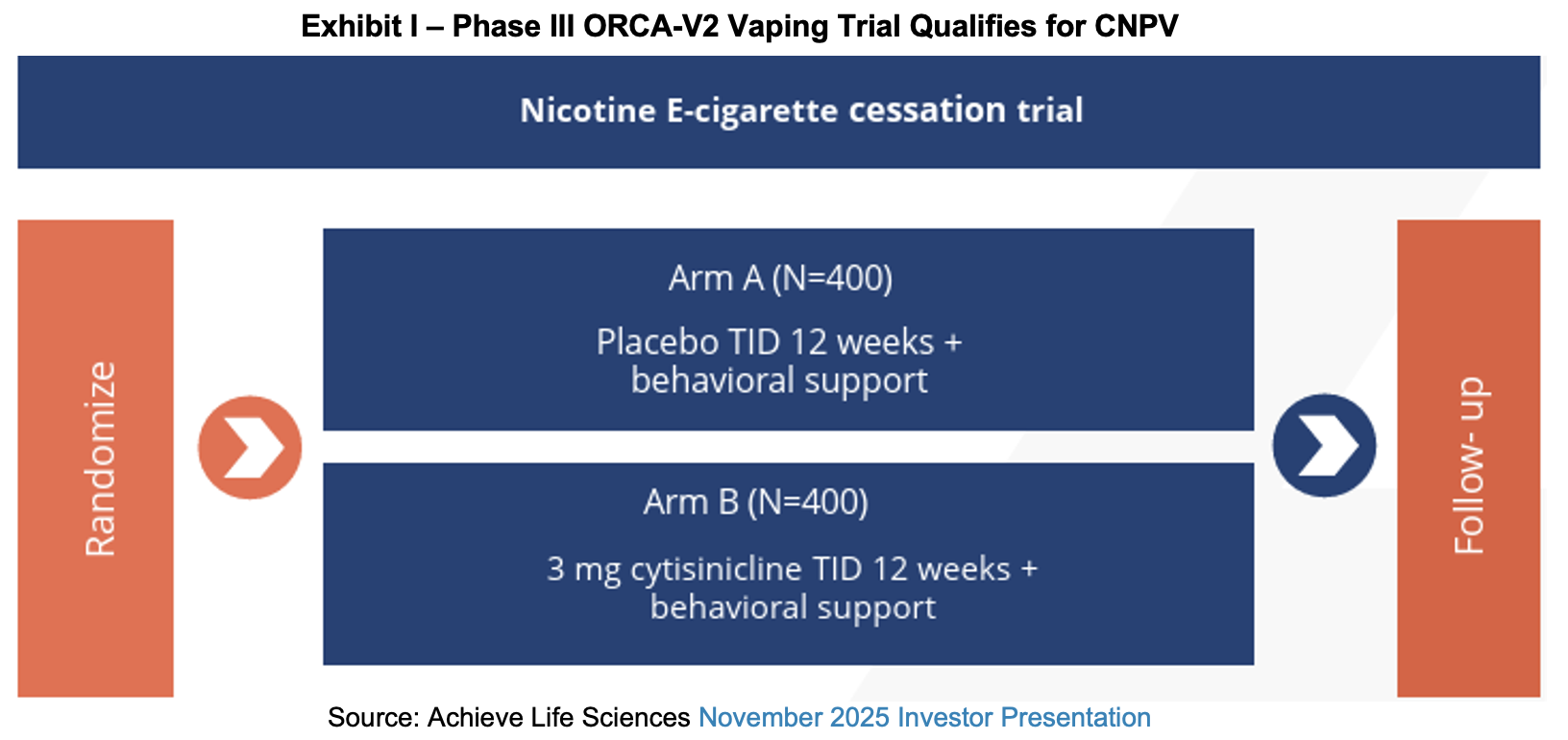
Achieve was awarded one of nine National Priority Vouchers for cytisinicline in the nicotine vaping addiction indication. Details of the award were provided in a mid-October announcement. A prospective recipient must offer a product with significant potential to address a major national priority. The priorities include meeting a large unmet medical need, reducing downstream health care utilization, addressing a public health crisis, boosting domestic manufacturing or increasing medication affordability with Most Favored Nation pricing. A drug and indication with a voucher will receive a decision within one to two months following filing of a complete application for a drug or biologic. In addition, sponsors will receive enhanced communications with review staff throughout the development process prior to their final submission and during the review period. The FDA may extend the review time if an application is incomplete, there are manufacturing violations or for other reasons. Achieve has two years to submit a new drug application for a vaping indication in order to take advantage of the voucher.
During the first Trump administration, under Food and Drug Administration (FDA) Commissioner Scott Gottlieb (appointed in 2017), the agency stated intentions to reduce the nicotine yield of combustible cigarettes. The administration also signed the 2020 Federal Budget which raised the smoking age from 18 to 21. The focus on nicotine addiction appears to have, at least in part, carried through to the second administration.
Appointments and Promotions
Achieve announced the appointment of Dr. Mark Rubinstein as interim Chief Medical Officer (CMO), the promotion of Craig Donnelly to Chief Operations Officer (COO) and the addition of Erik Atkisson as Chief Legal Officer (CLO). Dr. Rubinstein, M.D. succeeds Cindy Jacobs, Ph.D., M.D. in the role. Dr. Rubinstein was hired as Head of Medical Affairs at Achieve in October 2024 having previously served as Head of Medical Affairs at Blip, a smoking cessation company. Dr. Jacobs is expected to provide advisory services as the new CMO ramps up in the role. Craig Donnelly joined Achieve in 2022 as Executive Vice President of Chemistry, Manufacturing and Controls (CMC). As COO, Craig will lead the integration of Achieve’s supply chain and manufacturing activities with its commercial strategy. In late October, Achieve added a Chief Legal Officer to its ranks with the appointment of Erik Atkisson. Erik was previously at Rain Oncology and had over 25 years of experience in the pharmaceutical and biotechnology industries. He will oversee Achieve’s legal strategy, corporate governance, compliance and risk management.
Video Series Interviews
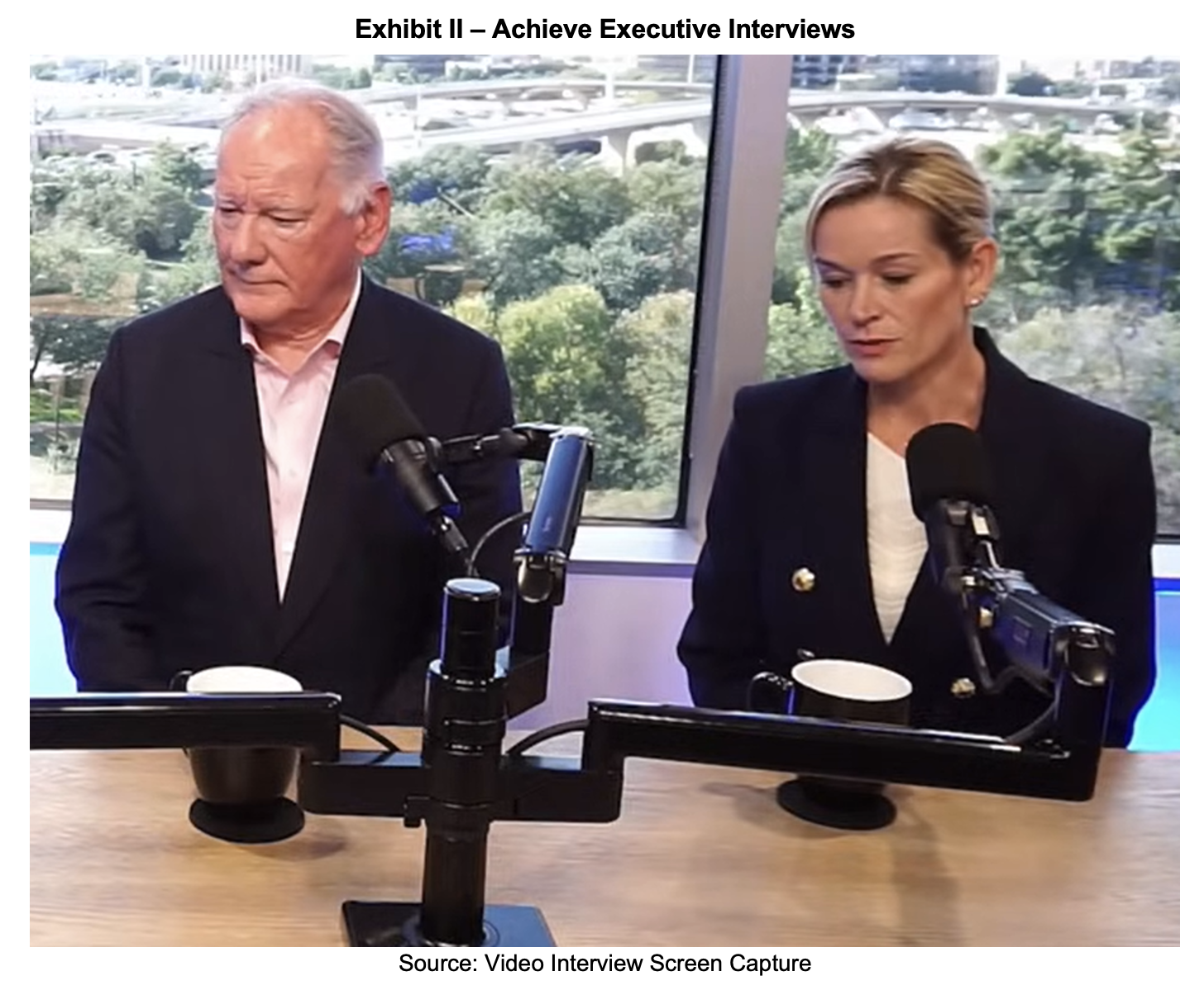
CEO Rick Stewart and CCO Jaime Xinos participated in a series of video interviews covering a range of topics including Omnicom’s role in the commercialization effort, to Artificial Intelligence (AI) and Achieve’s work in vaping cessation. The two executives enumerated near term milestones, shared anecdotal patient successes and reviewed Achieve’s balance sheet. See below for links to the excerpts.
Sopharma Relationship
Achieve noted in its 10-Q filing that it harbors concerns regarding Sopharma’s ability to pass an FDA pre-approval inspection and has engaged other third-party manufacturers to produce tableted and packaged cytisinicline. In response, Sopharma has alleged that engagement of third-party manufacturers is a breach of the Sopharma License and Supply Agreement. The two parties are discussing a resolution.
Achieve is now sourcing its cytisinicline from a supplier in China who is extracting cytisine from the Thermopsis tree. If Achieve is not able to come to an agreement with Sopharma, it plans to source cytisinicline from China, formulate, tablet and package it at partners in India and France, and then have it shipped to the United States for commercialization. Additionally, the company has also disclosed in its latest slide deck that it has intellectual property rights pending for synthetic cytisinicline. This may play a role in the future and could provide further sourcing flexibility and efficiency.
It is too early to tell how the dispute with Sopharma will resolve; however, we note that Achieve will owe Sopharma a royalty of 6% of sales. While moving beyond Sopharma provides more flexibility to source the product, it also lowers the barriers of entry for others when cytisinicline’s IP expires.
SUBSCRIBE TO ZACKS SMALL CAP RESEARCH to receive our articles and reports emailed directly to you each morning. Please visit our website for additional information on Zacks SCR.
DISCLOSURE: Zacks SCR has received compensation from the issuer directly, from an investment manager, or from an investor relations consulting firm, engaged by the issuer, for providing research coverage for a period of no less than one year. Research articles, as seen here, are part of the service Zacks SCR provides and Zacks SCR receives payments totaling a maximum fee of up to $50,000 annually for these services provided to or regarding the issuer. Full Disclaimer HERE.