By John Vandermosten, CFA
NYSE:AZTR
READ THE FULL AZTR RESEARCH REPORT
Azitra, Inc. (NYSE:AZTR) reported third quarter 2025 results in a November 12th press release and provided a business update. Since our previous quarterly update in August, Azitra has announced that its first patient has been dosed in the ATR-04 trial and it has presented preclinical data for its ATR-01 program. The ATR-12 study in Netherton Syndrome continues to evaluate patients. Management has participated in several conferences updating investors and other stakeholders on recent performance. In the financial sphere, the company raised additional funds with Alumni Capital. Looking ahead, Azitra expects to share topline efficacy results for the Netherton and ATR-04 trials in 1Q:26 and mid-year 2026, respectively.
Operational and Financial Results
Azitra reported 3Q:25 results in a press release and Form 10-Q filing with the SEC on November 12th. For the quarter ending September 30th, 2025, and versus the prior year’s comparable period, no revenues were reported. Net loss for the three-month period totaled ($2.8) million or ($0.67) per share.[1] Operational expenses fell 5% as decreases in general and administrative (G&A) expenses were only partially offset by higher research and development (R&D) expenses. Below, we detail financial results for 3Q:25, compared to the same prior year period:
- Research and development expenses increased by 16% to $1.2 million from $1.0 million stemming from greater clinical trial costs for the ATR-04 and ATR-01 programs, increased payroll costs due to raises and a new hire along with more lab supplies partially offset by lower clinical consultant expenditures;
- General & Administrative expenses totaled $1.6 million, down 17% from $1.9 million due to reduced legal fees, public company compliance initiatives, stock options expense, hiring costs, and other expenses. This was partially offset by a rise in costs related to obtaining the company’s equity line of credit with Avenue, greater use of business consultants, higher public relations, accounting and auditing expense, and a lift in software, equipment, and insurance costs;
- Net interest income was $4,000 compared to $44,000 with the prior year dominated by interest income related to a higher cash balance;
- Other expense was negligible compared with $1.9 million, largely related to positive change in fair value of warrants which occurred in the prior year;
- Net loss was ($2.8) million or ($0.67) per share vs. ($1.0) million or ($1.14) per share;[2]
As of September 30th, 2025, cash totaled $1.4 million. This amount compares to the $4.6 million balance in cash held at the end of 2024. No debt was held on the balance sheet. Cash burn for the first nine months of 2025 was ($8.4) million, slightly greater in magnitude than the ($7.9) million consumed in the same prior year period. Cash from financing was $5.3 million, representing proceeds from public offerings and the equity line of credit with Alumni Capital, partially offset by principal payments on finance leases. We expect that Azitra will regularly access the equity line to continue funding the pipeline activities. Post quarter end, Azitra raised $2.4 million with the equity line of credit.
ATR-04
Epidermal growth factor receptor inhibitors (EGFRi) are targeted cancer therapies that have been effective in breast, colon, lung and pancreatic cancer. EGFR is a protein found on the surface of cells, and it plays a role in cell growth and division. In some cancers, such as certain types of lung cancer and colorectal cancer, the EGFR gene is mutated or overexpressed, leading to uncontrolled cell growth. EGFR inhibitors work by blocking the activity of this protein, thereby slowing or stopping cancer cell growth.
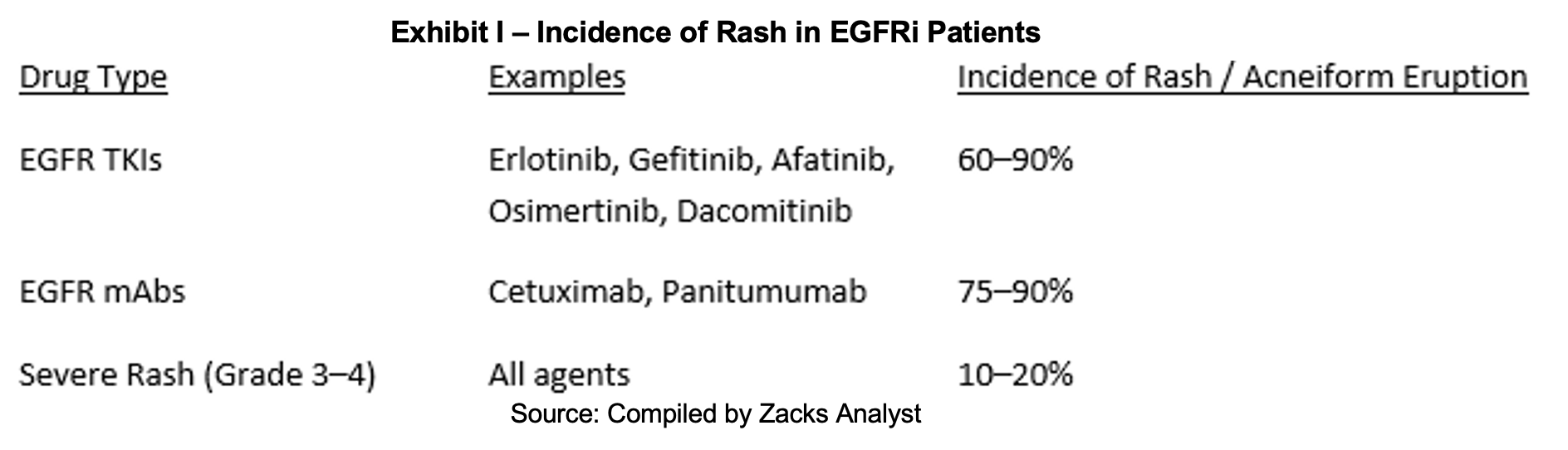
In the skin, EGFR regulates multiple keratinocyte functions, including proliferation, adhesion and migration, survival, and differentiation. Consequently, inhibition of EGFR in the skin results in adverse skin reactions, which make it difficult for patients to continue therapy. Two of the leading EGFR inhibitors, erlotinib and gefitinib, carry FDA labels that warn of rash and skin reactions in over 20% of patients. In many cases, it is severe enough for the individual to stop EGFRi therapy. The skin reaction, which is referred to as an acneiform or papulopustular rash, can vary in intensity. Mild rash is treated with topical medications and oral antibiotics; however, in severe cases, a doctor may stop treatment.
The side effect is an unmet need that may be addressed using ATR-04, which is a genetically modified strain of S. epidermidis. The strain demonstrated properties of inhibiting IL-36γ, S. aureus, and related biofilms. ATR-04 has been modified to be auxotrophic for D-alanine. The product is formulated as a topical application and may also help reduce the use of antibiotics, allow for better compliance with EGFRi regimens, and improve patient quality of life.
Preclinical work for ATR-04 was completed and assembled with other required data into an investigational new drug (IND) application submitted last year to the FDA. In September 2024, the FDA granted Fast Track Designation to ATR-04 for Azitra’s indication. In an August 22nd, 2024 press release, Azitra announced that the IND had been cleared, which allows the company to begin its Phase I/II study of ATR-04 for moderate to severe EGFRi-associated dermal toxicity. On August 27th, 2025, a press release reported that the first patient had been dosed.
Trial Design
ATR-04 or its vehicle will be applied to the face as well as affected areas on the neck, chest, back, and areas around nailbeds in a 3:1 randomization. The key objectives of the study will be to assess the safety and tolerability of topical ATR-04 and to evaluate efficacy signals, including severity of disease, pruritus, and pain. The bioavailability of the candidate and pharmacodynamic parameters will also be studied. This clinical study will establish the basis for continued clinical development of ATR-04.
ATR-04 will enroll eight patients in a single ascending dose Phase I study over 28 days. The Phase II portion will target 24 patients for this segment of the study. A contract research organization (CRO) is in place, and four sites across the US are being identified for use. Azitra anticipates a rapid enrollment as these are high-volume cancer centers with many potential candidates receiving EGFRi treatment.
Rash Incidence Literature Review
We conducted a brief literature review on the incidence of rash in EGFRi patients and of side effects experienced by patients. References are included in the footnotes.[3],[4],[5],[6] EGFRi treatment side effects are frequent, with skin rash being the most common.
EGFR inhibitors belong to the kinase inhibitor or tyrosine kinase inhibitor (TKI) class and include such agents as Erbitux (cetuximab), Tarceva (erlotinib) and Iressa (gefitinib). EGFR is expressed in many tissues including epithelial tissue, skin, hair follicles and the gastrointestinal tract. Many of these sites are some of the most affected with EGFRi treatment. The condition is so severe that it may lead to the discontinuation of the therapy. The most common of the side effects is a dose-dependent rash or pustular lesions that appear on the face, scalp, chest, and upper back. Researchers have noted a positive correlation between the appearance of rash and the clinical benefit of EGFRis.
Treatment for the dermatological toxicities includes the use of emollient ointments and moisturizers, sun and irritant avoidance, and short showers. However, even with these approaches, many patients discontinue treatment, preempting the benefits of the underlying drug. The relationship between toxicity and discontinuation is even more distinct when placed in the context of numerous studies that show a positive association between skin toxicity and efficacy. With this as background, it is clear that treating the rash will not only improve the quality of life in patients on EGFRi therapy but also improve outcomes for those who are able to avoid discontinuation.
ATR-01 Preclinical Data
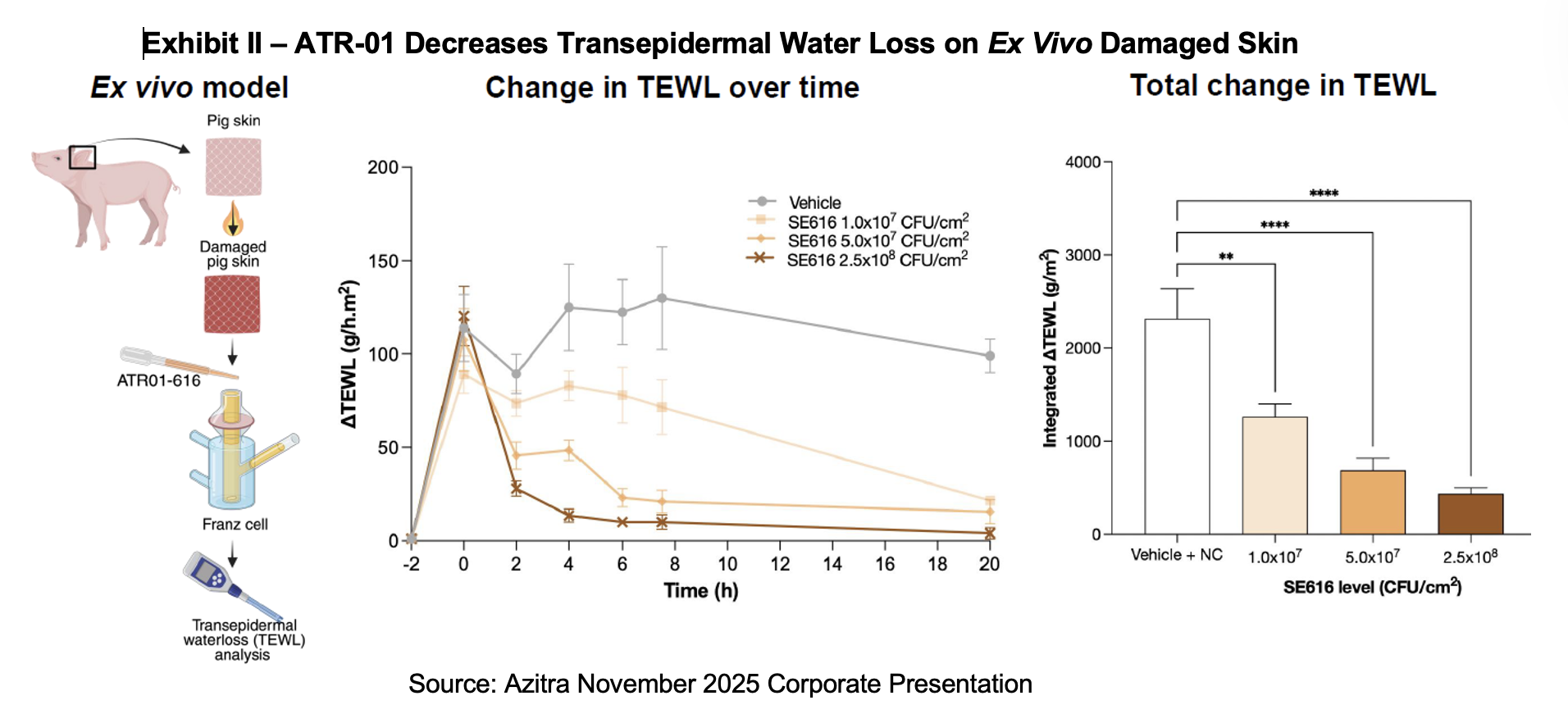
On October 20th, Azitra announced that it presented ATR-01 data at the BIO-Europe conference. ATR-01 is a filaggrin-secreting strain of S. epidermidis for ichthyosis vulgaris. Ichthyosis[7] vulgaris is an inherited skin disorder that is characterized by dry, scaly skin that is similar in appearance to fish scales. The presentation emphasized that ATR-01 offers a positive pharmacology profile across multiple preclinical models. In in vitro models, ATR-01 secreted functional filaggrin, as measured by keratin binding assays. Furthermore, in ex vivo human skin, it was found to deliver filaggrin through the stratum corneum, as was measured with fluorescence immunohistochemistry. In this model, ATR-01 delivered filaggrin below the skin barrier (p < 0.05). Finally, in an ex vivo damaged pig skin model, ATR-01 was shown to significantly reduce transepidermal water loss compared to vehicle control (p < 0.002). Together, these data demonstrate positive pharmacological activity and biodistribution. Azitra plans to conduct additional investigational new drug (IND)-enabling studies and submit an IND in 2026.
SUBSCRIBE TO ZACKS SMALL CAP RESEARCH to receive our articles and reports emailed directly to you each morning. Please visit our website for additional information on Zacks SCR.
DISCLOSURE: Zacks SCR has received compensation from the issuer directly, from an investment manager, or from an investor relations consulting firm, engaged by the issuer, for providing research coverage for a period of no less than one year. Research articles, as seen here, are part of the service Zacks SCR provides and Zacks SCR receives payments totaling a maximum fee of up to $50,000 annually for these services provided to or regarding the issuer. Full Disclaimer HERE.
________________________
[1] We update per share amounts in this report to reflect the 15:100 reverse stock split that took place on August 21st, 2025.
[2] We use financial statement data as originally reported and apply a 1:6.66 reverse stock split ratio for periods prior to August 21st, 2025. Prior year numbers in our reporting may not match Azitra’s current period comparisons.
[3] Fabbrocini, G., et al. Acneiform Rash Induced by EGFR Inhibitors: Review of the Literature and New Insights. Skin Appendage Disorders. February 2015.
[4] Pérez-Soler, R., Cutsem, E.V. Clinical Research of EGFR Inhibitors and Related Dermatologic Toxicities. Oncology. October 2007.
[5] Lacouture, M.E., et al. Dermatologic Toxicity Occurring During Anti-EGFR Monoclonal Inhibitor Therapy in Patients With Metastatic Colorectal Cancer: A Systematic Review. Clinical Colorectal Cancer. June 2018.
[6] Murphy-Rodríguez, E., et al. Cutaneous Toxicity Associated With Cetuximab Treatment in Metastatic Colorectal Cancer. Farmacia Hospitalaria. May 2011.
[7] The root of the word Ichthys is Greek for fish (ἰχθύς).