By David Bautz, PhD
NASDAQ:BCLI
READ THE FULL BCLI RESEARCH REPORT
Business Update
Receives Regulatory Clearance to Initiate Phase 3b Trial of NurOwn® in ALS
On May 19, 2025, BrainStorm Cell Therapeutics, Inc. (NASDAQ:BCLI) announced that the U.S. Food and Drug Administration (FDA) has cleared the company to initiate the Phase 3b trial of NurOwn® in the treatment of patients with amyotrophic lateral sclerosis (ALS). Clearance to conduct the Phase 3b trial was granted following the company filing an Investigational New Drug (IND) amendment, which concerned various technical aspects of the IND, including the tech transfer and chemistry, manufacturing and controls (CMC). The design of the trial was previously developed in consultation with the FDA under a Special Protocol Assessment (SPA), which confirms both the trial design and statistical plan.
Details of the Phase 3b trial, known as ENDURANCE, are now available at clinicaltrials.gov (NCT06973629). Included on the clinicaltrials.gov site is a list of the proposed 15 clinical trial sites. An overview of the planned Phase 3b trial is below. Up to approximately 200 patients with mild-to-moderate ALS will be enrolled into the two-part study: Part A will be a 24-week, randomized, double blind, placebo controlled period followed by Part B, which will be a 24-week open-label extension period. The primary endpoint will be based on the Amyotrophic Lateral Sclerosis Functional Rating Scale (ALSFRS-R). Patients will be treated at Weeks 0, 8, and 16 during Part A and then Weeks 24, 32, and 40 in Part B.
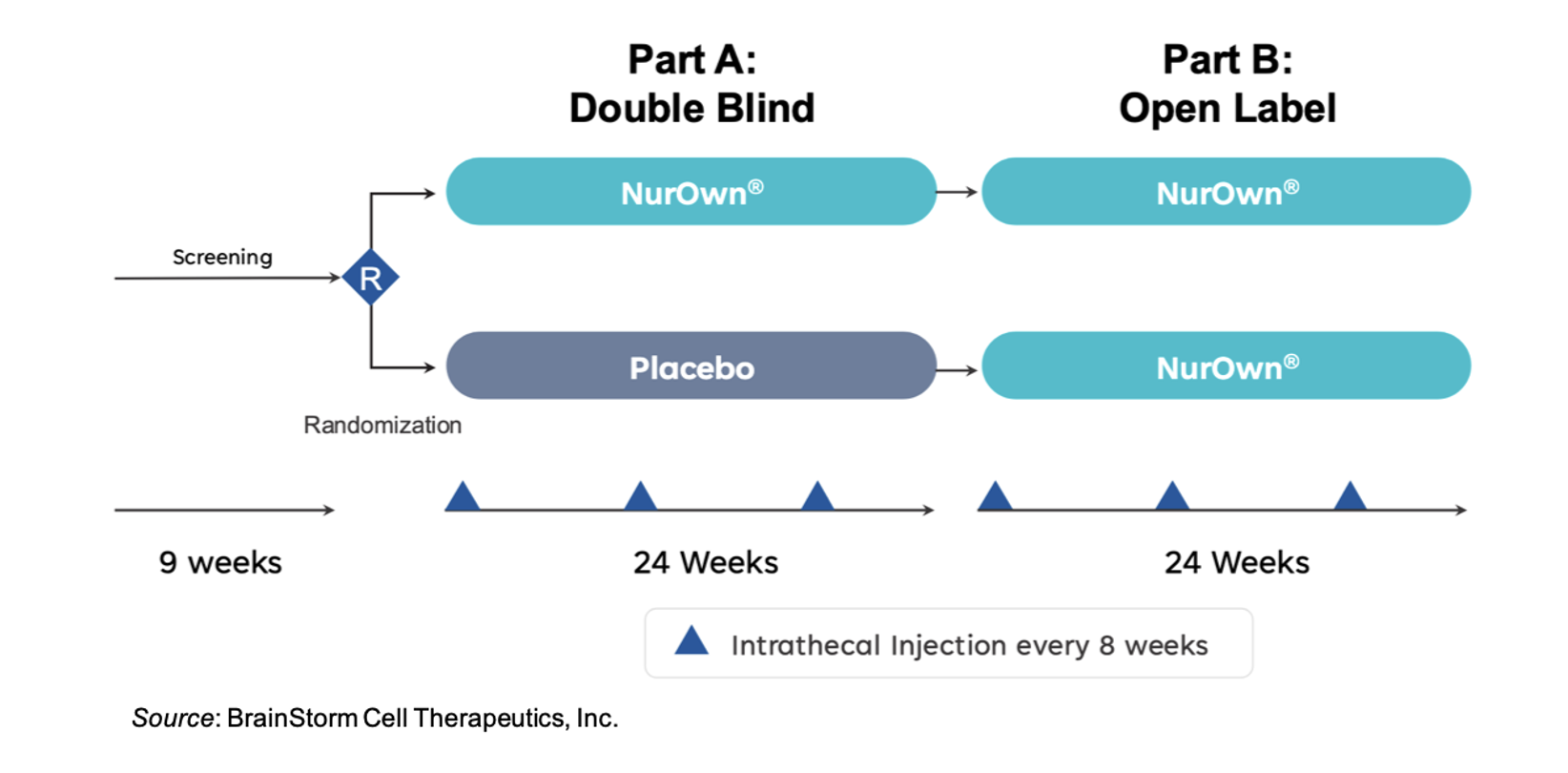
Some of the differences between the first Phase 3 trial and the proposed Phase 3b trial are as follows:
- In the first Phase 3 trial, patients were required to have an ALSFRS-R score ≥25, which allowed for the possibility to enroll advanced-disease participants. The Phase 3b trial will focus on those with earlier-stage disease, with all participants required to have ≥2 points on each item of the ALSFRS-R.
- The primary endpoint of the first Phase 3 trial was a responder analysis, with responders being defined as having a ≥1.25 points/month improvement in the post-treatment slope vs. pre-treatment slope in ALSFRS-R at Week 28. The Phase 3b trial will utilize the change in ALSFRS-R from baseline to Week 24, which is considered the “gold standard” for ALS trials.
- The first Phase 3 trial had a 20-week screening period, including a 3-month “run-in” period while the Phase 3b trial will eliminate the “run-in” and shorten the screening period to minimize changes between screening and baseline.
- Lastly, the Phase 3b trial has a SPA agreement with the FDA, while no such agreement existed for the first Phase 3 trial.
We believe these changes help to increase the probability for success in the Phase 3b trial, while having the SPA in place decreases the regulatory risk associated with the program.
In addition to getting all of the regulatory aspects in place, BrainStorm previously announced it had entered into a Memorandum of Understanding (MOU) with Pluri Inc. to manufacture NurOwn for use in the Phase 3b trial. Pluri will provide GMP-compliant manufacturing of NurOwn for the trial and the companies will explore the potential for manufacturing support for potential future commercial distribution of NurOwn, if approved.
Letter of Intent Signed with Minaris Advanced Therapies
On May 27, 2025, BrainStorm announced it had signed a Letter of Intent (LOI) with Minaris Advanced Therapies, a global Contract Development and Manufacturing Organization (CDMO) that specializes in cell and gene therapies, to manufacture NurOwn for the upcoming Phase 3b clinical trial. This partnership strengthens the company’s U.S. manufacturing capabilities and compliments the previously announced agreement between BrainStorm and Pluri, Inc. in Israel. Importantly, Minaris’ facility has passed FDA inspections, which decreases the regulatory risk. Lastly, these manufacturing agreements that BrainStorm has signed ensures that there is adequate capacity for NurOwn production to support the upcoming Phase 3b trial.
Pharmacogenomic Data Presented at 2025 ISCT Annual Meeting
On April 29, 2025, BrainStorm announced the acceptance of new pharmacogenomic data for oral presentation at the International Society for Cell & Gene Therapy (ISCT) 2025 Annual Meeting. Included in the presentation were data highlighting the impact of the UNC13A genotype on clinical outcomes for patients treated with NurOwn. A copy of the presentation can be found here.
The UNC13A protein is found in presynaptic terminals of the nervous system and is important for facilitating crucial steps in neurotransmission, enabling sustained neurotransmission, and maintaining and constructing the sites where neurotransmission can take place (Willemse et al., 2023). A gene variant of UNC13A (rs12608932 C allele) is associated with shorter survival time and more severe ALS (Diekstra et al., 2012; Tan et al., 2020). TDP-43 is a splicing protein that is responsible for binding to intronic sequences and repressing the inclusion of certain segments into mature RNA. TDP-43 cytosolic aggregates are found in up to 98% of sporadic ALS cases and are often accompanied by nuclear depletion of TDP-43 and the appearance of cryptic exons (Prasad et al., 2019). The rs12608932 allele is located within a UNC13A intron (or cryptic exon), thus loss of TDP-43 leads to an increase in the inclusion of cryptic exons in UNC13A (Ma et al., 2022). Thus, the loss of TDP-43 combined with the presence of certain risk variants leads to a large decrease in viable UNC13A mRNA and protein.
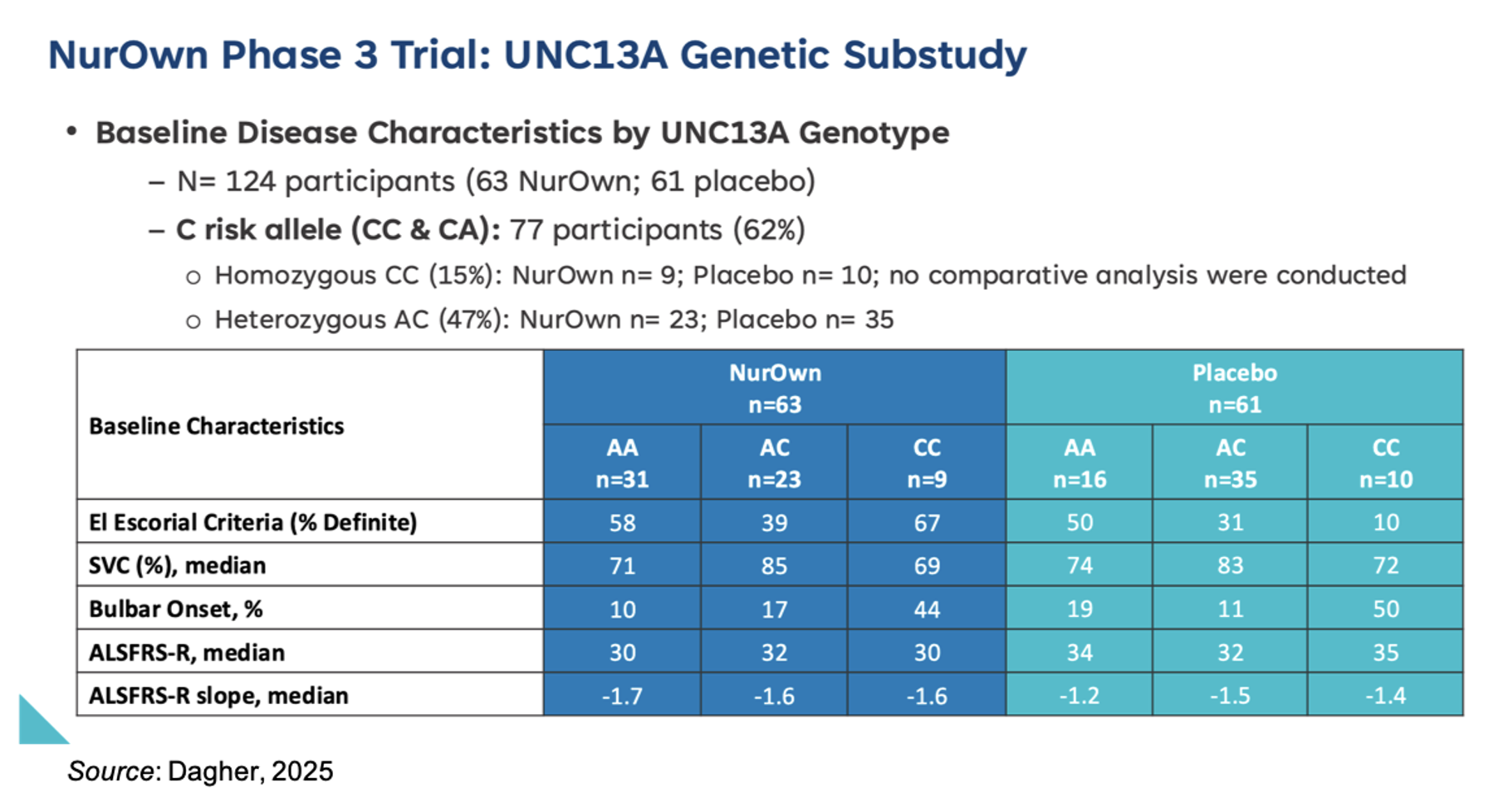
The data presented by BrainStorm examined the association between the rs12608932 allele and patient outcomes in the Phase 3 NurOwn trial. The following table gives the baseline characteristics for the Phase 3 trial participants stratified by genotype at rs12608932. Approximately 62% of participants had the C risk allele (either CC or CA), however only 15% of participants were homozygous CC (NurOwn n=9; placebo n=10), thus no comparative analysis was performed.
The results of the analysis showed that participants with the AC genotype had a significant clinical benefit and biomarker improvement. While the overall trial showed a responder rate of 33% for NurOwn treated patients compared to 28% for placebo treated patients, for those with the AC genotype the response rate was 65% for those treated with NurOwn compared to 29% for those treated with placebo (P=0.011). In addition, there was a positive trend for the change in ALSFRS-R from baseline at Week 28 in those with the AC genotype, as those treated with NurOwn had a decrease of -1.90 while those treated with placebo had a decrease of -3.75 (P=0.167).
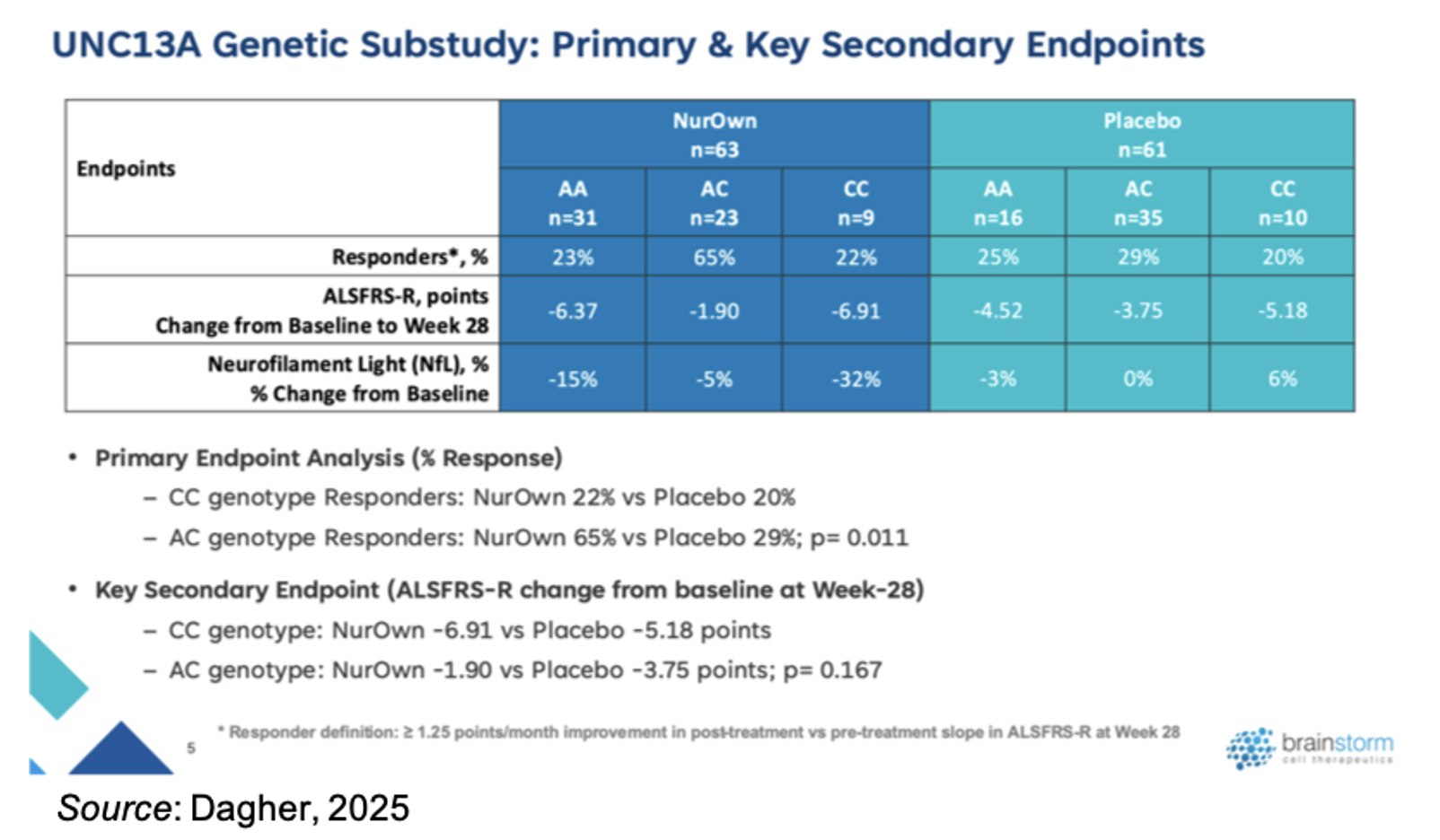
These results are the first pharmacogenomic analysis of Phase 3 data from an ALS trial and provide additional insight into treatment effects in different subpopulations based on genotype.
Financial Update
On May 15, 2025, BrainStorm announced financial results for the first quarter of 2025. As anticipated, the company did not report any revenues for the first quarter of 2025. Net R&D expenses for the first quarter of 2025 were $1.3 million, compared to $1.0 million for the first quarter of 2024. The increase was primarily due to increased payroll expenses and stock-based compensation. G&A expenses for the first quarter of 2025 were $1.8 million compared to $1.5 million for the first quarter of 2024. The increase was primarily due to higher stock-based compensation and consultant costs partially offset by a decrease in payroll expenses, rent, and investor relations activities.
The company exited the first quarter of 2025 with approximately $1.8 million in cash, cash equivalents, and restricted cash. The company is currently exploring various mechanisms to secure funding for the Phase 3b trial, including non-dilutive grants. As of May 11, 2025, BrainStorm had approximately 7.9 million common shares outstanding and, when factoring in stock options and warrants, a fully diluted share count of approximately 11.5 million.
Conclusion
Now that the FDA has given clearance to the company to initiate the Phase 3b trial of NurOwn in ALS patients, we look forward to updates regarding how the trial will be financed, site activation, and the enrollment of the first patient. Importantly, the company has also secured additional manufacturing capabilities to ensure there will be adequate production of NurOwn to support the trial. We have made no changes to our model and our valuation remains at $9 per share.
SUBSCRIBE TO ZACKS SMALL CAP RESEARCH to receive our articles and reports emailed directly to you each morning. Please visit our website for additional information on Zacks SCR.
DISCLOSURE: Zacks SCR has received compensation from the issuer directly, from an investment manager, or from an investor relations consulting firm, engaged by the issuer, for providing research coverage for a period of no less than one year. Research articles, as seen here, are part of the service Zacks SCR provides and Zacks SCR receives quarterly payments totaling a maximum fee of up to $40,000 annually for these services provided to or regarding the issuer. Full Disclaimer HERE.