By David Bautz, PhD
NASDAQ:DWTX
READ THE FULL DWTX RESEARCH REPORT
Business Update
100 Patients Enrolled in Phase 2b Trial of Halneuron®; Interim Analysis in 4Q25
Dogwood Therapeutics, Inc. (NASDAQ:DWTX) is currently conducting the Phase 2b HALT-CINP (Halneuron® Treatment of Chemotherapy-Induced Neuropathic Pain) trial. This is a four-week study that will examine the safety and efficacy of Halneuron in patients with moderate-to-severe CINP. The primary efficacy endpoint is the change from baseline at Week 4 in the weekly average of daily 24-hour recall pain intensity scores, which will be recorded in e-diaries on participants’ smartphones. Secondary efficacy endpoints include Patient Global Impression of Change (PIGC), PROMIS Fatigue, PROMIS Sleep, PROMIS-29, Pain Interference, Hospital Anxiety and Depression Scale (HADS), and Neuropathic Pain Symptom Inventory (NPSI).
The company recently reported that 100 patients have been enrolled thus far in the trial and that 80 patients have completed treatment. The study has a pre-specified interim analysis that we anticipate occurring in the fourth quarter of 2025. Currently the planned enrollment is 200 patients and topline data is expected in the second half of 2026, however, this number is subject to change depending on the results of the interim analysis.
Background on Halneuron
Halneuron (tetrodotoxin, TTX), a sodium channel blocker, was originally discovered in the pufferfish and subsequent research has identified the toxin in 13 phyla (in both Eukarya and Bacteria) that includes both marine and terrestrial eukaryotes (Lago et al., 2015). As a natural poison, TTX is extremely effective and is the most potent non-peptide neurotoxin known. It blocks the influx of sodium through voltage-gated sodium channels (NaVs), thereby preventing the initiation and propagation of action potentials in almost all neurons and muscle cells (Stevens et al., 2011).
Mammals possess nine voltage-gated sodium channels, NaV1.1-NaV1.9. TTX binds to NaV1.1, NaV1.2, NaV1.3, NaV1.4, NaV1.6, and NaV1.7 (Nieto et al., 2012). NaV1.7 is expressed in all types of dorsal root ganglion (DRG) neurons, sympathetic neurons, Schwann cells, and neuroendocrine cells (Catterall et al., 2005). It is responsible for the perception of pain, which is supported by multiple lines of evidence. Individuals with loss-of-function mutations in the SCN9A gene (which encodes the alpha-subunit of NaV1.7) experience a complete inability to sense pain (Cox et al., 2006) while those with a gain-of-function mutation in SCN9A experience erythromelalgia (Dib-Hajj et al., 2005). In animal models, NaV1.7 nociceptor-specific knockout mice showed increased mechanical and thermal pain thresholds (Nassar et al., 2004). These results led researchers to hypothesize that TTX could be a potential therapeutic to control pain.
Halneuron Clinical Trials
Previous clinical trials investigating Halneuron include a Phase 2 cancer related pain (CRP) study and a Phase 2 CINP trial.
Phase 2 CRP Trial
This was a randomized, double blind, parallel design, multicenter trial that enrolled 165 patients with moderate to severe inadequately controlled CRP. All patients were on standard of care pain management. Halneuron or placebo was administered twice a day for four days and all patients recorded their pain response from days 5-8 (early post-injection period) and from days 9-15 (late post-injection period). The results showed a statistically significant improvement in pain outcomes for Halneuron, with 51% of Halneuron patients experiencing a ≥30% reduction in pain compared to only 35% in the placebo group, as shown in the following image.
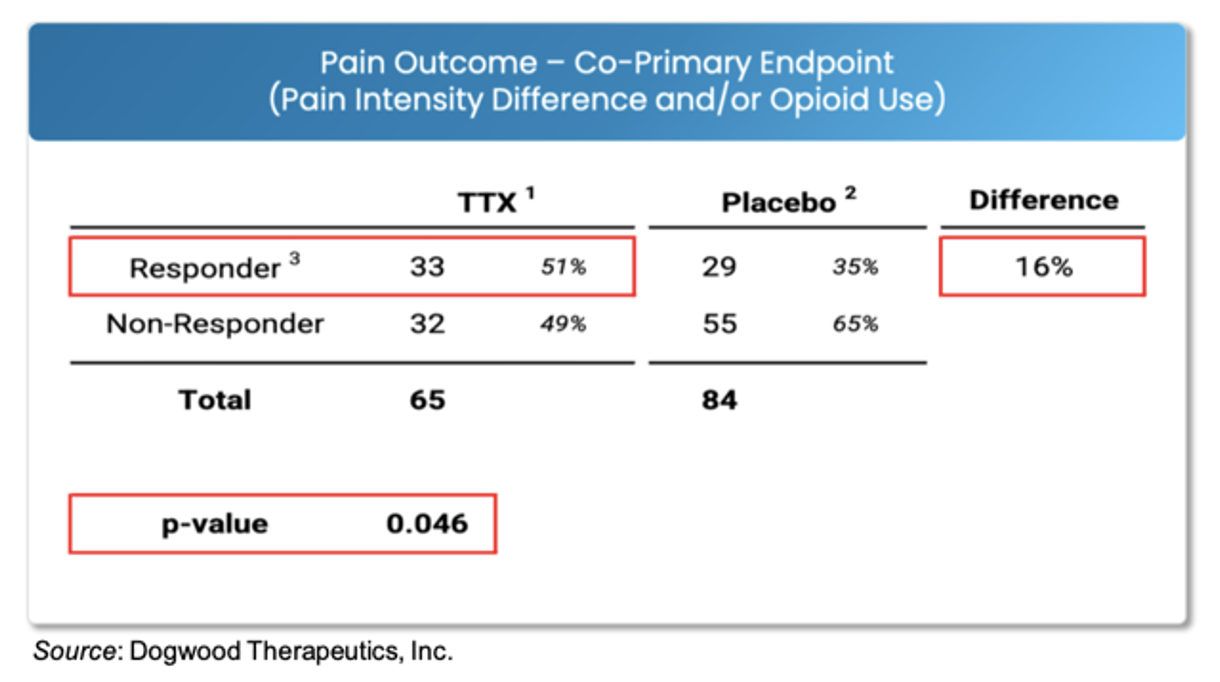
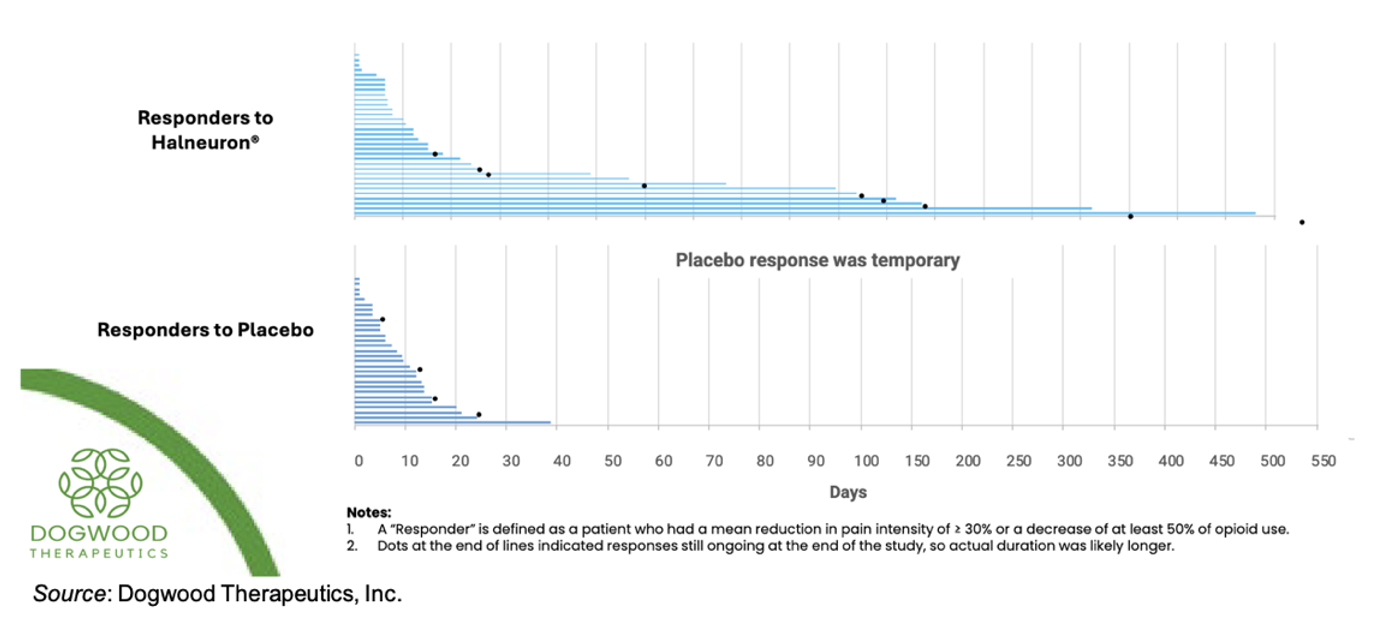
For Global Impression of Pain Change, 55% of Halneuron patients reported an improvement in pain compared to 24% of placebo patients. Conversely, 70% of placebo patients reported no change or worse pain compared to only 37% of patients. In addition to a positive pain response, the duration of pain relief was much higher for Halneuron patients, as shown in the following figure. The average pain response for Halneuron responders was 57.7 days compared to 10.5 days for placebo responders. Lastly, over one-quarter of Halneuron responders (27%) had pain relief that lasted for 30 days or longer after one cycle of treatment.
Phase 2 CINP Trial
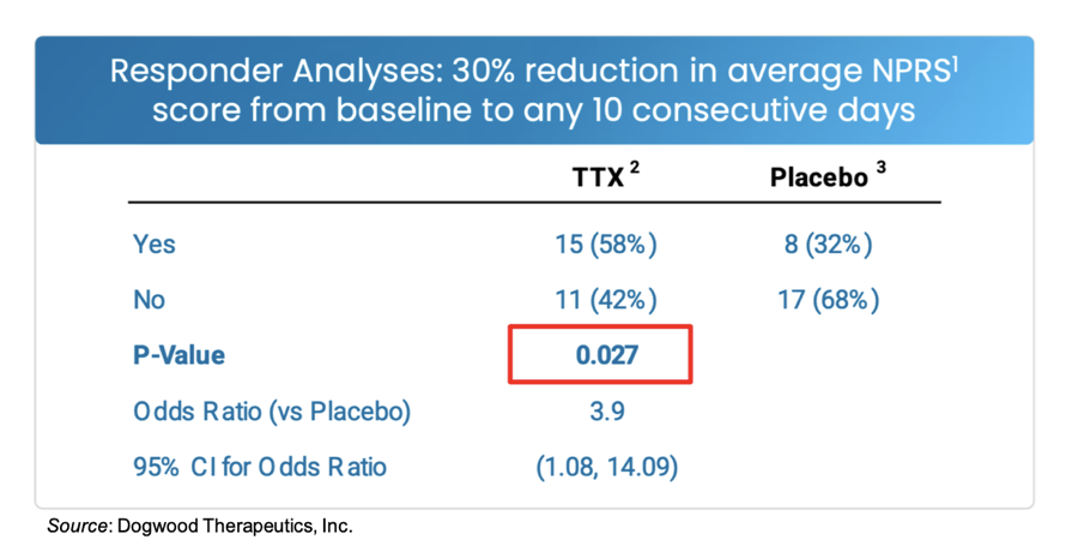
This was a randomized, double blind, dose-finding, placebo controlled, multicenter study in patients with CINP. Various doses of Halneuron were tested over four days of treatment followed by measurement over four weeks. The study included a total of 125 patients across five dosing cohorts (four active and one placebo). The results showed that a dose of 30 mg twice per day for four days demonstrated the highest level of pain reduction compared to placebo, with the responder analysis results given below.
Background on CINP
CINP is the result of injury to the somatosensory nervous system following chemotherapy treatment (Colvin, 2019). For agents such as paclitaxel and oxaliplatin, the rate of CINP is up to 81% and 98%, respectively (Hershman et al., 2010; Gebremedhn et al., 2018). CINP begins as an acute pain syndrome that coincides with drug administration, however it can progress to a chronic condition following multiple rounds of therapy.
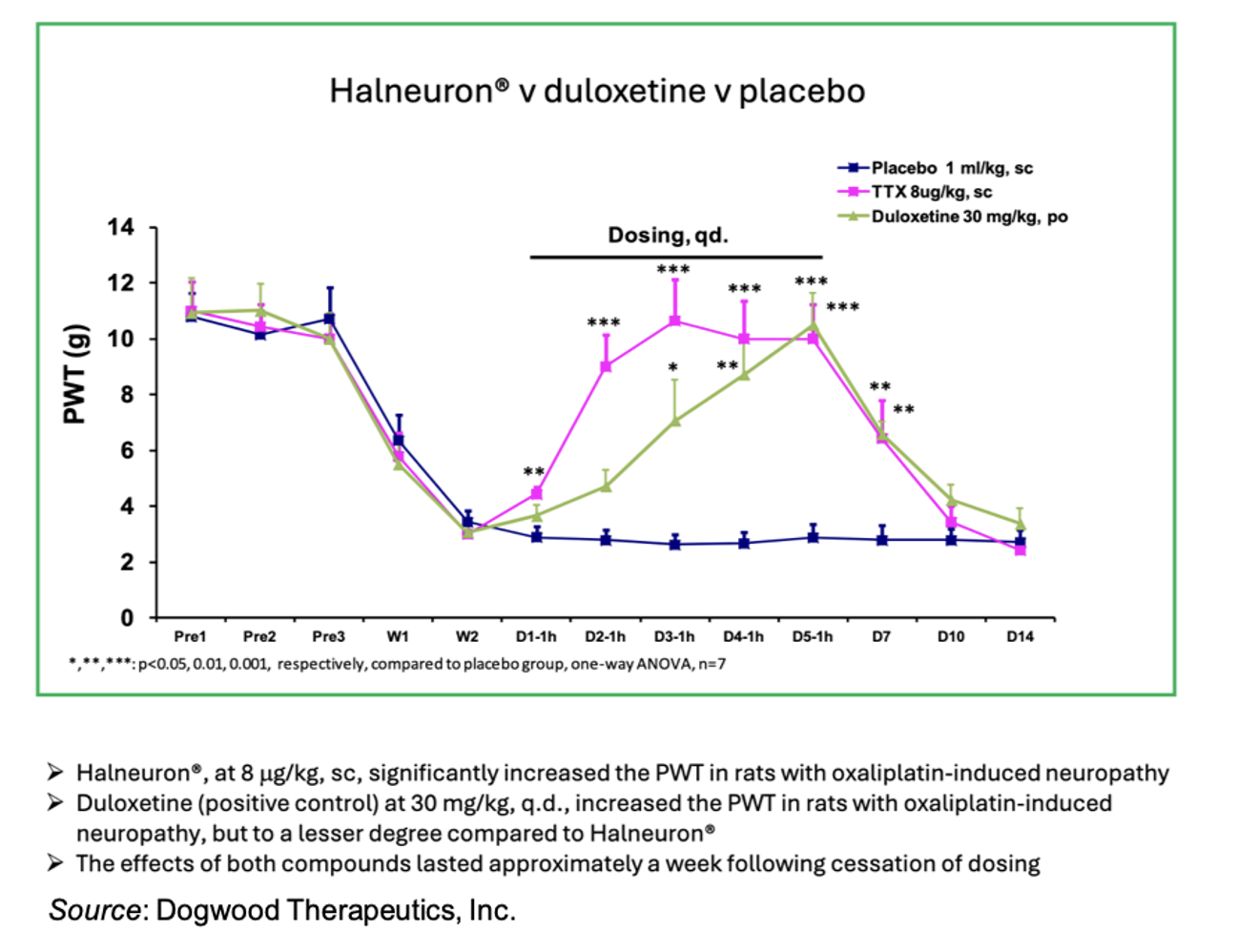
The only drug endorsed to treat CINP by the American Society of Clinical Oncology (ASCO) is duloxetine, which showed a significant reduction in pain in a Phase 3 clinical trial (Lavoie Smith et al., 2013). However, the drug is not FDA approved for the treatment of CINP. In addition, in a preclinical oxaliplatin-induced neuropathic pain model, Halneuron was superior to duloxetine based on the paw withdrawal threshold (PWT), a measure of pain tolerance.
There are an estimated 1.7 million CINP patients in the seven major markets (U.S., EU5, Japan). Opioids currently account for 30% of the global CINP market, which is estimated to be approximately $1.5 billion. The company also has plans to target CRP, which has a patient population approximately 7.5 times as large as CINP and a market worth approximately $5 billion.
Licenses SP16 for Cancer-Related Pain
In September 2025, Dogwood announced a royalty-free, global license deal with Serpin Pharma for SP16 for the management of cancer related pain (CRP), including a broad range of chemotherapy induced neuropathy symptoms. SP16 is an intravenously administered peptide that functions as an LRP1 agonist and has shown anti-inflammatory and neural repair activity. A Phase 1b trial of SP16 in Chemotherapy Induced Peripheral Neuropathy (CIPN) is scheduled to initiate in the first half of 2026 and is fully funded by the National Cancer Institute (NCI). For a full analysis of SP16 please see our previous report here.
Financial Update
On November 6, 2025, Dogwood announced financial results for the third quarter of 2025. As expected, the company did not report any revenues in the third quarter of 2025. R&D expenses for the quarter ending September 30, 2025, were $14.5 million compared to $0.5 million for the quarter ending September 30, 2024. The increase was primarily due to the acquired in-process research and development expenses of $12.0 million associated with the licensing agreement of SP16 and increased clinical trial expenses related to the Phase 2b study. G&A expenses for the third quarter of 2025 were $1.3 million compared to $1.8 million for the third quarter of 2024. The decrease was primarily due to decreased legal and accounting fees along with decreased costs associated with being a public company that were partially offset by an increase in salaries and related personnel costs.
As of September 30, 2025, Dogwood had approximately $10.1 million in cash and cash equivalents. We estimate this is sufficient to fund operations through the first quarter of 2026. As of November 5, 2025, Dogwood had approximately 2.3 million common shares outstanding and, when factoring in stock options, warrants, and the Series A and Series A-1 convertible shares, a fully diluted share count of approximately 29.2 million.
Conclusion
We look forward to the interim analysis of the Halneuron Phase 2b trial, which we continue to expect in the fourth quarter of 2025. We’re encouraged to see the steady rate at which the trial is enrolling, and as of now we anticipate topline results from the study in the second half of 2026, however this is subject to change based on the results of the interim analysis. With no changes to our model, our valuation remains at $13 per share.
SUBSCRIBE TO ZACKS SMALL CAP RESEARCH to receive our articles and reports emailed directly to you each morning. Please visit our website for additional information on Zacks SCR.
DISCLOSURE: Zacks SCR has received compensation from the issuer directly, from an investment manager, or from an investor relations consulting firm, engaged by the issuer, for providing research coverage for a period of no less than one year. Research articles, as seen here, are part of the service Zacks SCR provides and Zacks SCR receives payments totaling a maximum fee of up to $50,000 annually for these services provided to or regarding the issuer. Full Disclaimer HERE.