By David Bautz, PhD
NASDAQ:EDSA
READ THE FULL EDSA RESEARCH REPORT
Business Update
Advancing EB06 for Treating Vitiligo
Edesa Biotech, Inc. (NASDAQ:EDSA) is planning for a Phase 2 study of EB06, its anti-CXCL10 monoclonal antibody, for the treatment of moderate-to-severe non-segmental vitiligo patients. Vitiligo is a disease that causes areas of the skin to lose color, with non-segmental vitiligo being characterized by patches appearing on both sides of the body. It is caused when pigment-producing cells (melanocytes) die or stop producing melanin as a result of an autoimmune disease, genetics, or a triggering event (e.g., stress, sunburn, skin trauma).
Past research showed that the chemokine CXCL10 was elevated in both vitiligo patient skin and serum (El-Domyati et al., 2022). In a mouse model of vitiligo, which includes CXCL10 expression in the skin, neutralization of CXCL10 in mice with established, widespread depigmentation induced reversal of disease as shown by repigmentation (Rashighi et al., 2014). In addition, serum CXCL10 levels are significantly increased in vitiligo patients compared to controls, suggesting that CXCL10 may play a role in the pathogenesis of vitiligo in humans (Gharib et al., 2021). The following slide gives an overview of the mechanism of action of EB06 and data supporting its use in the treatment of vitiligo.
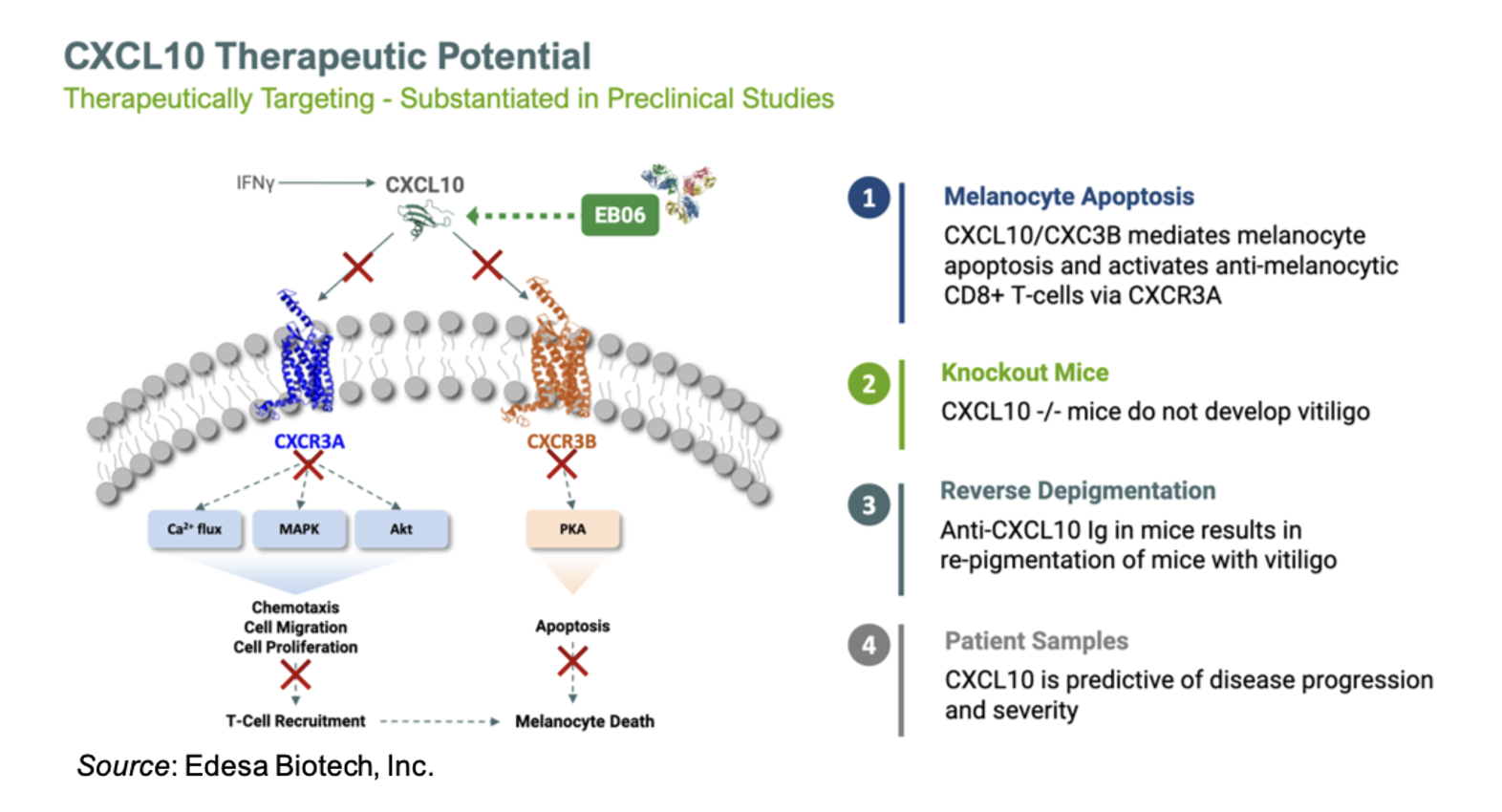
A 2022 publication reported that the estimated prevalence of vitiligo patients in the U.S. is between 1.9 million and 2.8 million (Gandhi et al., 2022). This corresponds to a vitiligo market that is projected to reach approximately $1 billion by 2030 (EvaluatePharma).
Edesa is continuing IND-enabling work for EB06 and has already received approval from Health Canada to conduct a Phase 2 trial. Manufacturing activities have begun and are likely to be concluded before the end of calendar 2025. In addition, the company has begun outreach to potential investigators for the Phase 2 trial. The study as currently planned will enroll approximately 150 patients with severe nonsegmental vitiligo, will evaluate three different doses of EB06, and will have a primary efficacy outcome of the percentage of patients that achieve ≥50% decrease from baseline in facial Vitiligo Area Scoring Index (F-VASI50), a composite measurement of the overall area of facial vitiligo patches and degree of depigmentation within patches. The final trial protocol will be contingent on feedback from the FDA. We anticipate the IND being filed before the end of 2025.
VYN201 Fails Phase 2 Trial in Vitiligo
On July 30, 2025, VYNE Therapeutics (NASDAQ:VYNE) announced that the Phase 2b trial of repibresib gel in 177 patients with nonsegmental vitiligo did not meet its primary endpoint of the proportion of subjects achieving an improvement in Facial Vitiligo Area Scoring Index of at least 50% from baseline (F-VASI50) at week 24 compared to placebo. The trial also missed a key secondary endpoint of F-VASI75. The company reported that the results of the trial were impacted by an unusually high placebo effect and further impacted by a higher-than-expected dropout rate in the active arms of the trial compared to placebo. VYNE is discontinuing the extension phase of the trial and will terminate the study.
We don’t see any type of read-through for Edesa’s potential in vitiligo based on VYNE’s failure. It may represent one less potential competitor in the space, albeit repibresib gel most likely would have directly competed with Opzelura.
Financial Update
On August 11, 2025, Edesa announced financial results for the third quarter of fiscal year 2025 that ended June 30, 2025. There were no revenues reported for the third quarter of fiscal year 2025. R&D expenses in the third quarters of both fiscal years 2025 and 2024 were $0.5 million. This was due to an increase in EB06-related expenses that were offset by a decrease in external research expenses for EB05. G&A expenses totaled $1.0 million for the third quarters of both fiscal year 2025 and 2024. A decrease in salaries in 2025 was offset by an increase in noncash share-based compensation and professional service fees.
As of June 30, 2025, Edesa had approximately $12.4 million in cash and cash equivalents. We estimate the company has sufficient capital to fund operations through the end of fiscal 2026. As of August 8, 2025, Edesa had approximately 7.0 million shares outstanding and, when factoring in stock options, warrants, RSUs, and the Series B-1 convertible preferred shares, a fully diluted share count of approximately 14.0 million.
Conclusion
We look forward to additional details regarding EB06’s manufacturing and the filing of the IND with the FDA before the end of 2025. Once the IND is filed, we estimate that data from the Phase 2 study could be available in 12-18 months. With no changes to our model, our valuation remains at $17 per share.
SUBSCRIBE TO ZACKS SMALL CAP RESEARCH to receive our articles and reports emailed directly to you each morning. Please visit our website for additional information on Zacks SCR.
DISCLOSURE: Zacks SCR has received compensation from the issuer directly, from an investment manager, or from an investor relations consulting firm, engaged by the issuer, for providing research coverage for a period of no less than one year. Research articles, as seen here, are part of the service Zacks SCR provides and Zacks SCR receives payments totaling a maximum fee of up to $50,000 annually for these services provided to or regarding the issuer. Full Disclaimer HERE.