By David Bautz, PhD
NASDAQ:FBLG
READ THE FULL FBLG RESEARCH REPORT
Business Update
Phase 1/2 Trial in Diabetic Foot Ulcers to Initiate in 1Q26
FibroBiologics (NASDAQ:FBLG) is continuing preparations for a Phase 1/2 trial of CYWC628, a fibroblast-based spheroid product candidate, in patients suffering from diabetic foot ulcers (DFUs), which we anticipate initiating in the first quarter of 2026 and completing in the third quarter of 2026. The company is set to complete manufacturing training runs for CYWC628 and confirm the sterility of the manufacturing process by the end of 2025 and then manufacture CYWC628 for the Phase 1/2 trial according to current Good Manufacturing Practices (cGMP).
DFUs cause significant morbidity for the 6.3% of diabetic adults (~33 million) that develop them. Of those, 20% will require lower extremity amputation and 10% will die within the first year of their first DFU. In addition, once a DFU forms there is a high rate of recurrence, both at one year (40%) and three years (70%).
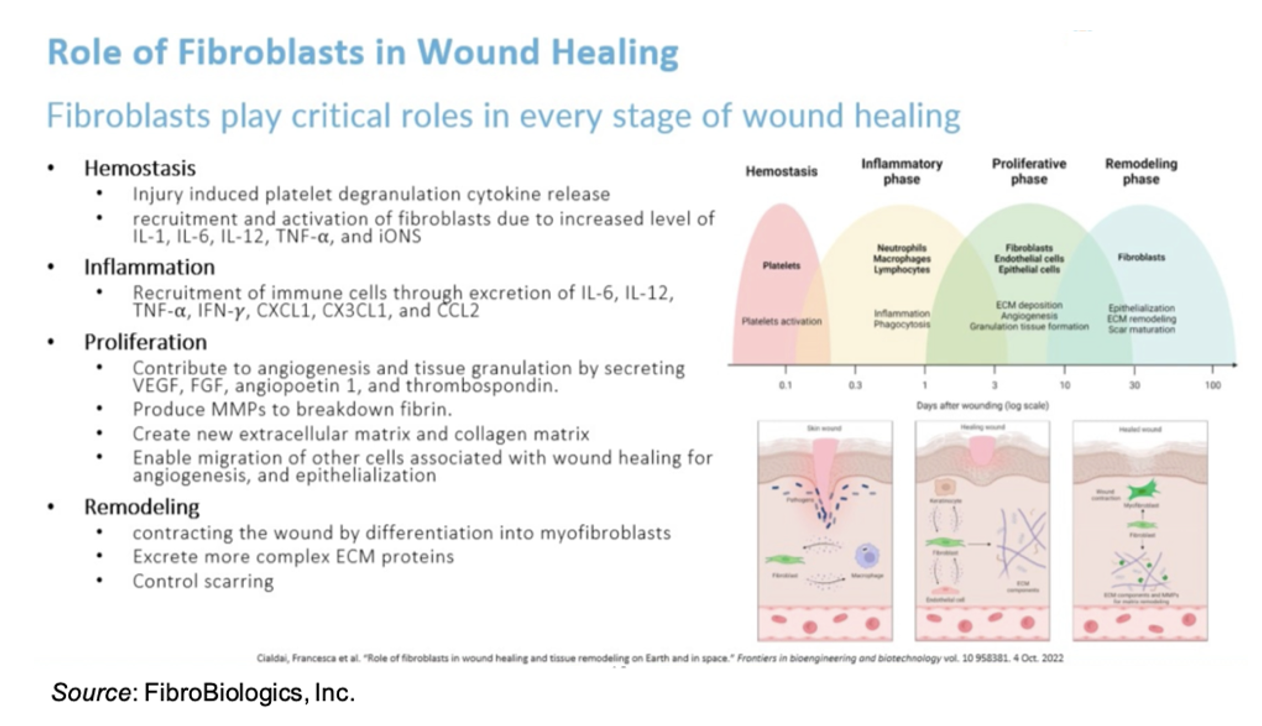
Fibroblasts have excellent therapeutic potential in the treatment of DFUs due to the critical role they play in every stage of wound healing, including hemostasis, inflammation, proliferation, and remodeling. Importantly, fibroblasts are the key cells that secrete extracellular matrix proteins that maintain all the tissues and organs in the body.
The company does not utilize single cell fibroblasts for treatment but instead a fibroblast spheroid, which is composed of approximately 3,000 fibroblasts and is administered to the top of the wound at which time the cells migrate from the surface of the wound and release various cytokines and growth factors to initiate the wound healing process. The use of spheroids is more practical from a therapeutic perspective as they have higher viability than single cells, they don’t require pre-culturing before administration, they can be easily frozen and thawed, and they have a significantly higher potency and efficacy compared to single cells.
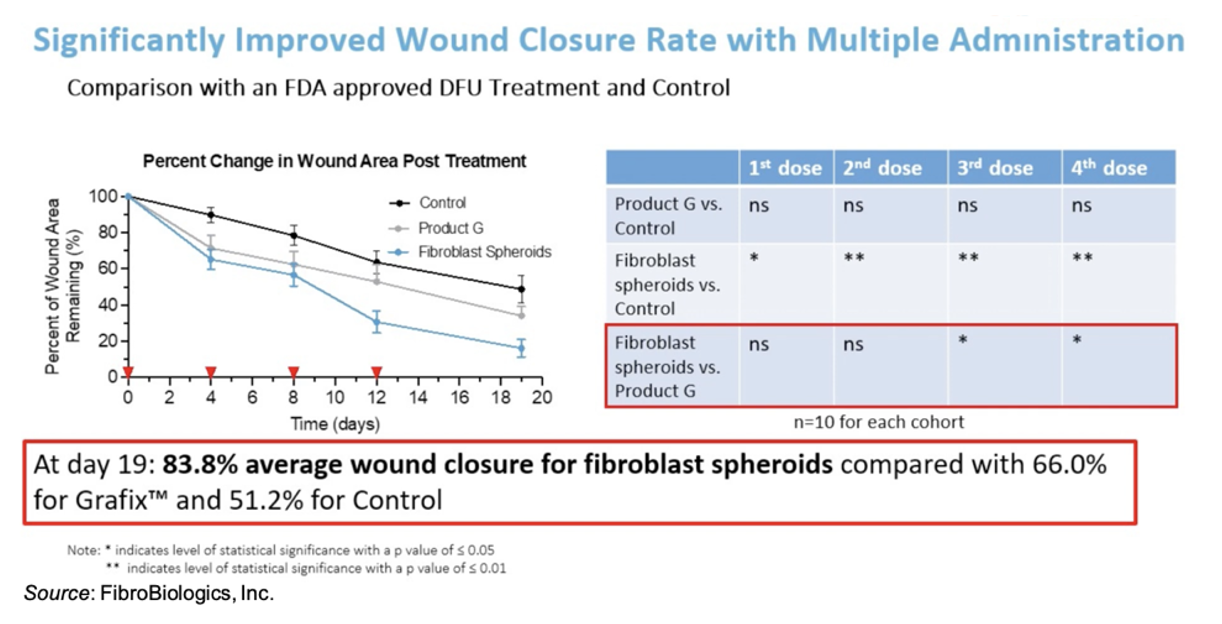
FibroBiologics has compiled a robust pre-clinical data set showing the efficacy of fibroblast spheroids in the treatment of wounds. For example, the following figure shows results using a diabetic mouse model in which administration of fibroblasts led to a statistically significant average 83.8% wound closure by Day 19 compared to 66.0% for Grafix™ and only 51.2% for control.
While wound healing is important, the quality of the wound healing is just as important. FibroBiologics has data on seven key biomarkers that are key to demonstrating the quality of the wound healing. Fibroblast treatment shows much better re-epithelialization, granulation, cell proliferation, neo-vascularization, recruitment and proliferation of fibroblasts, keratinocyte migration, and epithelial-mesenchymal transition. Intriguingly, even though the fibroblast spheroids are administered topically, there appears to be a systemic effect on cytokine levels, including IL-6, TNF-α, IL-1β, and IL-10.
The use of fibroblast spheroids for wound healing can be thought of as a platform technology. In addition to the treatment of DFUs, fibroblast spheroids could also be used for the treatment of burns and surgical wounds.
In regards to safety, the company has performed a number of experiments to examine any potential adverse events associated with fibroblast-based therapy. The cells do not graft into tissue. Following application, the cells stay on the surface of the wound and initiate the healing process before gradually dying off within four days of treatment. In addition, there is no impact on CBC, WBC, liver function, or kidney function, thus showing that administration of fibroblasts appears to be quite safe.
Psoriasis Program Update
In September 2025, FibroBiologics announced positive IND-enabling updates from its psoriasis research program. Previous results from an acute psoriasis model showed that a single administration of human dermal fibroblast (HDF) spheroids matched the efficacy of multiple doses of an anti-IL-23 monoclonal antibody. New results from a chronic-relapse model showed that the same single treatment significantly reduced disease recurrence. The company is now evaluating whether a single HDF spheroid treatment can be utilized for long-term protection against psoriasis relapse.
In addition to preparing for the Phase 1/2 trial in DFUs, the company will also be completing the preclinical IND-enabling studies for CYPS317, FibroBiologics’ fibroblast spheroid product candidate, and file an IND upon their successful completion.
Financial Update
On October 31, 2025, FibroBiologics announced financial results for the third quarter of 2025. As expected, the company did not report any revenues for the three months ending September 30, 2025. Research and development expenses were approximately $2.8 million in the third quarter of 2025, compared to approximately $1.2 million in the third quarter of 2024. The increase was primarily due to increased CRO costs and personnel related expenses. General and administrative expenses were approximately $2.2 million in the third quarter of 2025, compared to approximately $2.1 million in the third quarter of 2024. The increase was primarily due to additional personnel.
The company exited the third quarter of 2025 with approximately $4.9 million in cash and cash equivalents. As of October 31, 2025, FibroBiologics had approximately 51.5 million common shares outstanding and, when factoring in stock options, a fully diluted share count of approximately 57.2 million.
Conclusion
We look forward to updates from FibroBiologics regarding the manufacturing of CYWC628 as the company prepares for the initiation of the Phase 1/2 clinical trial in DFUs, which we anticipate beginning in the first quarter of 2026 and concluding in the third quarter of 2026. In addition, the company has plans to complete the pre-clinical IND-enabling studies for both CYPS317 and CYMS101 such that INDs can be filed for clinical trials to commence in psoriasis and multiple sclerosis, respectively. With no changes to our model our valuation remains at $11 per share.
SUBSCRIBE TO ZACKS SMALL CAP RESEARCH to receive our articles and reports emailed directly to you each morning. Please visit our website for additional information on Zacks SCR.
DISCLOSURE: Zacks SCR has received compensation from the issuer directly, from an investment manager, or from an investor relations consulting firm, engaged by the issuer, for providing research coverage for a period of no less than one year. Research articles, as seen here, are part of the service Zacks SCR provides and Zacks SCR receives payments totaling a maximum fee of up to $50,000 annually for these services provided to or regarding the issuer. Full Disclaimer HERE.