By John Vandermosten, CFA
NASDAQ:HURA
READ THE FULL HURA RESEARCH REPORT
Operational and Financial Results
On April 1st, 2025, TuHURA Biosciences, Inc. (NASDAQ:HURA) reported 2024 financial and operational results and filed its Form 10-K with the SEC. TuHURA provided updates on its Phase III trial in Merkel cell carcinoma (MCC), the acquisition of Kineta and introduced a new board member and executive. Initiation of the Phase III IFx-2.0 study in MCC is expected to begin in 2Q:25 and the acquisition of Kineta is targeted for 2Q:25. Below, we summarize 2024’s financial results.
TuHURA generated no revenues in 2024 and expended $17.6 million on operational activities related to advancing IFx-2.0 and other programs producing a net loss of ($21.7) million or ($1.16) on a per share basis. For the year ending December 31st, 2024 and versus the same prior year period:
- Research & development expense totaled $13.3 million, up 42% from $9.4 million, primarily attributable to an increase in spending on the IFx-2.0 program, additional preclinical research for the IFx-3.0 and myeloid derived suppressor cell (MDSC) initiatives and higher salary, personnel and facilities costs.
- No in-process research and development expenses were recognized versus $16.2 million related to the ADC technology in 2023;
- General & administrative expenses totaled $4.3 million, up 4% from $4.1 million due to increases in non-stock compensation and costs related to being a public company partially offset by lower legal fees;
- Net interest expense was ($3.8) million versus net interest income of $71,000 due to interest paid on convertible notes which was absent in the prior year;
- Other items totaled ($256,000) vs. $377,000 as a small amount of grant income was more than offset by a reduction in the value of the derivative liability which compares to recognition of a small amount of grant income and an employee retention tax credit in 2023;
- Net loss was ($21.7) million vs ($29.3) million, or ($1.16) and ($2.47) per share, respectively.
As of December 31st, 2024, TuHURA held $12.7 million in cash on its balance sheet. 2024 cash burn was ($14.8) million while cash flows from financing were $29.8 million related to proceeds from the convertible note and common stock issuance as well as stock option and warrant exercise partially offset by financing costs.
Video Series with Dr. James Bianco

Video links are included below:
Phase III IFx-2.0 Trial in MCC
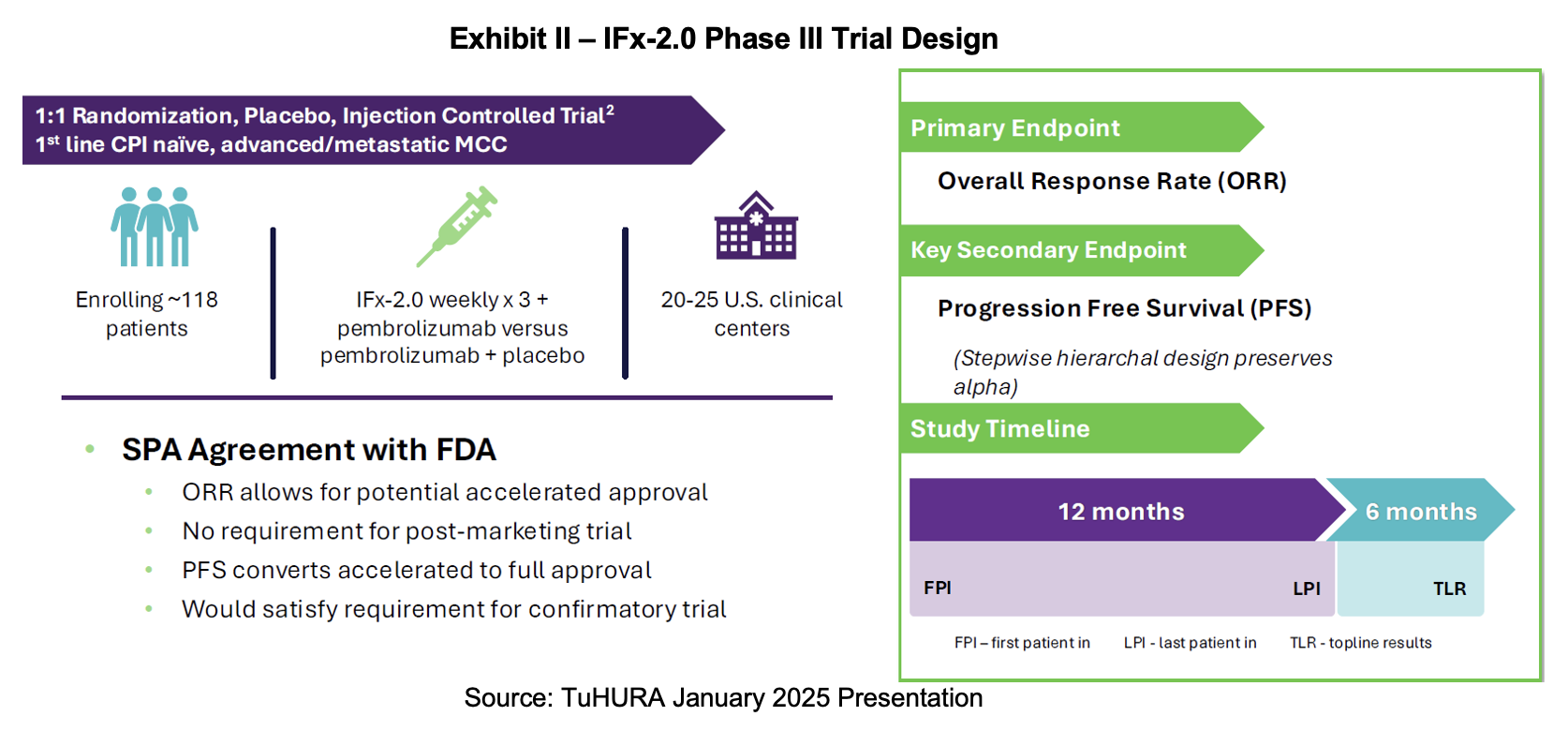
TuHURA plans to launch a pivotal Phase III study for its IFx-2.0 candidate in Merkel cell carcinoma (MCC) by the second quarter of 2025. It is working through chemistry, manufacturing and controls (CMC) requirements related to qualifying the potency assay and the mixing process[1] which put the study on track to begin in late 2Q:25. IFx-2.0 will pursue a new drug application using the FDA’s accelerated approval program under a special protocol assessment (SPA). The trial was designed with the input of the FDA’s Oncology Center of Excellence (OCE). Accelerated approval allows the sponsor to use surrogate endpoints that predict clinical benefit and is appropriate when pursuing serious indications that lack other therapies. In most cases, an accelerated approval will require post-market confirmatory trials to verify the clinical benefit. However, in the case of this trial, the FDA has indicated that secondary endpoints that demonstrate clinical benefit may be used. If successfully achieved, the trial may satisfy the requirements for full approval.
The trial will be designed as a 1:1 randomized, placebo and injection-controlled trial in first-line, checkpoint inhibitor naïve, advanced metastatic MCC. It plans to enroll 118 subjects at 20 to 25 clinical centers in the United States. IFx-2.0 will be administered three times per week in combination with pembrolizumab vs. placebo with pembrolizumab. The primary endpoint will be overall response rate (ORR) which will allow for accelerated approval. The secondary endpoint, which indicates clinical benefit is progression free survival (PFS). If this endpoint is achieved, it will allow for full approval and satisfy the requirement for a confirmatory trial.
For the primary endpoints to support an accelerated approval, ORR needs to be 75% compared to the 50% which is the historical rate from other trials. For full approval, based on a continuation of this same trial, PFS has to achieve a 50% or better result.
The trial is expected to start in the second quarter of 2025 with enrollment lasting 12 months. ORR will be measured at six months, which indicates that top line results can be available 18 months after the trial begins. Accelerated approval will allow a rolling review and potential approval within six months of topline data.
Anti-VISTA Phase II Proof of Concept Trial in AML
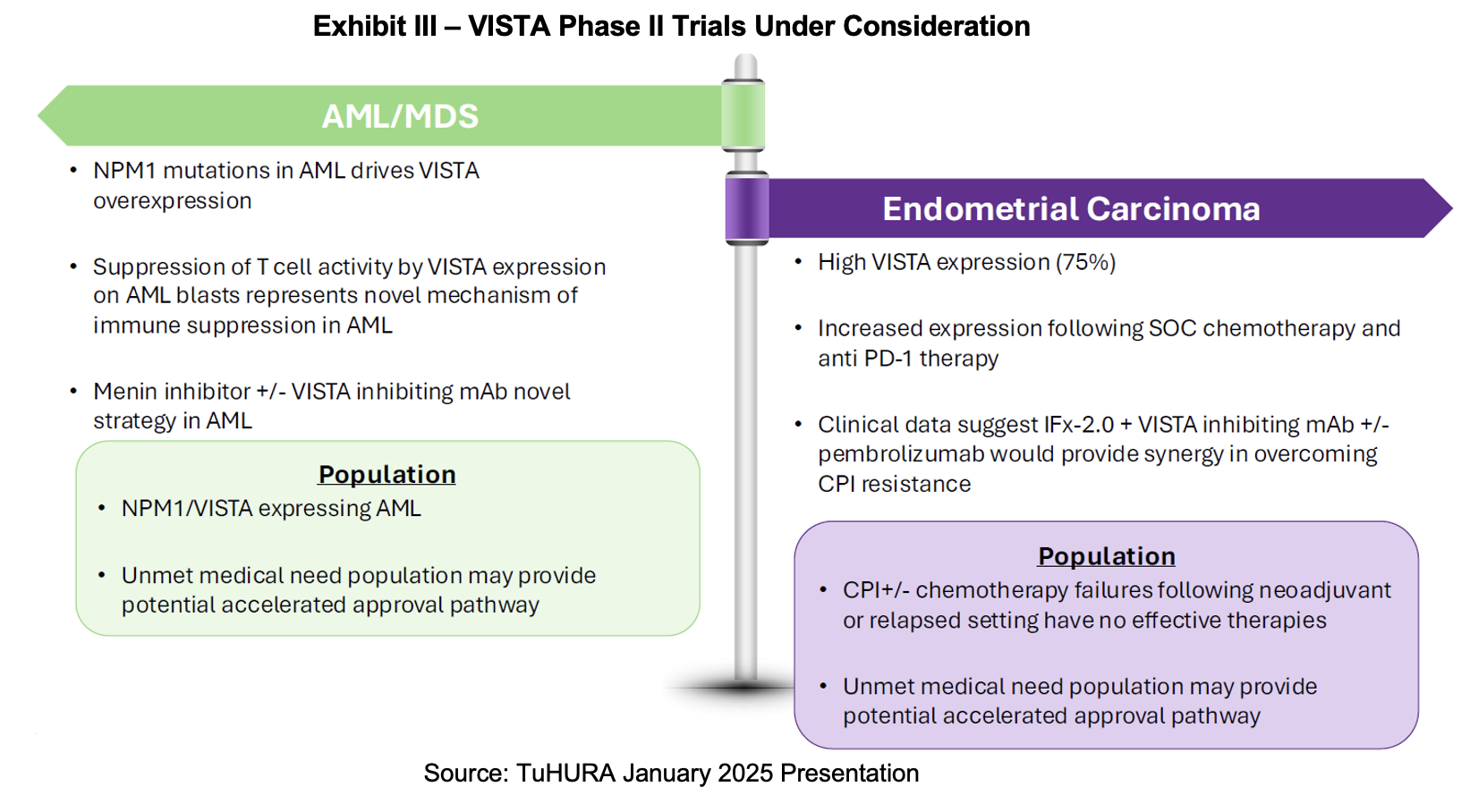
Following the acquisition of Kineta, TuHURA anticipates launching a Phase II proof of concept trial with the anti-VISTA monoclonal antibody. This is expected to begin in 4Q:25. The interest in using KVA12 in AML emerged from research showing that VISTA is overexpressed on myeloid-derived suppressor cells (MDSCs). The NPM1 mutation, found in 30–35% of AML cases, is another important biomarker in AML.
Work done by Vanderbilt University and presented at the December 2024 ASH meeting demonstrated that AML with mutated NPM1 expresses high levels of VISTA which creates an immunosuppressive environment. A recently approved class of drug called menin inhibitors, represented by Syndax Pharmaceuticals’ revumenib, can treat this group. Menin inhibitors bind to the menin protein and prevent it from binding to the KMT2A protein. This disrupts the interaction between the two, forcing leukemia cells to differentiate into normal cells. These AML cells may also express the VISTA checkpoint receptor that prevents T cells from recognizing and attacking them.
TuHURA plans to evaluate the combination of its anti-VISTA candidate KVA12 along with a menin inhibitor to identify if there is a material benefit. If the combination can block the NPM1 cascade and VISTA receptor, it can eliminate two important therapeutic choke points represented by proliferation and escape mechanism respectively. TuHURA estimates that for a few million dollars they can design a study that will show if the combination of KVA12 with revumenib provides greater complete remission compared with revumenib alone.
If the trial is successful, TuHURA will consult with the FDA to pursue a similar route to approval as IFx-2.0 with a Phase III trial. The candidate would seek the accelerated approval pathway and employ a trial design that obtains approval using a primary endpoint of a biomarker and a secondary endpoint demonstrating clinical benefit. Further details on the design and pathway forward are expected to be disclosed in upcoming quarters.
Appointments
Over the last few months, TuHURA has made two new additions to the company’s roster adding Craig Tendler, M.D. and Bertrand Le Bourdonnec, Ph.D. to serve as board member and head of drug discovery respectively.
Dr. Tendler has broad experience shepherding oncology candidates through the drug approval process at Johnson & Johnson. He can be a valuable resource as TuHURA moves IFx-2.0, the delta opioid receptor ADC and anti-VISTA through the drug development process. His appointment as director was announced on March 11th, 2025.
Dr. Le Bourdonnec was appointed as Head of Drug Discovery, Early Development and Program Management at TuHURA as detailed in an April 7th press release. He has a 20-year career in drug discovery and development honed at HDAX Therapeutics, Decipher Pharmaceuticals and Yumanity Therapeutics among other distinguished companies. His experience with the pharmacology and biochemistry of the Delta Opioid Receptor (DOR) will be valuable to TuHURA’s development of its ADC and APC assets.
SUBSCRIBE TO ZACKS SMALL CAP RESEARCH to receive our articles and reports emailed directly to you each morning. Please visit our website for additional information on Zacks SCR.
DISCLOSURE: Zacks SCR has received compensation from the issuer directly, from an investment manager, or from an investor relations consulting firm, engaged by the issuer, for providing research coverage for a period of no less than one year. Research articles, as seen here, are part of the service Zacks SCR provides and Zacks SCR receives quarterly payments totaling a maximum fee of up to $40,000 annually for these services provided to or regarding the issuer. Full Disclaimer HERE.
________________________
[1] Before administration, IFx-2.0 requires a specific mixing or compounding process at the clinical site. The mixing process involves combining pAc/emm55 (pDNA), complexed with two excipients: in vivo-jetPEI (a transfection reagent) and dextrose (a pDNA/polyethylenimine complex stabilizer) before administration. This step ensures that the plasmid DNA is prepared correctly for injection into the tumor. The process must be qualified and validated to meet regulatory standards, as outlined by the FDA. Validation includes in vitro testing and development to confirm potency and consistency.