By John Vandermosten, CFA
NASDAQ:LEXX
Lexaria Bioscience Corp. (NASDAQ:LEXX) announced that it had completed its GLP-1-H25-5 study last week and reported initial safety data. GLP-1-H25-5 was a pilot, cross-over investigation of 10 overweight volunteers that were administered oral DehydraTECH-liraglutide and Saxenda (injected liraglutide). The study was conducted to determine whether DehydraTECH (DHT) processing would produce an oral version of liraglutide comparable to Saxenda and if the 505(b)(2) pathway is appropriate.
GLP-1 Agonist Work
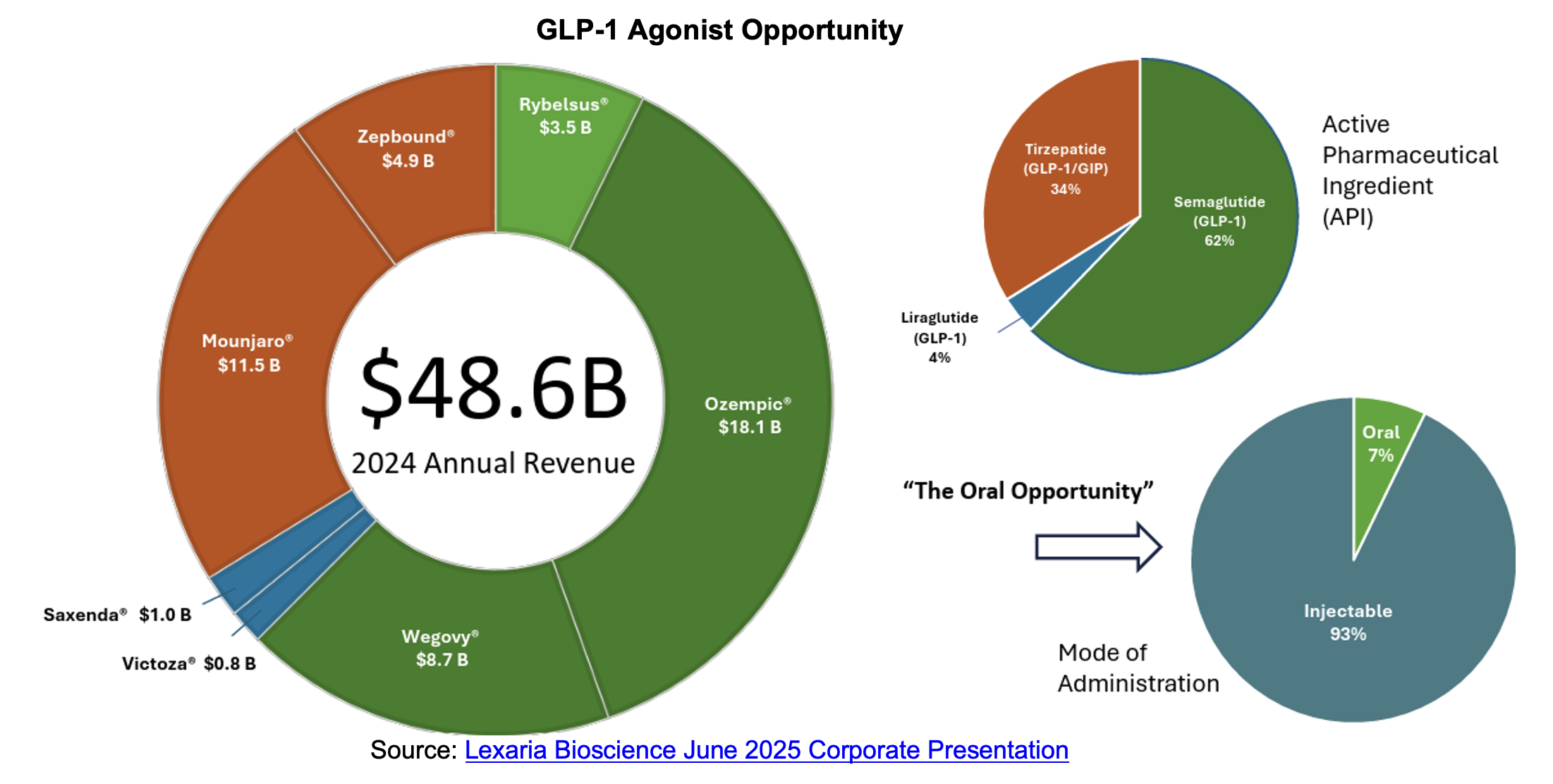
Over the last two years, Lexaria has evaluated the three leading Glucagon-Like Peptide-1 (GLP-1) agonists that are widely used for treating diabetes and weight loss. This includes liraglutide in the study referenced above as well as semaglutide and tirzepatide, which were evaluated in the GLP-1-H24-4 and GLP-1-H24-3 studies. With seven preclinical and clinical studies evaluating DHT, Lexaria has demonstrated improved performance from the technology and is seeking an established pharmaceutical partner to fund further clinical trials. The partnership would support a filing of a new drug application (NDA) leading to approval of a GLP-1 agonist-DHT oral formulation.
GLP-1-H25-5 Safety Data
In its June 11th press release, Lexaria provided adverse event (AE) safety data for the DHT and Saxenda arms of the trial. To place the data in context, it is necessary to understand the source of the AEs. A blood draw was required to evaluate drug performance and safety according to the trial protocol. Four AEs related to the blood draw in the DHT arm and one AE in the Saxenda arm were recorded. Since the blood draw was related to the trial and not the administration and effect of the drug, we exclude the blood draw related AEs in the next paragraph’s safety comparison.
Ignoring the blood draw’s impact, there were 17 AEs in the DHT arm and 22 AEs in the Saxenda arm. This shows a 22.7% lower incidence of AEs for the DHT arm relative to the Saxenda arm.[1] Specifically, nausea was 67% lower and gastrointestinal events were 31% lower for DHT. Blood glucose, insulin and body weight across most time points were not statistically significantly different between the two groups. Weight loss was achieved by 9 of 10 subjects with the magnitude of weight loss characterized as “slightly higher” in the Saxenda study arm. However, weight loss was not a primary goal of this short-duration study. The small sample size prevents the study from generating statistically significant results and readers should be cautious in overestimating the reliability of the findings. However, in context with the other studies run, these results provide additional confidence of the improved tolerability of DHT-formulated product.
Study Details
GLP-1-H25-5 was a pilot, cross-over investigation in 10 overweight volunteers. Saxenda injection was administered daily at its commercially available starting dose of 0.6 mg for seven days with a follow-up evaluation at day eight, compared to oral DHT-liraglutide (45 mg) also administered daily for seven days with an identical day eight evaluation. All drug administrations were performed after an overnight fast. Oral administration was accomplished with a 50 mL glass of water. Blood draws were performed upon the subjects at baseline (pre-dose) and multiple time points over the first 12 hours of day one of the study, followed by daily draws 30-minutes post-dosing on each of days two to seven of the Study and, finally, on day eight without any dosing. Subjects consumed standardized meals and snacks over the 12 hours post-dosing on the first treatment day at predetermined time intervals. Subjects were allowed to resume their normal diet following fasted dosing on the subsequent treatment days.
The DHT-liraglutide 45 mg dose was 75x the 0.6 mg Saxenda dose exposure tested. This dosing multiple was selected conservatively relative to the 98x to 196x dosing multiple for Novo Nordisk’s Rybelsus relative to the dose of injected semaglutide (Ozempic or Wegovy). Bioavailability of oral formulations of biologics is lower than injected forms, which requires higher doses of drug to achieve the same effect. Lexaria asserts that there is room to further titrate the DHT-liraglutide oral dose upwards in future studies to closely match the effectiveness of the injectable regimen consistent with a 505(b)(2) application.
The primary endpoint of the study was evaluation of safety and tolerability. Secondary and exploratory objectives included evaluations of pharmacokinetics (PK) and pharmacodynamic parameters including effects on body weight, blood glucose and blood insulin levels. Results from the PK component of the study are still being analyzed and will be reported when available.
Material Transfer Agreement (MTA) Update
Lexaria announced that it completed pre-clinical studies for the undisclosed product disclosed in the September 2024 MTA announcement. The results from the study are being evaluated by the partner with a focus on the safety and adverse event profile generated. The partner is also reviewing data from other Lexaria studies including the ongoing independent human study GLP-1-H24-4 underway in Australia. The relationship between the two will continue and the license will remain in force until the results of the GLP-1-H24-4 study are complete later this year. Lexaria is preparing for strategic planning discussions with the pharmaceutical company’s human clinical development team to potentially do additional work including human clinical studies.
MTA Background
Last September Lexaria announced its entry into a Material Transfer Agreement (MTA) with an undisclosed pharmaceutical company. Arrangement details were sparse on account of the partner’s desire to remain anonymous until the safety and PK profiles are confirmed. The goal of the arrangement is to use DHT to improve the side effect profile and PK for a product that is already on the market. Lexaria will provide the partner a temporary exclusive license to evaluate certain DHT concepts and formulations. If the work generates supportive data, the arrangement may advance to the next stage where upfront, milestone and royalty payments may be part of the deal.
Summary
Lexaria completed its GLP-1 agonist study for DHT-liraglutide and demonstrated improved tolerability compared to Saxenda. Nine of ten patients administered DHT-liraglutide lost weight over the short duration of the study. Despite the favorable change in subjects’ weight, the trial was not designed to measure weight loss but rather to determine if the DHT-liraglutide oral formulation works and if the 505(b)(2) regulatory pathway is appropriate. The company also updated investors on the status of its MTA with the undisclosed partner. While the arrangement has not yet advanced to the next stage, the prospect continues to review DHT data and may conduct further studies including a human clinical trial.
SUBSCRIBE TO ZACKS SMALL CAP RESEARCH to receive our articles and reports emailed directly to you each morning. Please visit our website for additional information on Zacks SCR.
DISCLOSURE: Zacks SCR has received compensation from the issuer directly, from an investment manager, or from an investor relations consulting firm, engaged by the issuer, for providing research coverage for a period of no less than one year. Research articles, as seen here, are part of the service Zacks SCR provides and Zacks SCR receives quarterly payments totaling a maximum fee of up to $40,000 annually for these services provided to or regarding the issuer. Full Disclaimer HERE.
________________________
[1] Including the AEs related to the peripheral intravenous line used for blood sampling, DHT produced 21 AEs while Saxenda produced 23.