By John Vandermosten, CFA
NASDAQ:LTRN
READ THE FULL LTRN RESEARCH REPORT
Lantern Pharma, Inc (NASDAQ:LTRN) reported first quarter 2025 results. Since the full-year 2024 update, the company highlighted two recent FDA clearances and early-stage trial starts for LP-184. One in triple negative breast cancer (TNBC) in combination with olaparib and the other in non-small cell lung cancer (NSCLC) with the KEAP1 and/or STK11 mutations. Lantern also set out milestones including one for a readout of the HARMONIC trial with LP-300 in 3Q:25 and another for completion of the Phase Ia LP-184 trial in solid tumors.
Other relevant news year to date includes the continuation of enrollment in the HARMONIC trial at sites around the globe with the most recent focus on Taiwan and Japan, where the prevalence of never-smoker non-small cell lung cancer (NSCLC) is from two to three times higher than in the United States. Lantern’s RADR (Response Algorithm for Drug Positioning & Rescue) platform continues to break ground with new capabilities in predicting blood brain barrier (BBB) permeability of drug candidates and improving the development of antibody drug conjugate (ADC) design. Lantern’s LP-184 gains another Fast Track designation for triple negative breast cancer (TNBC) following the receipt of the same designation for glioblastoma last October. GBM also made an appearance in a recent transaction where Jazz Pharmaceuticals (NASDAQ:JAZZ) made a bid to acquire Chimerix (CMRX) for its brain cancer drug for almost $1 billion. The deal should provide an additional framework for determining the value of Lantern’s STAR-001 asset in GBM. Lantern further received patent protection for its AI model from the World Intellectual Property Organization (WIPO).
On May 15th, 2025, Lantern announced 1Q:25 financial and operational results, filed its Form 10-Q with the SEC and hosted a video webcast to review accomplishments. A slide deck was included to guide the discussion. In the financial sphere, Lantern generated no revenues in 1Q:25 and incurred operating expense of $4.8 million, producing a net loss of ($4.5) million or ($0.42) per share.
For the quarter ending March 31st, 2025 and versus the same prior year period:
- Research & development expenses totaled $3.3 million, falling 23% from $4.3 million resulting from decreases in research services. This includes reductions in contract research organization and clinical site costs for LP-184. Lower salaries and benefits also contributed to the decrease. These changes were partially offset by an increase in licensing fees;
- General & administrative expenses were $1.5 million, rising 2%. The change was attributable to higher professional fees and salary and benefit increases. This was partially offset by a decrease in business development expenses;
- Interest income was $150,000 versus $201,000 while other income saw little change at $87,000 versus $90,000. Lower dividend income and reduced research and development tax incentives related to the Australian subsidiary were augmented by foreign currency losses to produce the year over year change;
- Net loss was ($4.5) million, or ($0.42) per share, compared to ($5.4) million, or ($0.51) per share.
As of March 31st, 2025 cash and marketable securities on the balance sheet totaled $19.7 million, compared to year end 2024 cash balances of $24.0 million. 1Q:25 cash burn was ($4.4) million versus ($3.1) million in the same prior year period. 1Q:25 cash from financing was $0 compared to $55 in 1Q:24 related to warrant exercises. Management anticipates sufficient cash to support operations for at least the remainder of 2025.
LP-184 Clearance for Non-Small Cell Lung Cancer (NSCLC)
Following FDA clearance of an investigational new drug (IND) application for LP-184, Lantern will start a Phase Ib/II trial for biomarker-defined, treatment-resistant non-small cell lung cancer (NSCLC) patients. Enrolled patients will present the KEAP1 and/or STK11 mutations[1],[2] along with low PD-L1 expression. The trial will administer LP-184 along with checkpoint inhibitors nivolumab and ipilimumab.
The population that Lantern is pursuing produces a limited response to approved first-line therapies. Based on the company’s work evaluating populations that respond to LP-184, the NSCLC population with these mutations appears to be particularly attractive. The Phase Ib/II study will assess safety, preliminary efficacy and biomarker correlations to support further advancement of the combination. Due to the small size of the population and the high level of unmet need, Lantern may be granted a Fast Track or Accelerated Approval designation based on the data generated in this trial.
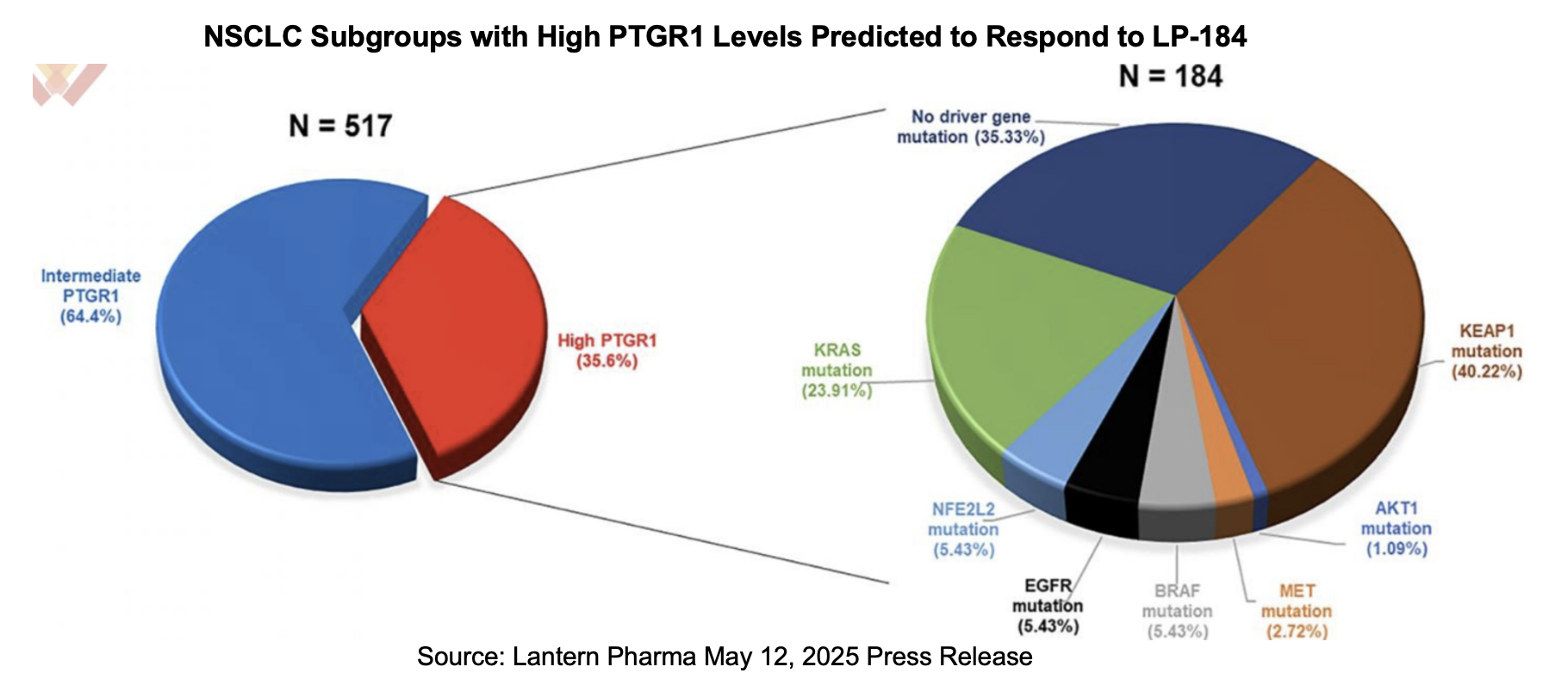
Lantern provides further information about the indication in its May 12th press release noting that overall survival for advanced NSCLC patients with KEAP1 and/or STK11 mutations treated with chemo-immunotherapy averages 15 months. This is worse than the average for the non-mutation NSCLC group. Survival for those that fail first line therapy have an even shorter duration of survival at 6.3 months.
Milestones
- Submission of clinical trial protocol to FDA for LP-183 + Olaparib – 1Q:25
- FDA IND clearance for LP-184 in NSCLC – May 2025
- LP-184 enrollment completion – June 2025
- LP-184 investigator led study in bladder cancer (Denmark) - 2025
- HARMONIC LP-300 interim readout of 30+ subjects – 3Q:25
SUBSCRIBE TO ZACKS SMALL CAP RESEARCH to receive our articles and reports emailed directly to you each morning. Please visit our website for additional information on Zacks SCR.
DISCLOSURE: Zacks SCR has received compensation from the issuer directly, from an investment manager, or from an investor relations consulting firm, engaged by the issuer, for providing research coverage for a period of no less than one year. Research articles, as seen here, are part of the service Zacks SCR provides and Zacks SCR receives quarterly payments totaling a maximum fee of up to $40,000 annually for these services provided to or regarding the issuer. Full Disclaimer HERE.
________________________
[1] KEAP1 mutations are genomic alterations in NSCLC and other cancers, occurring in approximately 11–27% of cases. These loss-of-function (LOF) mutations disrupt the KEAP1-NRF2 axis, a critical regulatory pathway for cellular homeostasis under oxidative and metabolic stress. Normally, KEAP1 targets NRF2 (encoded by NFE2L2) for proteasomal degradation, but mutations in KEAP1 or gain-of-function (GOF) mutations in NFE2L2 lead to NRF2 accumulation, driving tumor progression and therapy resistance
[2] STK11 (serine/threonine kinase 11) mutations are genomic alterations in cancer, particularly NSCLC. The mutations occur in ~13% of lung adenocarcinomas and are associated with altered cellular metabolism, immune evasion and therapy resistance.