By John Vandermosten, CFA
NASDAQ:LTRN
A May 5th press release indicated that the FDA cleared Lantern Pharma, Inc.’s (NASDAQ:LTRN) LP-184 trial in triple negative breast cancer (TNBC). Lantern will now run a Phase Ib/II clinical trial evaluating LP-184 both as a monotherapy and in combination with olaparib. The trial will evaluate Lantern’s candidate in recurrent, advanced-stage TNBC patients with the BRCA1 or BRCA2 mutation. Endpoints will include safety and efficacy with the goal to support design and execution of registrational studies.
Clinical Trial Design
The Phase Ib/II trial for LP-184 will enroll approximately 30 patients in the monotherapy arm with advanced stage TNBC. This arm will focus on identifying the optimal dose to maximize safety and potential efficacy for TNBC patients. The combination trial will evaluate LP-184 with olaparib in second-line settings for patients with advanced stage TNBC with BRCA1 or BRCA mutations. The primary endpoints for the study include safety and efficacy sufficient to support regulatory studies.
The trial will be run at several centers in the United States and academic centers and institutions in India and Nigeria. The sites overseas have access to populations with a higher incidence of TNBC and leverage collaborative research networks in these countries.
LP-184
LP-184 is a novel, clinical-stage small molecule drug which belongs to the acylfulvene class of molecules and functions as a prodrug. The candidate is designed to be preferentially activated in cancer cells that overexpress a specific enzyme, Prostaglandin Reductase 1 (PTGR1). Once activated by PTGR1, LP-184 becomes a potent alkylating agent. It works by binding to the DNA of cancer cells, creating DNA adducts which triggers cell apoptosis. Lantern is developing LP-184 in several cancer indications including pancreatic, glioblastoma, atypical teratoid rhabdoid tumors, ovarian, bladder, prostate, lung and TNBC. LP-184 has received multiple expedited designations from the FDA including Orphan Drug, Fast Track and Rare Pediatric Disease.
Olaparib
Olaparib (branded Lynparza) is a poly ADP-ribose polymerase (PARP)[1] inhibitor that is used to bring about synthetic lethality in mutated breast cancer cells. Olaparib is a targeted therapy used in patients whose cancer is associated with an inherited mutation in the breast cancer (BRCA)1 or BRCA2 genes. The drug also works with other homologous recombination deficiencies (HRD) and prevents these cells from repairing their DNA, leading to cancer cell death.
First approved in 2024, olaparib is used in ovarian, prostate and pancreatic cancer. It is also approved in HER2 negative breast cancer with BRCA mutations. Treatment begins after surgery and chemotherapy for high-risk early-stage disease or for metastatic disease that has progressed after other treatments.
Triple Negative Breast Cancer (TNBC)
TNBC is a type of breast cancer that lacks three receptors: estrogen (ER), progesterone (PR) and human epidermal growth factor 2. The lack of these receptors means that these TNBC patients will not benefit from therapies that use these receptors to fight cancer. This includes drugs like tamoxifen and aromatase inhibitors, which target ER or PR, medications such as trastuzumab and pertuzumab, which target the HER2 protein. Many targeted therapies that have shown success in other breast cancer types have failed in TNBC clinical trials, largely due to the lack of actionable molecular targets and the heterogeneity of TNBC.[2]
TNBC accounts for ~15% of the 320,000 annual breast cancer cases in the United States.[3] The incidence of TNBC has shown a steady increase over time, with over two million cases reported globally in 2018.[4] This subtype of breast cancer has the worst prognosis of breast cancers, especially if metastatic.[5]
Lantern notes that nearly 70% of TNBCs harbor deficiencies in homologous recombination pathways, which make the tumors sensitive to LP-184 and suggests that olaparib will work well in combination. It also notes that average survival for newly diagnosed, metastatic TNBC is about 18 months, highlighting the severity of the unmet need.
To demonstrate the efficacy of LP-184 in TNBC, Lantern included the results of preclinical work that shows how its candidate is able to shrink tumors in both PARPi resistant and PARPi sensitive tumors.
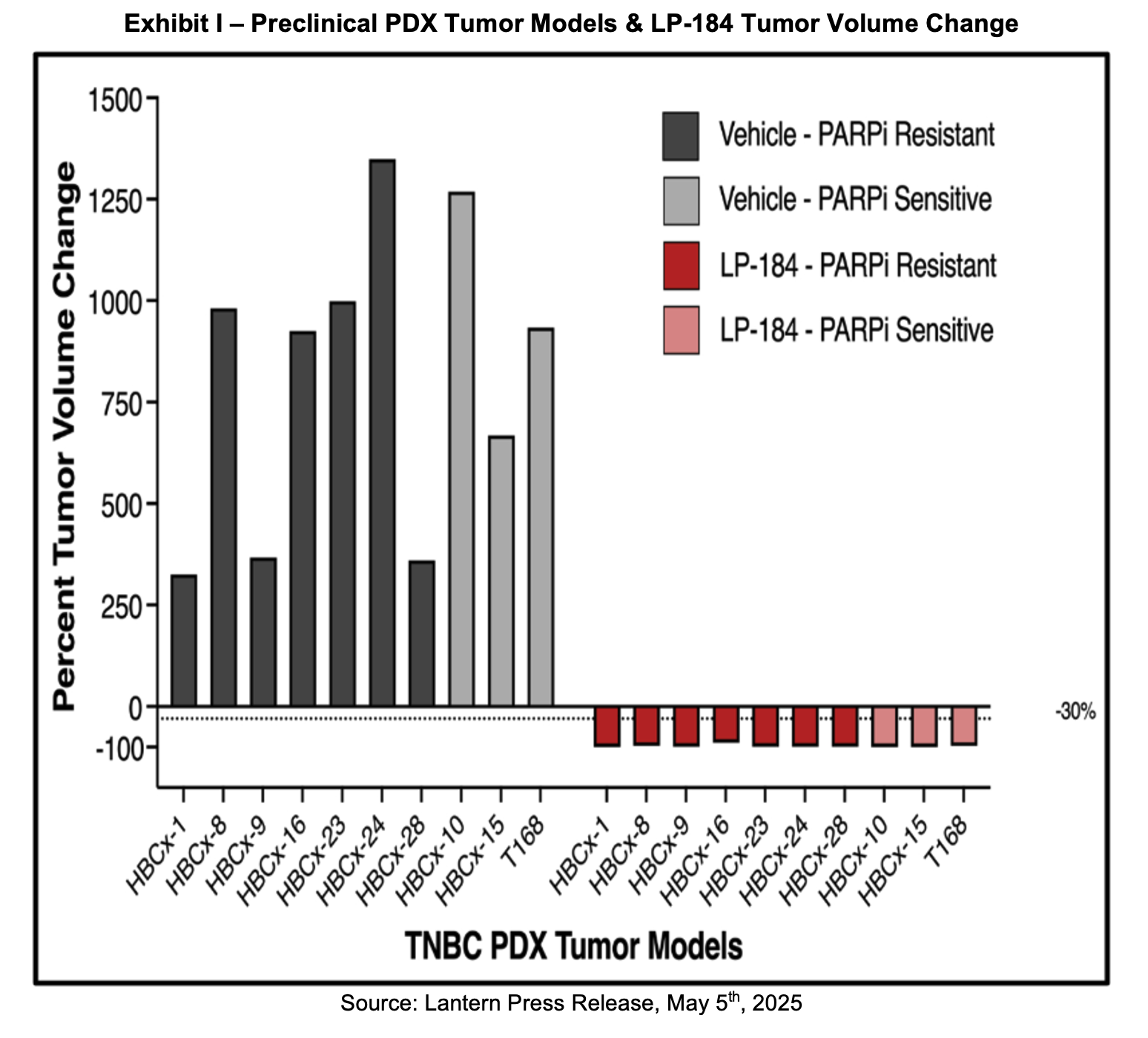
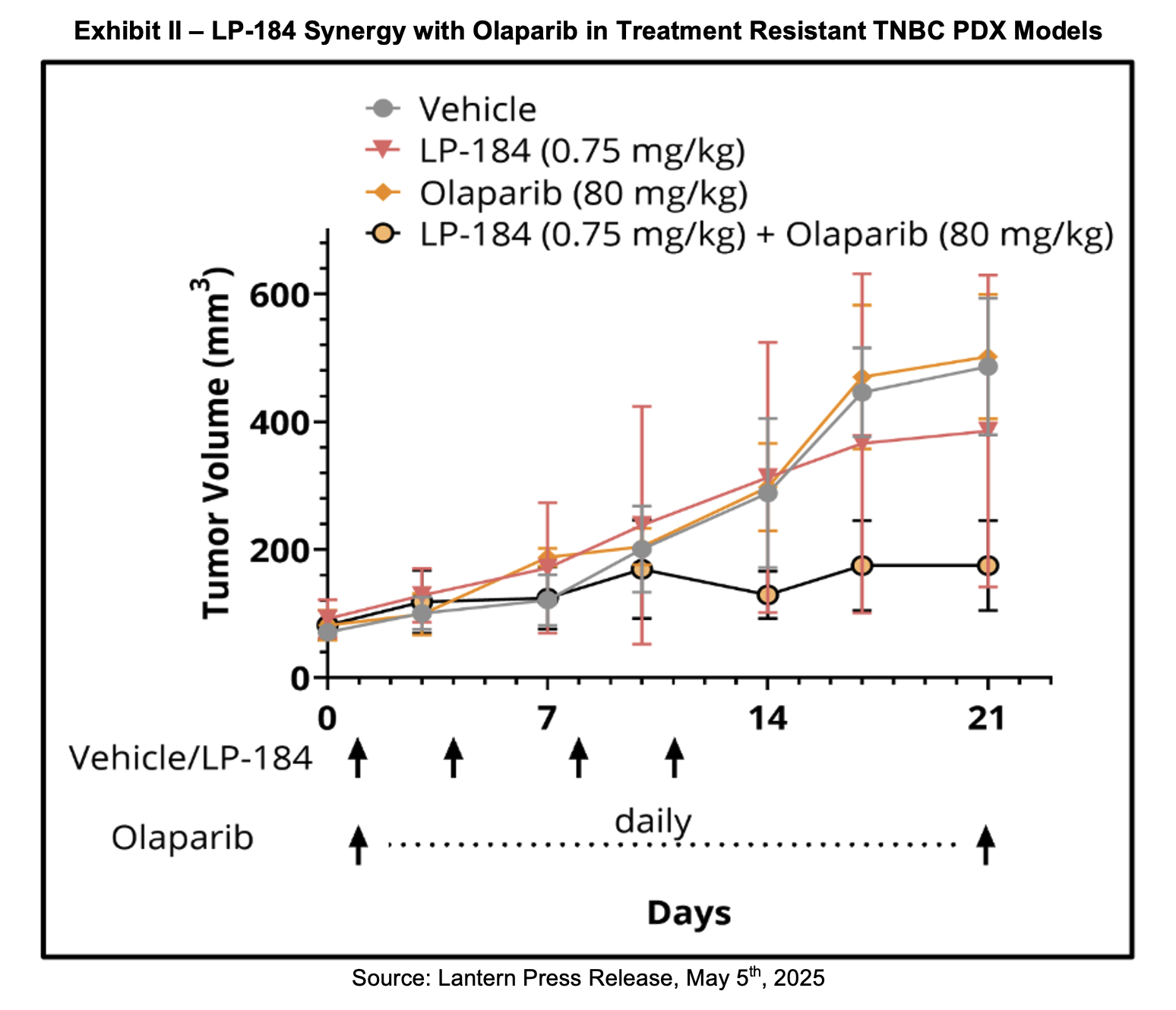
Lantern conducted further LP-184 animal studies using a patient-derived xenograft (PDX) model where tumor tissue from human breast cancer is implanted into a mouse. The implanted tumor was resistant to the PARP inhibitor and produced evidence of re-sensitization in combination with LP-184 as shown in Exhibit II.
Lantern’s continued advancement of LP-184 in a variety of cancer types and its arsenal of expedited pathways make it an attractive asset in the company’s pipeline. The indication in TNBC joins other clinical assets including other LP-184 indications, STAR-001 in CNS indications, LP-284 in recurrent non-Hodgkin’s lymphoma and LP-300 in non-small cell lung cancer for never smokers.
SUBSCRIBE TO ZACKS SMALL CAP RESEARCH to receive our articles and reports emailed directly to you each morning. Please visit our website for additional information on Zacks SCR.
DISCLOSURE: Zacks SCR has received compensation from the issuer directly, from an investment manager, or from an investor relations consulting firm, engaged by the issuer, for providing research coverage for a period of no less than one year. Research articles, as seen here, are part of the service Zacks SCR provides and Zacks SCR receives quarterly payments totaling a maximum fee of up to $40,000 annually for these services provided to or regarding the issuer. Full Disclaimer HERE.
________________________
[1] PARP is an enzyme that helps repair damaged DNA in cells.
[2] Salimbeni, B.T., et al. The triple negative breast cancer drugs graveyard: a review of failed clinical trials 2017-2022.
[3] American Cancer Society. Cancer Statistics, 2025.
[4] Singh S., et al. Role of Immune Checkpoint Inhibitors in the Revolutionization of Advanced Melanoma Care. International Immunopharmacology. 2020
[5] National Cancer Institute. Cancer Stat Facts: Female Breast Cancer Subtypes.