By David Bautz, PhD
NASDAQ:MTVA
READ THE FULL MTVA RESEARCH REPORT
Business Update
8-Week Data for DA-1726 48 mg Cohort Expected in 4Q25
MetaVia, Inc. (NASDAQ:MTVA) is currently conducting a Phase 1 clinical trial of DA-1726, the company’s oxyntomodulin (OXM) analog that is a dual agonist of the glucagon-like peptide-1 receptor (GLP1R) and glucagon receptor (GCGR). The company is currently evaluating 8-week treatment with 48 mg DA-1726, and we anticipate topline results from this cohort before the end of 2025. The purpose of this longer-treatment cohort is to explore the safety and longer-term early efficacy, along with other secondary endpoints. In addition, there is no titration with this cohort, which was undertaken due to the relatively benign adverse event profile seen in previous cohorts (discussed below).
MetaVia previously announced positive results from the 32 mg cohort that demonstrated a maximum reduction in body weight of -6.3%, a mean body weight reduction of -4.3% (-3.1% placebo adjusted; P=0.0005), early satiety in 83% of patients, and waist reductions of up to 3.9 inches by Day 33. In addition, DA-1726 showed an overall favorable safety and tolerability profile, as shown in the following chart. All of the adverse events (AEs) in the 32 mg cohort were considered mild to moderate, and there were no treatment-related discontinuations. There was no diarrhea reported, as well as no significant changes in heart rate in this cohort. The three subjects who experienced vomiting in the 32 mg cohort all reported it after the first dose, but with no reoccurrence. Similarly, the two subjects who experienced mild nausea after the first dose reported that it resolved within 12 hours, and there were no additional reports of nausea after the 2nd and subsequent doses. Overall, we view the AE profile observed thus far as a clear differentiator for DA-1726.
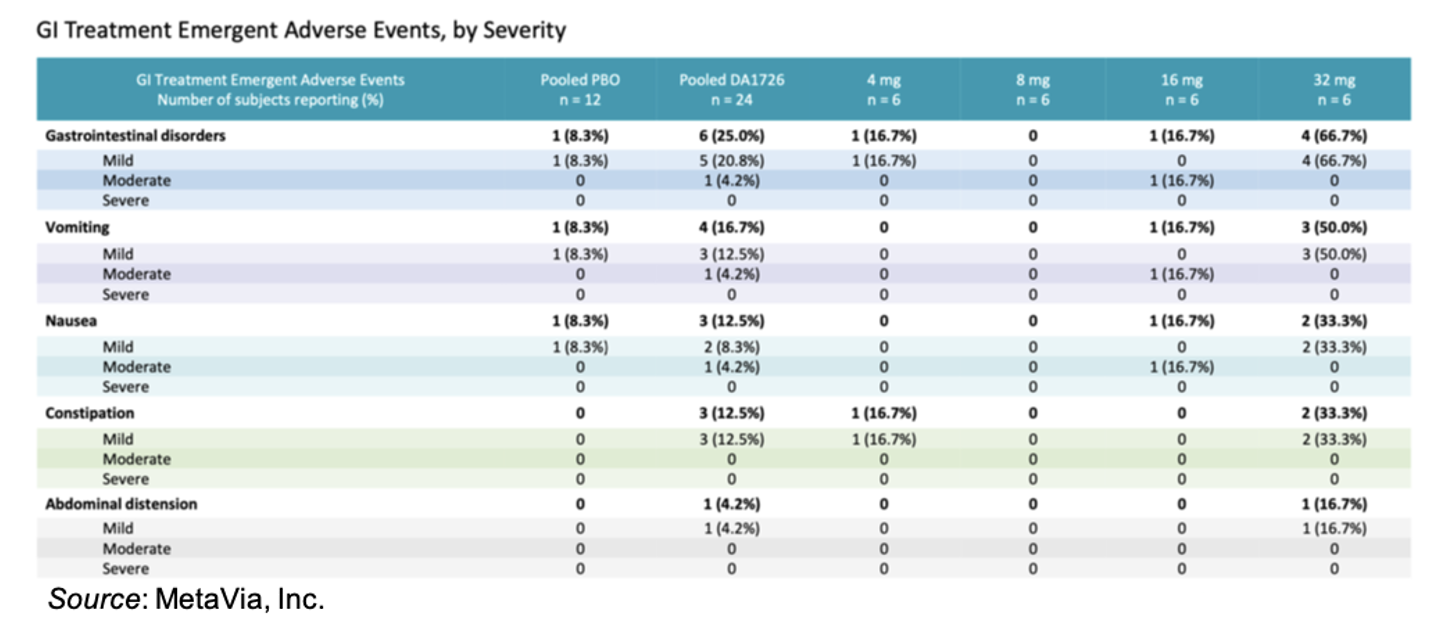
One of the concerns with targeting GLP-1 and glucagon receptors is the potential for increased heart rate. Novo Nordisk discontinued the development of NN1177, a dual glucagon/GLP-1 co-agonist, despite achieving weight loss up to 12.6% at week 12 after multiple Phase 1 trials showed an increase in heart rate (5-22 beats per minute), impaired glucose tolerance, and increased markers of inflammation (fibrinogen and C-reactive protein) (Friedrichsen et al., 2023). Thus, determining cardiac safety is of the utmost importance for DA-1726, given its similar mechanism of action. In the Phase 1 study, the mean heart rate for subjects on DA-1726 showed a slight decrease from baseline in all treatment groups besides the 16 mg group, where the baseline was significantly lower than the others. In addition, there were no onsets of QTcF (QT interval corrected for heart rate using the methods of Fridericia) and no risk of cardiovascular events.

We’re very encouraged by the results from the MAD Part 2 of the Phase 1 trial of DA-1726, as the drug appears to be effective, well tolerated, and shows no signs of any potential negative cardiovascular effects. We look forward to reviewing the 8-week data from the 48 mg cohort before the end of 2025.
PK Data Supports Once-Weekly Dosing of DA-1726
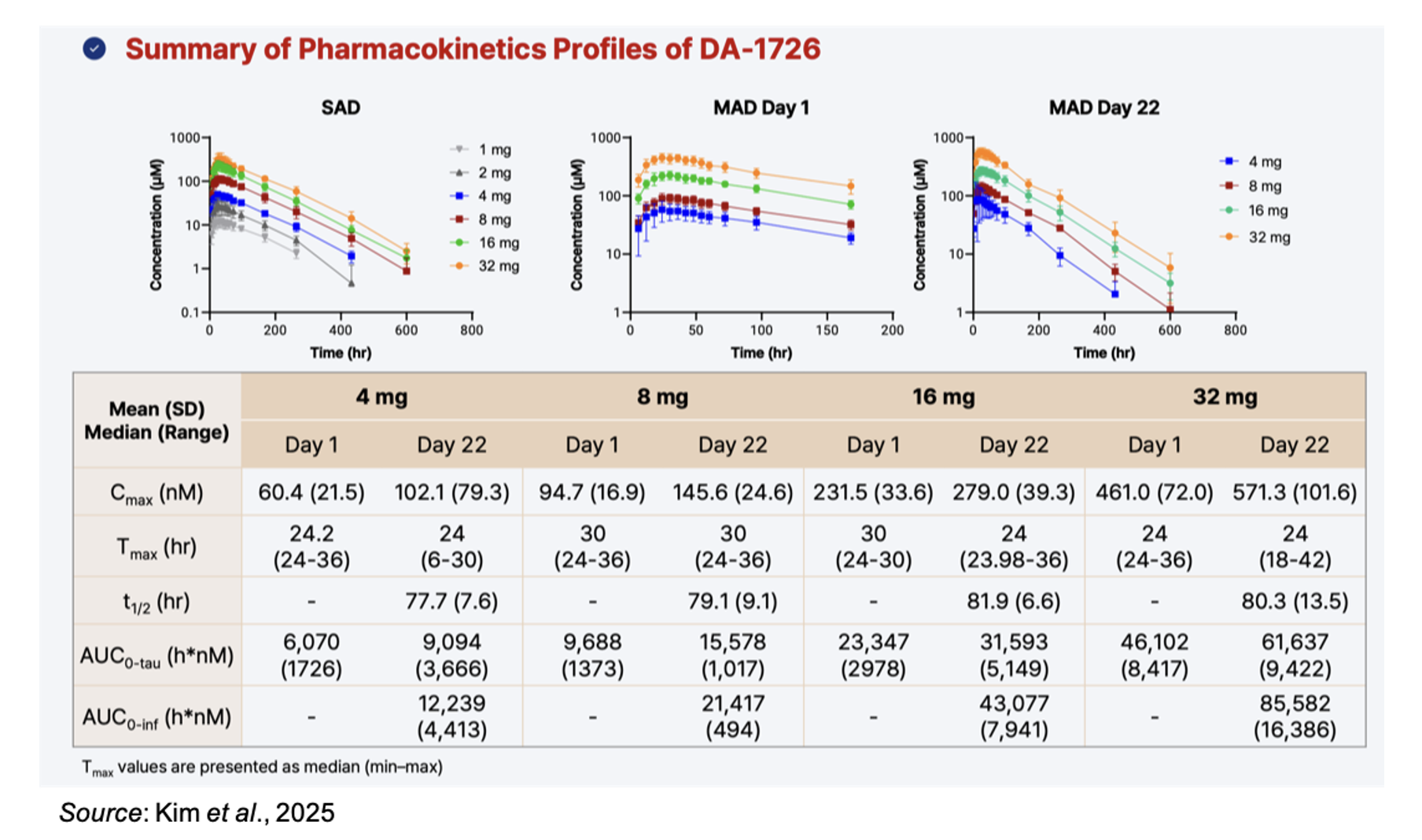
MetaVia recently presented new pharmacokinetic (PK) data from the Phase 1 trial of DA-1726 at Obesity Week 2025. A copy of the poster presentation can be found here. The following image shows the PK data for the single-ascending dose (SAD), and Day 1 and Day 22 for the multiple-ascending dose (MAD) portions of the Phase 1 trial. The results show a linear increase in exposure as the dose increased along with an approximately 80-hour half-life, which supports the use of a once-weekly dose.
Financial Results
On November 6, 2025, MetaVia announced financial results for the third quarter of 2025. As expected, the company did not report any revenues in the third quarter of 2025. R&D expenses for the third quarter of 2025 were approximately $1.9 million compared to approximately $4.5 million for the third quarter of 2024. The decrease was primarily due to decreased expenses related to DA-1241 and DA-1726. G&A expenses were approximately $1.6 million for the third quarter of 2025 compared to $1.7 million for the third quarter of 2024. The decrease was primarily due to decreased consulting expenditures, employee expenses, and other G&A expenses.
As of September 30, 2025, MetaVia had approximately $14.3 million in cash and cash equivalents. We estimate the company has sufficient capital to fund operations through the first quarter of 2026. As of November 5, 2025, MetaVia had approximately 24.2 million shares outstanding and, when factoring in stock options and warrants, a fully diluted share count of approximately 32.2 million.
Conclusion
We look forward to the 48 mg 8-week data from the Phase 1 trial of DA-1726. We will be especially interested in the early efficacy data along with the side effect profile. Thus far, DA-1726’s side effect profile has been relatively benign; thus, it will be interesting to see what effect the 48-mg dose has on the side effect profile, given that there will be no titration period. Additional early efficacy secondary endpoints that will be of particular interest include change in waist circumference and glucose control. For DA-1241 (vanoglipel), the company will be scheduling an ‘End-of-Phase 2’ meeting with the FDA in order to determine next steps for that program. We believe the company is intending to either out-license or partner the drug before advancing it further in clinical development. As we await the 48-mg cohort data, we have made no changes to our valuation, which remains at $21 per share.
SUBSCRIBE TO ZACKS SMALL CAP RESEARCH to receive our articles and reports emailed directly to you each morning. Please visit our website for additional information on Zacks SCR.
DISCLOSURE: Zacks SCR has received compensation from the issuer directly, from an investment manager, or from an investor relations consulting firm, engaged by the issuer, for providing research coverage for a period of no less than one year. Research articles, as seen here, are part of the service Zacks SCR provides and Zacks SCR receives payments totaling a maximum fee of up to $50,000 annually for these services provided to or regarding the issuer. Full Disclaimer HERE.