By Steven Ralston, CFA
NYSE:UHAL
READ THE FULL UHAL RESEARCH REPORT
EXECUTIVE SUMMARY
U-Haul Holding Company (NYSE: UHAL) reported 4Q and full-year FY2025 results on May 28th after the close. Revenues were above expectations in the seasonally slowest quarter, but the bottom line was impacted by rising depreciation expense from the higher prices paid for fleet replacements ($128 million higher in FY2025 than in FY2024) as well as by fewer retired pickups and cargo vans being sold at lower resale values ($140 million lower in FY2025). So far in FY2026, the OEM pricing for ICE trucks and pricing in the resale market are beginning to improve in favor for U-Haul. The depreciation issue is expected to normalize as OEM automakers refocus on their core competencies rather than subsidizing EV programs.

Fiscal 2026 Outlook
In the self-moving equipment rental business, management expects continued modest top-line growth, which started in 1Q FY2025. There are signs of customer optimism as well as the willingness to accept slight rate increases. Revenue trends in April and May 2025 continue to exhibit positive YOY comparisons. Management will continue to focus on increasing transaction volume and equipment utilization, along with improving pricing.
The continual investment of capital and resources in the self-moving segment, self-storage and the U-Box program is an important component of the company’s overall operational strategy.
In the self-moving area, management’s initial fleet capex is budgeted at $1.295 billion for FY2026 compared the $1.211 billion spent on the rental equipment fleet during FY2025. Total capital expenditures on all self-moving rental equipment were $1.863 billion) during FY2025.
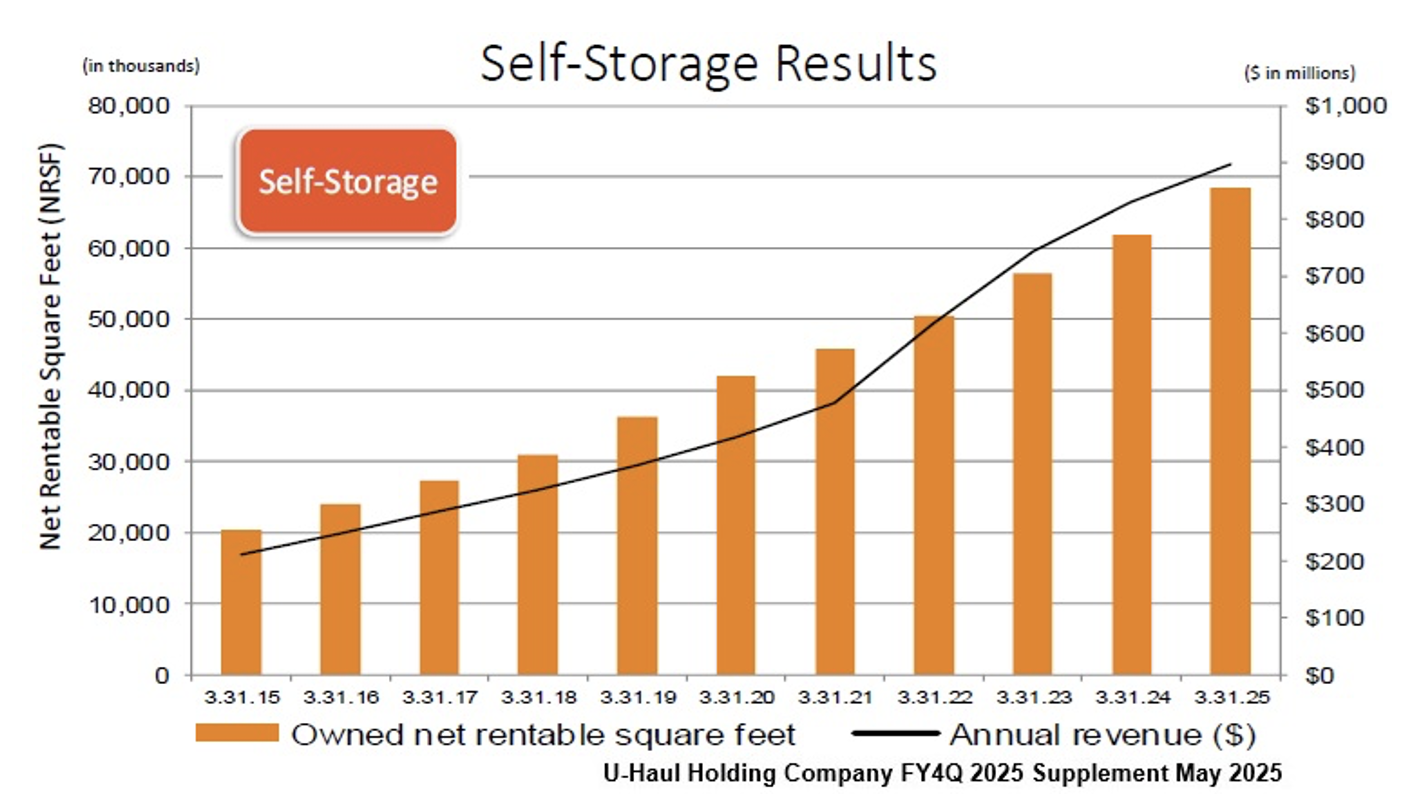
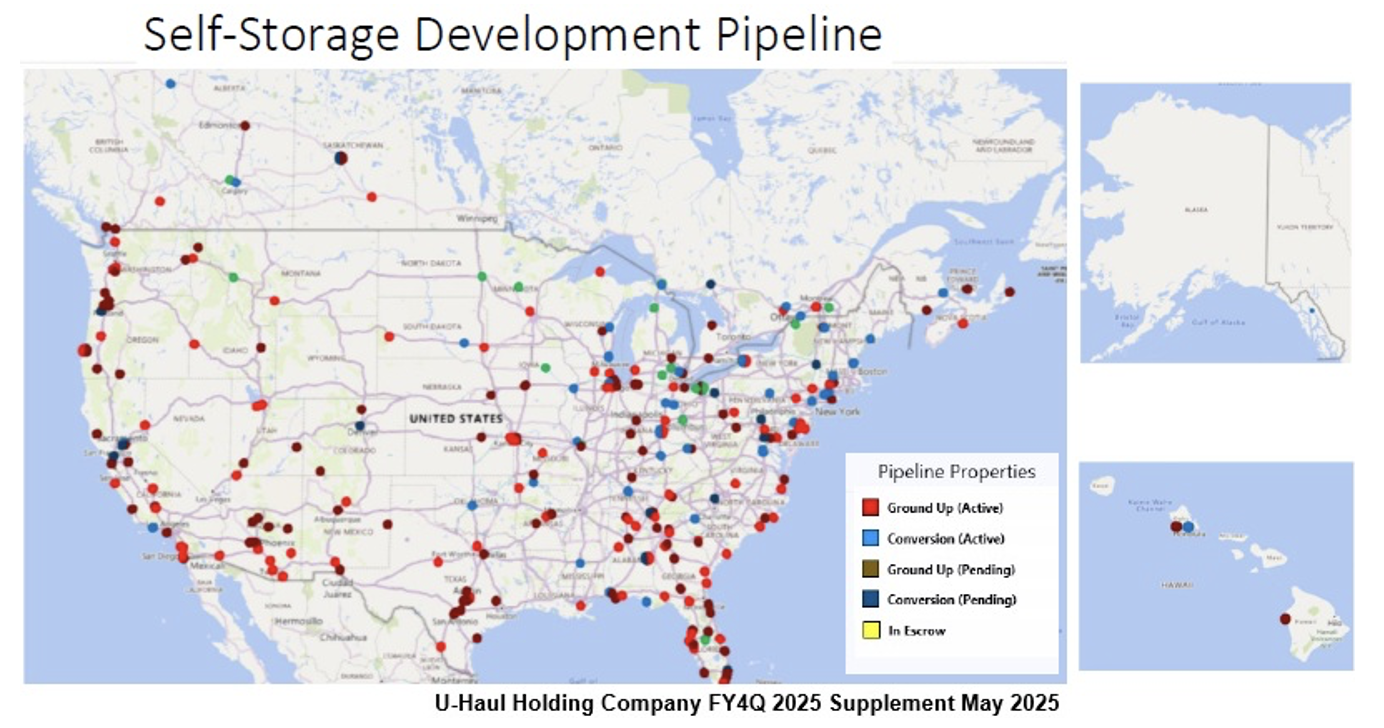
In the self-storage area, management continues to open new locations and expand select existing locations, but now in a more measured way with the initial opportunities already having been exploited. During fiscal 2025, approximately 6.5 million net rentable square feet (71,000 new rooms) were added, and currently roughly 7 million new net rentable square feet is being actively developed with another 8 million square feet in the pipeline
U-Box remains a higher growth area with transactions in both self-moving and storage categories. Though the financial results of U-Box are reported in the “Other revenue” line item, it is obvious that U-Box is growing at a faster rate than the self-moving equipment segment.
In the Annual Review Section below, the company’s financial metrics have been updated in the order to convey U-Haul’s stature in the Self-Moving and Self-Storage industries.
Fiscal 2025 Financial Results
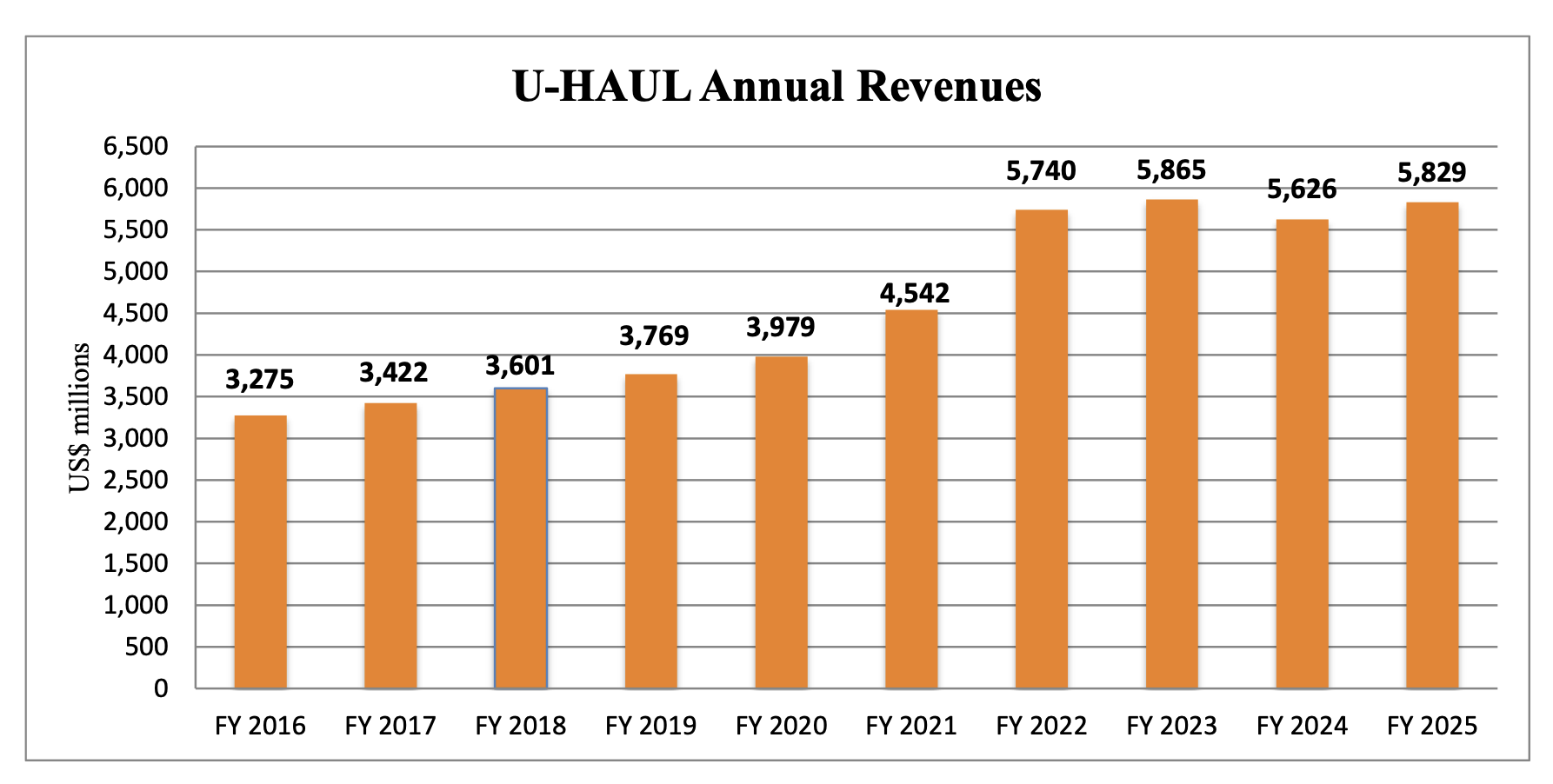
On May 28, 2025 after the market close, U-Haul Holding Company reported financial results for the 2025 fiscal year ending March 31, 2025. Total revenues increased 3.6% to approximately $5.83 billion, which was primarily driven by the 2.8% increase (or $100.8 million) in the self-moving equipment rental revenue, the 8.0% increase (or $66.8 million) in the self-storage business and the 8.6% increase (or $40.3 million) in “Other revenue,” which is primarily driven by moving and storage transactions related to U-Box. Of note, the number of pickup trucks in the rental fleet has been reduced due to lowered profitability in this type of rental vehicle.
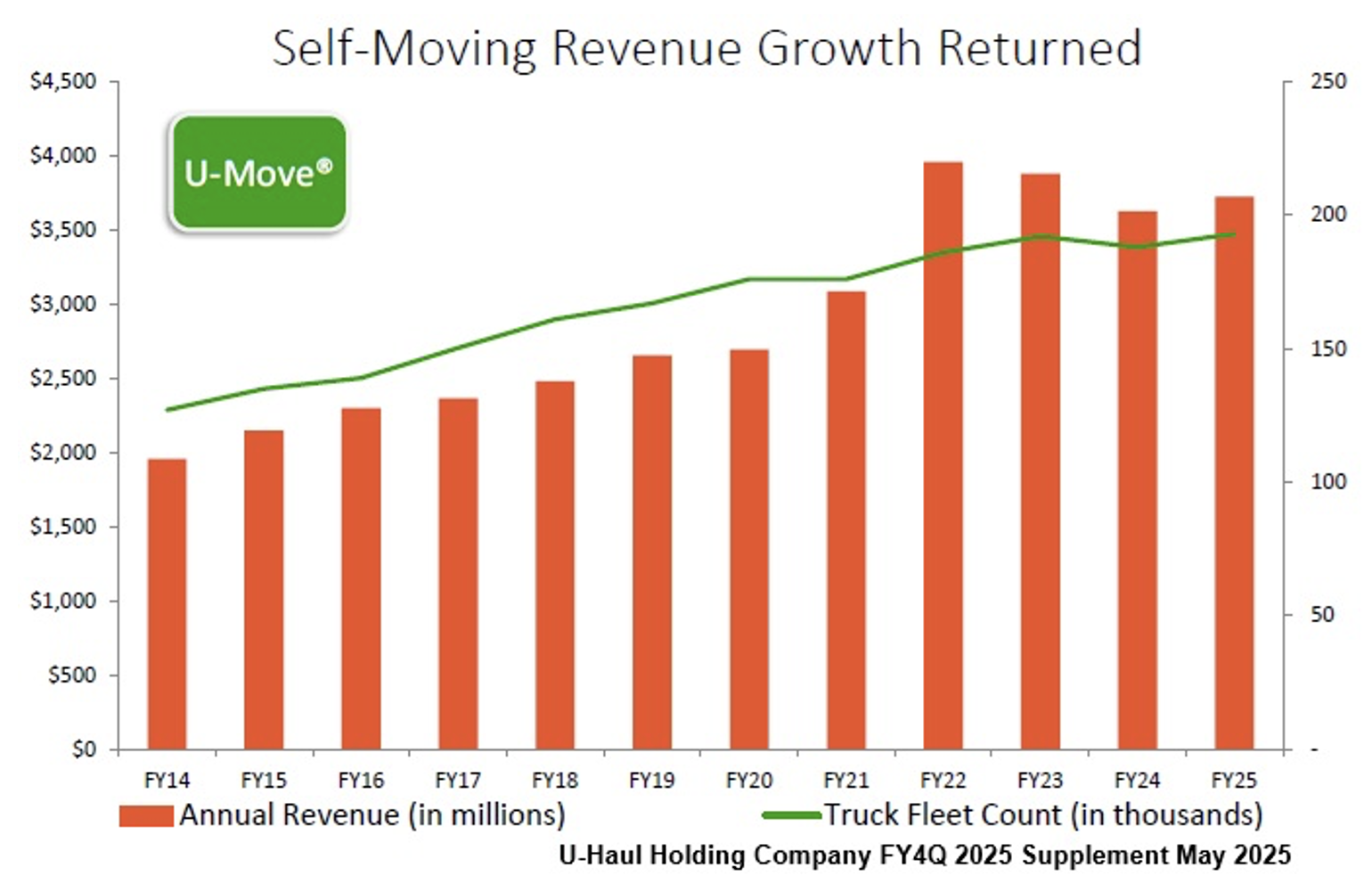
In the self-moving equipment rental business, revenues improved by 2.8% (or $100.8 million). In the in-town business, the volume of transactions increased and the average revenue per transaction improved. In the one-way market, revenue per transaction increased despite the average miles driven per transaction decreasing.
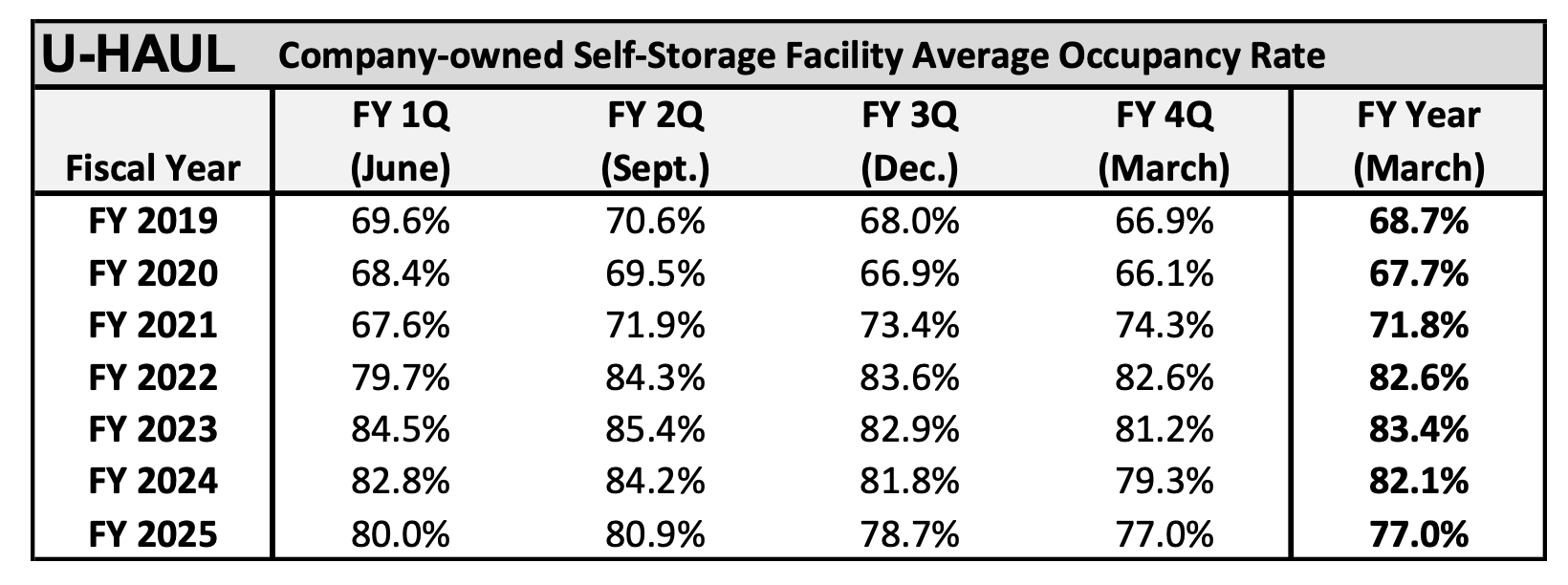
In the self-storage area, revenues increased 8.0% (or $66.8 million) as the average monthly number of occupied units increased by 6.2% (or 35,441 units) during fiscal 2025 as average revenue per occupied square foot increased 1.5%. During fiscal 2025, approximately 6.5 million net rentable square feet (71,000 new rooms) were added.
Other revenue increased 8.6% (or $40.3 million), primarily driven by increased sales in the U-Box program. Management continues to expand the breadth and reach of the U-Box program through the addition of warehouse space and, moving & storage containers as well as delivery equipment.
In self-moving/self-storage products & services, revenue decreased by 2.5% (or $8.32 million), which was entirely related to Mercury Partners L.P. exercising of an option in February 2024 and purchasing 78 U-Haul branded self-storage locations. Excluding the effects of this ownership change, revenue from products and supplies at U-Haul owned and operated locations increased.
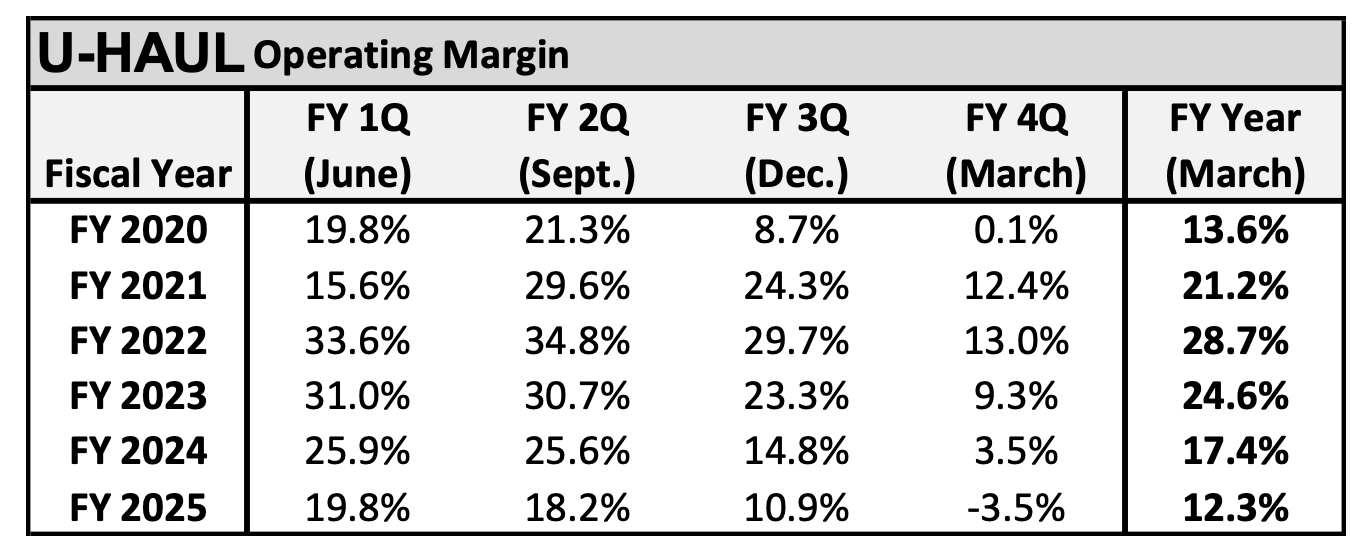
For the fiscal year, total costs and expenses increased 10.0% (or $464.6 million). The operating leverage was apparent as the operating margin compressed by 509 bps from 17.4% in fiscal 2024 to 12.3%, which was the major factor for the decline in net income and EPS. Operating expenses (which are associated with self-moving equipment rentals and self-storage) increased 4.8%, mainly from increased personnel costs, property taxes & maintenance expenses. Cost of sales (related with self-moving & self-storage products & services) decreased 3.1% while commission expenses increased 6.1%.
Depreciation expense increased 44.3% (or $294 million), primarily due to the pace of expanding the rental fleet with $1.211 billion spent in capex on its rental equipment fleet during fiscal 2025. Fleet capex accounted for 65% of the gross capital expenditures on all rental equipment (or $1.863 billion) during fiscal 2025. Management estimates that approximately $1.295 billion will be spent in reinvesting in the rental equipment fleet during fiscal 2026.
The company benefits somewhat by investing cash balances in U.S. Treasury securities; this cash management effort generated $59.06 million during fiscal 2025; this new line item of other interest income was added to the income statement to account for the interest received when Treasury Bill rates increased to above 5% during fiscal 2024.
Earnings from operations decreased 26.8% (or by $261.6 million) to $716.2 million compared to $977.8 million in fiscal 2024 year.
For the 2025 fiscal year, net income declined 41.6% to $367.1 million (or $1.69 per diluted share of voting stock) compared to $628.7 million (or $3.04 per diluted share) for fiscal 2024.
Note: Management utilizes the two-class method where distributed earnings (dividends) and undistributed earnings are allocated in a three-step process to each class of common stock. Our EPS calculation differs from the company’s GAAP-compliant calculation in that we are attempting to illuminate the earnings power behind each voting share rather than adjust EPS for the distribution dividends.
As of March 31, 2025, U-Haul Holding Company has a strong liquidity position in the Moving and Storage operating segment of approximately $1.348 billion (cash plus availability from existing loan facilities). Working capital was approximately $4.546 billion on March 31, 2025.
KEY POINTS OF U-HAUL HOLDING COMPANY
- U-HAUL primarily provides “do-it-yourself” moving and storage and supplies products and services. The company also has Property and Casualty and Life Insurance subsidiaries.
- U-Haul is one of the most recognized names in North America and has a commanding share of the consumer self-moving business.
- U-Haul has a network of approximately 24,000 company-operated and independent locations in all 50 United States and 10 Canadian provinces.
- As of the end of the company’s fiscal year (March 31, 2025), the size of U-Haul’s rental fleet was approximately 192,100 trucks, 137,500 trailers and 39,700 towing devices
- U-Haul also provides moving supplies (boxes, tape etc.) and the service of selling and installing trailer hitches
- The company has expanded into ancillary products/services
- U-Box (portable moving and storage units)
- CollegeBoxes (a packing, storage and shipping solution for college students)
- Moving Help (an online marketplace connecting consumers to service providers who help with packing, unpacking, loading and unloading)
- Storage Affiliates (through the WebSelfStorage platform enables independent self-storage operators to manage their facility and connect to customers on uhaul.com)
- The company also supplies propane as alternative-fuel for vehicles & for backyard BBQs.
- U-Haul is also one of the leading companies in the self-storage industry
- a complementary operation to the self-moving business
- As of the end of the company’s fiscal year (March 31, 2025),U-Haul operated almost 1,079,000 rentable storage units consisting of approximately 7 million square feet of storage space in all 50 United States and 10 Canadian provinces
- Individual storage units range in size from 6 square feet to over 1,000 square feet
- The self-storage business also provides value-added services, such as an electronic monitoring system (Max Security), access during extended hours and individually alarmed units.
- Property and Casualty Insurance - Repwest Insurance
- Repwest underwrites components of the Safemove, Safetow, and Safestor protection packages to U-Haul customers
- Life Insurance - Oxford Life Insurance
- Oxford underwrites life and health insurance products, primarily to the senior market
- Creation of Series N Non-Voting Common Stock
- Shares of a new N-Series Non-Voting Common Stock was distributed to existing shareholders at the close of trading on November 9, 2022. Trading of the non-voting shares began on November 10, 2022 under the ticker UHAL.B. The new series of non-voting stock is intended to preserve the current voting structure of the company so that management’s long-term operational orientation can be retained. The stock dividend had almost the same effect as a 10-for-1 stock split with every holder of current voting shares subsequently holding ten (10) shares, of which one (1) was voting and nine (9) were non-voting.
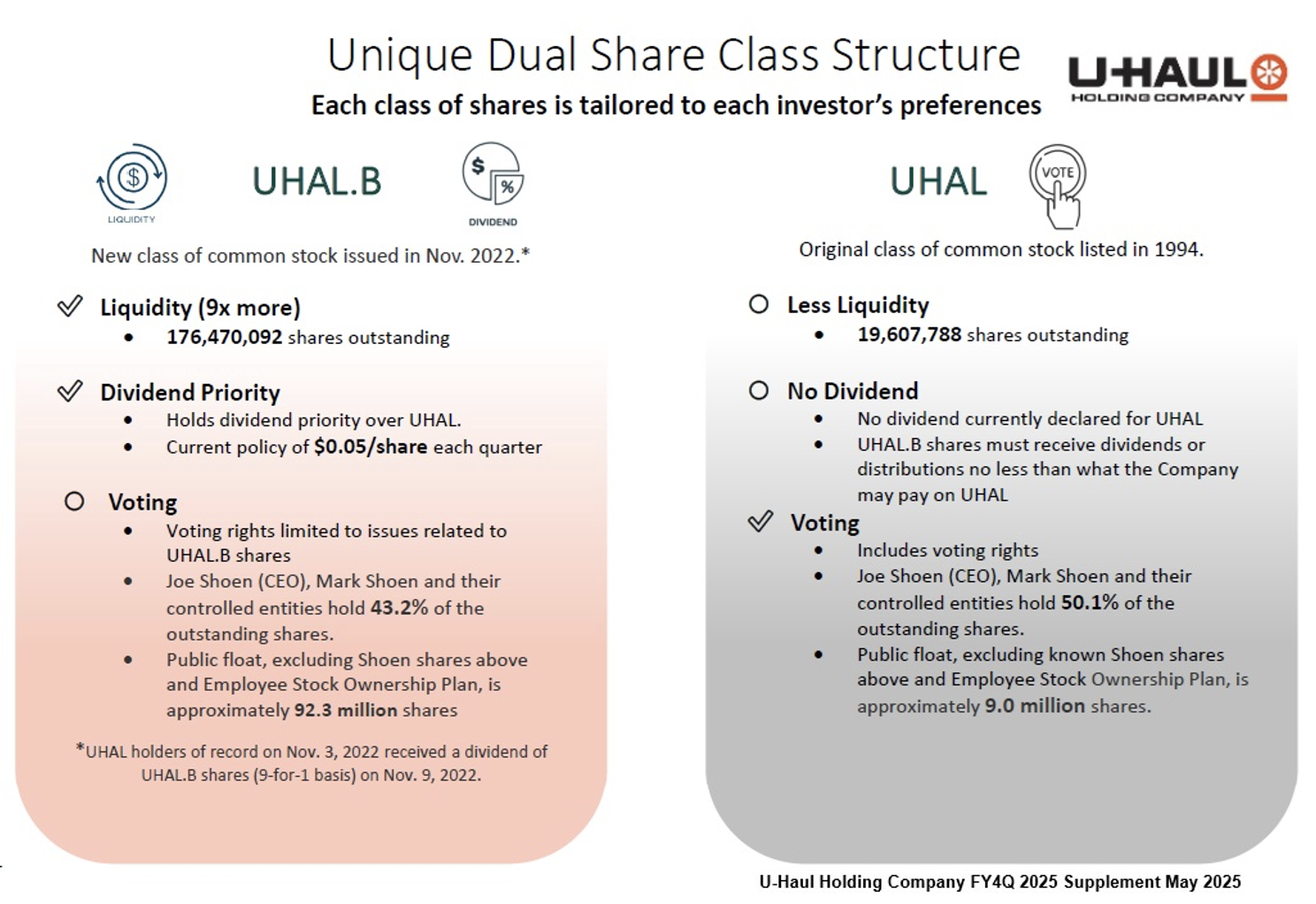
- In October 2022, the company announced that the Board of Directors had adopted a formal dividend policy for the newly-created Series N Non-Voting Common Stock.
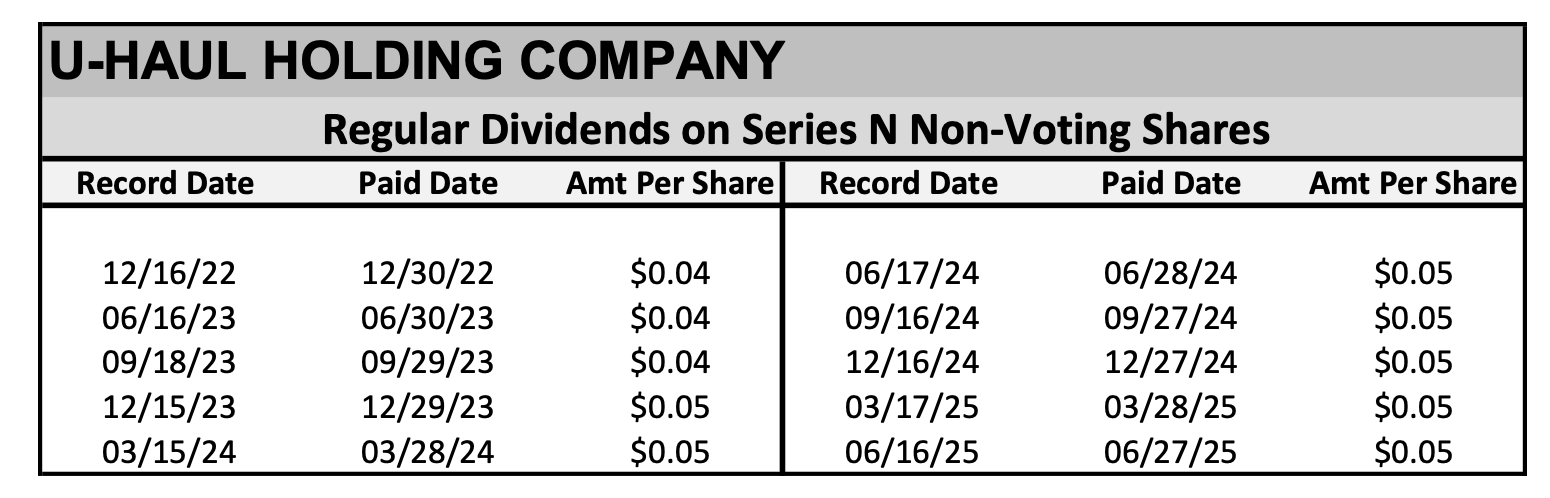
- The Board’s policy is to declare and pay quarterly cash dividends on the Series N Non-Voting Common Stock. Regular quarterly cash dividends on the Series N Non-Voting Common Stock (UHAL-B) have been declared since December 2022. The quarterly dividend on the Series N Non-Voting Common Stock was increased to $0.05 per share in December 2023.
- In mid-August, the management of U-HAUL provides an Investor Presentation via live webcast.
ANNUAL REVIEW OF U-HAUL HOLDING COMPANY (FY 2025)
Management’s goal is to be the predominant provider of moving and storage services for “do-it-yourself” consumers in North America through U-Haul International. The company has developed complementary verticals to better serve its customers, from moving supplies (boxes, tape etc.) and trailer hitches to ancillary products/services, such as the filling of propane tanks and specialty extension services, such as U-Box (portable moving and storage units) and eMove (an online marketplace of independent moving and self-storage affiliates).
The company operates in three reportable segments:
- Moving & Storage (through its U-Haul and Real Estate Company subsidiaries)
- Property & Casualty Insurance (through Repwest Insurance Company)
- Life Insurance (through Oxford Life Insurance Company)
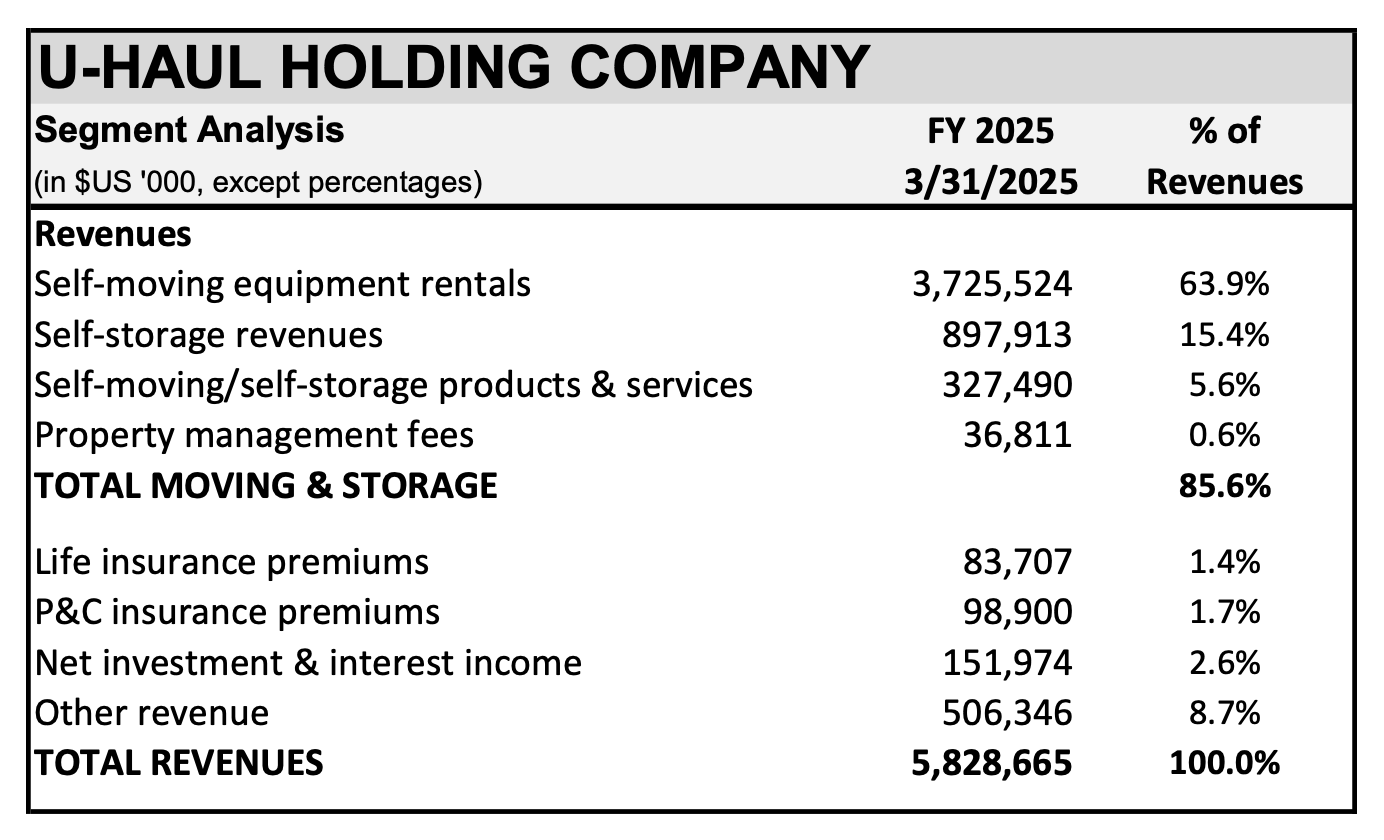
The Moving & Storage segment, by far the company’s largest and most significant segment, engages in the rental of trucks, trailers, specialty rental items, and self-storage spaces to the “do-it-yourself” mover and management of self-storage properties owned by others, as well as sales of moving supplies, towing accessories, and propane. Operations are conducted under the registered trade name U-Haul® throughout the United States and Canada. The company sells U-Haul brand boxes, tape and other moving and self-storage products and services to do-it-yourself moving and storage customers at all of its distribution outlets. Net revenue from the Moving & Storage segment in fiscal 2025 accounted for approximately 85.6% of total revenues; this excludes “Other revenue” (8.7% of total revenues), which mainly consists of U-Box, another Moving & Storage entity.
U-HAUL is one of the leading companies in the self-storage industry (the third largest self-storage operation in North America), a complementary operation and logical extension of its self-moving business.
U-Haul maintains and continually enlarges a fleet of rental equipment, including trucks, trailers and towing devices. Historically, revenue growth has been achieved by
- Growing the distribution network
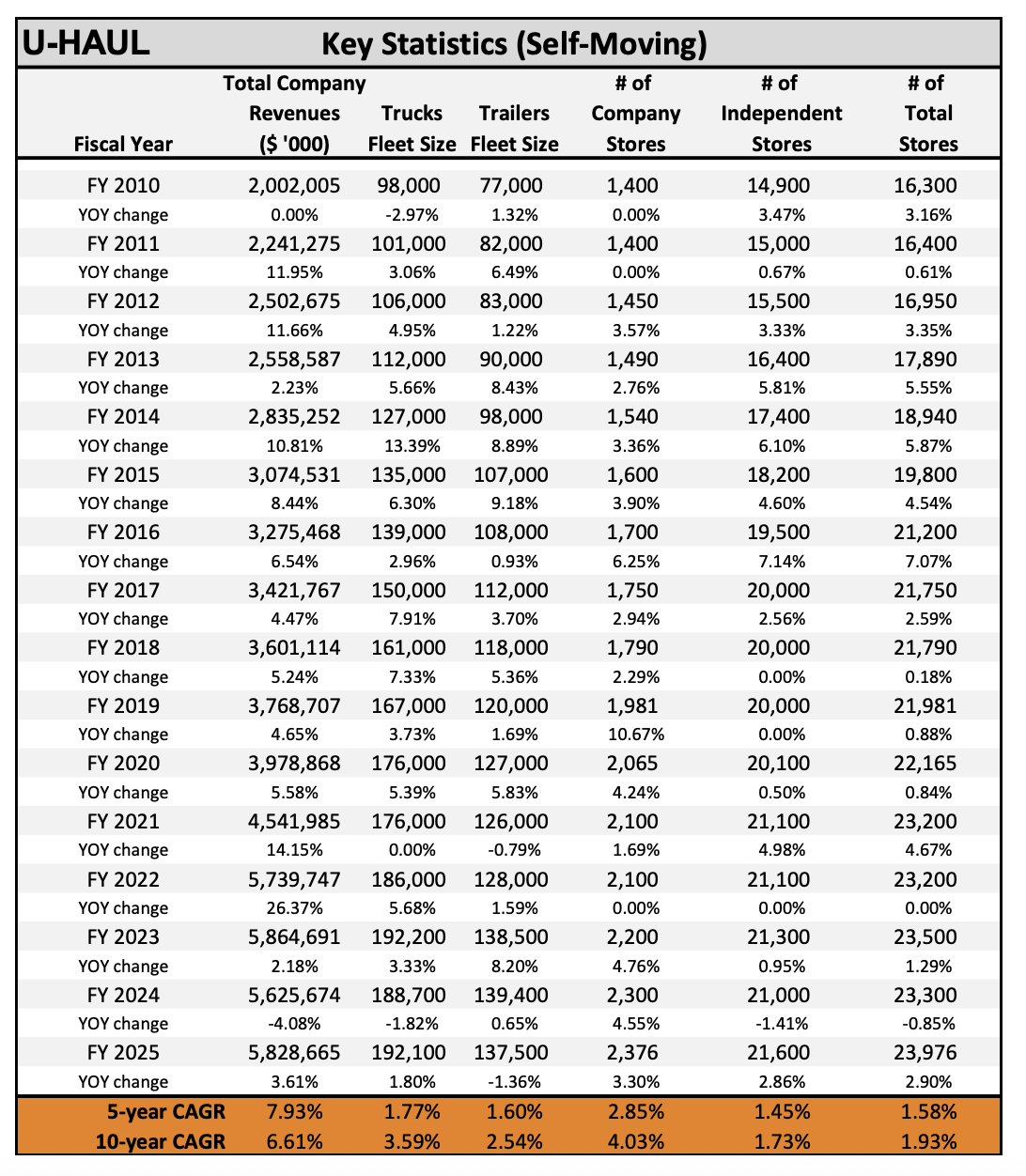
- The number of company’s retail locations has grown at a 10-year CAGR of 4.03%
- Increasing the size of the fleet
- The truck fleet has grown at a 10-year CAGR of 3.59%
- The trailer fleet has grown at a 10-year CAGR of 2,54%
- Expanding the self-storage footprint
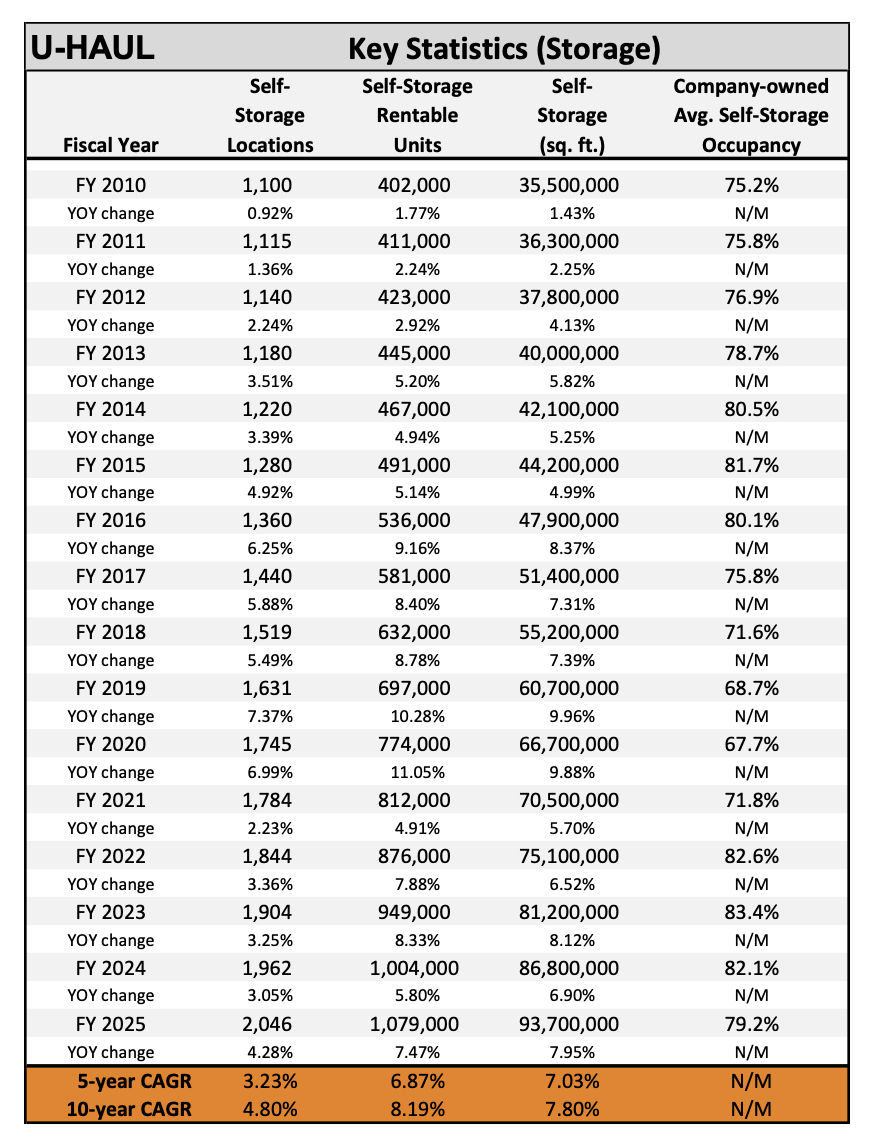
- The number of self-storage locations has grown at a 10-year CAGR of 4.80%
- The number of rentable units has grown at a 10-year CAGR of 8.19%
- The rentable square footage has grown at a 10-year CAGR of 7.80%
As a result, U-HAUL’s total revenues have increased at a 10-year CAGR of 6.61%.
Operationally, management strives to maximize vehicle utilization by adjusting the distribution of the truck and trailer fleets among the 2,376 company stores and approximately 21,600 independent stores. The company’s earning leverage is highly dependent on equipment utilization as well as pricing and volume. The critical factor of vehicle utilization in the truck rental business hinges on the geographical distribution of the fleet after one-way rentals, since U-Haul does not back-haul equipment. Traditionally, pricing has been the method by which equipment can be relocated.
In order to maintain the company’s top-line growth trajectory, management must allocate an appropriate level of investments into the retail fleet network, the fleet itself (with new trucks, trailers and towing devices) and the self-storage business. Over the past decade, management has consistently increased the total number of rental trucks in the fleet with new additions exceeding the number of trucks removed for retirement. Hence, management also faces the challenges of executing its fleet rotation program, requiring both the procurement of truck chassis from North American manufacturers and the retirement of vehicles through the used-truck sales market.
U-HAUL also owns holds two insurance companies: a property & casualty company (Repwest Insurance) that offers rental coverage to customers (through Safemove, Safetow and Safestor policies) and a life insurance company (Oxford Life Insurance), initially held for insuring employees, but later expanded into specialty lines.
The Property and Casualty Insurance segment offers moving and storage contents insurance products, including Safemove and Safetow policies that provide moving customers with a damage waiver, cargo protection, and medical and life coverage; and Safestor, which protects storage customers from loss of their goods in storage. Repwest provides loss adjusting and claims handling for U-Haul through regional offices across North America. Repwest also underwrites components of the Safemove, Safetow, and Safestor protection packages to U-Haul customers. The business plan for Repwest includes offering property and casualty products for other U-Haul related programs. Net revenue from the P&C segment in fiscal 2025 accounted for approximately 1.7% of total revenues.
The Life Insurance segment includes Oxford Life Insurance Company, which provides life and health insurance products, primarily to the senior market through the direct writing or reinsuring of life insurance, Medicare supplement and annuity policies. Net revenue from the life insurance segment in fiscal 2025 accounted for approximately 1.4% of total revenues.
MOVING & STORAGE OPERATIONS
Self-Moving
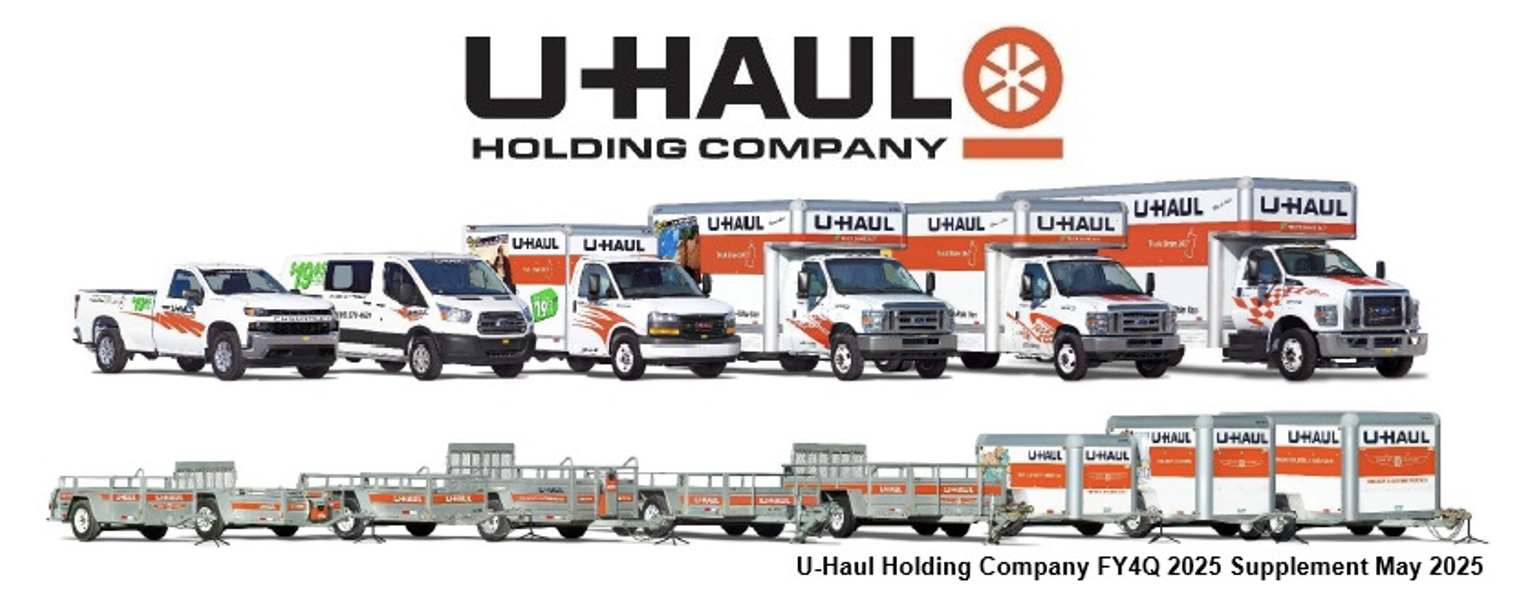
U-HAUL rents its distinctive orange U-Haul trucks and trailers through a network of over 2,300 company operated retail-moving centers and approximately 21,000 independent U-Haul dealers. The company also has a storage facility network with thousands of independent service providers participating as Storage Affiliates. As of March 31, 2025, the company’s rental fleet consisted of more than 192,100 trucks, 137,500 trailers and 39,700 towing devices.
The company has at least six different truck models and eight major types of trailers. The truck chassis are engineered by domestic truck manufacturers and made to U-Haul's specifications. The chassis are delivered to one of seven U-Haul manufacturing centers to be fitted with a cargo box. These manufacturing centers also build the trailers from the "ground up." Eleven (11) manufacturing and assembly facilities are strategically located throughout the United States in order to efficiently provide vehicles regionally.
Commonality of features (gear boxes, rear axles, tires, etc.) and parts reduce maintenance expenses and improve the efficiency of the parts inventory. All engines are gasoline powered to potential fueling problems. The company provides almost all of the preventive maintenance on the fleet with the exception of warranty claims. U-Haul dealers also offer moving supplies, including a wide variety of U-Haul-brand boxes, tape and packing materials. In addition, specialty boxes are available for dishes, computers, other electronic equipment, hanging clothes, etc.
U-Haul is one of the most recognized names in the world and has a commanding share of the consumer self-moving business. The company is the consumer’s number one choice as the largest installer of permanent trailer hitches in the automotive aftermarket industry. U-Haul’s brand awareness is very high. A survey of public brand identification of truck manufacturers placed U-Haul second behind Mack Truck, even though U-Haul does not make trucks. The name U-Haul is as well-known as Kleenex (Kimberly-Clark), Coke (The Cola-Cola Company) and Clorox. U-Haul trucks often appear in movies and television without U-HAUL having to pay for advertising.
Independent dealers receive trucks on a consignment basis and are paid a commission based on gross revenue generated by the dealer. The independent dealers are not franchisees. U-Haul does not franchise its name. Dealer contracts can be terminated upon 30 days written notice by either party.
To further leverage U-HAUL's web-based technology platform, the company developed eMove®, an online marketplace that connects consumers with a network of affiliates of independent moving service providers and independent self-storage affiliates that have been vetted by U-Haul. Through MovingHelp.com, service providers can provide help to pack and load items while the Storage Affiliates offer self-storage services where U-Haul may not have facilities that are conveniently located for the consumer.
A component of the truck rental fleet is the disposal of trucks that are removed from the fleet for retirement dubbed the fleet rotation program, a dynamic process that affects fleet size, non-cash depreciation charges, proceeds from the sale of retired trucks (which are dependent on the state of the used truck market) and the availability of rentable trucks. Typically, as new trucks are added to the fleet, older (high mileage) trucks are and sold.
Furthermore, U-Haul sells and installs a broad range of hitches and components for towing trailers, boats, jet skis, motorcycles, campers, horse trailers etc. Management believes that U-Haul is the largest seller and installer of hitches and towing systems in North America.
U-Haul is also one of the largest refillers of propane tanks in North America, primarily for alternative-fuel vehicles and backyard barbecues. The company’s trained and certified personnel provide propane at nearly 1,200 locations.
The moving truck and trailer rental industry is large and highly competitive. There are two distinct users of rental trucks: commercial and “do-it-yourself” residential users. U-HAUL focuses primarily on the “do-it-yourself” residential user and is the largest self-moving company with over 50% of the applicable market. There are few large competitors and new entrants have found it difficult to achieve a significant market share. Within this segment, the company’s major competitors are Avis Budget Group, Inc. (NASDAQ:CAR) and Penske Truck Leasing (a closely-held company). Enterprise Rent-a-Car (a private holding company) started a small truck service, which targets the light local delivery business.
Consumer self-moving and self-storage are relatively single-digit, top-line growth industries (around 5% annually). However, both are highly fragmented industries; therefore, there are opportunities to gain market share. Both industries are less cyclical than most, since in bad times some people downgrade their living quarters (and some move back in with their parents) and use self-storage and consumer truck rental to move and store their belongings. In good economies, people move up-scale from small apartments to larger ones or to houses.

Self-Storage
The primary market for storage rooms is for the storage of household goods. U-Haul serves millions of ‘do-it-yourself’ household moving customers annually. A large number of renters use a rental truck or trailer to move goods in or out of the storage facilities. It was a logical extension of the do-it-yourself-moving business to be also in the self-storage industry.
U-Haul operates almost 1,079,000 rentable storage units, comprising approximately 93.7 million square feet of storage space in all 50 United States and 10 Canadian provinces. The target market for the rental of storage units is for the storage of household goods. Individual storage units range in size from 6 square feet to over 1,000 square feet. The company’s provide competitive self-storage services, such as an electronic system that monitors the storage facility 24 hours a day (Max Security), access during extended hours and individually alarmed units. Many locations include climate controlled facilities, which is a growing trend in the self-storage industry.
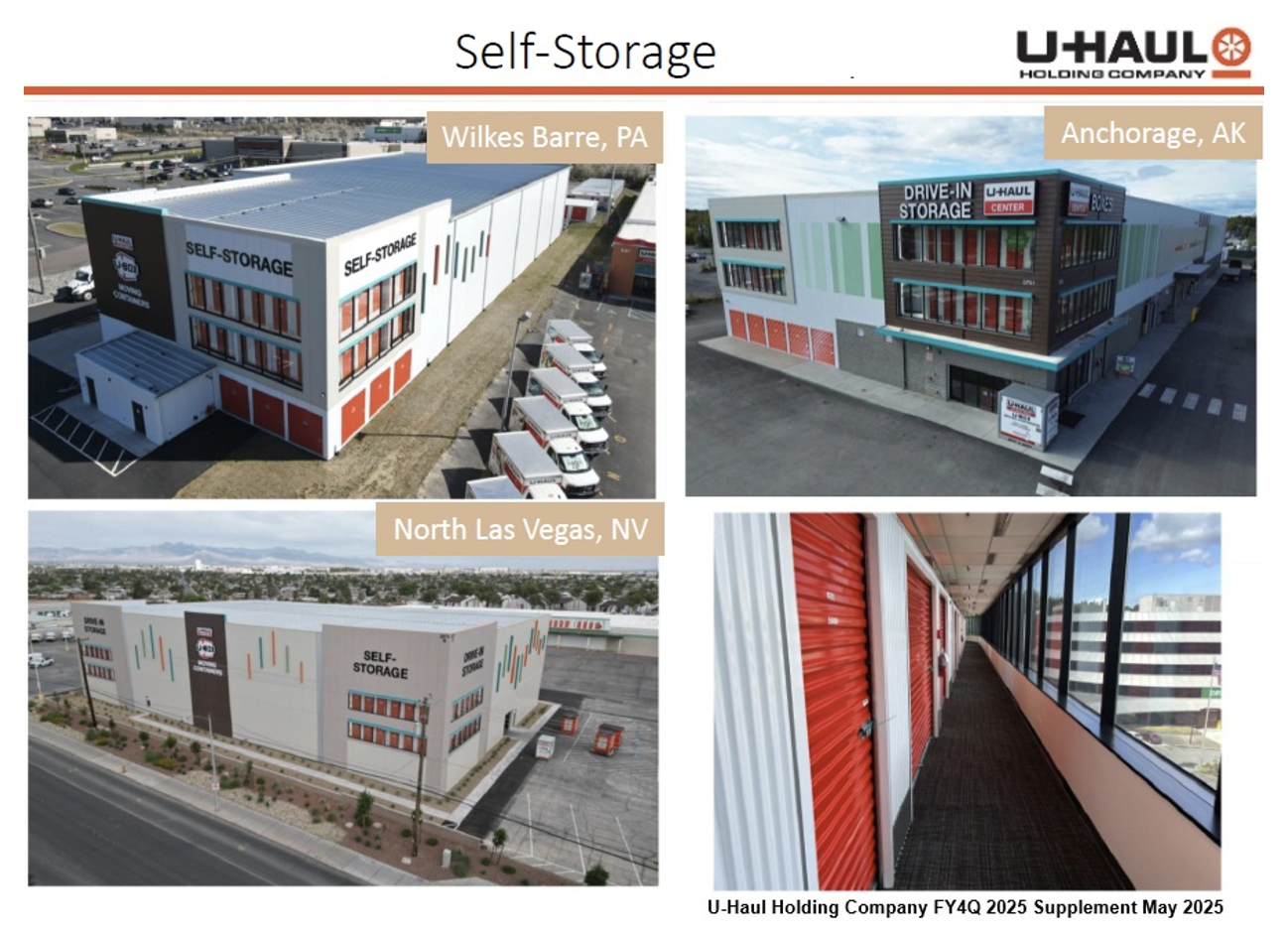
The self-storage market is large and highly fragmented. The largest national storage competitors include Public Storage Inc. (NYSE:PSA), Extra Space Storage, Inc. (NYSE:EXR), Life Storage Inc. (NYSE: LSI), formerly known as Sovran Self-Storage Inc., CubeSmart REIT (NYSE:CUBE) and National Storage Affiliates Trust (NYSE:NSA).
Valuation
U-HAUL operates in both the “do-it-yourself” consumer truck and trailer rental business and in the self-storage industry. The vehicle rental business requires considerable investment in infrastructure (rental facilities and vehicles). Earnings in this segment tend to exhibit cyclicality, which is a consequence of the substantial earnings leverage that can be derived from improved utilization of the fleet. On the other hand, despite also requiring a significant investment in infrastructure (storage buildings), self-storage operations tend to be much less cyclical and provide steady cash flow.
From an investment perspective, both types of operations are generally valued on the metric of EV-to-EBITDA (Enterprise Value-to-Earnings Before Interest, Taxes, Depreciation and Amortization). From the Industry Comparable table below, it is easily observable that self-storage operations are valued at a much higher EV-to-EBITDA basis (17.9 on average compared to 14.2 for truck rental companies) due to each industry’s fundamental attributes described above. Due to the small sample size of public truck rental companies (since Penske and Enterprise are not publicly traded), the EV-to-EBITDA metric is distorted.
By expecting the high EV-to-EBITDA valuation metric to be 10.9 at some point during the next 12 months, a target price of $74.25 is indicated.
SUBSCRIBE TO ZACKS SMALL CAP RESEARCH to receive our articles and reports emailed directly to you each morning. Please visit our website for additional information on Zacks SCR.
DISCLOSURE: Zacks SCR has received compensation from the issuer directly, from an investment manager, or from an investor relations consulting firm, engaged by the issuer, for providing research coverage for a period of no less than one year. Research articles, as seen here, are part of the service Zacks SCR provides and Zacks SCR receives quarterly payments totaling a maximum fee of up to $40,000 annually for these services provided to or regarding the issuer. Full Disclaimer HERE.