By John Vandermosten, CFA
NYSE: AZTR
READ THE FULL AZTR RESEARCH REPORT
Over the last month, Azitra, Inc. (NYSE: AZTR) has updated investors on its two leading programs and announced a reverse stock split. The ATR-04 Phase I/II EGFR inhibitor-associated rash program has advanced to cohort 2 after being given Safety Review Committee clearance. The program has also expanded its addressable population to include patients with rashes due to KRAS and MEK inhibitors. The cosmetic program has presented data from an ex vivo study which, according to multiple measurement approaches, showed visible improvements in fine lines, wrinkles and elasticity after a single dose with the ATR-COSF cosmetic product candidate.
Beyond a summary of these most recent events, we update our valuation to reflect the 1:10 reverse stock split. Based on our estimates and assumptions, our model generates a valuation of $3.00 per share.
ATR-COSF Ex Vivo Results
Azitra presented a first look at new data for ATR-COSF in an October 26th press release. Additional detail for these findings will be presented by Chief Operating Officer Travis Whitfill at BIO-Europe in Cologne, Germany on November 10th. In the study, ATR-COSF was evaluated in two different models of ex vivo cosmetic surgery skin, which was maintained in serum-free, nutrient-rich media. Two models were used to evaluate the reduction in fine lines and the improvement in skin elasticity.
The first model utilized dorsal torsoplasty skin explants that were received approximately 18 hours after the donor’s surgery. A 2% concentration of ATR-COSF was applied to the skin samples and compared to a control that was administered the hydrogel vehicle without ATR-COSF. A surface evaluation of wrinkles (SEw) was conducted at four timepoints: Hours 3, 4.5, 24 and 48. The SEw analysis showed reductions in the measured appearance of fine lines and wrinkles of approximately 15% at 3 hours, which increased to 20% at 24 hours and 50% at 48 hours. Investigators concluded that ATR-COSF preserved net skin elasticity over the 48-hour period, whereas the hydrogel vehicle alone was associated with a meaningful decline in elasticity.
Exhibit I – Epidermis Layers
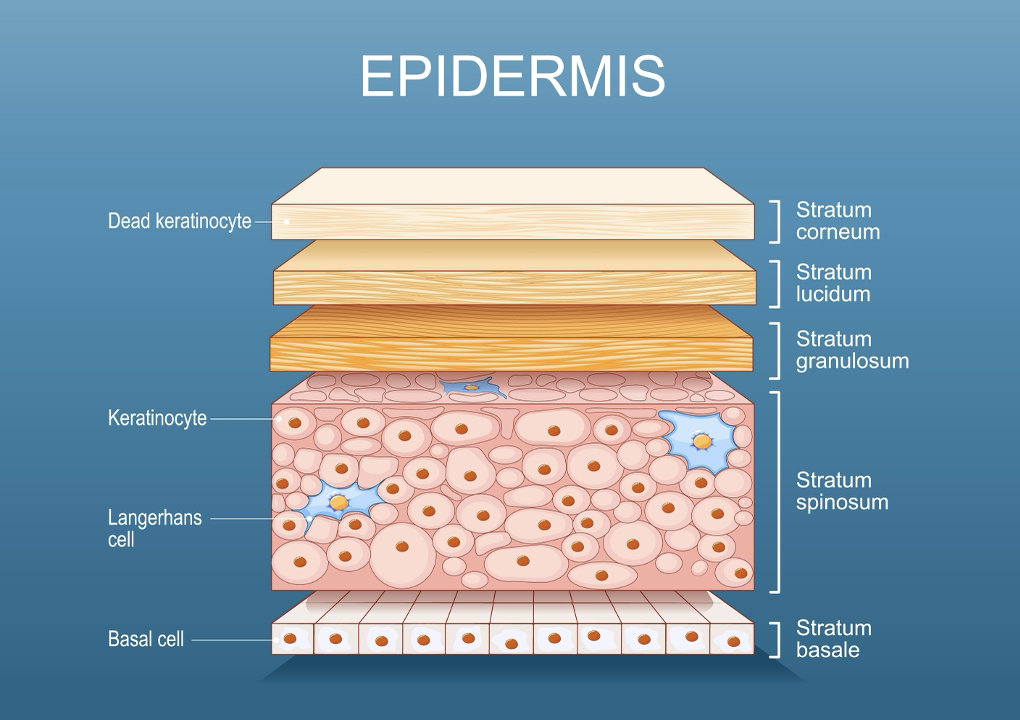
Source: Shutterstock Image #2453690763
The second model evaluated facelift skin explants about 48 hours after surgery. ATR-COSF was applied at 2% and 4% concentrations compared with the hydrogel vehicle-only control. ATR-COSF and the vehicle were topically applied as a single dose and skin elasticity was measured six hours post-application. At the 6-hour time point, the 4% ATR-COSF formulation outperformed the 2% formulation and the hydrogel alone across each of the elasticity parameters from the suction and recovery test. Both the 2% ATR-COSF formulation and hydrogel alone showed either a decline in elasticity or no improvement, whereas the ATR-COSF 4% formulation demonstrated clear improvements across the measured elasticity parameters.
Chief Operating Officer Travis Whitfill will present these data in more detail at the BIO-Europe conference which will be held in Cologne, Germany from November 9 to 11. Dr. Whitfill will be available for 1:1 meetings with conference participants. Azitra plans to launch a first-in-human clinical study of 4% ATR-COSF in approximately 30 subjects with initial data expected by year end.
ATR-04
In late February 2026, Azitra announced that it had added MD Anderson Cancer Center in Houston, Texas as a clinical site for its Phase I/II trial evaluating ATR-04 in EGFR inhibitor-associated skin rash. Six sites are now listed on the clinicaltrials.gov website for the trial registered as NCT06830863 and include cancer centers and hospitals in Arkansas, Connecticut, New York, Ohio, Texas and Virginia. Enrollment for the ATR-04 trial has been slow due to oncodermatologists working with oncologists who prophylactically administer antibiotics and steroids. The administration of antibiotics and steroids are exclusion criteria for enrollment in the trial. As of October 1st, 2026, the trial was cleared to advance to Cohort 2. Seven patients were treated in Cohort 1 and 24 patients are expected to be treated in Cohort 2. Investigators are making adjustments to increase the addressable population.
The medical community seeks to reduce the use of antibiotics to reduce the risk of antimicrobial resistance. Physicians also recognize the risk of topical steroid use which can cause thinning of the skin, precipitate other types of rashes and increase the risk of infection. Azitra has more fully communicated the benefits that ATR-04 may confer to the oncology care teams at its trial sites in order to increase the number of eligible patients.
In an October 29th press release, Azitra announced an expansion of eligibility for participants in the ATR-04 Phase I/II trial. The patient set will add individuals treated with KRAS1 inhibitors (such as sotorasib and adagrasib) and MEK2 inhibitors (such as trametinib and cobimetinib). Azitra believes that this expansion will significantly broaden potential treatment opportunities for ATR-04 beyond EGFR inhibitor-associated skin rash. The expanded eligibility also includes patients with neurofibromatosis type 1 (NF1) with rash associated with MEK inhibitors. The amendments shorten the required washout periods for antibiotics and steroids. These changes broaden the potential treatment opportunities for ATR-04 beyond its initial focus on EGFRi-associated skin rash while expanding the pool of eligible patients to facilitate recruitment.
Azitra estimates that 220,000 of the addressable market are EGFRi patients and another 85,000 comprise the MEK & KRAS inhibitor groups. Neurofibromatosis type 1 (NF1) is a rare genetic disorder that affects about 100,000 persons in the US. NF1 patients who receive MEK inhibitors and develop rash are also included in the expansion. Based on our review of US revenues for KRAS and MEK inhibitors, we see the vast majority of new incremental patients falling in the MEKi category.
Exhibit II – ATR-04 Original Trial Design (Lacks Updates for Amendments)
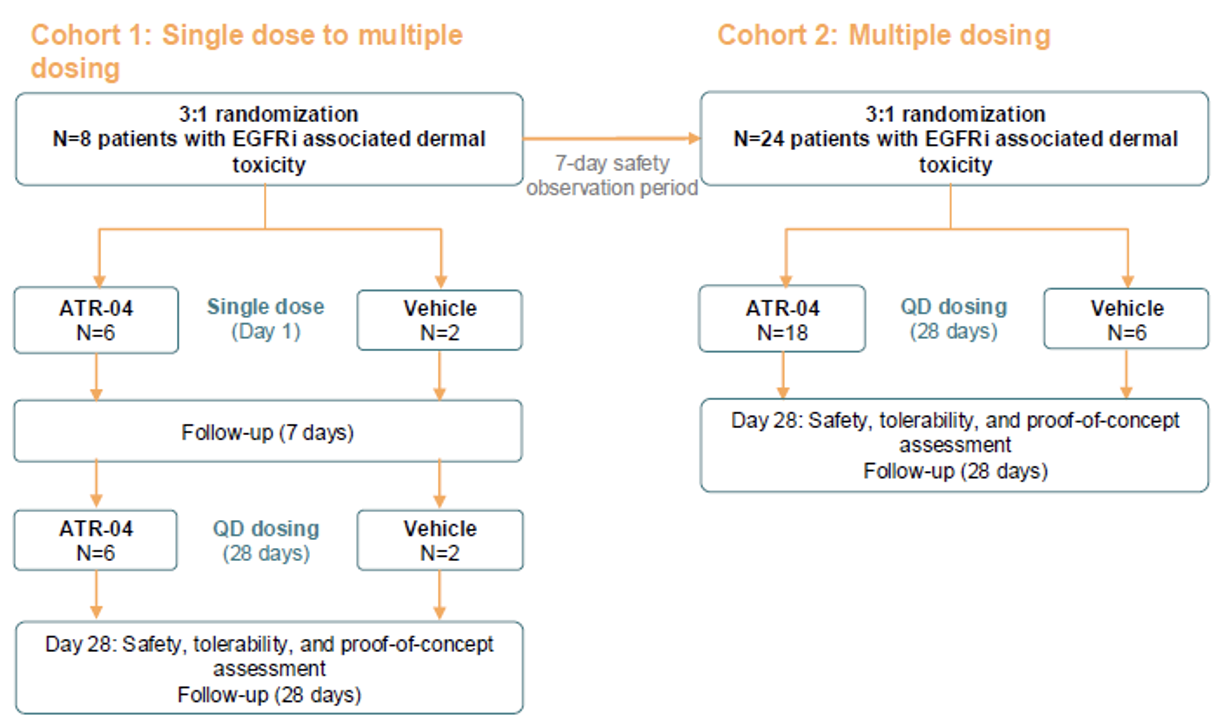
Source: August 2026 Corporate Presentation
Valuation of the ATR-COSF and ATR-04 Programs
We recently updated our valuation to reflect only the ATR-COSF and ATR-04 programs. As we recognize the continued capital needs and the reverse stock split, we adjust our valuation. Relative to our previous estimates, we decrease the number of shares used in our valuation by a factor of 10 to reflect the 1:10 reverse stock split that was effective on October 26th. Please note that our shares outstanding includes the 6.06 million shares that exist after the split plus the split-adjusted 4.24 million pre-funded warrants, which we treat as common shares for valuation purposes. We also add four million shares to the denominator of our calculation to reflect an assumed $3 million capital raise over the next 12 to 18 months. The number of shares is calculated using the most recent share price. These changes generate a valuation of $3.00 per share.
Milestones
- Presentation at Biotech Showcase – January 2026
- Presentation at BIO Investment & Growth Summit – March 2026
- Private Placement of $10.5 million – March 2026
- Poster Presentation at ASGCT meeting – May 2026
- Results from ATR-COSF study on cosmetic surgery skin – mid-2026
- Pause of enrollment in ATR-12 program – June 2026
- Azitra regains compliance with NYSE listing standards – August 21st, 2026
- Participation in the HC Wainwright Conference – September 2026
- ATR-04 Cohort 1 initial data announcement – 4Q:26
- Advancement of ATR-04 trial to Cohort 2 – October 2026
- Updated fine lines and elasticity results from the ATR-COSF trial – October 26th, 2026
- 1:10 reverse stock split – October 26th, 2026
- Initiation of human cosmetic study – 4Q:26
- ATR-01 IND submission – 2027
Exhibit III – Azitra Pipeline
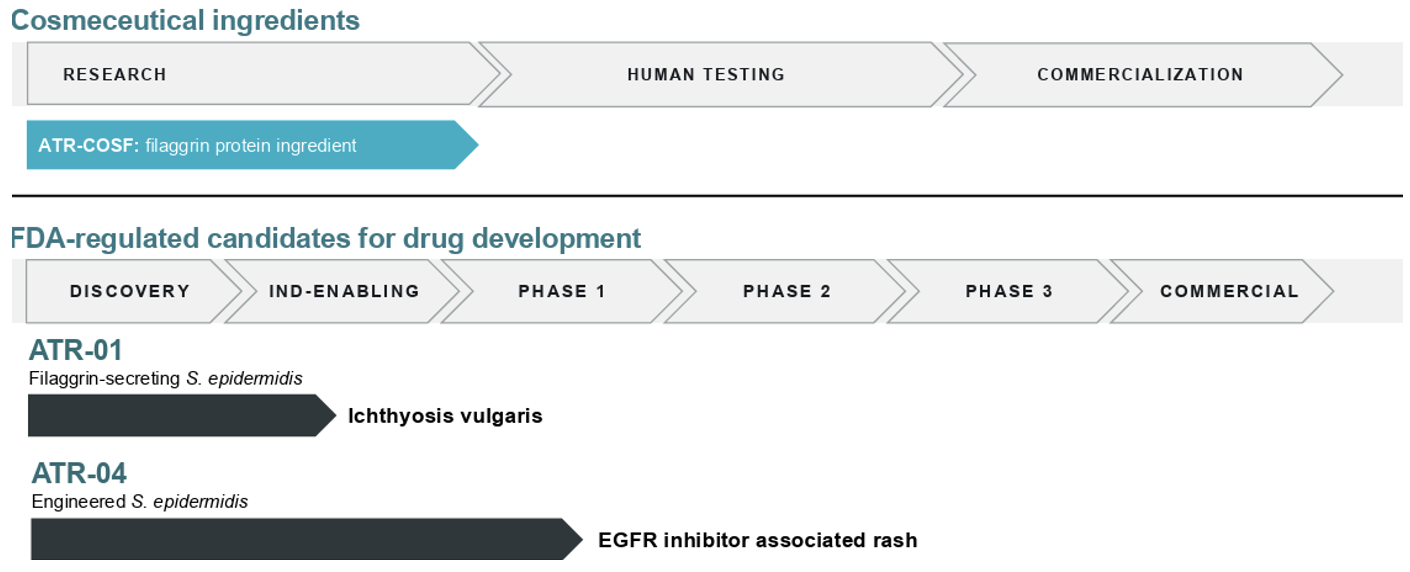
Source: August 2026 Corporate Presentation
SUBSCRIBE TO ZACKS SMALL CAP RESEARCH to receive our articles and reports emailed directly to you. Please visit our website for additional information on Zacks SCR.
DISCLOSURE: Zacks SCR has received compensation from the issuer directly, from an investment manager, or from an investor relations consulting firm, engaged by the issuer, for providing research coverage for a period of no less than one year. Research articles, as seen here, are part of the service Zacks SCR provides and Zacks SCR receives payments totaling a maximum fee of up to $50,000 annually for these services provided to or regarding the issuer. Full Disclaimer HERE.
1 Kirsten Rat Sarcoma Viral Oncogene Homolog (KRAS)
2 Mitogen-Activated Protein Kinase Kinase (MEK)