By John Vandermosten, CFA
NYSE: AZTR
READ THE FULL AZTR RESEARCH REPORT
Azitra, Inc. (NYSE: AZTR) reported second quarter 2026 financial and operational results on August 12th, 2026, and provided a business update. Year to date 2026, Azitra has raised gross proceeds of approximately $10.5 million in capital that will support the launch of a new initiative in cosmetics and cosmeceuticals along with its other clinical programs. The company is moving away from its ATR-12 Netherton syndrome program and emphasizing its cosmetics work and ATR-04 skin rash program. It has also participated in the BIO International Convention, presented a poster at the Annual Meeting of the American Society of Gene & Cell Therapy (ASGCT), and secured a new patent for ATR-12.
We update our valuation to reflect the pause in the ATR-12 program and emphasize the opportunity for the cosmetics and ATR-04 skin rash initiatives. We discuss the assumptions behind our updated target price in the valuation section of this report. Based on our estimates, our model generates a valuation of $0.34 per share. See our full report for valuation details.
Operational and Financial Results
Azitra’s second quarter 2026 results were presented in a press release and Form 10-Q filing with the SEC on August 12th. For the quarter ending June 30th, 2026, and versus the prior year’s comparable period, no revenues were reported. Net loss for the three-month period totaled $3.3 million or $0.17 per share.[1] Below, we detail 2Q:26 financial results compared to the same prior year period:
- General and administrative expenses totaled $2.1 million, up 41% from $1.5 million due to higher payroll and benefits related to retention bonuses, greater legal fees, increased accounting costs, and greater use of business consultants, along with more overhead expenses. These were partially offset by lower insurance, public relations, and software and equipment costs;
- Research and development expenses decreased by 4% to $1.4 million on lower ATR-12 and ATR-04 spending. The use of clinical consultants declined, also contributing to the change. These were partially offset by greater payroll and benefits related to retention bonuses, greater spending on lab supplies and an increase in the use of chemistry, manufacturing and controls (CMC) consultants along with higher miscellaneous costs;
- Net interest income was $73,000 compared to $15,000 due to greater interest income from higher cash balances;
- Other expense was $1,788 compared with $32,688;
- Net loss was $3.3 million or $0.17 per share vs. $2.9 million or $1.18 per share;[2]
As of June 30th, 2026, cash and equivalents totaled $6.7 million. This compares with the $2.1 million at the end of 2025. There is no debt. Cash burn for the first six months of 2026 was $5.8 million, on par with the $5.9 million in the same prior year period. Cash from financing was $10.6 million, representing proceeds from a private placement, equity line of credit, and warrant-exercise proceeds.
ATR-COSF Ex Vivo Results
On July 15th, Azitra announced ex vivo results from its ATR-COSF program demonstrating controlled distribution of the rHD filaggrin[3] into the stratum granulosum (SG) in increased amounts over prior single dose experiments in human skin. The experiments established improvements in elasticity and reduced the appearance of fine lines and wrinkles in human skin. Two studies were evaluated. The first evaluated ex vivo fresh, healthy human explants to measure recombinant human derived (rHD) filaggrin delivery. The second ex vivo model used defatted human skin explants to evaluate the effect of the lyophilized rHDfilaggrin supernatant in a hydrogel formulation on human skin elasticity.
Study I
Study I showed that the ATR-COSF supernatant provided a positive penetration and distribution profile for rHDfilaggrin using multiple doses of a 2% lyophilized supernatant in a hydrogel formulation. The functional unit of filaggrin protein was delivered through the SC and into the SG layers (see following exhibit for reference). The amount delivered was greater than what had been achieved in single dose previous work. Drug concentration was also greater in the SC and SG layers.
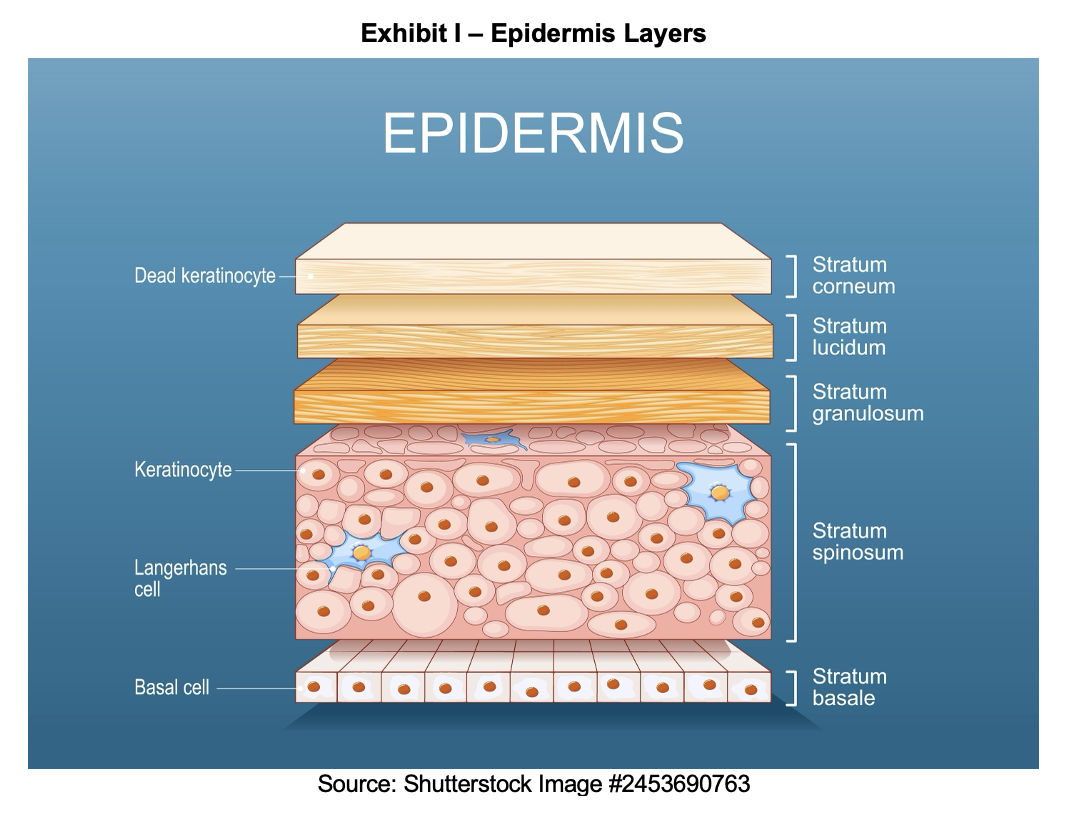
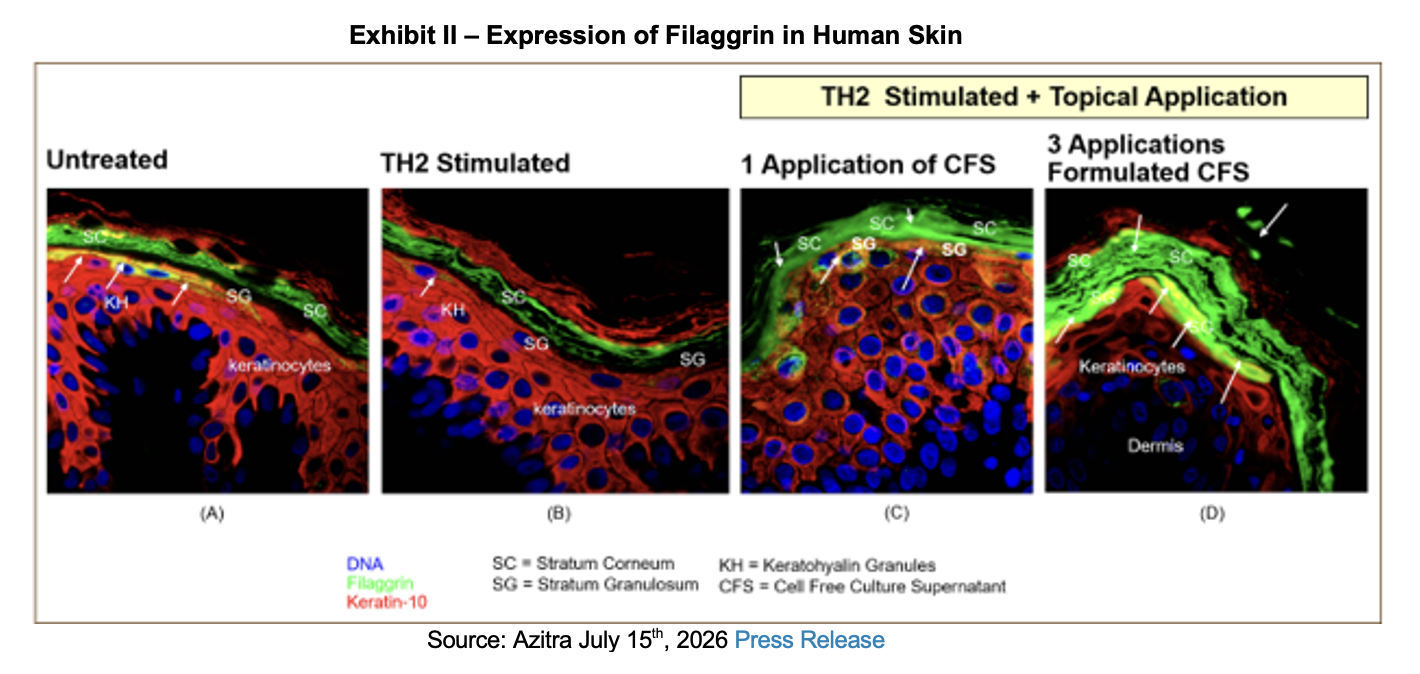
Azitra asserts that this ex vivo model offers a biologically relevant system for evaluating skin penetration while preserving the architecture of human skin. The skin explants were stimulated with TH2 cytokines to reduce the levels of endogenous filaggrin in the samples. Researchers detected rHDfilaggrin penetration in the middle to lower SC following a single application of the 2% formulation. Additional applications of rHDfilaggrin produced increased amounts of the protein in the measured skin layers. Azitra’s safety testing showed that the 2% supernatant formulation is non-irritating and non-corrosive to the skin and eyes. The methods used to measure this were not disclosed.
The following exhibit illustrates the penetration of filaggrin into the skin after single and multiple applications of the supernatant. Figure A shows explanted healthy skin prior to treatment. Native filaggrin is present, stained in green, in the SG layer. Figure B shows the skin sample after TH2 cytokine stimulation, which seeks to reduce or eliminate native filaggrin in the SG layer. Figure C shows the penetration and distribution of rHD filaggrin into the SG layer after one application, and Figure D shows penetration after three applications of the lyophilized cell-free supernatant in a hydrogel formulation.
Study II
The second ex vivo model sought to assess the effect of the lyophilized rHDfilaggrin supernatant in a hydrogel formulation on human skin elasticity. Supernatant concentrations in the hydrogel ranged from 0.0% to 7.5% by weight. Elasticity was measured at 20 hours post application. Skin samples were incubated at 30° Celsius. The exhibit below shows the results demonstrating a greater elasticity relationship with higher supernatant concentration. The press release did not disclose the method used for measuring elasticity.
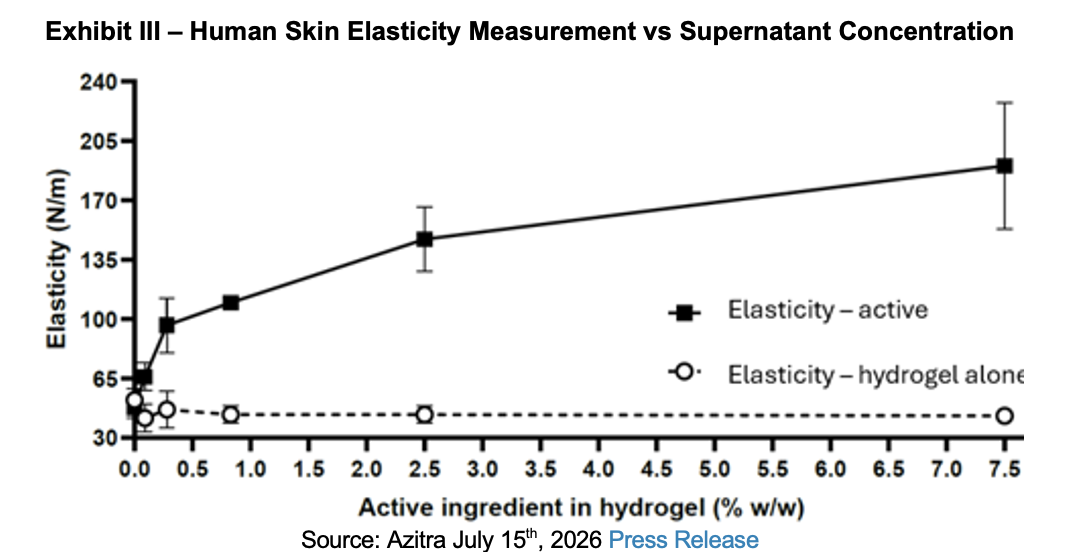
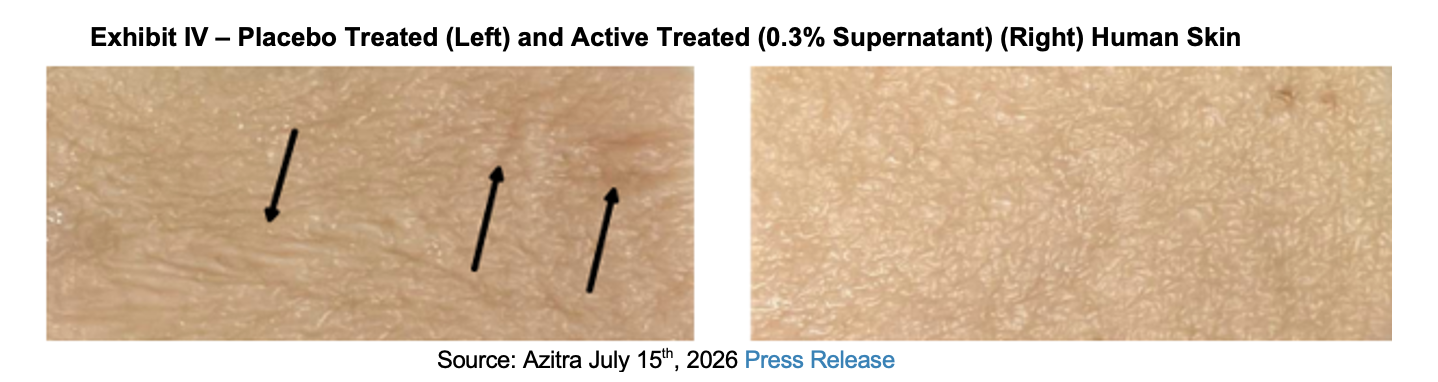
Minimum and maximum effects in elasticity enhancement were observed in hydrogels containing 0.09% weight/ weight (w/w) (1.6-fold) and 7.5% w/w (4.4-fold) of active ingredient. Hydrogels containing 0.28% w/w of active ingredient restored ex vivo abdominoplasty skin elasticity to values historically observed in healthy skin. Photographs of the skin samples after the incubation period are shown in the following exhibit. On the left is the placebo treated skin and on the right is the 0.3% supernatant treated skin. The actively treated sample produced twice the elasticity of the placebo-treated skin sample according to Azitra’s measurement methods.
The preclinical work here is an encouraging first look at the effects of ATR-COSF, and we are eager to see further analysis in a peer reviewed journal article.
Valuation of the ATR-COSF and ATR-04 Programs
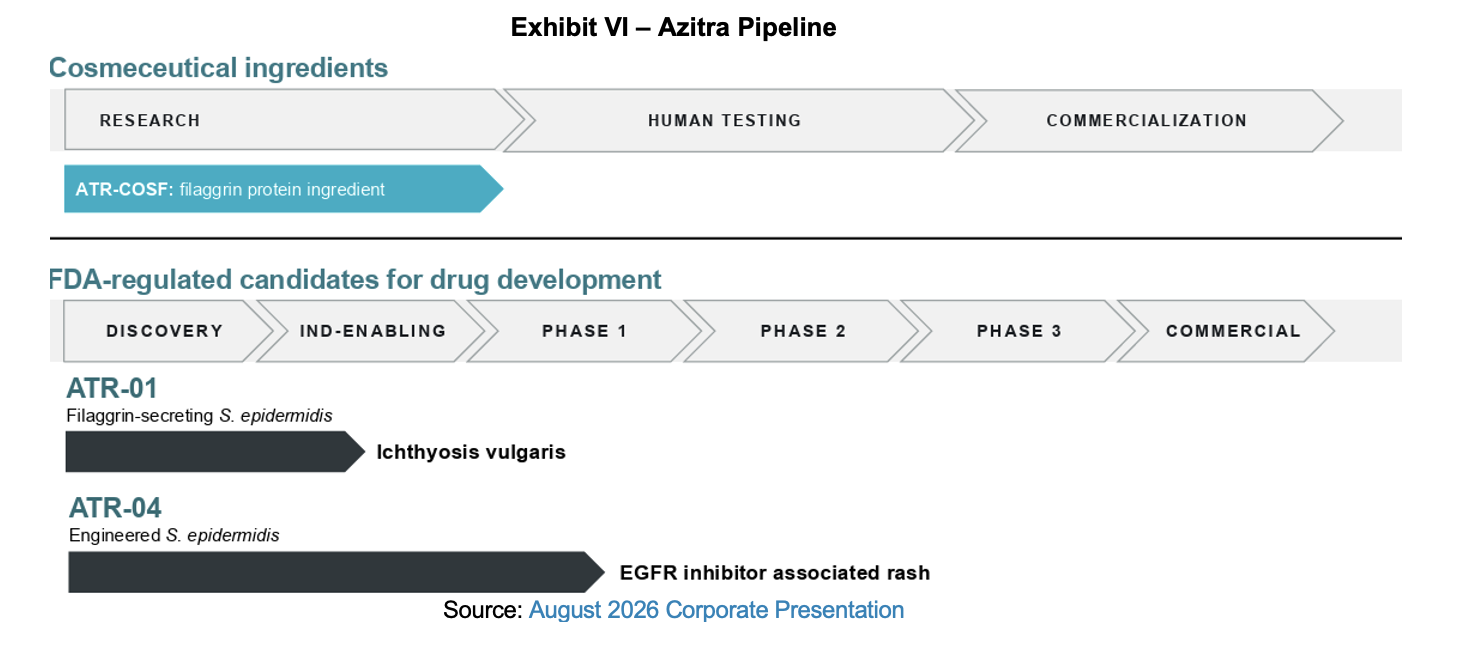
Azitra has paused its Netherton syndrome program and has refocused its primary efforts. Therefore, we put aside our ATR-12 valuation and add ATR-COSF and ATR-04. See our full report for valuation details and justification for our $0.32 target price.
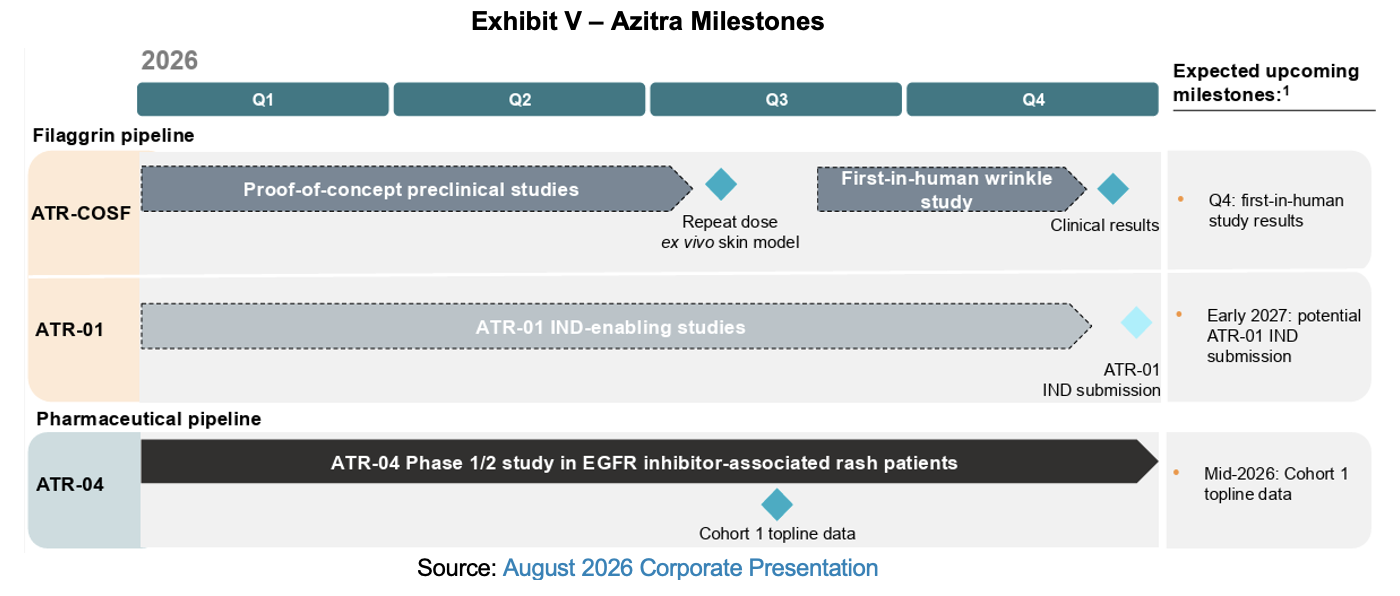
Milestones
- Presentation at Biotech Showcase – January 2026
- Presentation at BIO Investment & Growth Summit – March 2026
- Private Placement of $10.5 million – March 2026
- Poster Presentation at ASGCT meeting – May 2026
- Results from ATR-COSF study on cosmetic surgery skin – mid-2026
- Pause of enrollment in ATR-12 program – June 2026
- Azitra regains compliance with NYSE listing standards – August 21st, 2026
- Launch of human cosmetic application study (ATR-COSF) – 2H:26
- Participation in the HC Wainwright Conference – September 2026
- Initiation of human cosmetic study – 2H:26
- ATR-04 first cohort topline announcement – 2H:26
- ATR-04 Cohort 1 initial data announcement – 4Q:26
- ATR-01 IND submission – 2027
SUBSCRIBE TO ZACKS SMALL CAP RESEARCH to receive our articles and reports emailed directly to you. Please visit our website for additional information on Zacks SCR.
DISCLOSURE: Zacks SCR has received compensation from the issuer directly, from an investment manager, or from an investor relations consulting firm, engaged by the issuer, for providing research coverage for a period of no less than one year. Research articles, as seen here, are part of the service Zacks SCR provides and Zacks SCR receives payments totaling a maximum fee of up to $50,000 annually for these services provided to or regarding the issuer. Full Disclaimer HERE.
________________________
[1] We update per share amounts in this report to reflect the 1:6.66 reverse stock split that took place on August 21st, 2025.
[2] We use financial statement data as originally reported and apply a 1:6.66 reverse stock split ratio for periods prior to August 21st, 2025. Prior year numbers in our reporting may not match Azitra’s current period comparisons.
[3] Filaggrin means filament aggregating protein. It facilitates aggregation of keratin filaments