By John Vandermosten, CFA
NASDAQ: BLRX
READ THE FULL BLRX RESEARCH REPORT
BioLineRx Ltd. (NASDAQ: BLRX) reported first quarter 2026 financial and operational results in a May 27th press release. For the quarter, it produced license revenues of $477,000 and a net loss of $2.6 million. The joint venture (JV) with Hemispherian, Tetragon Biosciences, has started a Phase I/IIa study evaluating GLIX1 in glioblastoma (GBM) and other cancers. The first patient has been dosed. The Phase I trial seeks to establish the safety, recommended dose, and proof-of-concept for the drug. Additionally, BioLineRx will present two abstracts at the upcoming ASCO conference that highlight preclinical data for GLIX1. Enrollment for Columbia’s CheMo4METPANC Phase 2b study continues, and management anticipates that an interim readout will occur later in 2026.

1Q:26 Operational and Financial Results
BioLineRx reported first quarter sales of $477,000, producing a net loss of $2.6 million or $0.00 per share. The results were announced in a press release on May 27th, 2026, followed by a conference call with management and the filing of Form 6-K providing additional information.
Below we summarize financial results for the three-month period ended March 31st, 2026, compared to the same prior year period:
- Total and license revenues were $477,000 from the sale of Aphexda compared to $255,000. Ayrmid’s Aphexda product sales for 1Q:26 were $2.7 million vs $0.9 million;
- Cost of revenues was $95,000 compared with $34,000. The amounts represent license fee and royalty pass-throughs to Biokine as a proportion of royalty on motixafortide revenues;
- Research and development (R&D) expenses totaled $2.5 million, rising 56% from $1.6 million. The increase is attributable to spending on the new GLIX1 development program;
- General and administrative (G&A) expenses were $858,000, down 13% from $989,000, primarily due to lower legal and other miscellaneous expenses;
- Non-operating income was $458,000 vs. $7.6 million, predominantly reflecting changes in fair-value adjustments of warrant liabilities on the balance sheet;
- Net financial expense amounted to $42,000, reflecting interest expense exceeding interest income;
Net loss was $2.6 million or $0.00 compared to net income of $5.1 million, or $0.00. Cash, equivalents, and short-term bank deposits as of March 31st, 2026, totaled $17.3 million, down from the year-end 2025 balance of $20.9 million. Cash burn for 1Q:26 was $2.3 million, and net cash used in financing was $1.2 million. Financing cash outflows were related to loan repayments and lease liability repayments. At the end of the first quarter, loans were carried at $7.8 million on the balance sheet. The term loan is expected to be fully repaid by the end of 2027. Management reiterated its forecast of holding sufficient cash to support operations until 1H:27.
GLIX1 Phase I/IIa Clinical Trial in the Treatment of Glioblastoma
BioLineRx announced the start of its Phase I/IIa clinical trial evaluating GLIX1 for the treatment of glioblastoma in a March 26th press release. As of late May, the trial has dosed the first patient at NYU Langone Health and added two additional sites at Northwestern University and Moffitt Cancer Center.
The Phase I/IIa GLIX1 trial is an open-label, multicenter trial. Its first part is a dose escalation study where an anticipated 30 glioblastoma patients will receive GLIX1 daily as monotherapy. It will seek a maximum tolerated and recommended dose for the next stage of the trial. The Phase I portion will also identify pharmacokinetics (PK), pharmacodynamics (PD), and preliminary efficacy. Trial updates are anticipated in 2H:26 and full results in 2027. Management is optimistic on enrollment, anticipating efficient enrollment and limited competition for patients from other investigational modalities. It also has a favorable view on the space, as few other treatments are showing success.
The Phase IIa portion will include additional indications beyond GBM, including newly diagnosed GBM and other select cancers. The study will evaluate GLIX1 as monotherapy and in combination with standard of care. It will also evaluate GLIX1 in combination with Poly (ADP-ribose) Polymerase (PARP) inhibitors. The Phase IIa expansion will identify preliminary efficacy, PD assessments, and dose optimization data.
GLIX1 ASCO Presentation
BioLineRx and partner Hemispherian AS will feature two presentations at the American Society of Clinical Oncology (ASCO) 2026 Annual Meeting, which is being held May 29th to June 2nd, 2026, in Chicago, Illinois. Details of BioLineRx’s participation in the event are included in a May 2026 press release. Below we provide the titles and summaries of the two abstracts.
- GLIX1: A first-in-class oral molecule targeting the DNA damage response by restoring TET2[1] activity
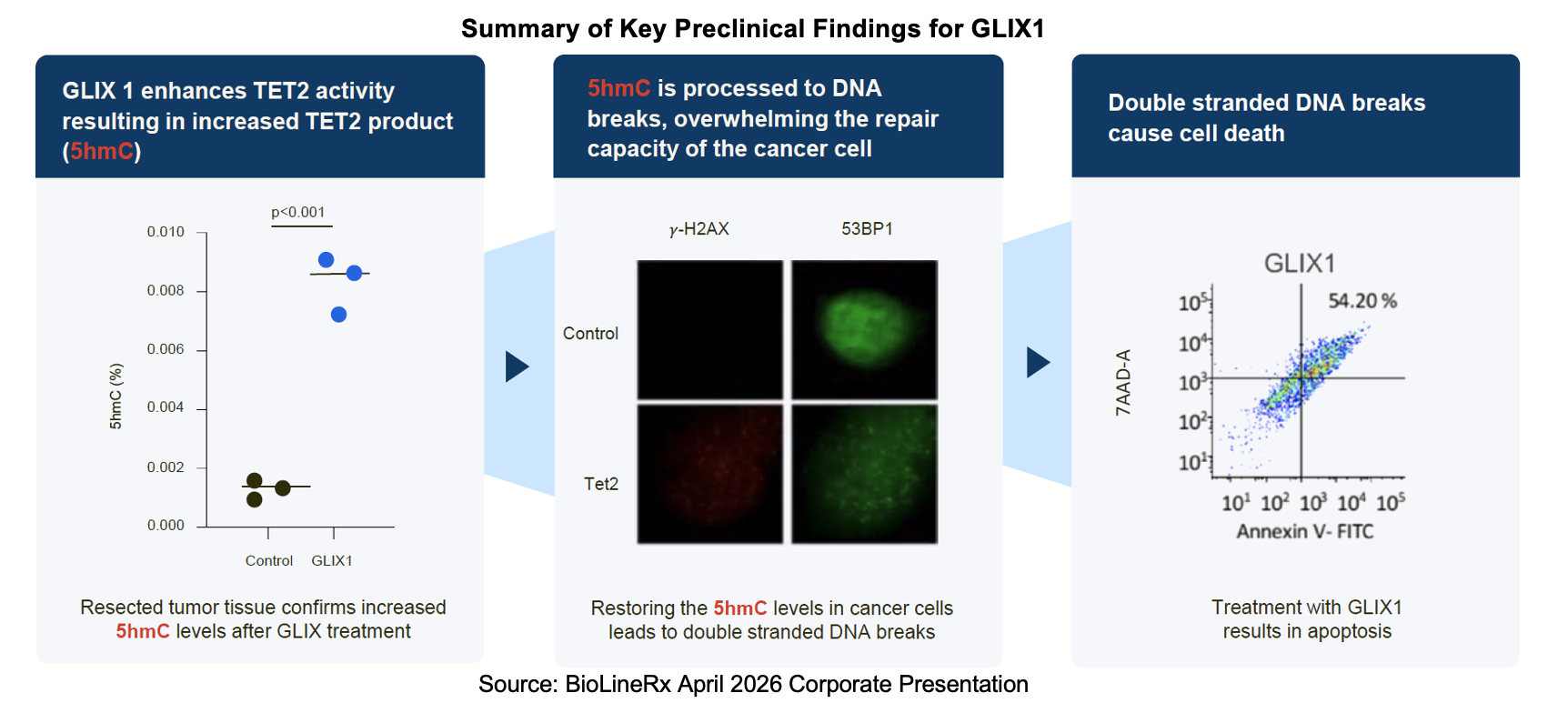
- The abstract describes GLIX1 and its role in restoring activity of the TET2 enzyme. TET2 is usually suppressed in cancer, and its inhibition in tumors contributes to abnormal DNA hypermethylation. By reactivating TET2, GLIX1 increases DNA demethylation and triggers excessive base excision repair, leading to the accumulation of single-strand DNA breaks that ultimately convert into lethal double-strand breaks in cancer cells;
- The mechanism works in many tumor types and is particularly relevant in glioblastoma, where TET2 activity is significantly impaired;
- Preclinical studies have shown that GLIX1 increases TET2 activity and 5hmC production. The drug has demonstrated strong antitumor activity in multiple glioblastoma xenograft models with desirable brain penetration levels;
- The abstract presents a favorable safety profile in animals with a 2000 mg/kg dose tested in rats and a 1000 mg/kg dose tested in dogs. Investigators assessed that the animals tolerated the doses well.
- Synergistic antitumor activity of GLIX1, a small molecule TET2 activator, in combination with PARP inhibition across multiple cancers
- The abstract reviews synergies resulting from the combination of GLIX1 with PARP inhibitors (PARPi). PARP detects and repairs single-stranded DNA breaks; when inhibited, the repair process is blocked, leading to cell death;
- GLIX1 may increase tumor-selective DNA damage by restoring TET2 activity, which generates single-stranded DNA breaks through base excision repair. Combined with PARPi, GLIX1 is able to prevent cancer cell DNA from repairing itself, resulting in apoptosis;
- In preclinical models, GLIX1 / PARPi combinations have demonstrated strong and consistent cytotoxic effects, including in tumor types less responsive to PARPi. The results were repeatable with multiple PARPi;
- The findings discussed in this abstract provide a compelling mechanistic rationale for using GLIX1 and PARPi in combination.
SUBSCRIBE TO ZACKS SMALL CAP RESEARCH to receive our articles and reports emailed directly to you each morning. Please visit our website for additional information on Zacks SCR.
DISCLOSURE: Zacks SCR has received compensation from the issuer directly, from an investment manager, or from an investor relations consulting firm, engaged by the issuer, for providing research coverage for a period of no less than one year. Research articles, as seen here, are part of the service Zacks SCR provides and Zacks SCR receives payments totaling a maximum fee of up to $50,000 annually for these services provided to or regarding the issuer. Full Disclaimer HERE.
________________________
[1] TET2 (Ten-Eleven Translocation 2) is a key epigenetic enzyme that initiates active DNA demethylation by converting 5-methylcytosine (5mC) in DNA into oxidized derivatives, ultimately leading to the restoration of unmethylated cytosine. This process alters gene expression by "turning on" or activating previously silenced genes.