By John Vandermosten, CFA
NASDAQ: CING
READ THE FULL CING RESEARCH REPORT
Cingulate, Inc. (NASDAQ: CING) reported 2025 results on March 18th, 2026. The company generated no revenue and recorded operating expense of $20.0 million. The new drug application (NDA) submitted to the FDA has been accepted and investors are looking forward to the FDA decision; however, CMC questions may delay the anticipated approval date. Since our previous update, Cingulate has been expanding its ranks to prepare for marketing and commercialization activities. This includes the addition of Bryan Downey as Chief Commercial Officer and Rick Arce as Senior Vice President of Market Access. In the financing sphere, Cingulate announced a $12 million private placement in February 2026 to support the anticipated launch of CTx-1301.
2025 Financial and Operational Results
Cingulate reported 2025 results in a press release and Form 10-K filing with the SEC on March 18th. For the year ending December 31st, 2025, the company reported a net loss of $22.5 million or $4.44 per share. For 2025 versus the prior year period:
- Research and development expenses were $9.8 million, up 3% from $9.4 million. The change was attributable to an increase in personnel expenses, manufacturing costs and regulatory costs partially offset by a decline in clinical operations expense. Personnel costs were further broken down into separation costs for an executive and the payment of a contingent bonus due upon acceptance of the NDA by the FDA. Manufacturing costs were related to preparation for product validation batches of CTx-1301. Regulatory costs were up as the team prepared the NDA;
- General & administrative expenses rose 64% to $10.2 million from $6.2 million on account of increased pre-commercialization costs, personnel expenses and legal and professional fees, higher costs related to the arrangement with Indegene and personnel expenses related to the contingent bonus plan earned upon FDA acceptance of the NDA;
- Net interest and other expense were $2.5 million related to consideration for Lincoln Park’s commitment to purchase shares and change in fair value of the derivative asset;
- Net loss was $22.4 million vs. the originally reported net loss of $15.5 million or $4.44 and $10.20 per share, respectively.
As of December 31st, 2025, cash totaled $11.0 million. This amount compares to the $12.2 million cash balance held at the end of 2024. 2025 cash burn was $17.4 million mostly offset by $16.1 million in financing cash contributions from the issuance of common stock and proceeds from notes payable. After year end, Cingulate closed a $12 million private placement which will fund pre-commercialization activities.
Cingulate’s Pre-Commercialization and Market Access Efforts
Cingulate is preparing for approval by advancing pre-commercialization activities. The company is targeting the approximately 500,000 U.S. stimulant prescribers, focusing on the 20% who account for 80% of prescriptions, primarily psychiatrists and pediatricians. In partnership with Indegene and IQVIA, Cingulate will deploy a multichannel strategy at launch. Indegene will leverage machine learning to tailor provider engagement around clinical data, patient fit, and access, while IQVIA will support sales force deployment in key regions.
Market access efforts, led by Rick Arce, are focused on pricing, contracting, payer segmentation, reimbursement, and distribution to ensure launch readiness. This includes gross-to-net modeling, regulatory pricing compliance, and coordination with manufacturing partners. A key priority is negotiating with payors by clearly communicating CTx-1301’s value proposition and navigating access barriers such as prior authorizations, step edits, and formulary tiers. Cingulate is also proactively engaging payors to ensure inclusion in upcoming plan cycles and facilitate patient access at launch.
Commercial Launch
In its earnings press release, Cingulate indicated that the FDA requested additional information related to chemistry, manufacturing and control (CMC) elements of the application. The company is in the process of answering the questions and warned that the FDA may require additional time to evaluate the information. Further details were provided in the Form 10-K filing which explained that the FDA conducted a pre-approval inspection of Cingulate’s CDMO. The CDMO was issued a Form 483[1] with three observations. Two were related to the CDMO’s facility and one was specific to CTx-1301. The CDMO is working to resolve these discrepancies which may lead to a delay in approval. It is developing responses to the observations, with input from Cingulate where relevant.
In addition to the CDMO discrepancies potentially contributing to a delay, there have been at least six requests for information by the FDA over the last six months which led to an extension of a PDUFA date.[2] This may be related to understaffing at the agency and could impact the timing of approval. With CMC issues in the mix and a recent history of PDUFA date pushbacks, management now targets 1H:27 for a full commercial launch.
Management Interview: Commercialization Efforts
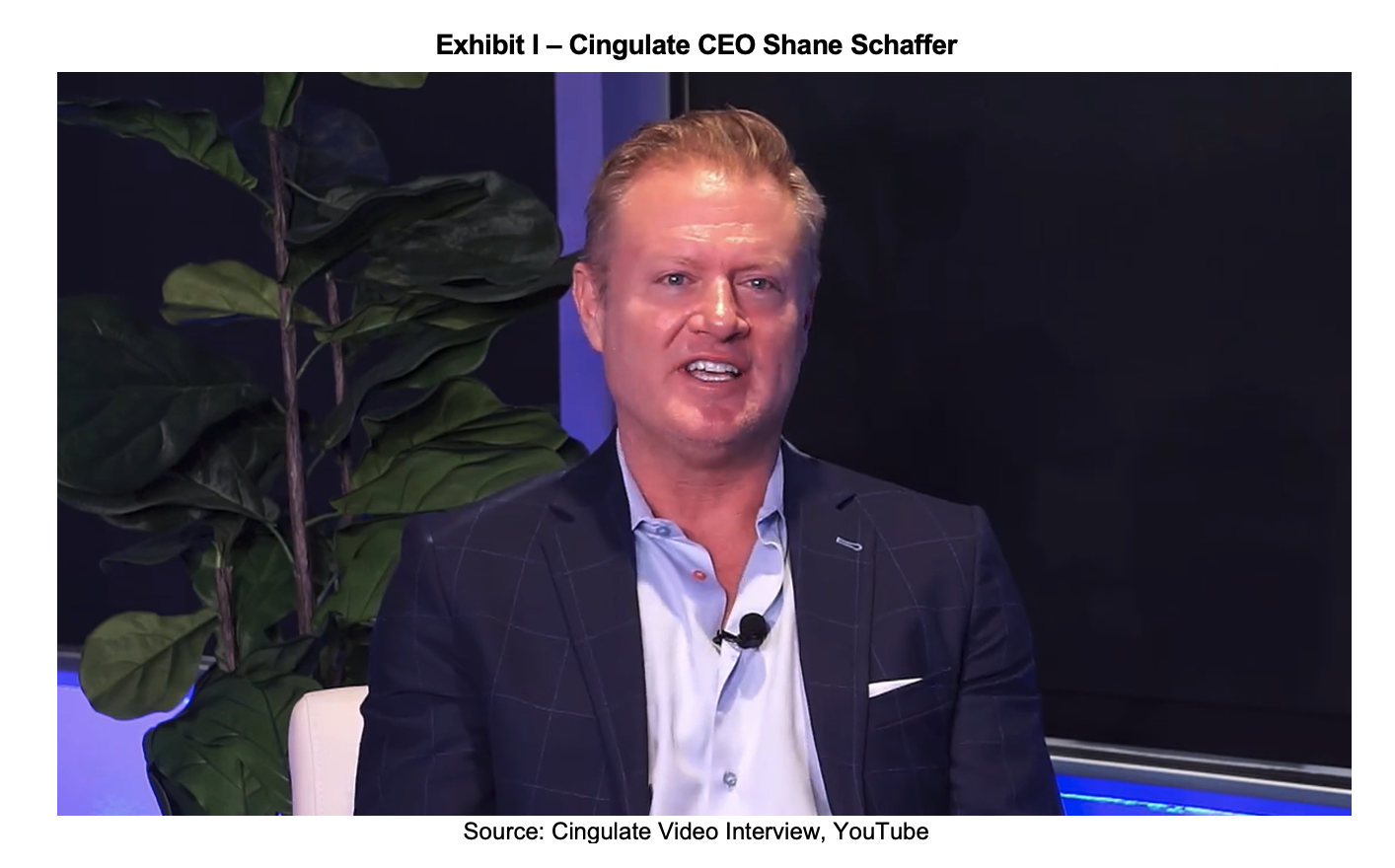
Watch the other videos in this series with the Cingulate team using the links below.
$12 Million Private Placement
On February 17th, Cingulate announced the closing of a $12 million private placement priced at-the-market. The private investment in public equity (PIPE) was led by certain affiliates of Falcon Creek Capital Advisors. Falcon Creek received the right to designate up to two members of Cingulate’s board. It was completed at $5.04 per share with 80% warrant coverage and includes a 180-day lock-up. 2,147,472 shares of common stock and 954 shares of Series A convertible stock were issued. The conversion price of the convertible shares is $5.04 per share.
Patents Allowed and Granted
Cingulate was issued a Notice of Allowance by the United States Patent and Trademark Office (USPTO) for a patent application covering CTx-1301. Generally, the next steps before a patent is issued are administrative. After the issue fee is paid, the USPTO will process the application and issue the patent grant shortly after. The patent is expected to provide protection through May 2042 for key aspects of CTx-1301’s formulation and method of use, further strengthening Cingulate’s intellectual property portfolio surrounding its Precision Timed Release platform.
Cingulate received a European patent for CTx-1301 covering the specificity of its tri-modal, precision timed pulsatile release profile for ADHD treatment. The patent, number 22808184, was granted on December 17th, 2025, and extends protection through May 2042 and is expected to be validated in 30 European countries, including the UK.
Milestones
- FDA pre-NDA meeting – April 2nd, 2025
- Written notes from pre-NDA meeting – May 2025
- CTx-1301 NDA submitted to FDA – July 31st, 2025
- Bryan Downey appointed as Chief Commercial Officer – November 2025
- Participation in the CHADD conference in Kansas City – November 2025
- Completion of $6 million financing – November 2025
- Close of $12 million private placement – February 2026
- FDA pre-approval inspection of Gainesville facility – February 2026
- CTx-1301 PDUFA Date – May 31st, 2026
- CTx-1301 launch – 1H:27
Summary
Cingulate reports full year 2025 results following a capital raise of $12 million. As investors look ahead to the upcoming PDUFA date, management refines its anticipated timing for the launch of CTx-1301 to the first half of 2027. Form 483 observations have raised questions that Cingulate and its CDMO are in the process of answering. This may extend the assigned PDUFA date. It may also give the company time to build up commercial supply, further develop relationships and contract with the key payors and PBMs while aligning the availability of CTx-1301 with the payors’ plan year. In interviews and conversations, management has outlined their partners and process for supporting a successful launch and obtaining market access for patients who will benefit from the precision timed release of dexmethylphenidate. We anticipate that the Cingulate team will continue its efforts to lay the foundation for a 1H:27 launch over the next months as we keep an eye on the FDA’s decision.
SUBSCRIBE TO ZACKS SMALL CAP RESEARCH to receive our articles and reports emailed directly to you each morning. Please visit our website for additional information on Zacks SCR.
DISCLOSURE: Zacks SCR has received compensation from the issuer directly, from an investment manager, or from an investor relations consulting firm, engaged by the issuer, for providing research coverage for a period of no less than one year. Research articles, as seen here, are part of the service Zacks SCR provides and Zacks SCR receives payments totaling a maximum fee of up to $50,000 annually for these services provided to or regarding the issuer. Full Disclaimer HERE.
________________________
[1] An FDA Form 483, or inspectional observation, is a document issued at the conclusion of an FDA inspection when investigators find conditions that may violate Food, Drug and Cosmetic (FD&C) Act regulations. It highlights potential deficiencies in procedures, equipment, or processes, requiring a written response and corrective action plan.
[2] Several PDUFA (Prescription Drug User Fee Act) or target action date extensions occurred in the last 6 months (roughly September 2025 to March 2026). These were primarily standard 3-month extensions triggered by "major amendments" to applications. This includes sponsors submitting additional data, analyses or responses to FDA information requests or the agency needing extra review time. To put it in context, there are about 50 to 55 products approved by the FDA every year. Here are the examples of delays that we found: Denali Therapeutics’ tividenofusp alfa BLA for Hunter syndrome with an original PDUFA date of January 5, 2026, extended to April 5, 2026. The delay was attributed to a major amendment. Rhythm Pharmaceuticals’ IMCIVREE sNDA for acquired hypothalamic obesity. The original PDUFA date of December 20, 2025, was extended to March 20, 2026, because the FDA requested additional sensitivity analyses of Phase III efficacy data. Ascendis Pharma’s TransCon CNP NDA for achondroplasia. The date was extended by three months to February 28, 2026, because the information submitted on post-marketing requirements constituted a major amendment. Aldeyra Therapeutics’ reproxalap NDA for dry eye disease. The original PDUFA date of December 16, 2025, was extended to March 16, 2026. The FDA requested the full Clinical Study Report from the reproxalap field trial following a meeting. Travere Therapeutics’ Filspari sNDA for focal segmental glomerulosclerosis. The target action date of January 13, 2026, was extended to April 13, 2026, as the FDA information considered responses to requests clarifying clinical benefit. Lantheus Holdings’ Ga 68 edotreotide NDA for PET diagnostic imaging of somatostatin receptor-positive neuroendocrine tumors. The date was extended by three months to June 29, 2026, from March 2026. The FDA needed additional time to complete review of the application. Sanofi’s tolebrutinib NDA for non-relapsing secondary progressive multiple sclerosis. The PDUFA date was extended from September 28, 2025, to December 28, 2025, on account of a major amendment from additional analyses.