By David Bautz, PhD
NASDAQ: COCP
READ THE FULL COCP RESEARCH REPORT
Business Update
Presentation at ICAR 2026 Showcases CDI-988
On April 30, 2026, Cocrystal Pharma, Inc. (NASDAQ: COCP) announced an oral presentation on CDI-988 at the 39th International Conference on Antiviral Research (ICAR 2026). The presentation, titled “First Oral Direct-Acting Antiviral CDI-988 for Norovirus Infection Prevention and Treatment: Novel Mechanism of Action and Phase 1 Study Results,” was delivered by Sam Lee, PhD, the company’s President and co-CEO.
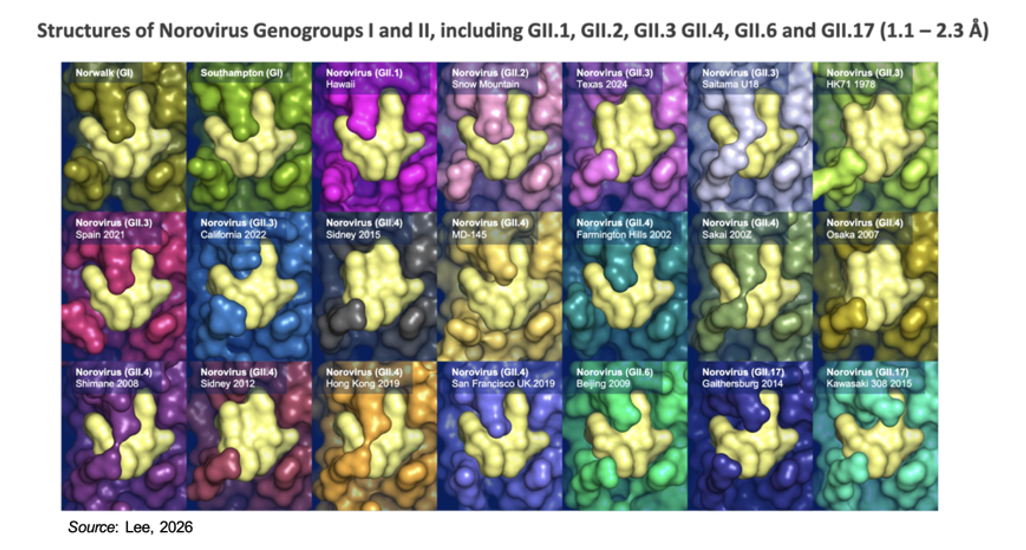
Dr. Lee highlighted the fact that even though norovirus causes approximately 700 million infections, leading to approximately 200,000 deaths worldwide, there are still no approved vaccines or treatments available aside from palliative care. The reason for this is that norovirus has a large genetic variation and drift that includes 10 genogroups and 49 genotypes. Dr. Lee then proposed that CDI-988 may offer a solution due to the following reasons:
- The drug was engineered to bind to a conserved region in different norovirus genogroups – the following image shows how CDI-988 (yellow) binds to a pocket in multiple genogroups, which suggests broad-spectrum coverage.
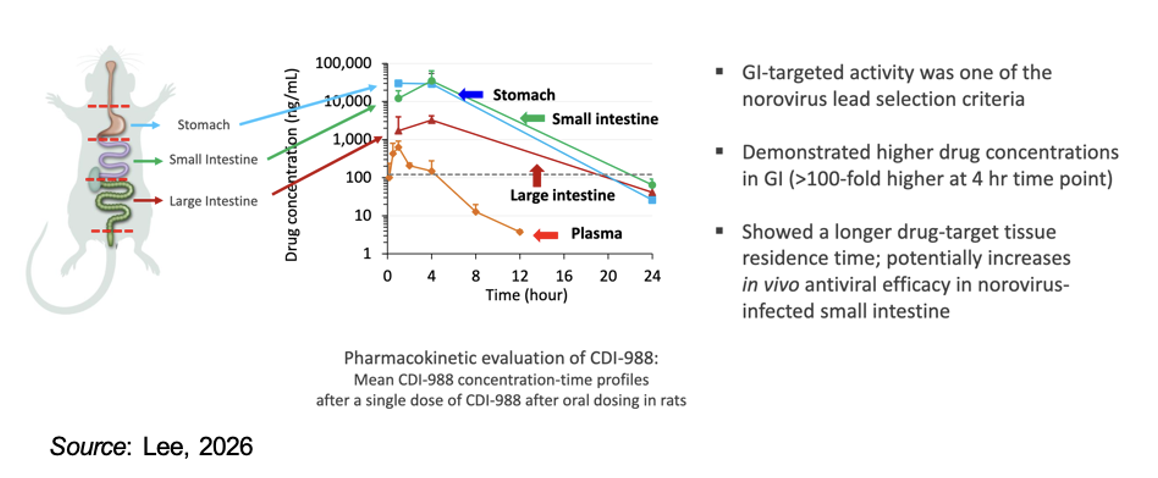
- Promising PK/PD Data – the following image shows CDI-988 has a significantly longer half-life in the stomach and intestines (>100-fold higher at 4-hr timepoint), which means that the drug will remain where it is needed to extend its antiviral efficacy.
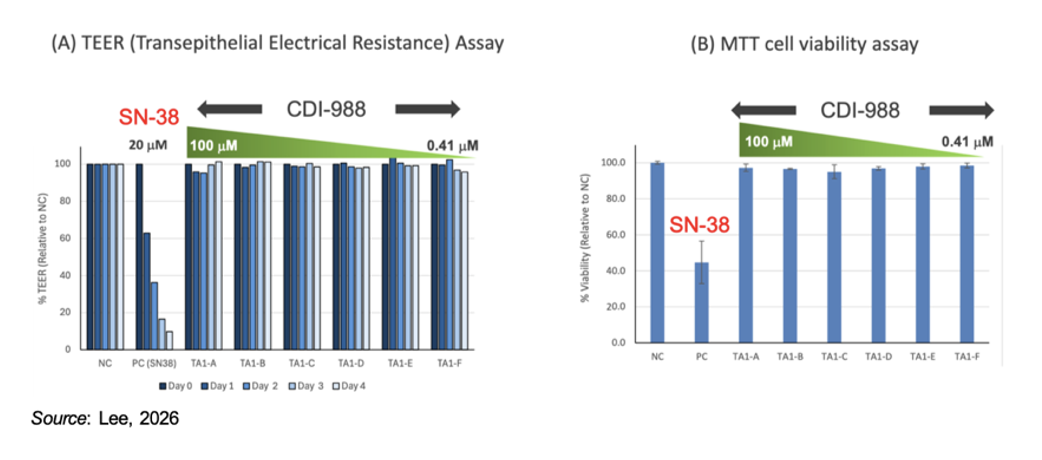
- Limited GI toxicity – In multiple assays, CDI-988 showed limited toxicity in cell-based assays compared to the reference compound SN-38, which is known to cause GI toxicity, including diarrhea, nausea, and vomiting. The following figure shows the results of a TEER (Transepithelial Electrical Resistance) Assay and an MTT cell viability assay, both of which show that compared to SN-38, which shows toxicity compared to the normal control, CDI-988 shows results similar to the normal control, indicative of limited effects on normal epithelial tissue.
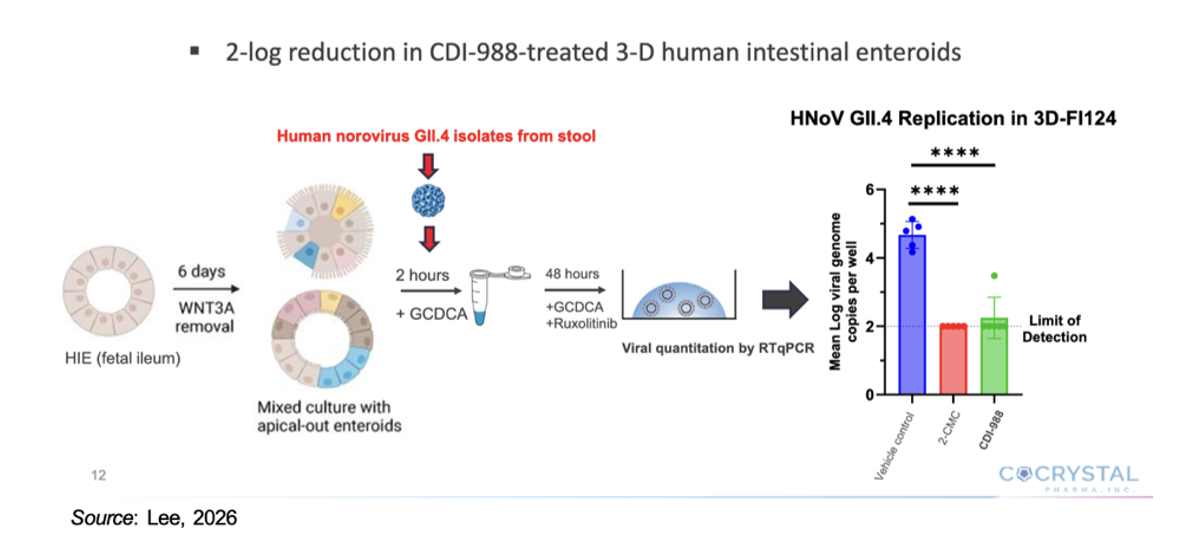
- In Vitro Efficacy – In a 3-D human intestinal enteroids model, CDI-988 exhibited a 2-log reduction in norovirus genome copies per well, suggesting it exhibits strong antiviral behavior.
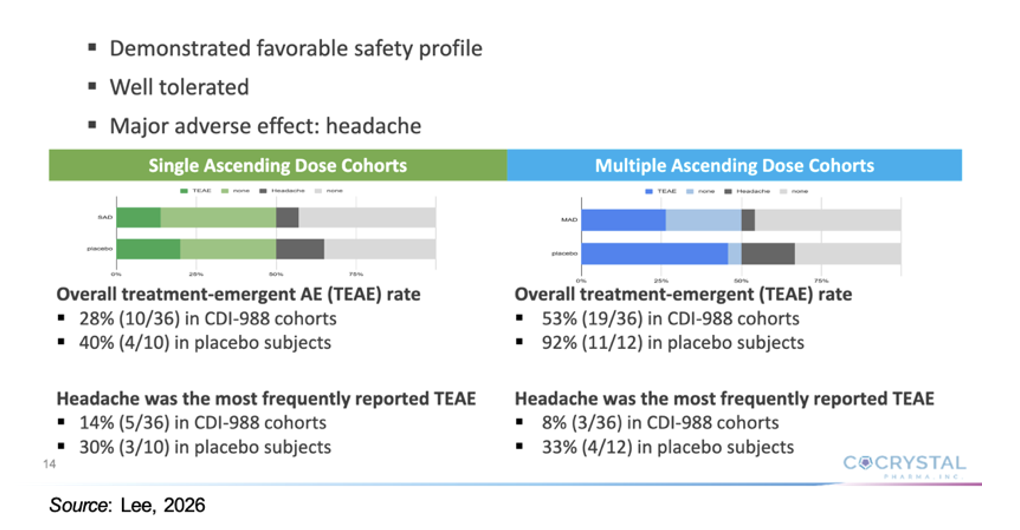
Dr. Lee then discussed the previously presented results from the Phase 1a study that enrolled 46 (N=36 drug; N=10 placebo) individuals into the single ascending dose (SAD) cohort and 48 (N=36 drug; N=12 placebo) individuals into the multiple ascending dose (MAD) cohort. The SAD results showed that all doses (100 mg to 1200 mg) were well tolerated, there were no reports of serious adverse events, no clinically relevant ECG changes, no clinically significant pathology results, and no discontinuations from the study or use of the study drug. Similar results were seen in the MAD cohort, as all doses (200 mg to 1200 mg) were well tolerated, there were no reports of serious adverse events, no clinically relevant ECG changes, and no clinically significant pathology results. There was one discontinuation from the study and study drug due to Grade 2 diarrhea for an individual in the 1200 mg BID Fed group. This discontinuation was deemed probably related to study drug. CDI-988 shows a strong food effect (5-fold higher plasma exposure when administered after a high-fat meal), which may have contributed to the Grade 2 diarrhea for that individual.
The topline safety data are summarized in the figure below. Headache was the most frequently reported treatment-emergent adverse event (TEAE), and overall, the placebo groups had a higher frequency of TEAEs than the CDI-988 groups.
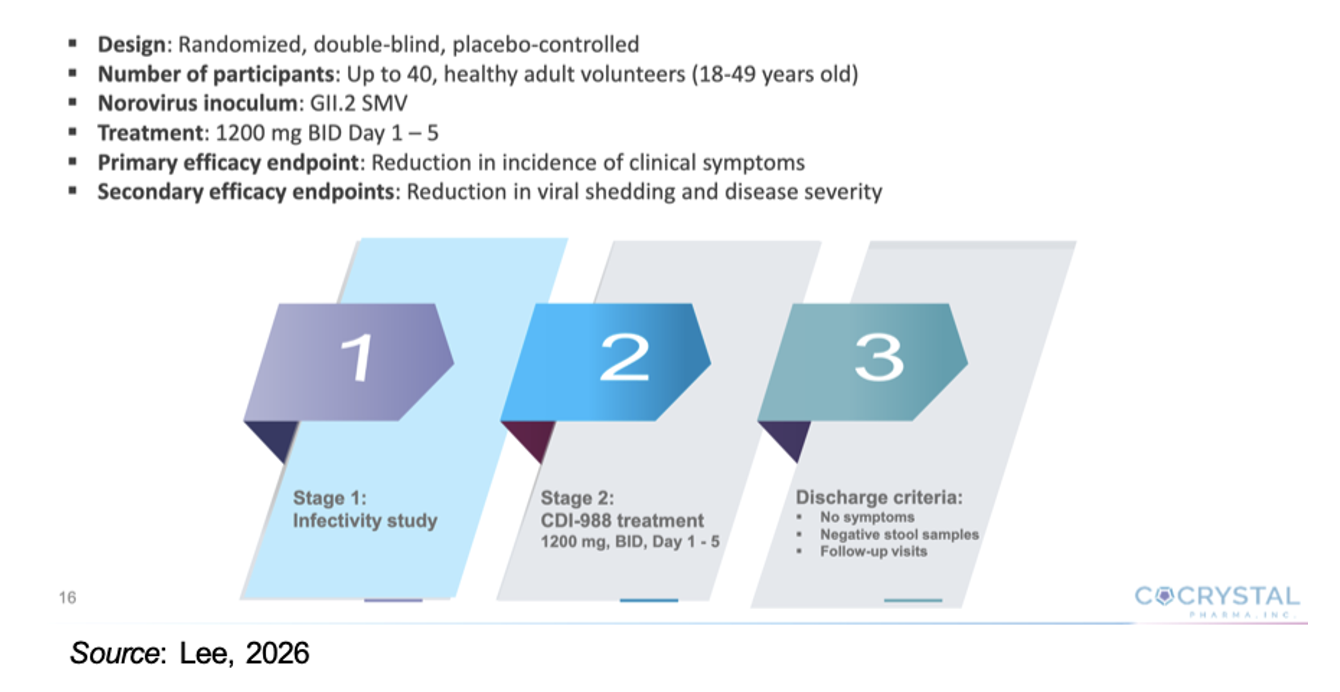
Lastly, Dr. Lee provided an overview of the ongoing Phase 1b clinical trial of CDI-988. It is a randomized, double blind, placebo-controlled study that will enroll up to 40 healthy subjects ages 18-49. All participants in the study will be infected with the norovirus GII.2 (Snow Mountain Virus) strain (NCT07198139). The initial cohort of subjects is to assess the infectivity rate of the challenge inoculum, GII.2 (Snow Mountain Virus). Subsequent cohorts will be orally administered CDI-988 or placebo. The primary endpoint of the trial is the efficacy of CDI-988 versus placebo in reducing the incidence of clinical symptoms. Secondary endpoints being evaluated include reduction in viral shedding and disease severity, along with safety and pharmacokinetic profile. The challenge study is designed to serve as a surrogate for clinical efficacy data.
Recently, the company announced that CDI-988 was granted Fast Track designation to CDI-988. Fast Track designation is designed to facilitate and accelerate the development of novel therapeutics for serious conditions that address unmet medical needs. It allows companies to have early and frequent communication with the FDA during the entire development process, as well as a rolling review of a New Drug Application (NDA). In addition, it may qualify a product for Priority Review when the NDA is submitted.
Financial Update
On May 15, 2026, Cocrystal announced financial results for the first quarter of 2026. The company received a $500,000 Small Business Innovation Research (SBIR) Phase I award from the NIH to support the development of a novel, oral, broad-spectrum antiviral candidate for the treatment of influenza A and B infections. Grant income is earned as the company incurs costs for the program. Grant income for the first quarter of 2026 was $225,000 compared to $0 for the first quarter of 2025. R&D expenses for the first quarters of 2026 and 2025 were $1.4 million. G&A expense in the first quarter of 2026 was $1.2 million compared to $1.0 million in the first quarter of 2025. The increase was primarily due to an increase in legal and consult costs, partially offset by a decrease in salaries and wages.
Cocrystal exited the first quarter of 2026 with approximately $4.7 million in cash and cash equivalents. As of May 15, 2026, the company had approximately 13.8 million shares outstanding and, when factoring in stock options and warrants, a fully diluted share count of 21.9 million.
Conclusion
We look forward to continued updates for the Phase 1b trial of CDI-988 as the year progresses, along with updates regarding the company’s influenza program, for which another Phase 2a trial is currently being planned. With no changes to our model, our valuation remains at $8 per share.
SUBSCRIBE TO ZACKS SMALL CAP RESEARCH to receive our articles and reports emailed directly to you each morning. Please visit our website for additional information on Zacks SCR.
DISCLOSURE: Zacks SCR has received compensation from the issuer directly, from an investment manager, or from an investor relations consulting firm, engaged by the issuer, for providing research coverage for a period of no less than one year. Research articles, as seen here, are part of the service Zacks SCR provides and Zacks SCR receives payments totaling a maximum fee of up to $50,000 annually for these services provided to or regarding the issuer. Full Disclaimer HERE.