By David Bautz, PhD
NASDAQ: CVKD
READ THE FULL CVKD RESEARCH REPORT
Business Update
Launches Strategic Partnering Process for Cardiac Acute Critical Care Franchise
Cadrenal Therapeutics, Inc. (NASDAQ: CVKD) has launched a structured strategic partnering process for its Cardiac Acute Critical Care Franchise that is centered on three commercial pillars. At this time, the company will not be pursuing late-stage clinical trials for these assets, but instead will seek licensing, co-development, and commercialization partnerships.
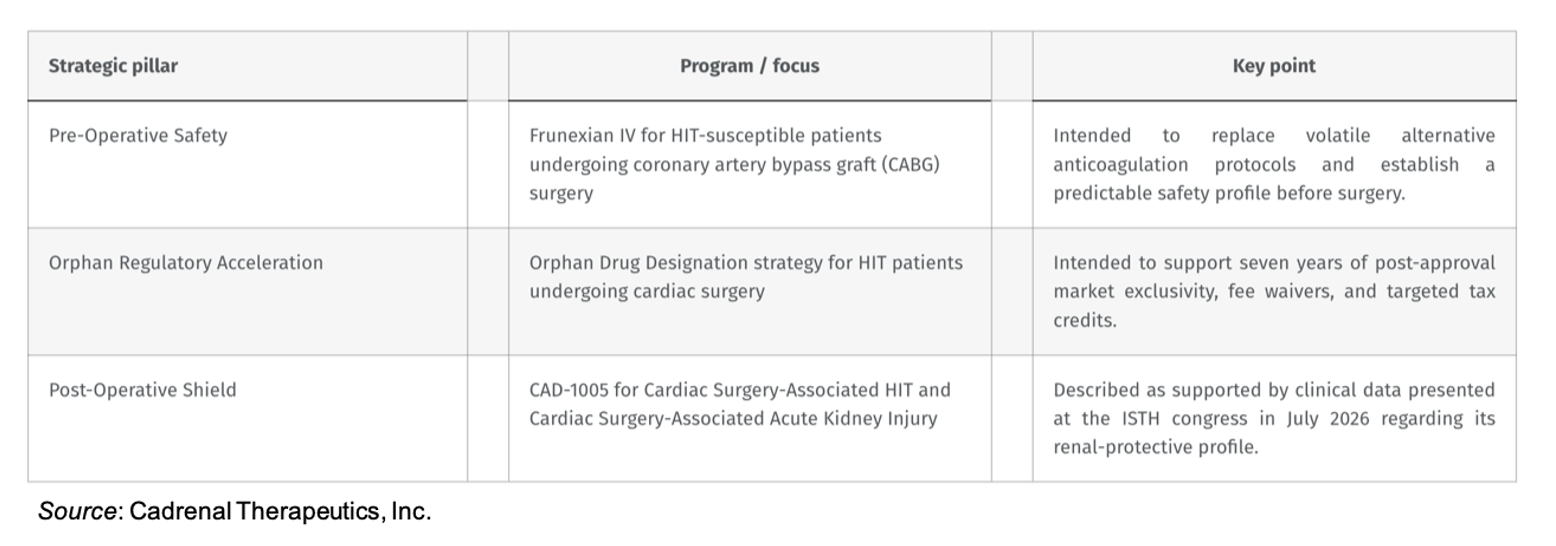
- Pre-Operative Safety (Frunexian IV): Frunexian is a Phase 2-ready asset that is intended for heparin-induced thrombocytopenia (HIT)-susceptible patients that are undergoing coronary artery bypass graft surgery.
- Orphan Regulatory Acceleration (Tecarfarin): Tecarfarin has completed Phase 2 development and is being advanced into orphan cardiovascular indications, including Kawasaki disease, where Rare Pediatric Disease and Orphan Drug Designation could provide regulatory incentives, market exclusivity, and potential Priority Review Voucher eligibility.
- Post-Operative Shield (CAD-1005): CAD-1005 is an intravenous 12-LOX inhibitor that has completed Phase 2 testing. It is being developed to prevent platelet hyperactivation and thrombotic risk in patients with post-operative HIT. In addition, the drug may also block the inflammatory cascade that leads to cardiac surgery-associated acute kidney injury (CSA-AKI).
Reaches Alignment on Phase 3 Study Design for CAD-1005 in HIT
On August 31, 2026, Cadrenal announced a successful outcome to a Type D meeting with the U.S. FDA in which alignment was reached on key aspects of the protocol and statistical analysis plan for the Phase 3 registrational study of CAD-1005 in patients with HIT. Based on feedback from the FDA, the primary endpoint will be worsening of HIT based on progression of thrombotic events through Day 14 of treatment or hospital discharge. The worsening component of the primary endpoint will also include extension of an existing thrombus into a new vascular segment or bed. The updated composite primary endpoint will measure the proportion of Serotonin Release Assay positive (SRA+) patients with adjudicated new or worsening composite thromboembolic events through Day 14 or hospital discharge. The study will use placebo control with standard anticoagulation therapeutics for both the CAD-1005 and placebo arms. The safety population will include all patients who receive at least one dose of study drug and will include bleeding using standard International Society on Thrombosis and Haemostasis (ISTH) criteria.
CAD-1005 Phase 2 Data Presented at ISTH 2026
In July 2026, Cadrenal announced the presentation of late-breaking clinical data from the Phase 2 trial of CAD-1005 at the International Society on Thrombosis and Haemostasis (ISTH) 2026 Congress. The Phase 2 study demonstrated that CAD-1005 reduced clinically meaningful thrombotic events without increasing bleeding risk, supporting the hypothesis that selective inhibition of 12-LOX may interrupt the immune-mediated platelet activation responsible for thrombosis in HIT. Importantly, the trial also suggested that platelet count recovery alone may be an inadequate surrogate endpoint for clinical benefit. Highlights from the presentation include:
- CAD-1005 is designed to address the root cause of coagulation by blocking the underlying 12-LOX immune signaling loop that promotes antibody-mediated platelet activation
- Patients treated with CAD-1005 showed >25% reduction in new or worsening thrombotic events compared to the placebo arm (50% vs >75%)
- There were no serious adverse events attributed to CAD-1005, no major bleeding events, and no deaths. While those treated with CAD-1005 had fewer thromboembolic events, there was no subsequent increase in major bleeding.
- The trial showed that platelet count recovery rate is an inadequate surrogate for clinical efficacy since thrombotic events continue even after recovery.
CAD-1005 has received Orphan Drug and Fast Track designations from the U.S FDA and Orphan Drug status from the European Medicines Agency (EMA).
Expanding the Commercial Opportunity into CSA-AKI
Cardiac Surgery-Associated Acute Kidney Injury (CSA-AKI) remains a significant unmet medical need, occurring in approximately 20-30% of patients undergoing cardiac surgery, with severe cases affecting roughly 35,000 patients annually in the U.S. Despite advances in perioperative care, there are currently no FDA-approved pharmacologic therapies specifically indicated for the prevention of CSA-AKI. The inflammatory and thrombotic mechanisms implicated in CSA-AKI overlap with the biological pathways targeted by CAD-1005, providing a mechanistic rationale for expanding development into this indication.
While CSA-AKI may represent a substantially larger commercial opportunity than HIT, we believe the primary significance of this program is strategic rather than financial. By demonstrating potential activity across multiple acute inflammatory and thrombotic conditions, management broadens the commercial narrative surrounding CAD-1005 beyond a single orphan indication. We believe a platform with multiple clinical applications may be considerably more attractive to potential pharmaceutical partners than a single-indication asset.
Alexion Discontinues Phase 3 ARTEMIS Study in CSA-AKI
Alexion Pharmaceuticals (ALXN) initiated the Phase 3 ARTEMIS study to evaluate the effects of ravulizumab in patients with CSA-AKI (NCT05746559). Ravulizumab is a humanized monoclonal antibody that binds complement C5 to inhibit the terminal complement pathway (Vu et al., 2022). ARTEMIS was a Phase 3, randomized, double blind, placebo controlled, study with a primary outcome of reduction of major adverse kidney events (MAKE) at 90 days following surgery with cardiopulmonary bypass (CPB). On July 21, 2026, the company posted an update to clinicaltrials.gov indicating that the trial was terminated due to lack of efficacy.
The failure of the ARTEMIS study underscores the need for additional treatment options for CSA-AKI patients and offers the potential for first-in-class positioning for CAD-1005 in that indication. We do not believe there is any read-through from the ARTEMIS failure, as ravulizumab utilizes a mechanism of action distinct from CAD-1005.
Tecarfarin’s New Strategic Opportunity
In June 2026, Cadrenal announced a new strategic opportunity for tecarfarin as a treatment for pediatric patients with Kawasaki disease (KD) who develop coronary artery aneurysms that require chronic oral anticoagulation. Current long-term anticoagulation options for children with giant coronary artery aneurysms are limited and often complicated by variable dosing, dietary interactions, and frequent monitoring requirements associated with warfarin. Since tecarfarin is metabolized independently of CYP2C9, the drug has the potential to provide more predictable anticoagulation in this setting.
The company is seeking Rare Pediatric Disease Designation for tecarfarin in KD, which, if granted, would make the company eligible for a Priority Review Voucher (PRV) upon the approval of tecarfarin for the treatment of KD. PRVs are fully transferable, and recent transactions have generally ranged from $180 million to $205 million. While the clinical opportunity in KD is relatively modest, we believe the pursuit of tecarfarin in KD helps to reinforce the attractiveness of its portfolio ahead of partnering discussions.
Financial Update
On August 13, 2026, Cadrenal announced financial results for the second quarter of 2026. As expected, the company did not record any revenues for the three months ending June 30, 2026. R&D expenses in the second quarter of 2026 were $0.7 million compared to $1.1 million in the second quarter of 2025. The decrease was primarily due to lower expenses associated with chemistry, manufacturing, and controls (CMC), lower personnel expenses, and decreased professional fees. G&A expenses were $2.6 million in the second quarter of 2026 compared to $2.7 million in the second quarter of 2025.
As of June 30, 2026, Cadrenal had approximately $4.2 million in cash and cash equivalents. Based on the current operating plan, which includes no plan to commence a clinical trial unless sufficient funding to complete the trial is in place, we estimate the company has sufficient capital to fund operations through the first quarter of 2027. Cadrenal currently has approximately 3.6 million shares outstanding and, when factoring in stock options and warrants, a fully diluted share count of approximately 8.6 million.
Conclusion
Cadrenal is transitioning from being primarily a clinical development story into a business development story. While additional clinical progress remains important, we believe future shareholder value will increasingly depend on management’s ability to secure attractive licensing or collaboration agreements for CAD-1005, tecarfarin, and frunexian. Positive Phase 2 data and pipeline expansion into additional indications collectively strengthen management’s negotiating position as the company initiates a formal partnering process. With no changes to our model, our valuation remains at $17 per share.
SUBSCRIBE TO ZACKS SMALL CAP RESEARCH to receive our articles and reports emailed directly to you. Please visit our website for additional information on Zacks SCR.
DISCLOSURE: Zacks SCR has received compensation from the issuer directly, from an investment manager, or from an investor relations consulting firm, engaged by the issuer, for providing research coverage for a period of no less than one year. Research articles, as seen here, are part of the service Zacks SCR provides and Zacks SCR receives payments totaling a maximum fee of up to $50,000 annually for these services provided to or regarding the issuer. Full Disclaimer HERE.