By David Bautz, PhD
NASDAQ: CVKD
READ THE FULL CVKD RESEARCH REPORT
Business Update
Published Results Show Potential for 12-LOX Inhibition in Obesity and Type 2 Diabetes
On March 12, 2026, Cadrenal Therapeutics, Inc. (NASDAQ: CVKD) announced the publication of preclinical research findings that show the potential for its first-in-class 12-lipoxygenase (12-LOX) inhibitor, CAD-1005, as a treatment for the inflammatory effects of obesity and type 2 diabetes (T2D).
The progression of obesity and T2D has previously been linked to signaling by the products of 12-LOX enzymes (Kulkarni et al., 2021). The LOX enzymes are responsible for the oxygenation of polyunsaturated fatty acids to form eicosanoids, with 12-LOX producing the pro-inflammatory metabolite 12-hydroxyeicosatetraenoid acid (12-HETE). The main 12-LOX enzyme that produces 12-HETE is encoded by the ALOX12 gene, however human 12-LOX is structurally distinct from its mouse orthologue so inhibitors of human 12-LOX can’t be tested in mice. Thus, the current study utilized a human gene replacement mouse model in which the mouse 12-LOX gene (Alox15) was replaced by the human ALOX12 gene prior to placing male mice on a high-fat diet and then treating with CAD-1005 (VLX-1005) (Kaylan et al., 2026). This work builds upon previously published research showing that VLX-1005 delayed the onset of autoimmune diabetes and reduced islet inflammation in nonobese diabetic mice in which human ALOX12 replaced mouse Alox15 (Nargis et al., 2024).
The results of the study showed that treatment with VLX-1005 improved glucose homeostasis, reduced β-cell dedifferentiation, and alleviated macrophage-mediated inflammation in both pancreatic islets and adipose tissue. The decreased β-cell dedifferentiation was shown by a decrease in ALDH1A3 expression, which is a marker of β-cell failure and reduced glucose-stimulated insulin secretion (Kim-Muller et al., 2016). The decrease in ALDH1A3 following VLX-1005 treatment suggests that the drug improves β-cell health and may contribute to increased capacity to meet insulin secretory needs. Treatment with VLX-1005 also reduced macrophage infiltration and cytokine expression in adipose tissue, which are both implicated in obesity-associated inflammatory responses (Russo et al., 2018).
While Cadrenal continues to be fully focused on advancing CAD-1005 as a treatment for heparin-induced thrombocytopenia (HIT), these results support the potential for 12-LOX inhibition as a therapeutic agent in managing obesity and altered glucose metabolism by targeting peripheral inflammation associated with visceral adiposity.
Planning for Phase 3 Trial in HIT
Cadrenal recently conducted an ‘End-of-Phase 2’ meeting with the U.S. Food and Drug Administration (FDA) to clarify the potential registration pathway for CAD-1005 in HIT. The company is currently in the process of incorporating the feedback into its proposed Phase 3 protocol. While we don’t know the specifics yet, we believe the company intends to use thrombotic event reduction as the primary endpoint in Phase 3, build on the safety profile observed to date, and leverage CAD-1005’s Orphan Drug Designation (ODD) and Fast Track status.
Background on HIT
HIT is a severe, immune-mediated prothrombotic disorder triggered by exposure to heparin, an anticoagulant used widely in clinical practice (e.g., surgery, dialysis). It is estimated to occur in approximately 1 in 1500 hospital admissions (Dhakal et al., 2018). Data shows that certain variables can increase the risk of developing HIT, including cardiac surgery (Pishko et al., 2017) and exposure to unfractionated heparin vs. low molecular weight heparin (Warkentin et al., 1995), while a shorter exposure to heparin appears to decrease the risk of developing HIT (Smythe et al., 2007).
Diagnosis of HIT uses the “4Ts Score”, which is a pre-test scoring system that assesses the probability of HIT (Lo et al., 2006). It is calculated as a sum of points from four components: Thrombocytopenia, Timing of platelet count fall, Thrombosis or other sequelae, and oTher causes of thrombocytopenia. Laboratory diagnosis of HIT is divided into two steps: an immunoassay and a functional assay. The immunoassay examines for the presence of anti-platelet factor 4 (PF4)/heparin antibodies. If anti-PF4/heparin antibodies are identified, a functional assay is performed to determine if those antibodies are pathogenic. The 14C-serotonin release assay (SRA) is the “gold standard” functional assay and has both high sensitivity (~0.95) and specificity (~0.95) (Warkentin et al., 2015).
Management for patients suspected of suffering from HIT includes 1) the avoidance of heparin, indefinitely if possible, and 2) use of non-heparin anticoagulation. The duration of non-heparin anticoagulation will be dictated by the presence of absence of thrombosis. Preferred agents for non-heparin anticoagulation therapy include argatroban and bivalirudin, which can be administered IV, or danaparoid, which can be administered subcutaneously.
For patients who develop HIT, there are a number of potential negative outcomes, including thrombosis, bleeding, amputation, increased risk of hospital stay, and even death. Despite decades of research, no approved therapy directly targets the core immune and platelet activation mechanisms in HIT. Current anticoagulants decrease the risk of coagulation but do not modulate immune-mediated platelet activation, which leaves patients at persistent risk of thrombosis.
CAD-1005 for HIT
CAD-1005 is a highly selective inhibitor of human 12-LOX and is designed to reduce or prevent platelet activation and the downstream pro-thrombotic cascade in HIT. By inhibiting 12-LOX activity, CAD-1005 reduces the production of proinflammatory and procoagulant 12-LOX metabolites that feed into platelet activation loops. The drug also addresses the immune-driven aspect of HIT pathogenesis, which is the pathway that links immune complexes and platelet hyperactivity, a mechanism wholly distinct from direct anticoagulation. Lastly, preclinical and Phase 1 clinical trial results indicate there is no increased bleeding signal, which distinguishes CAD-1005 from traditional anticoagulants that reduce the risk of clotting at the cost of an increased risk of bleeding.
Market Opportunity
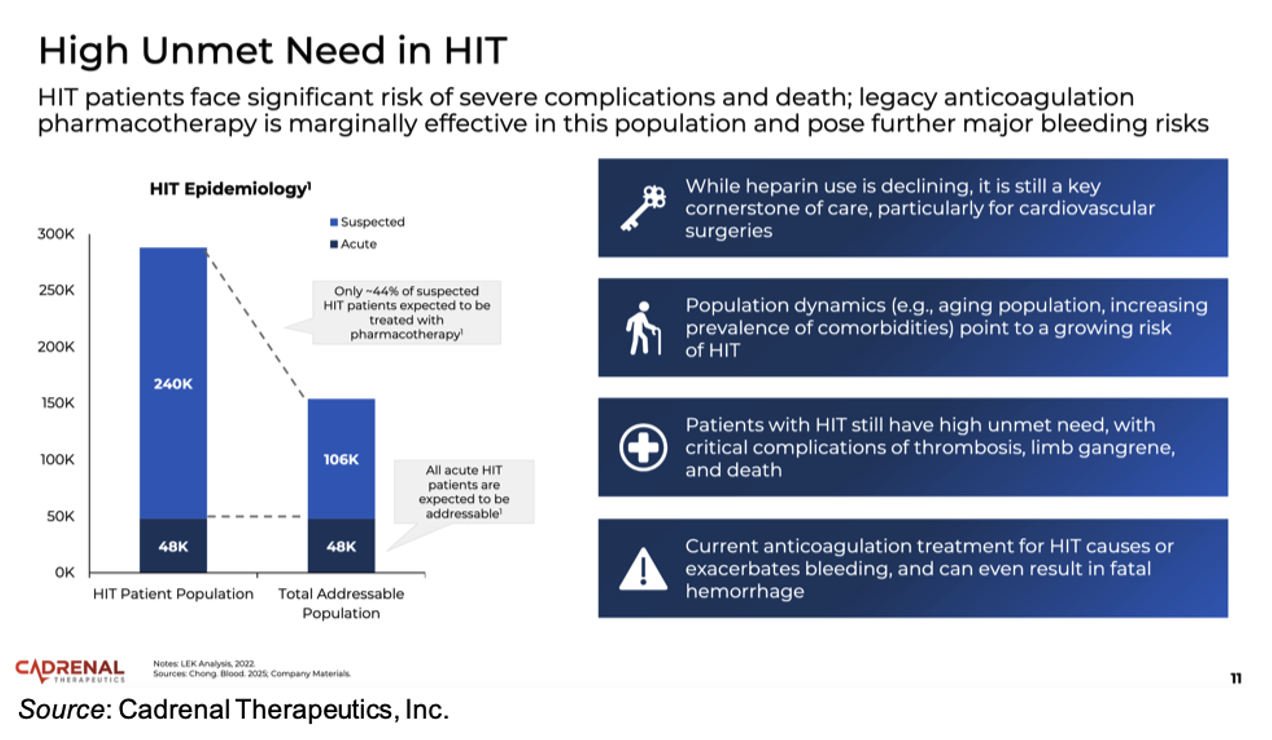
Currently approved HIT treatments focus on non-heparin anticoagulation, which mitigate clot propagation but do not directly modulate immune platelet activation, which is the core driver of HIT pathology. Thus, there is a high residual risk of thrombosis that persists in HIT patients despite anticoagulant therapy. In addition, there are no approved agents that target the immune-mediated platelet activation pathway, thus positioning CAD-1005 as a first-in-class drug. There are approximately 240,000 suspected cases and approximately 48,000 confirmed cases of HIT in the U.S. each year, thus offering a large patient population that could potentially benefit from a safe and effective HIT therapy.
Financial Update
On March 31, 2025, Cadrenal announced financial results for 20245. As expected, the company did not record any revenues in 2025. R&D expenses in 2025 were $4.1 million compared to $4.2 million in 2024. The decrease was primarily due to reduced consulting expenses partially offset by increased expenses associated with the asset purchase agreements in September and December 2025. G&A expenses were $9.4 million in 2025 compared to $6.8 million in 2024. The increase was primarily due to increased expenses related to being a public company, increased stock-based compensation, and increased consulting and professional fees.
As of December 31, 2025, Cadrenal had approximately $4.0 million in cash and cash equivalents. Subsequent to the end of the year, the company sold 168,690 shares of common stock through its at-the-market (ATM) facility for net proceeds of approximately $1.3 million. Cadrenal is currently evaluating various financing and strategic alternatives to support its planned clinical development activities. As of March 27, 2026, the company had approximately 2.5 million shares outstanding and, when factoring in stock options and warrants, a fully diluted share count of approximately 4.0 million.
Conclusion
We look forward to additional details regarding the planned Phase 3 trial of CAD-1005 in HIT after the company is able to incorporate the FDA’s feedback into the trial plan. In addition, we will be interested to learn how the company is planning to finance the Phase 3 program for CAD-1005. The new results showing positive effects of 12-LOX inhibition in preclinical obesity models is very interesting as it shows the potential for pipeline expansion with CAD-1005. As we await word on next steps for the CAD-1005 program we have made no changes to our model and our valuation remains at $25.00 per share.
SUBSCRIBE TO ZACKS SMALL CAP RESEARCH to receive our articles and reports emailed directly to you each morning. Please visit our website for additional information on Zacks SCR.
DISCLOSURE: Zacks SCR has received compensation from the issuer directly, from an investment manager, or from an investor relations consulting firm, engaged by the issuer, for providing research coverage for a period of no less than one year. Research articles, as seen here, are part of the service Zacks SCR provides and Zacks SCR receives payments totaling a maximum fee of up to $50,000 annually for these services provided to or regarding the issuer. Full Disclaimer HERE.