By David Bautz, PhD
NASDAQ: EDSA
READ THE FULL EDSA RESEARCH REPORT
Business Update
Vitiligo Trial to Initiate Shortly
Edesa Biotech, Inc. (NASDAQ: EDSA) will be conducting a Phase 2 study of EB06, its anti-CXCL10 monoclonal antibody, for the treatment of moderate-to-severe non-segmental vitiligo patients. Vitiligo is a disease that causes areas of the skin to lose color, with non-segmental vitiligo being characterized by patches appearing on both sides of the body. It is caused when pigment-producing cells (melanocytes) die or stop producing melanin as a result of an autoimmune disease, genetics, or a triggering event (e.g., stress, sunburn, skin trauma).
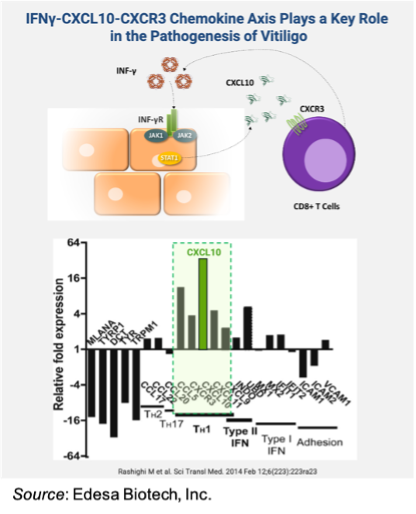
Past research showed that the chemokine CXCL10 was elevated in both vitiligo patient skin and serum (El-Domyati et al., 2022). In a mouse model of vitiligo, which includes CXCL10 expression in the skin, neutralization of CXCL10 in mice with established, widespread depigmentation induced reversal of disease as shown by repigmentation (Rashighi et al., 2014). In addition, serum CXCL10 levels are significantly increased in vitiligo patients compared to controls, suggesting that CXCL10 may play a role in the pathogenesis of vitiligo in humans (Gharib et al., 2021). The following figure demonstrates the interferon-gamma (IFN-g)/CXCL10/CXCR3 chemokine axis as it relates to the pathogenesis of the disease.
A 2022 publication reported that the estimated prevalence of vitiligo patients in the U.S. is between 1.9 million and 2.8 million (Gandhi et al., 2022). This corresponds to a vitiligo market that is projected to reach approximately $1.2 billion by 2030 (EvaluatePharma). Currently, the only FDA approved therapy is topical ruxolitinib (Opzelura®), which generated $678 million in revenue in 2025, with approximately $390 million of that coming from sales for vitiligo (EvaluatePharma). Opzelura carries a black-box warning due to the potential for serious infections, major adverse cardiovascular events, and thrombosis (Opzelura prescribing information). Thus, there is clearly an unmet need to additional safe and effective treatment options for vitiligo patients.
Edesa has completed the preparations for its Phase 2 trial of EB06 in moderate-to-severe vitiligo patients and has begun activating its first investigational sites, with recruitment expected to begin shortly in Canada followed by additional jurisdictions following regulatory approval and administrative filings. The study will enroll approximately 80 patients with severe nonsegmental vitiligo and will evaluate treatment for 28 weeks as the primary endpoint. Additional details for the trial will be released following the enrollment of the first patient, which we anticipate occurring in late 3Q26 or early 4Q26 with topline results likely in late 2027.
Positive Exploratory Data for Paridiprubart in AKI
In June 2026, Edesa Biotech, Inc. (EDSA) announced the presentation of positive exploratory data for paridiprubart (EB05), the company’s first-in-class anti-TLR4 monoclonal antibody, in patients with acute kidney injury (AKI) and acute respiratory distress syndrome (ARDS). The data expanded on previously reported results from 48 AKI patients from the Phase 3 intent-to-treat (ITT) population along with additional patients from the Phase 2 study and a broader 278-patient treatment population for a combined total of 101 patients. The results were presented at the 63rd European Renal Association (ERA) Congress.
Patients in the AKI cohort (mean age 58) were severely ill, with approximately 90% having moderate-to-severe ARDS and approximately 50% requiring invasive mechanical ventilation (IMV) or ECMO. Favorable results were seen in a multiple areas, including:
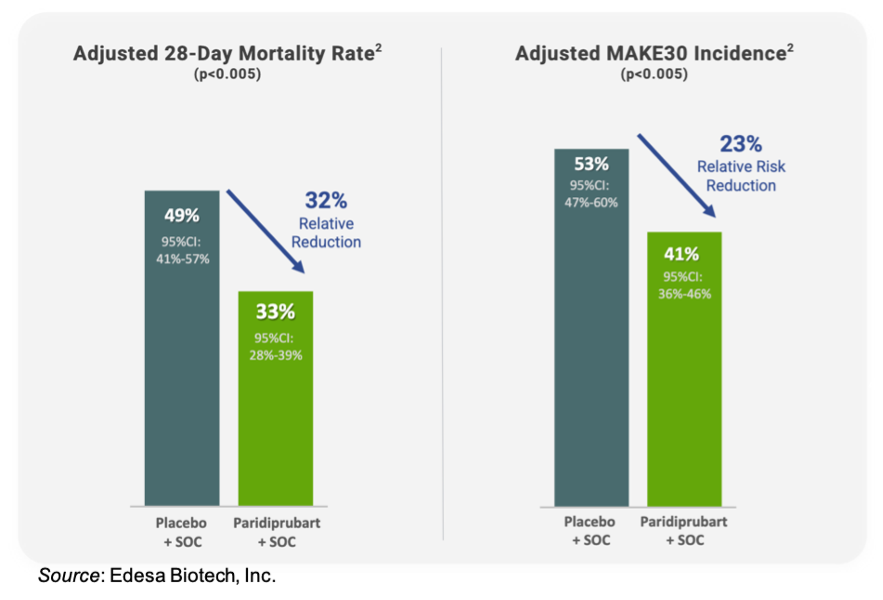
28-Day Mortality: Patients treated with paridiprubart plus standard-of-care (SOC) had adjusted 28-day mortality of 33% compared to 49% for those treated with placebo plus SOC, which represents a 32% relative reduction in the risk of death (nominal P<0.005).
MAKE30: MAKE30 (Major Adverse Kidney Events at 30 days) is a composite endpoint comprising all-cause mortality, initiation of renal replacement therapy, or persistent renal dysfunction through Day 30. The results showed that patients treated with paridiprubart plus SOC had an incidence of MAKE30 of 41% compared to 53% for those treated with placebo plus SOC, which represents a 23% relative reduction in MAKE30 incidence (nominal P<0.005).
Safety and Tolerability: Paridiprubart was well tolerated in AKI patients. The overall rates of adverse events, serious adverse events, and infections were low and there were no significant differences between the paridiprubart-treated and placebo-treated groups. The safety profile was consistent with that seen for >400 patients that have been treated with paridiprubart across multiple clinical trials.
Financial Update
On August 13, 2026, Edesa announced financial results for the third quarter of fiscal year 2026 that ended June 30, 2026. As expected, there were no revenues reported for the third quarter of fiscal year 2026. R&D expenses in the third quarter of fiscal year 2026 were $4.0 million, compared to $0.9 million for the third quarter of fiscal year 2025. The increase was primarily due to higher manufacturing costs and other preparations for the planned Phase 2 clinical study of EB06 in vitiligo patients. G&A expenses totaled $1.6 million for the third quarter of fiscal year 2026 compared to $1.0 million for the third quarter of fiscal year 2025. The increase was primarily due to an increase in non-cash, share-based compensation and professional fees.
As of June 30, 2026, Edesa had approximately $10.3 million in cash and cash equivalents. On August 19, 2026, Edesa announced an underwritten public offering of 1) 3.875 million shares and 3.875 million warrants and 2) in lieu of common shares to investors who so choose, pre-funded warrants to purchase up to 675,000 shares and 675,000 accompanying warrants. The common share warrants have an exercise price of $7.50 and will expire on the earlier of 1) 18 months following issuance or 2) 30 days following the company’s public announcement of Phase 2 vitiligo topline data for EB06. The combined price of each common share and accompanying warrant is $5.50 with gross proceeds expected to be approximately $25 million. Following the financing, we estimate Edesa currently has approximately 13.5 million shares outstanding and, when factoring in stock options and warrants, a fully diluted share count of approximately 24.2 million.
Conclusion
We look forward to the initiation of the Phase 2 vitiligo trial in the near term. We estimate the trial will take approximately 12 months to conduct, thus topline results could be available toward the end of 2027, but that timeline will be dependent upon when the trial initiates and patient enrollment rates. In addition, Edesa is continuing to evaluate regulatory pathways for EB05 in the treatment of ARDS and will provide an update when warranted. Our current valuation remains at $19 per share.
SUBSCRIBE TO ZACKS SMALL CAP RESEARCH to receive our articles and reports emailed directly to you each morning. Please visit our website for additional information on Zacks SCR.
DISCLOSURE: Zacks SCR has received compensation from the issuer directly, from an investment manager, or from an investor relations consulting firm, engaged by the issuer, for providing research coverage for a period of no less than one year. Research articles, as seen here, are part of the service Zacks SCR provides and Zacks SCR receives payments totaling a maximum fee of up to $50,000 annually for these services provided to or regarding the issuer. Full Disclaimer HERE.