By David Bautz, PhD
NASDAQ: ESLA
READ THE FULL ESLA RESEARCH REPORT
Business Update
STARLIGHT I Dose Expansion Underway
Estrella Immunopharma (NASDAQ: ESLA) is currently conducting the Phase 1/2 STARLIGHT-1 trial of EB103 in patients with relapsed/refractory B-cell non-Hodgkin’s lymphoma (NHL). The company recently announced that the first patient was dosed in the expansion phase, following encouraging durability data from the Phase 1 dose-escalation portion of the study. At the six-month assessment, all evaluable patients without CNS involvement who had previously achieved a complete remission (CR) remained in CR. Earlier Phase 1 data had shown a 100% CR rate at Month 1 in the high-dose cohort, with all patients achieving CR remaining in response at the latest data cutoff.
The transition into dose expansion represents an important inflection point for EB103, as the expansion cohort is intended to further characterize the safety and efficacy of EB103 at the recommended Phase 2 dose level and generate data that will inform the company’s pivotal development strategy. Importantly, Estrella has moved quickly to expand the clinical infrastructure supporting the study. Baylor Scott & White Research Institute in Dallas was activated as the second site on July 29 and began screening and enrolling patients, followed by Oregon Health & Science University in Portland on August 3. University Hospitals Cleveland Medical Center was activated as the fourth clinical site on August 11 and is expected to begin screening and enrollment following completion of site initiation activities.
The expanding site network should improve patient access and, importantly, provide Estrella with a broader base from which to evaluate EB103 in the expansion cohort. As of June 30, 11 patients had been dosed in STARTLIGHT-1, including nine during Phase 1 and two Phase 2 patients dosed in January and June. The Phase 1 population was heavily pretreated and included patients with high-risk disease, including primary CNS lymphoma. The absence of treatment-related serious adverse events in the nine-patient Phase 1 population, combined with the durable CRs, remains encouraging for EB103’s potential differentiation within the CD19-directed cell therapy market.
Background on EB103
Estrella’s strategic objective is to advance a next-generation engineered T-cell therapy platform capable of addressing the key biological and clinical limitations inherent to first-generation CD19 CAR-T therapies. Central to this strategy is the ARTEMIS (Antibody-T-Cell Receptor Engagement System) platform, a proprietary antibody-T-cell receptor (AbTCR) architecture licensed from Eureka Therapeutics that is designed to combine specific antibody targeting with physiologic T-cell receptor–like signaling in order to improve safety, persistence, and overall anti-tumor activity.
The ARTEMIS approach represents a departure from conventional CAR-T constructs, which typically fuse a single-chain variable fragment (scFv) to an intracellular signaling domain composed of CD3ζ in combination with costimulatory domains (e.g., 4-1BB or CD28). While CAR-T modalities have demonstrated potent antitumor responses in select hematologic malignancies, their synthetic signaling architecture has been implicated in supraphysiologic T-cell activation, excessive cytokine release, and premature T-cell exhaustion, all factors that collectively limit durability and widen the therapeutic window. ARTEMIS seeks to address these limitations by integrating antigen recognition through antibody fragments with native T-cell receptor signaling machinery, thereby aligning target engagement with more regulated and nuanced T-cell activation pathways.
The core innovation of the ARTEMIS platform lies in the construction of an “AbTCR” that links an antibody-derived binding domain to endogenous T-cell receptor components, enabling engineered T-cells to engage cancer antigens through a signaling cascade that more closely resembles natural T-cell receptor biology. Specifically, EB103 T-cells consist of two domains: 1) the AbTCR consists of a target binding domain from an antibody fragment antigen binding (Fab) region and an effector domain derived from portions of a human gamma/delta T-cell receptor (TCR); 2) the co-stimulatory molecule consists of a target binding domain derived from a single-chain variable fragment (scFv) and a co-stimulatory domain derived from portions of a human co-stimulatory receptor. Both the AbTCR and the co-stimulatory molecule bind CD19.
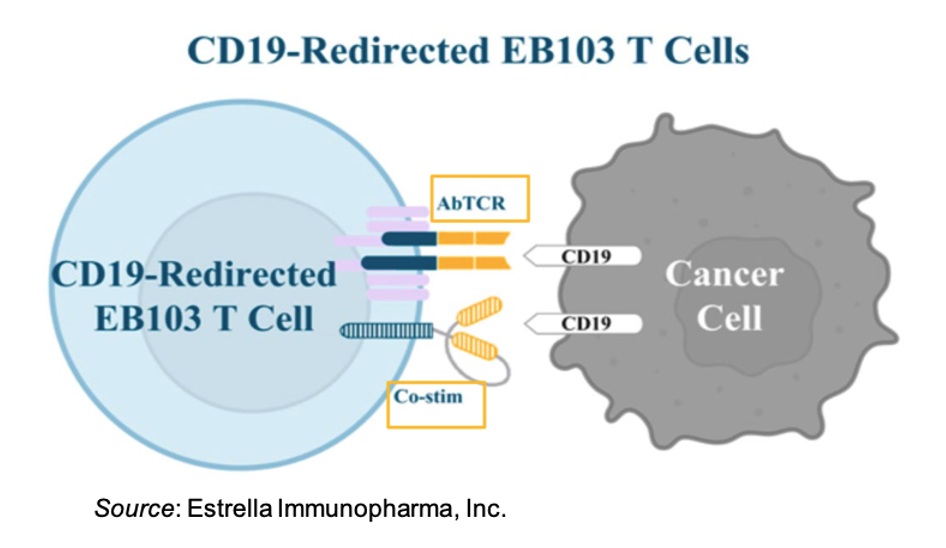
Preclinical and translational literature provides context for the potential advantages of this approach. For example, AbTCR constructs have been shown to confer antigen-specific cytotoxicity with reduced inflammatory cytokine release and a less exhausted T-cell phenotype compared with conventional CAR constructs in xenograft models, while maintaining comparable tumor-killing activity (Xu et al., 2018). These effects are attributed to engagement of the endogenous multimeric CD3 complex and preservation of native TCR signaling pathways, which may reduce the intensity of immune overactivation associated with CAR signaling domains.
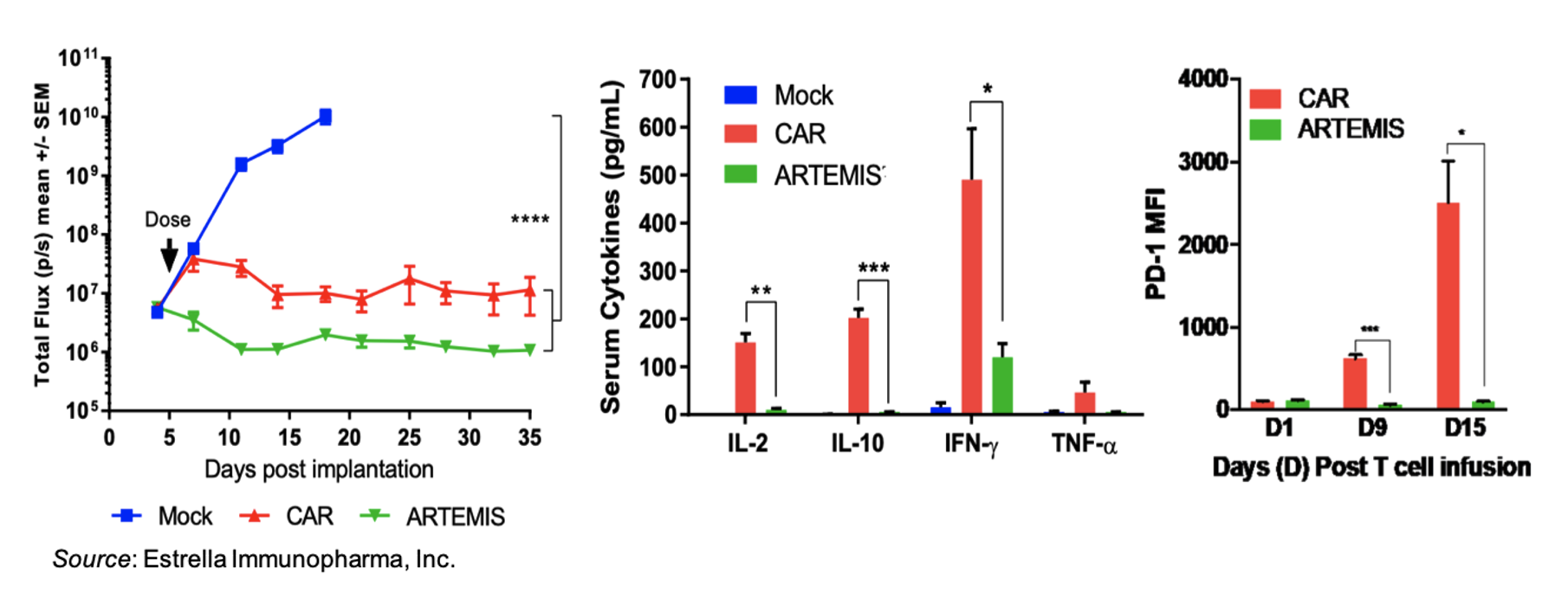
In the study by Xu et al., the in vivo antitumor activity of AbTCR constructs (ET190L1-AbTCR-T cells) was tested in an established CD19+ Raji B-cell lymphoma xenograft model against a CAR-T construct (ET190L1-CAR). The following figure shows that treatment with the AbTCR cells resulted in tumor regression and long-lasting tumor rejection. In fact, when the control mice had to be euthanized, tumor burden was on average approximately 1000-fold less in mice treated with the CAR cells than placebo and approximately 5300-fold lower in mice treated with AbTCR cells than in the placebo-treated mice. While treatment with the CAR cells caused a large increase in inflammatory cytokines such as Interleukin (IL)-2, IL-10, Interferon-gamma (IFN-γ), and tumor necrosis factor alpha (TNF-α), much lower levels of those cytokines were released by the AbTCR cells. Lastly, T cells collected from peripheral blood nine- and 15-days post-T cell dosing also showed that AbTCR cells exhibited significantly lower levels of PD-1 (an exhaustion marker) than CAR cells. Taken together, the data show that AbTCR cells have potent in vivo anti-tumor activity while simultaneously releasing lower levels of inflammatory cytokines and lower levels of exhaustion markers than CAR-T cells.
Financial Update
On August 13, 2026, Estrella filed Form 10-Q with financial results for the second quarter of 2026. As expected, the company did not report any revenues for the second quarter of 2026. R&D expenses for the second quarter of 2026 were $1.4 million compared to $4.7 million for the second quarter of 2025. The decrease was primarily due to timing of patient dosing milestones payable to Eureka. G&A expenses for the second quarter of 2026 were $0.7 million compared to $0.9 million for the second quarter of 2025. The decrease was primarily due to lower legal and professional fees.
As of June 30, 2026, Estrella had approximately $0.15 million in cash and cash equivalents. As of August 11, 2026, Estrella had approximately 43.5 million shares outstanding and, when factoring in stock options and warrants, a fully diluted share count of 55.4 million.
Conclusion
With STARLIGHT-1 now entering dose expansion and four clinical sites activated, the focus for Estrella is shifting from establishing an initial clinical signal to demonstrating that the encouraging response and durability profile observed in Phase 1 can be reproduced in a larger patient population. The next several quarters should provide greater visibility into the breadth and durability of EB103’s activity at the recommended Phase 2 dose and, ultimately, whether the program can support a pivotal strategy. With no changes to our model, our valuation remains at $12 per share.
SUBSCRIBE TO ZACKS SMALL CAP RESEARCH to receive our articles and reports emailed directly to you. Please visit our website for additional information on Zacks SCR.
DISCLOSURE: Zacks SCR has received compensation from the issuer directly, from an investment manager, or from an investor relations consulting firm, engaged by the issuer, for providing research coverage for a period of no less than one year. Research articles, as seen here, are part of the service Zacks SCR provides and Zacks SCR receives payments totaling a maximum fee of up to $50,000 annually for these services provided to or regarding the issuer. Full Disclaimer HERE.